 Luvinci
September 17, 2026
Sight Word Board Game: 20 Heart Words (Free Printable PDF)
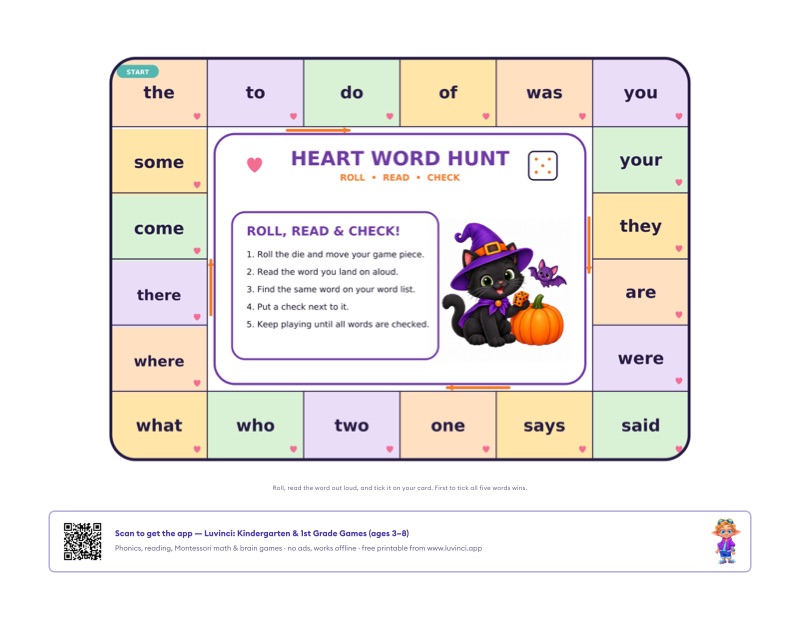
Free printable · PDF · 1129 KB
Sight Word Board Game: 20 Heart Words (Free Printable PDF)
No signup needed — print it and stick it on the fridge.
Download PDFA sight word board game works because your child reads the same twenty words out loud again and again, and it never feels like a drill. This printable is a loop of twenty heart words, one die, a counter each, and a small card of five words to hunt down. Print it, cut the cards out, and you’re playing in five minutes. No signup, no email.
The twenty words, in order from START: the, to, do, of, was, you, your, they, are, were, said, says, one, two, who, what, where, there, come, some.
Why these twenty words
Most sight words sound out like any other word once your child knows the letter sounds. Heart words don’t. One part breaks the rules, so your child learns that part by heart. In said, the s and the d play fair. The ai says /e/, so the ai gets the heart.
Those belong on a board. Repetition is what fixes them. The full list is in our heart words post.
What you need
- The sweet spot is 2 to 4 players, and the cards stretch to 8
- One die
- A counter each: a coin, a button, a dry bean
- Scissors, for the word cards
- About 35 minutes for two players
How to play
- Cut out one word card per player. Each card holds five of the twenty board words. Write a name on the back.
- Put every counter on START. Youngest player rolls first.
- Roll the die and move that many squares around the loop.
- Read the word you land on out loud. Every time, even when it isn’t one of yours.
- If that word is on your card, tick its box.
- The first player to tick all five words wins.
A full game is a real game. Two players take about 35 minutes, and four take longer. If your child is tired, say up front that you’re playing to three words instead of five. It ends while everyone still wants it to.
The eight cards are two sets of four
The cards are numbered. They make two complete sets. Cards 1 to 4 split the twenty words with no overlap, so up to four players never hunt the same word. Cards 5 to 8 split the same words a different way. Deal all eight to a bigger group and each word belongs to exactly two children.
Read it aloud, then tick it
The tick box isn’t keeping score. It’s why the game works.
Ask for the word out loud on every turn, even when nobody needs it. A child who says “were” while looking straight at were has matched the shape on the square with the word in their mouth. That’s the link a heart word needs.
The card handles the other half. Your child scans their own five words before every roll, so they see those five far more often than they land on them. If they stall on a word, just tell them. This isn’t a test. Guessing is the habit heart words are meant to replace.
Printing, and making it last
The PDF is three pages of US letter:
- Page 1 is the board. It prints landscape. The winning rule sits on the line underneath.
- Page 2 is the eight cut-out word cards.
- Page 3 is the full rules, for the drawer or the classroom folder.
In a hurry? Pages 1 and 2 are the game.
In a classroom, laminate the board or slide it into a plastic sleeve. Sleeve the cards too. Ticks go on with a dry-erase marker and wipe off between groups, so you print this once instead of every week.
About the Halloween board
Today’s board is dressed for Halloween. There’s a cat in a witch hat, a pumpkin and a bat. That’s decoration only. If you open this in March and the artwork has changed, everything above still applies.
Quick takeaways
- Roll, move, read the word out loud, tick it if it’s yours. First to five ticks wins.
- About 35 minutes for two players. Play to three words for a short game.
- Every word gets read aloud, including the ones on nobody’s card. That repetition is the whole point.
Once the board is back in the drawer, our reading games practise the same words on screen, and the printables library has the rest of the free sheets.
Common questions
What age is this for? Roughly 5 to 8, or any child just starting to meet words like said and was. A younger child can play on a grown-up’s team.
Can we play with only one child? Yes. Take a card yourself and race them. Read your own words aloud too. Hearing you read what and who correctly is worth as much as reading them.
We do not have a die. Write 1, 2 and 3 on scraps of paper, turn them face down, and draw one instead of rolling.
Does this teach my child to read the words? It gives them practice on words they have already been shown. That’s how heart words move into memory. Teaching comes first: map the sounds, name the tricky part, draw the heart. Our heart words post walks through that routine. Play this afterwards.