Luvinci
July 13, 2026
The Summer Before Kindergarten: A Relaxed 8-Week Prep Plan
Free printable · PDF · 454 KB
The Summer Before Kindergarten: A Relaxed 8-Week Prep Plan
No signup needed. Just print it.
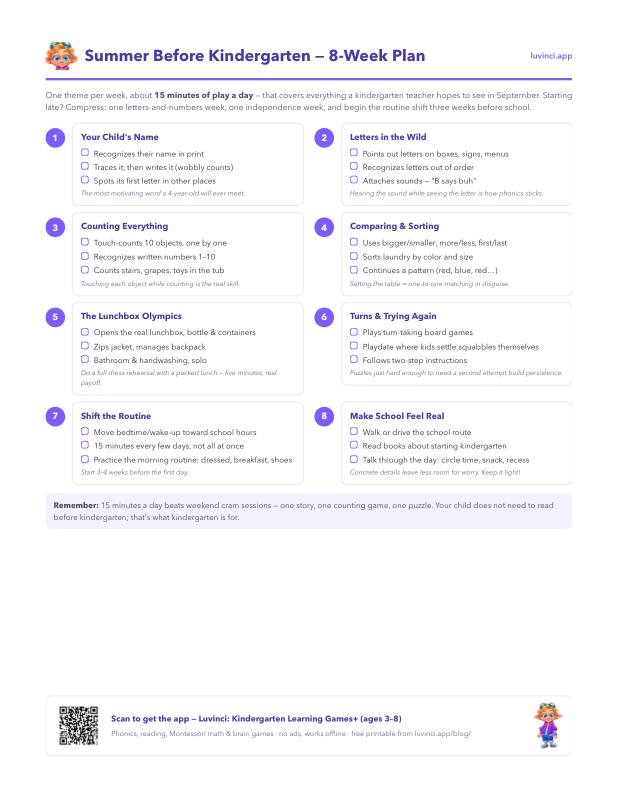
Download PDFThe summer before kindergarten is plenty of time to get your child ready — no workbooks, no pressure, no summer school required. About fifteen minutes of playful practice a day, aimed at letters, counting, independence, and routines, covers everything a kindergarten teacher hopes to see in September.
Here’s a week-by-week way to spread it out. Starting later than eight weeks before school? No problem — the weeks compress well. Do one letter-and-numbers week, one independence week, and start the routine shift about three weeks out.
Weeks 1–2: letters, everywhere
Start with your child’s own name — recognizing it in print, then tracing it, then writing it (wobbly counts). Their own name is the most motivating word a four-year-old will ever meet.
Then move to letters in the wild: cereal boxes, street signs, the menu at the ice cream shop. The goal isn’t reciting the alphabet at speed; it’s recognizing letters out of order and starting to attach sounds to them — “B says /b/” (the clipped sound, not “buh”). Hearing a letter’s sound while looking at it is exactly how phonics sticks, which is why ABC games that sound out letters work so well at this age.
Weeks 3–4: counting and comparing
Count everything — stairs, grapes, toy cars in the bathtub. Touch each object while counting; that one-to-one matching is the real skill, not the number song. Work toward counting 10 objects reliably, recognizing written numbers 1–10, and using comparison words: bigger, smaller, more, less, first, last.
Sorting laundry by color and size is a genuine early math lesson. So is setting the table: one fork for each plate is one-to-one correspondence in disguise.
Week 5: the lunchbox olympics
Ask any kindergarten teacher what they wish parents practiced, and the answer is rarely academic. It’s independence:
- Opening the actual lunchbox, water bottle, and snack containers they’ll bring to school
- Zipping their own jacket and managing their backpack
- Using the bathroom and washing hands without help
Do a full dress rehearsal: pack a real lunch, have them open every container. It’s five minutes and it saves real tears in the cafeteria.
Week 6: taking turns and trying again
Social readiness matters more to teachers than any academic skill. Play board games that require waiting for a turn. Arrange playdates where you stay out of the negotiations. Offer puzzles just hard enough to need a second attempt — persistence is a muscle, and games with the right difficulty curve train it gently.
Practice two-step instructions too: “put your shoes by the door and wash your hands.”
Week 7: shift the routine
About three to four weeks before school starts, begin syncing bedtime and wake-up time to the school schedule. Move it fifteen minutes every few days rather than all at once. Add a consistent morning routine — dressed, breakfast, shoes — so the first school morning feels familiar rather than frantic.
Week 8: make school feel real
Walk or drive the route to school. Play on the school playground if it’s open. Read books about starting kindergarten, and talk about what a day will look like: circle time, snack, recess. The more concrete details children have, the less room anxiety has to fill in the blanks. Keep the tone light — school is coming, and it’s going to be good. When the big morning is a week away, our first-day guide and countdown checklist takes over from here.
One parent of a five-year-old put it this way in an App Store review of our app: “It’s a very educational app for 5-6 year old children, and it prepares kids very well for kindergarten” — App Store review, United States. Whatever tools you use, that’s the spirit of the summer: gentle preparation, mostly through play.
The takeaways
- 15 minutes a day beats weekend cram sessions — one story, one counting game, one puzzle
- Prioritize independence: lunchbox, zippers, bathroom — the skills teachers mention most
- Letter sounds over alphabet speed, counting objects over counting aloud
- Start the bedtime shift 3–4 weeks out, gradually
- Make school concrete: visit, read about it, describe the day
- Don’t panic about reading — kindergarten is where they learn it, not the entry fee
Want to know exactly which skills to aim for? Our kindergarten readiness checklist breaks down what teachers actually hope to see on day one.