Luvinci
July 19, 2026
Social Skills for Kindergarten: The 8 That Matter (and the Games That Build Them)
Free printable · PDF · 501 KB
Social Skills for Kindergarten: The 8 That Matter (and the Games That Build Them)
No signup needed. Just print it.
Download PDFThe social skills for kindergarten that matter most are surprisingly few: taking turns, listening to and following simple directions, asking for help in words, separating from you without prolonged distress, joining other children’s play, and recovering from frustration without a full meltdown. Every one of them is learnable through games — no worksheets, no lectures — and “imperfectly” is the passing grade.
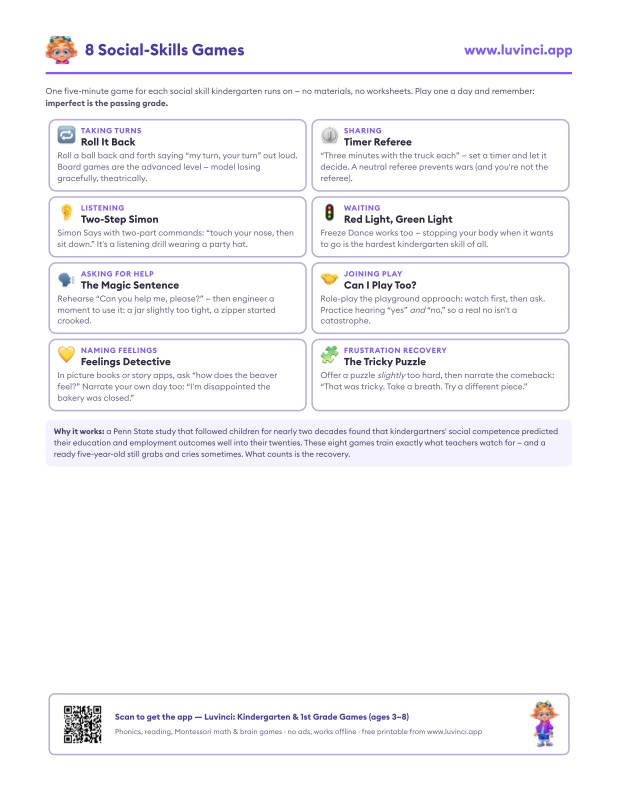
We’ve turned the practice into a free printable sheet of eight social-skills games — one game per skill, each needing five minutes and no materials. No signup.
Why teachers watch social skills more than letters
Ask kindergarten teachers what readiness means and social skills top the list, ahead of letters and numbers — this is the pattern across everything teachers say they expect. The research backs the instinct: a Penn State study published in the American Journal of Public Health followed children for nearly two decades and found that kindergarten teachers’ ratings of a child’s social competence — sharing, cooperating, helping — predicted education and employment outcomes well into their twenties.
That’s not a reason to panic; it’s a reason to treat turn-taking practice as seriously as alphabet practice. Happily, it’s more fun.
The 8 social skills for kindergarten (with a game for each)
1. Taking turns. Any board game works; so does rolling a ball back and forth with “my turn, your turn” said out loud. Losing a turn gracefully is the advanced version — model it yourself, theatrically.
2. Sharing — imperfectly. Set a timer: “three minutes with the truck each.” A timer is a neutral referee, and neutral referees prevent wars.
3. Listening and following two-step directions. Play Simon Says with two-part commands: “touch your nose and then sit down.” It’s a listening drill wearing a party hat.
4. Waiting. Red Light, Green Light and Freeze Dance train the single hardest kindergarten skill: stopping your body when it wants to go.
5. Asking for help in words. Rehearse the sentence — “Can you help me, please?” — then engineer moments to use it (a jar slightly too tight, a zipper started crooked).
6. Joining play. Role-play the playground approach: watch, then ask “Can I play too?” Practice both answers — yes and no — so a “no” on the real playground isn’t a catastrophe.
7. Naming feelings. Children who can say “I’m frustrated” tend to hit and cry less than children who can’t put the feeling into words. Name feelings in stories — “how do you think the beaver feels?” — and in your own day: “I’m disappointed the bakery was closed.”
8. Recovering from frustration. Offer puzzles slightly too hard, then narrate the recovery: “That was tricky. Take a breath. Try a different piece.” Logic and puzzle games with a gentle difficulty curve give this exact practice — challenge, wobble, recover, succeed.
Stories are social-skills rehearsal
Pretend play and story time are where children safely try on other minds. Interactive stories with expressive characters give feelings a face and a name, which is why they’re such a natural supplement to real-world practice:
“The role of the story books, games and interactive objects made the learning experience enjoyable for Pre-K toddlers and Kindergarten. This game is very suitable for practicing emotions, ABC’s, numbers, counting and shapes.” — TinaEducator, App Store review (US)
The rule of thumb: screens can name the feelings and model the scripts; playgrounds, siblings and playdates are where the muscles actually get used. Of the two, the playground matters far more — but the naming genuinely helps.
What “ready” looks like (spoiler: not polished)
A ready five-year-old still grabs sometimes, still cries sometimes, still forgets to wait their turn. Teachers expect works-in-progress — what they hope for is a child who recovers: who can be redirected, who tries again, who lets an adult help. If most of the eight skills above show up most of the time, your child is on track. The full readiness checklist puts these alongside the academic and motor skills for the complete picture.
Social skills FAQ
My child is shy — is that a problem for kindergarten? No. Shy is a temperament, not a deficit. A shy child who can ask the teacher for help and play alongside other kids is socially ready. Give them the “Can I play too?” script and let warm-up time do the rest.
We didn’t do preschool. Will my child be behind socially? Preschool is one place to practice these skills, not the only one — playdates, siblings, playgrounds, and family board games build the same muscles. Focus on separation practice (time with other trusted adults) in the months before school.
How do I handle playdate conflicts — jump in or stay out? Wait a beat longer than instinct says. Children who get ten seconds to solve it themselves often do; if not, step in as a narrator (“You both want the truck — what could we do?”) rather than a judge.
Can apps teach social skills? They can support the naming part — feelings, scripts, story empathy — and that part matters. The practicing part needs other children. Treat apps as the picture book, not the playground.
The takeaways
- Print the eight games — one per skill, five minutes each, no materials
- Turn-taking, listening, waiting, asking for help — the core four teachers see immediately
- Name feelings everywhere — stories, your own day, theirs
- Frustration recovery beats frustration avoidance — slightly-too-hard puzzles are training equipment
- Imperfect is the passing grade — teachers expect works-in-progress
And when the first morning arrives, our first-day guide covers the drop-off itself — goodbye rituals included.