 Luvinci
September 12, 2026
Multiplication Chart Printable: 1-12 Times Table + Blank PDF
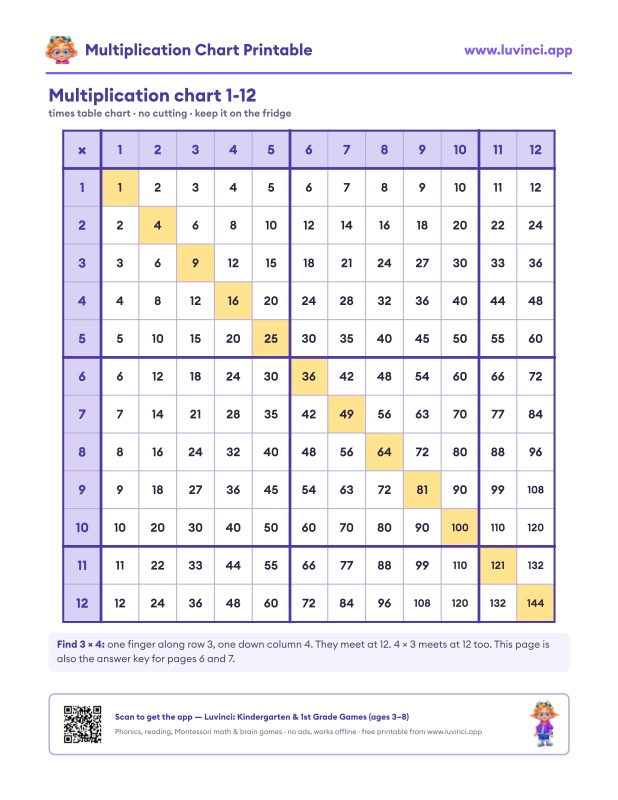
Free printable · PDF · 1047 KB
Multiplication Chart Printable: 1-12 Times Table + Blank PDF
No signup needed. Just print it.
Download PDFThis free multiplication chart printable is a grid with the numbers 1 to 12 across the top and down the side, and every answer in between. Go along row 3 and down column 4, and they meet at 12, because 3 × 4 = 12. People also call this page a multiplication table printable or a times table chart.
Our free multiplication chart PDF has 13 pages: a black and white 1-12 chart for the fridge, 1-10, 0-12 and 1-20 charts, a “facts you already know” chart, fill-in, blank and mixed-up charts, two games, an answer key and a color chart. You’ll get a free printable multiplication chart pack on US Letter. No signup, no email. To print just the chart, choose Pages: 1 in the print box.
A 1-12 chart has 144 boxes but only 78 different facts. Know the 1s, 2s, 5s and 10s, and a 1-10 chart has just 21 facts left.
Times tables are a 3rd grade goal. The Common Core standards (3.OA.7) say that “By the end of Grade 3,” children should “know from memory all products of two one-digit numbers.” In 2nd grade, children add equal rows of objects, which is the groundwork (2.OA.4).
Jump to: the 13 pages · full chart · how to read it · blank chart · patterns · what to learn first · games · FAQ
Free multiplication table printable (PDF)
Keep page 1 handy. You’ll use it as the answer key for the fill-in and blank 1-12 pages.
- Multiplication chart 1-12 (page 1). Every answer from 1 × 1 to 12 × 12, no cutting, for the fridge or a folder.
- Multiplication chart 1-10 (page 2). The one-digit facts plus the 10s, in bigger boxes.
- Multiplication chart 0-12 (page 3). Adds the 0 row and column, where every answer is 0.
- Multiplication chart 1-20 (page 4). An extra for older kids, or for a parent to look things up.
- Facts you already know (page 5). The 1s, 2s, 5s and 10s shaded, so the 21 facts left stand out.
- Fill-in multiplication chart 1-12 (page 6). The easy rows are printed; your child fills in the rest.
- Blank multiplication chart 1-12 (page 7). Headers only. Fill it from memory, then check with page 1.
- Blank multiplication chart 1-10 (page 8). Bigger boxes for younger writers. Check with page 2.
- Mixed-up multiplication chart (page 9). The headers are out of order, so counting along won’t work.
- Four in a row (page 10). A two-player game with two paper clips.
- Roll and cover (page 11). A two-player dice game.
- Answers: mixed-up chart (page 12). The key for page 9.
- Color multiplication chart 1-12 (page 13). Each row in its own soft color. Skip it on a black and white printer.
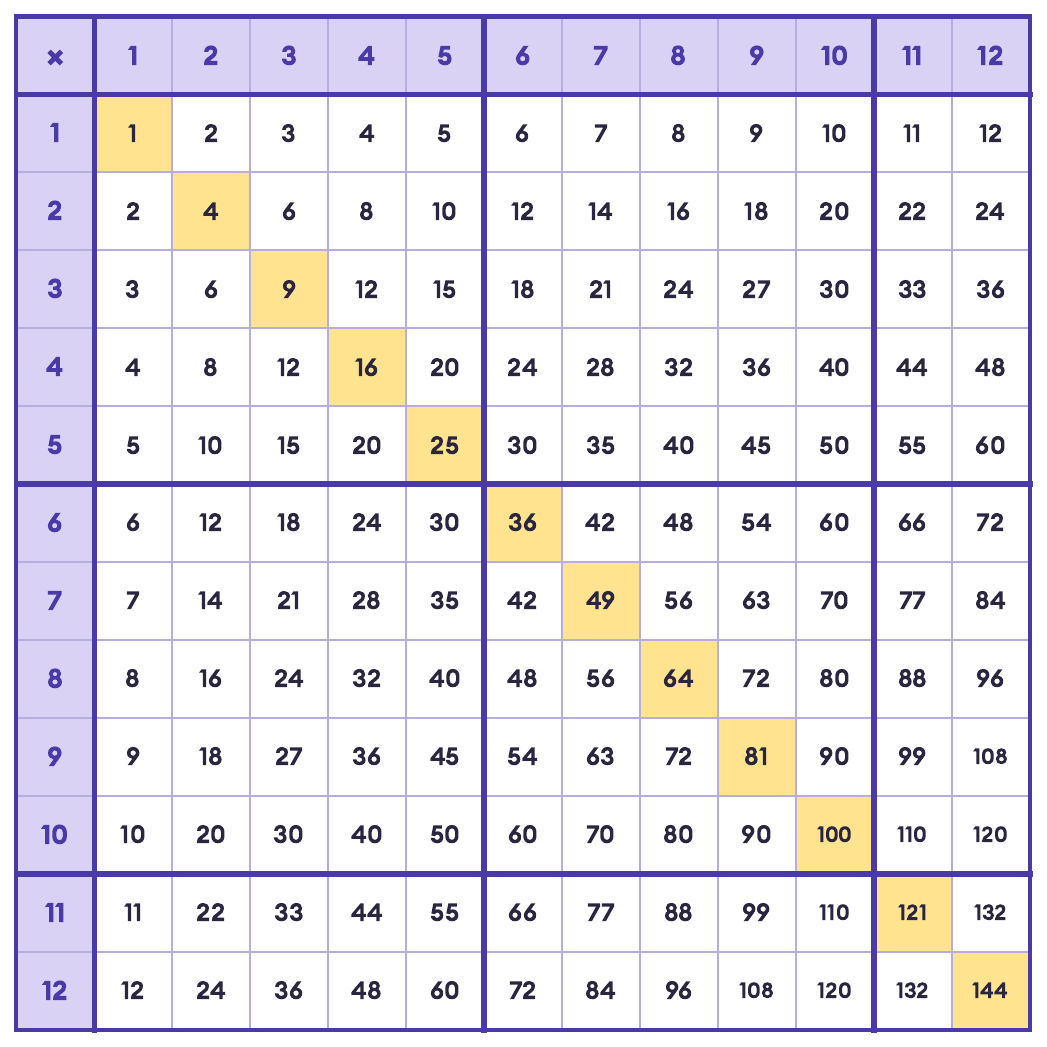
Page 1: the multiplication chart 1-12.
Sizes: 1-10, 1-12, 0-12 or 1-20
Most printed charts go to 12, so a times table chart printable usually means a 12x12 multiplication chart. That’s 144 boxes. Page 1 is that one, a multiplication table 1-12 printable PDF page you can keep in a folder all year.
A 1-10 chart covers the one-digit facts in 3.OA.7 except the 0s (page 3 has those), plus the 10s, and it ends at 100. It isn’t a hundreds chart, which counts 1 to 100 in order.
The 0-12 chart adds the 0 row and the 0 column. Every answer there is 0, which is a fact in itself.
The 1-20 chart is an extra, in small type, for older kids or a parent to look up. It isn’t a grade goal.
Color or black and white?
Page 1 is ink-first, so it prints clearly on any printer. On a black and white printer, the shaded diagonal (yellow in color) and the header shading turn light gray, so this black and white multiplication chart still shows where the headers end.
If you want a colored multiplication chart, page 13 gives each row its own soft color. It still reads as light and darker gray bands in black and white, but you can skip it on a black and white printer.
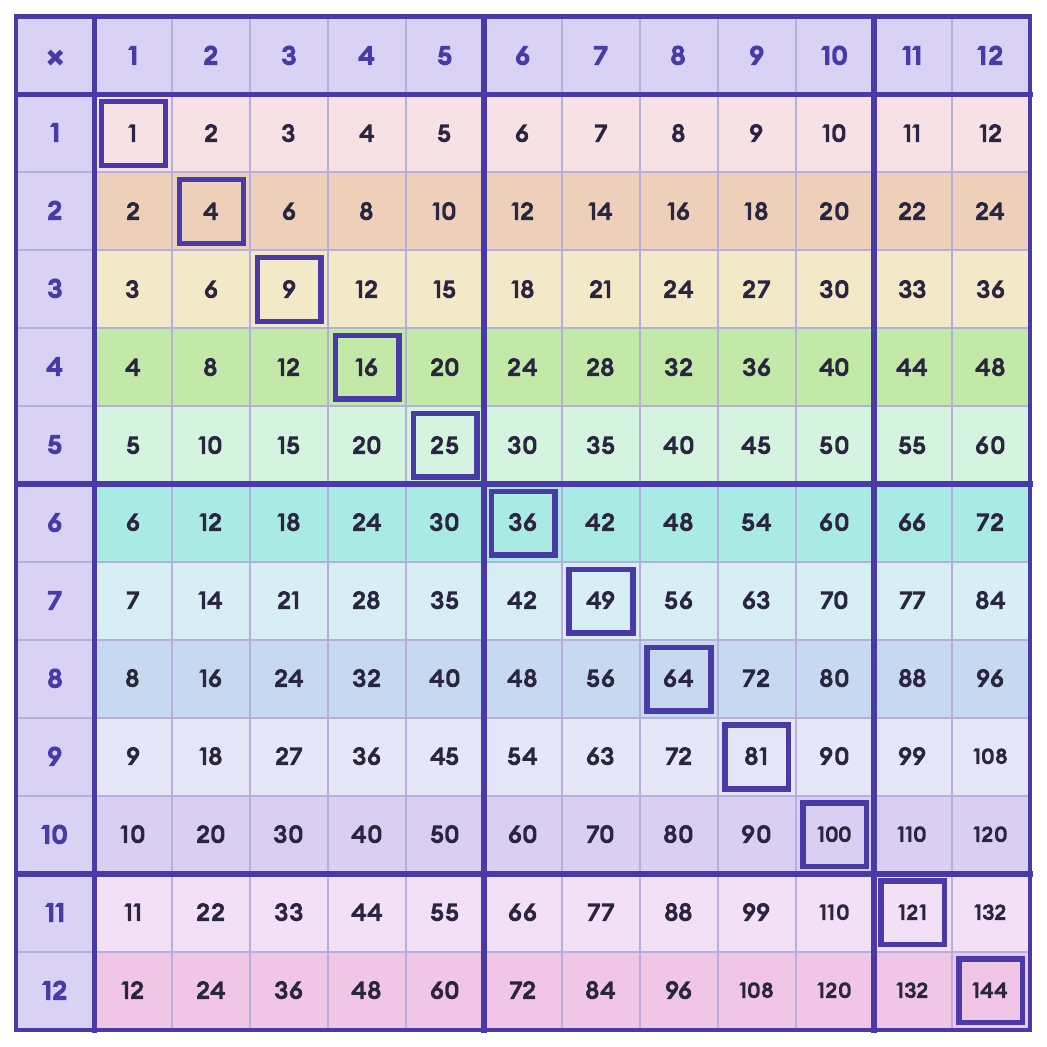
Page 13: the color multiplication chart.
Printing tips
- Print on US Letter at “Actual size”. On A4 paper, choose “Fit to page”.
- To print one page, type Pages: 1 (or the page number you want) in the print box.
- A sheet protector and a dry-erase marker turn pages 6-8 into boards you can wipe and use again.
- For a large multiplication chart on the wall, a copy shop can print page 1 on 11 x 17 inch paper.
Full multiplication chart 1-12
A multiplication chart is a grid where every box is its row number times its column number. People also call it a multiplication table, a multiplication facts chart, a times table chart, or in the UK a multiplication grid, times table grid or multiplication square.
The same chart is below as text, so you can read it on a phone or with a screen reader.
| × | 1 | 2 | 3 | 4 | 5 | 6 | 7 | 8 | 9 | 10 | 11 | 12 |
|---|---|---|---|---|---|---|---|---|---|---|---|---|
| 1 | 1 | 2 | 3 | 4 | 5 | 6 | 7 | 8 | 9 | 10 | 11 | 12 |
| 2 | 2 | 4 | 6 | 8 | 10 | 12 | 14 | 16 | 18 | 20 | 22 | 24 |
| 3 | 3 | 6 | 9 | 12 | 15 | 18 | 21 | 24 | 27 | 30 | 33 | 36 |
| 4 | 4 | 8 | 12 | 16 | 20 | 24 | 28 | 32 | 36 | 40 | 44 | 48 |
| 5 | 5 | 10 | 15 | 20 | 25 | 30 | 35 | 40 | 45 | 50 | 55 | 60 |
| 6 | 6 | 12 | 18 | 24 | 30 | 36 | 42 | 48 | 54 | 60 | 66 | 72 |
| 7 | 7 | 14 | 21 | 28 | 35 | 42 | 49 | 56 | 63 | 70 | 77 | 84 |
| 8 | 8 | 16 | 24 | 32 | 40 | 48 | 56 | 64 | 72 | 80 | 88 | 96 |
| 9 | 9 | 18 | 27 | 36 | 45 | 54 | 63 | 72 | 81 | 90 | 99 | 108 |
| 10 | 10 | 20 | 30 | 40 | 50 | 60 | 70 | 80 | 90 | 100 | 110 | 120 |
| 11 | 11 | 22 | 33 | 44 | 55 | 66 | 77 | 88 | 99 | 110 | 121 | 132 |
| 12 | 12 | 24 | 36 | 48 | 60 | 72 | 84 | 96 | 108 | 120 | 132 | 144 |
How to use a multiplication chart
- Find a fact. Put one finger on 3 in the left column and one on 4 in the top row. Slide them along and down until they meet: 12. A ruler or a folded card under the row helps kids who lose their place.
- Turn-arounds are twins. 3 × 4 and 4 × 3 both land on 12, in mirror boxes across the shaded diagonal. The Common Core puts it this way: “If 6 × 4 = 24 is known, then 4 × 6 = 24 is also known” (3.OA.5), and adds that “Students need not use formal terms for these properties.” So learning one fact gets your child its twin.
- The diagonal is the squares. 1, 4, 9, 16 … 144: a number times itself.
- Read it backwards to divide. The 3rd grade standard’s own example: “knowing that 8 × 5 = 40, one knows 40 ÷ 5 = 8” (3.OA.7). Find 40 in the 5 column; the row is 8.
A U.S. Department of Education guide for children who find math hard notes that “Teachers could also refer to a multiplication chart as an additional support,” when children are connecting adding equal groups to multiplying. Find first, then check, then cover it up.
Blank multiplication chart
A blank multiplication chart printable has the numbers 1 to 12 across the top and down the side and empty boxes inside. It’s a times table chart without the answers. Think of it as a multiplication chart template. The headers are printed, and the boxes are your child’s.
An empty multiplication chart shows what your child knows without any hints. Four pages in the blank multiplication chart PDF (pages 6-9) do this job:
- Page 6: a fill-in 1-12 chart, partly filled. The 1s, 2s, 5s and 10s are printed.
- Page 7: a blank 1-12 chart with headers only.
- Page 8: a blank multiplication table, 1-10, with bigger boxes.
- Page 9: a mixed-up chart, with its key on page 12.
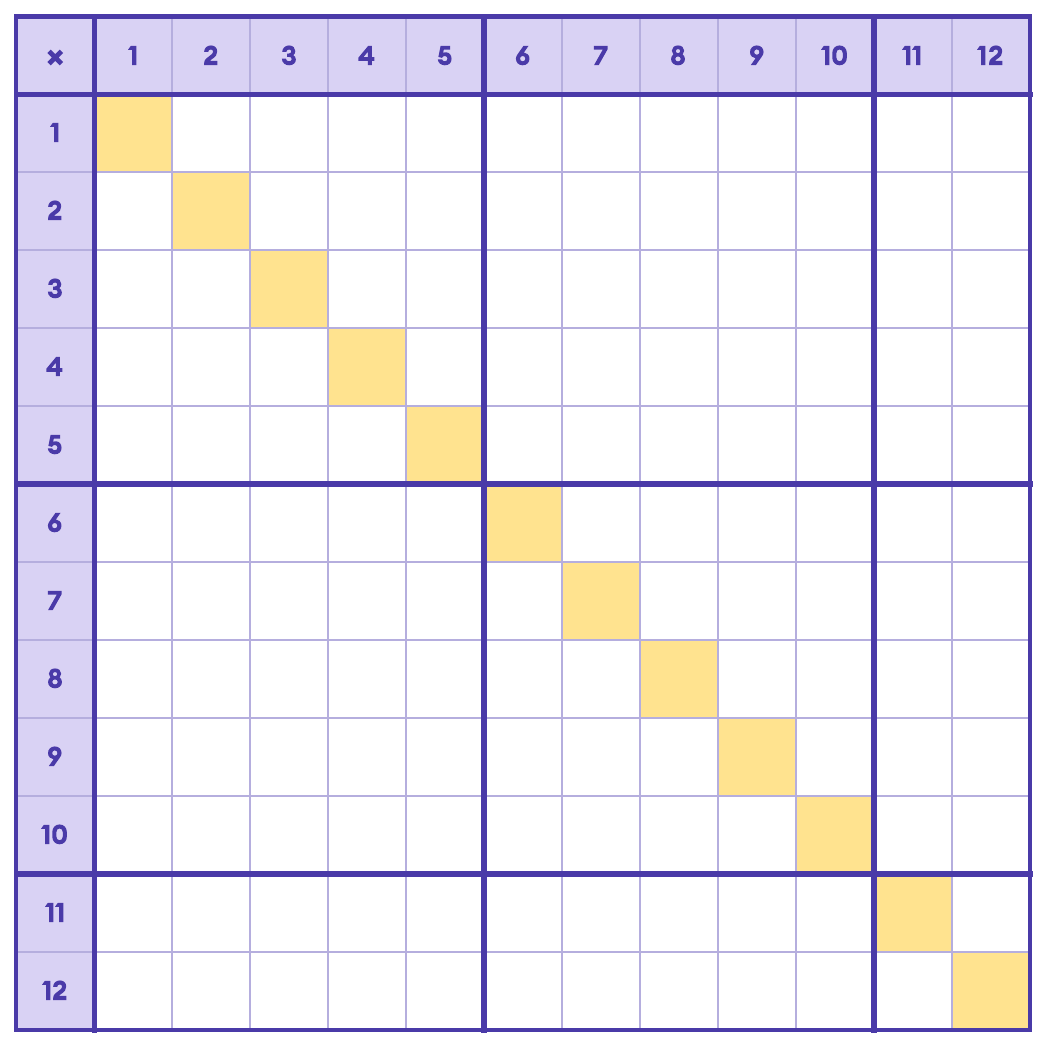
Page 7: fill it in, then check with page 1.
Fill in the blank multiplication chart
Fill it row by row, in the learning order below. Then check with page 1. The boxes are the same size and in the same place, so you can hold the two pages up to a window and see every answer line up.
Page 6 is partly filled, so your child starts with wins. Big answers like 132 are tight in a 13 mm box. Write small, or use page 8 (1-10) for bigger boxes.
Multiplication chart patterns
The standard asks children to “Identify arithmetic patterns (including patterns in the addition table or multiplication table), and explain them using properties of operations” (3.OA.9). The patterns jump out on a chart.
| Row | Pattern | Try it |
|---|---|---|
| ×1 | the number stays the same | 1 × 7 = 7 |
| ×2 | doubles facts | 2 × 6 = 6 + 6 = 12 |
| ×4 | double, then double again | 4 × 6: 12, then 24 |
| ×5 | ends in 0 or 5; half of ×10 | 5 × 7 = 35 |
| ×9 | from 9 × 1 to 9 × 10 the digits add to 9, and the tens digit is one less than the number | 9 × 7 = 63 |
| ×10 | put a 0 on the end | 10 × 8 = 80 |
| ×11 | 11 × 1 to 11 × 9 repeat the digit | 11 × 4 = 44 |
| ×12 | ×10 plus ×2 | 12 × 3 = 30 + 6 = 36 |
The standard has its own example too: it asks kids to “observe that 4 times a number is always even” (3.OA.9). Run a finger along row 4 on page 1 and check.
What order to learn the times tables
The same U.S. Department of Education guide is clear about where to start: “If working on multiplication facts, for example, focus on zeroes and ones first. Then integrate the tens and fives, and so on.” Add the next set as the first one gets easy, and keep mixing the easy facts back in. The 2s fit in early too, since they’re doubles.
- 0s and 1s
- 2s, 10s and 5s
- 3s, 4s (double the 2s) and 9s (the pattern)
- 6s, 7s and 8s, built from facts your child knows. The standard’s own example: “8 × 7 as 8 × (5 + 2) = (8 × 5) + (8 × 2) = 40 + 16 = 56” (3.OA.5).
- 11s and 12s last. They’re extras, beyond the 3rd grade goal.
Our free Multiplication Facts Workbook follows this order: 20 days of facts from 0 × 0 to 10 × 10, one set at a time with the easy facts mixed back in, and the answers at the back. One page a day is plenty.
Facts you already know: the chart is smaller than it looks
Shade the 1s, 2s, 5s and 10s on a 1-10 chart, rows and columns. 36 boxes stay white. Because 6 × 7 and 7 × 6 are the same fact, that’s only 21 facts to learn, and 6 of them are squares like 7 × 7. Learn the 9s pattern and 15 are left. On a 1-12 chart, after the 1s, 2s, 5s, 10s and 11s, 28 facts are left (21 once the 9s are known).
If the 1s, 2s, 5s and 10s aren’t solid yet, start there. That’s the plan on page 5.
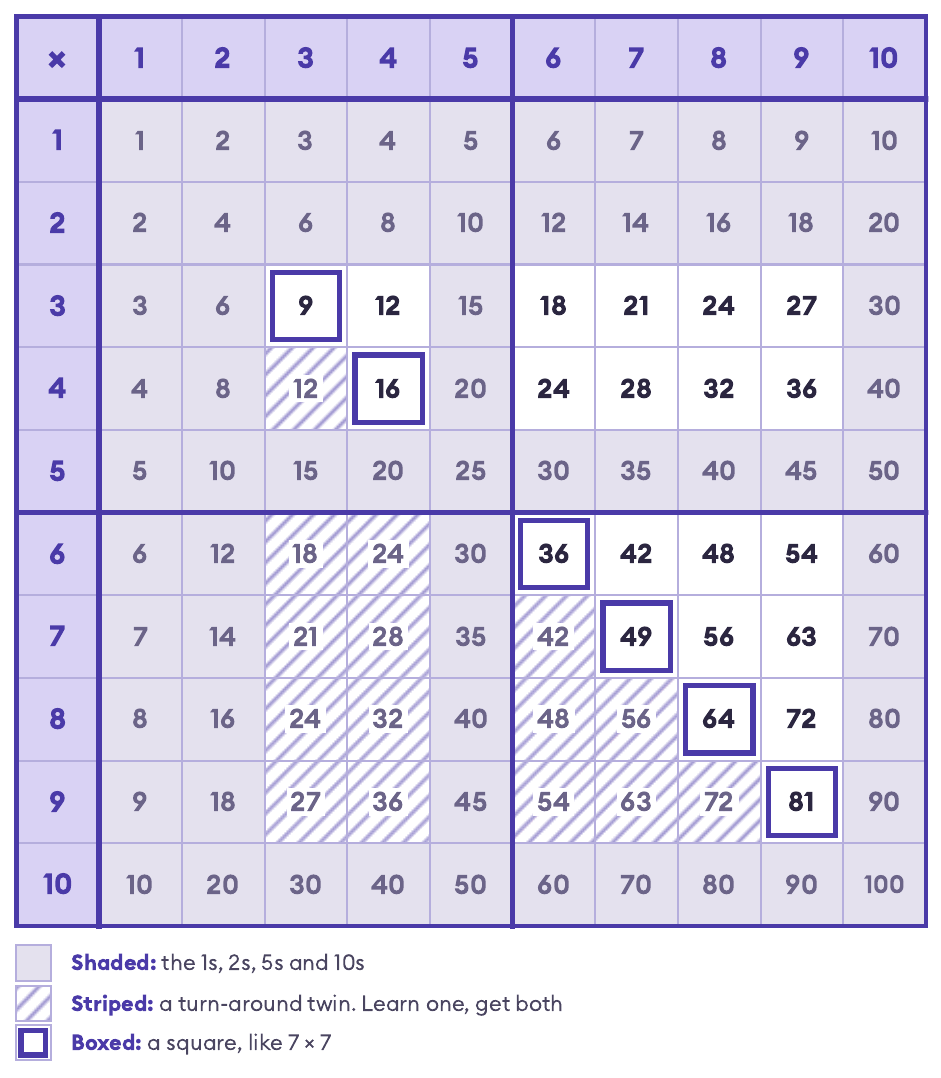
Page 5: color a box when your child knows the fact both ways.
Each week, color one box and its striped twin. Your child can see the white part of the chart shrink.
Multiplication chart for 3rd graders (and 2nd graders)
In 2nd grade, children add equal rows of objects (2.OA.4). That’s the groundwork, not the memory goal. In 3rd grade they start with what multiplying means: the standard asks them to “interpret 5 × 7 as the total number of objects in 5 groups of 7 objects each” (3.OA.1). By the end of the year, the goal is to know the facts from memory (3.OA.7).
The one-digit facts run from 0 to 9. The 10s go past the 3rd grade goal, but they’re the easiest row, so learn them early. The 11s and 12s are extras.
Use page 1 to find, page 6 to fill in, page 7 from memory, and then the chart only to check.
The app’s times tables run from ×2 to ×9, and every fact is shown as equal groups, like 3 plates of 4 (in the full app). See how Luvinci’s math games work.
Multiplication games to play with the chart
These printable multiplication games use the chart pages, two paper clips or a pair of dice, and buttons or dried beans to cover the answers (one player uses buttons, the other beans). They’re multiplication chart games. Each one uses a page from the PDF. Buttons and dried beans are small, so play with an adult.
- Four in a row (page 10). Two paper clips on a 1-9 strip. Move one clip, multiply the two numbers, cover the answer. Four in a row wins. It covers facts up to 9 × 9.
- Roll and cover (page 11). Roll two dice, multiply, and cover one box with that answer. Four in a row wins, or the most boxes when the board is full. Dice facts go up to 6 × 6, so it suits beginners.
- Beat your own chart. Fill page 8 (blank 1-10) for 3 minutes. Tomorrow, try to beat your count. Use a fresh copy or a sheet protector each day.
- Hide a box. Cover one box on page 1 with a scrap of paper. Your child names it, then lifts the paper to check.
FAQ
Can you show me a times table chart without the answers?
Yes. Pages 7 and 8 are blank charts, 1-12 and 1-10. Page 9 is a mixed-up one, with its key on page 12.
Should a multiplication chart go to 10 or 12?
The 3rd grade goal is the one-digit facts, so 1-10 covers it, plus the easy 0s on page 3. Most printed charts go to 12. Start with 1-10, then move to a multiplication chart to 12.
How many facts are on a multiplication chart?
A 1-12 chart has 144 boxes and 78 different facts. A 1-10 chart has 100 boxes and 55 facts. The rest are turn-around twins.
What age is a multiplication chart for?
2nd and 3rd grade, about ages 7 to 9. The goal is to know the one-digit facts from memory by the end of 3rd grade.
Is using a multiplication chart cheating?
No. It’s a tool for finding and checking. The plan is find, then check, then cover. Once a row is solid, your child covers it and works from memory.
Should I time my child?
A U.S. Department of Education guide for children who find math hard recommends short timed activities, usually 1 to 5 minutes, once a child can work the facts out, with the aim of beating their own past score. The same panel’s opinion is that timed worksheets alone don’t build fluency. If a timer brings tears, drop it.
What is the best free app for learning multiplication tables?
We make Luvinci, so we’re biased, and its times tables aren’t free. The app’s times tables run from ×2 to ×9, and every fact is shown as equal groups, like 3 plates of 4 (in the full app). For free practice, this chart and a pair of dice go a long way.
Where can I download a PDF of the multiplication tables?
Right here: the free multiplication chart PDF. Page 1 is the printable times table for the fridge. Pages 2-4 give you a printable multiplication table in three more sizes. No signup, no email. To print only the 1-12 chart, choose Pages: 1 in the print box.
The takeaways
- Every box is row × column. 3 × 4 and 4 × 3 meet in mirror boxes.
- 144 boxes, 78 facts, and after the 1s, 2s, 5s and 10s, 21 left (1-10 chart).
- Learn 0s and 1s, then 2s, 10s and 5s, then 3s, 4s and 9s, then 6s, 7s and 8s.
- A blank multiplication chart is the check: fill it from memory, then use page 1 as the key.
- Times tables are a 3rd grade goal (3.OA.7); the 11s and 12s are extras.
- Print the free multiplication chart PDF: 1-12, 1-10, 0-12, 1-20 and color charts, fill-in, blank and mixed-up charts, and two games.
More free math worksheets: ten frames, number charts, addition and subtraction, daily practice workbooks and more, all in one place. See the math printables →
