 Luvinci
September 20, 2026
Doubles Facts in Math: Chart, Doubles Plus One (Free PDF)
Free printable · PDF · 684 KB
Doubles Facts in Math: Chart, Doubles Plus One (Free PDF)
No signup needed. Just print it.
Download PDFDoubles facts in math are sums where a number is added to itself, like 3 + 3 = 6 or 7 + 7 = 14. Kids remember these faster than most other sums, and harder facts come more easily later. Once your child knows 6 + 6 = 12, 6 + 7 is just one more. That’s 13.
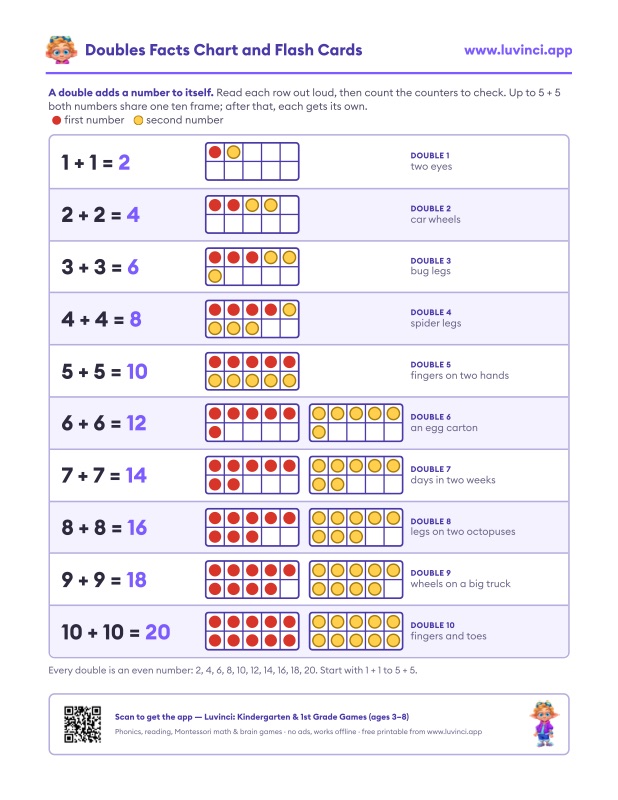
1 + 1 = 2, 2 + 2 = 4, 3 + 3 = 6, 4 + 4 = 8, 5 + 5 = 10, 6 + 6 = 12, 7 + 7 = 14, 8 + 8 = 16, 9 + 9 = 18, 10 + 10 = 20
Our free doubles facts printable has a picture doubles chart, 10 cut-out flash cards with answer cards and a doubles plus one page. No signup, no email.
What are doubles facts?
A doubles fact adds two numbers that are the same. 4 + 4 is a double. 4 + 5 isn’t, but it’s very close to one (more on that below).
Kids like doubles because they can see them. Two hands show 5 + 5 fingers. A spider has 4 legs on each side, so 4 + 4 = 8. An egg carton is two rows of 6, so 6 + 6 = 12. A double is two matching groups, and matching groups are easy to picture.
The picture is what makes it stick. A child who sees two rows of 4 and says “8” without counting every dot already knows a fact. For a lot of kids, doubles are the first facts they know instead of counting.
Doubles are also a kind of number bond. The bonds of 8 run from 0 and 8 to 8 and 0. One of those pairs is two equal parts, 4 and 4.
When do kids learn doubles?
- Kindergarten: most kids meet doubles to 5 + 5, with fingers, counters and pictures. The goal is to see the two equal groups and find the total.
- 1st grade: kids learn doubles to 10 + 10, and start using them as a strategy. The Common Core standard for 1st grade (1.OA.6) gives this exact example: 6 + 7 = 6 + 6 + 1 = 12 + 1 = 13.
- 2nd grade: by the end of the year, kids are expected to know all the single-digit sums by heart, doubles included.
Doubles chart: 1 + 1 to 10 + 10
Here’s the full doubles chart, with something real to picture for each one. Page 1 of the PDF has the same chart with every double drawn on ten frames, red counters for the first number and yellow for the second, so your child can see both halves.
| Double | Answer | Picture it |
|---|---|---|
| 1 + 1 | 2 | two eyes |
| 2 + 2 | 4 | the wheels on a car |
| 3 + 3 | 6 | a bug’s legs, 3 on each side |
| 4 + 4 | 8 | a spider’s legs, 4 on each side |
| 5 + 5 | 10 | fingers on two hands |
| 6 + 6 | 12 | an egg carton, two rows of 6 |
| 7 + 7 | 14 | the days in two weeks |
| 8 + 8 | 16 | the legs on two octopuses |
| 9 + 9 | 18 | a big 18-wheel truck, 9 wheels on each side |
| 10 + 10 | 20 | fingers and toes |
Two things to point out as you read the chart together:
- The answers go up by 2. 2, 4, 6, 8, 10. That’s counting by 2s. If your child can count by 2s to 10, they already know the first five answers.
- Every double is even. Two equal groups always make an even number. If the answer to a double comes out odd, something slipped.
From 6 + 6 on, the chart gives each number its own ten frame, red on the left and yellow on the right. 7 + 7 is a full row of 5 and 2 more, twice, so your child sees 7 without counting every counter.
A ten frame shows the small doubles too. Put 3 red counters in the first boxes and 3 yellow right after them. That’s 3 + 3 = 6, with 4 boxes left. Fill the frame with 5 red and 5 yellow and you have 5 + 5 = 10, a full ten frame.
Doubles plus one and near doubles
This is the payoff. Once doubles are known, a whole set of harder facts gets easier.
Doubles plus one
A doubles plus one fact adds two numbers that sit next to each other, like 4 + 5 or 7 + 8. To solve it, double the smaller number, then add one more. For 6 + 7, double 6 is 12, and one more is 13.
Show it on a ten frame. Put 4 red counters, then 5 yellow right after them. Four of the yellow match the 4 red. That’s the double, 4 + 4 = 8. One yellow has no partner. That’s the plus one, and 8 + 1 = 9.
Here are all the doubles plus one facts up to 20:
| Fact | Think: double, then one more | Answer |
|---|---|---|
| 1 + 2 | 1 + 1 = 2, then + 1 | 3 |
| 2 + 3 | 2 + 2 = 4, then + 1 | 5 |
| 3 + 4 | 3 + 3 = 6, then + 1 | 7 |
| 4 + 5 | 4 + 4 = 8, then + 1 | 9 |
| 5 + 6 | 5 + 5 = 10, then + 1 | 11 |
| 6 + 7 | 6 + 6 = 12, then + 1 | 13 |
| 7 + 8 | 7 + 7 = 14, then + 1 | 15 |
| 8 + 9 | 8 + 8 = 16, then + 1 | 17 |
| 9 + 10 | 9 + 9 = 18, then + 1 | 19 |
Every answer is odd, because it’s an even double plus one. The order doesn’t matter either. 5 + 4 is the same as 4 + 5, so double the smaller number either way.
Page 4 of the PDF has nine doubles plus one problems drawn on ten frames. Use one frame when the total is 10 or less, and two frames past 10. The counter with no partner has a small “+1” tag next to it, so your child can spot “the one more” at a glance, even on a black and white printer. Each row has boxes for the double, then for the double’s answer + 1.
Near doubles: doubles minus one and plus two
“Near doubles” is the bigger family. Doubles plus one comes first, and two more follow from the same idea:
- Doubles minus one. Double the bigger number and take one away. For 7 + 6, think 7 + 7 = 14, so 7 + 6 is 13.
- Doubles plus two. For numbers two apart, like 4 + 6, double the smaller and add 2: 4 + 4 + 2 = 10. Or move one across: 4 + 6 is the same as 5 + 5.
Get doubles plus one steady before the others. These are 1st grade strategies. In kindergarten, it’s enough to know the small doubles. For sums that cross 10, like 8 + 5, there’s a second trick. You’ll find the make 10 strategy in our ways to make 10 post.
Doubles work backwards too. If 7 + 7 = 14, then 14 take away 7 is 7.
Doubles games and a song
A short game beats a long drill. Five minutes at a time, a few times a week, is plenty.
A doubles chant
Say it with a clap on each number. Your child fills in the answer once they know it.
Double 1, that’s 2: two eyes looking at you.
Double 2, that’s 4: four wheels out the door.
Double 3, that’s 6: bug legs, click click.
Double 4, that’s 8: spider on the gate.
Double 5, that’s 10: wave your hands again.
Double 6, that’s 12: eggs up on the shelf.
Double 7, that’s 14: two weeks, count them clean.
Double 8, that’s 16: two octopuses in the sea so green.
Double 9, that’s 18: wheels on a big machine.
Double 10, that’s 20: fingers, toes, and plenty!
Start with the first five lines. Add the rest in 1st grade. When the chant is easy, say only “Double 7” and let your child call out “14”.
Five doubles games
- Mirror doubles. Put 3 blocks in front of a small mirror. How many can you see now? A paper butterfly works too: paint 4 dots on one half, fold while the paint is wet, open, and count both wings.
- Roll a double. Roll one die and double it: roll a 4, say “4 + 4 = 8”. With two dice, whoever rolls a double says the sum and scores a point. First to 3 points wins.
- Doubles match. First cover the small fact on each answer card with a sticky note, so only the big answer shows. Then lay all 20 cards face down. Take turns turning over two. A fact and its answer (3 + 3 and 6) make a pair you keep. No match? Turn them back. Most pairs wins. Lift the notes at the end to check.
- Build the twin. Build a tower of 5 blocks. Your child builds its twin, then counts both.
- Beat the count. Hold up a flash card. Your child says the answer before you count to three. Right answers go in a “fast” pile.
If your child still puts small things in their mouth, use big blocks instead of small counters, and stay close.
Free doubles flash cards
The doubles facts flash cards are pages 2 and 3 of the PDF. Page 2 has ten fact cards, 1 + 1 to 10 + 10, each with its counters on ten frames. Page 3 has the answer cards, with the big answer, the full fact and a real-life clue. Cut them out on the dashed lines.
The answer cards line up with the fact cards. Print page 3 on the back of page 2 (flip on the long edge) and each card has its answer on the back. Or print them separately for the match game.
The counters are red and yellow, like the two-color counters used in class, and they still look different on a black-and-white printer.
How to use the cards:
- Start small. Use cards 1 to 5 in kindergarten. Add 6 to 10 once those are quick.
- Counters first, then no counters. At first, let your child look at the ten frames. Later, cover them with a thumb and see if the fact comes on its own.
- Mix in doubles plus one. Once the doubles are quick, hold up 4 + 4, then ask “and 4 + 5?”
The app’s addition boards within 10 include doubles. Its Singapore Math board with sums that make 8 and 10 also shows 4 + 4 and 5 + 5 on ten frames. Those boards are in the full app; the counting board is free. For more on how the boards work, see our math games page.
FAQ
What are doubles facts in math?
Doubles facts are addition facts where both numbers are the same, like 2 + 2 = 4 or 8 + 8 = 16. The ten doubles from 1 + 1 to 10 + 10 have the answers 2, 4, 6, 8, 10, 12, 14, 16, 18 and 20.
What is the doubles plus one strategy?
It’s a way to solve a sum of two numbers that are next to each other, like 5 + 6. Double the smaller number (5 + 5 = 10), then add one more (11). It turns a hard fact into a double your child already knows.
What grade learns doubles facts?
Kindergartners usually meet doubles to 5 + 5 with fingers and counters. In 1st grade, kids learn doubles to 10 + 10 and use doubles plus one as a strategy. By the end of 2nd grade, most are expected to know all the single-digit sums from memory.
Why are doubles always even?
A double is two equal groups. Anything that splits into two equal groups is even. That’s also why every doubles plus one answer is odd. It’s an even number and one more.
What are near doubles?
Near doubles are facts that are close to a double: doubles plus one (6 + 7), doubles minus one (7 + 6 as 7 + 7 take away 1) and doubles plus two (4 + 6). Your child finds the double inside the fact, then adjusts.
The takeaways
- A doubles fact adds a number to itself: 1 + 1 to 10 + 10, with answers 2 to 20.
- Doubles are easy to see: two hands, spider legs, an egg carton. Use the pictures.
- Start with 1 + 1 to 5 + 5 in kindergarten; the bigger doubles and doubles plus one belong to 1st grade.
- Doubles plus one: double the smaller number, then add one more. 6 + 7 = 6 + 6 + 1 = 13.
- Short games beat long drills: a chant, a die, a mirror and five minutes.
- Print the free doubles facts PDF: a picture chart, 10 flash cards with answer cards, and a doubles plus one page.
More free math worksheets: ten frames, number charts, addition and subtraction, daily practice workbooks and more, all in one place. See the math printables →
