 Luvinci
September 26, 2026
Printable Hundreds Chart: Color, Blank, Fill-In (Free PDF)
Free printable · PDF · 634 KB
Printable Hundreds Chart: Color, Blank, Fill-In (Free PDF)
No signup needed. Just print it.
Download PDFA printable hundreds chart lays out the numbers 1 to 100 in 10 rows of 10. One step right is 1 more, and one step down is 10 more. With that idea, a page of numbers becomes a map. Kids use it to count to 100, find numbers, and see the patterns that make big numbers easy.
Our free hundreds chart PDF has 8 pages: color, black and white, missing numbers, fill-in and blank charts, counting by 10s on ten frames, a cut-out puzzle and chart pieces to fill in. Use this free hundreds chart printable at home or in class. You don’t need to sign up or leave an email.
If your child is at the end of kindergarten or in 1st grade, this guide is for you. If 100 feels like a lot, start with our number chart 1-20.
Jump to: the 8 pages · how to use it · counting to 100 · counting by 10s · blank and missing numbers · puzzles · games
Free printable hundreds chart PDF
Keep one copy of page 1 handy. It’s also the answer key for the fill-in pages.
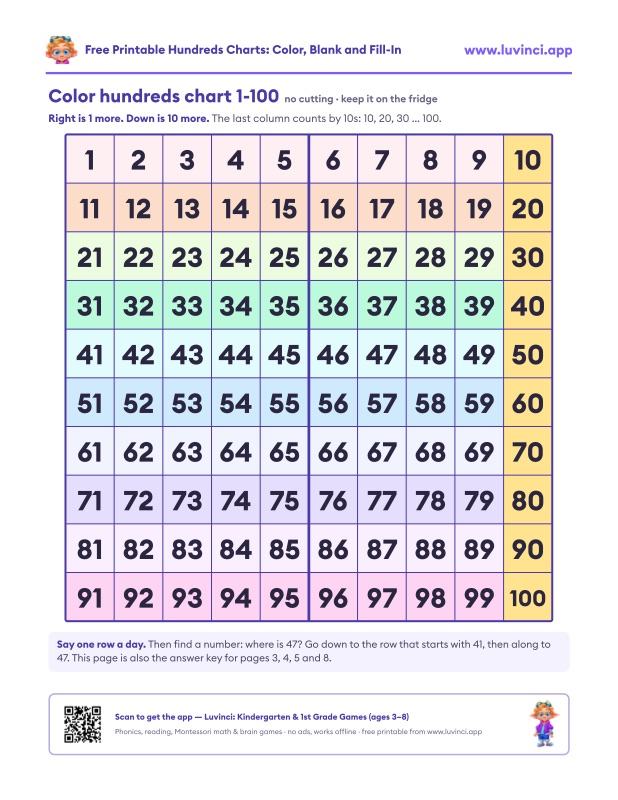
- Color hundreds chart 1-100 (page 1). Each row has its own soft color, and the last column (10, 20, 30 … 100) is yellow. No cutting. Put it on the fridge.
- Black and white hundreds chart (page 2). The same chart in ink only, for coloring patterns.
- Missing numbers hundreds chart (page 3). 20 numbers are hiding in circles. Kindergartners say them out loud.
- Fill-in hundreds chart (page 4). Only the first number of each row is printed. 1st graders write the rest.
- Blank hundreds chart (page 5). 100 empty boxes, for writing 1 to 100 or building the puzzle.
- Count by 10s to 100 (page 6). Ten full ten frames, 10 more each time, up to 100.
- Hundreds chart puzzle (page 7). The color chart with dashed lines to cut it into 8 chunky pieces.
- Hundreds chart pieces (page 8). Small shapes from the chart, each with one number given. Your child fills in the rest.
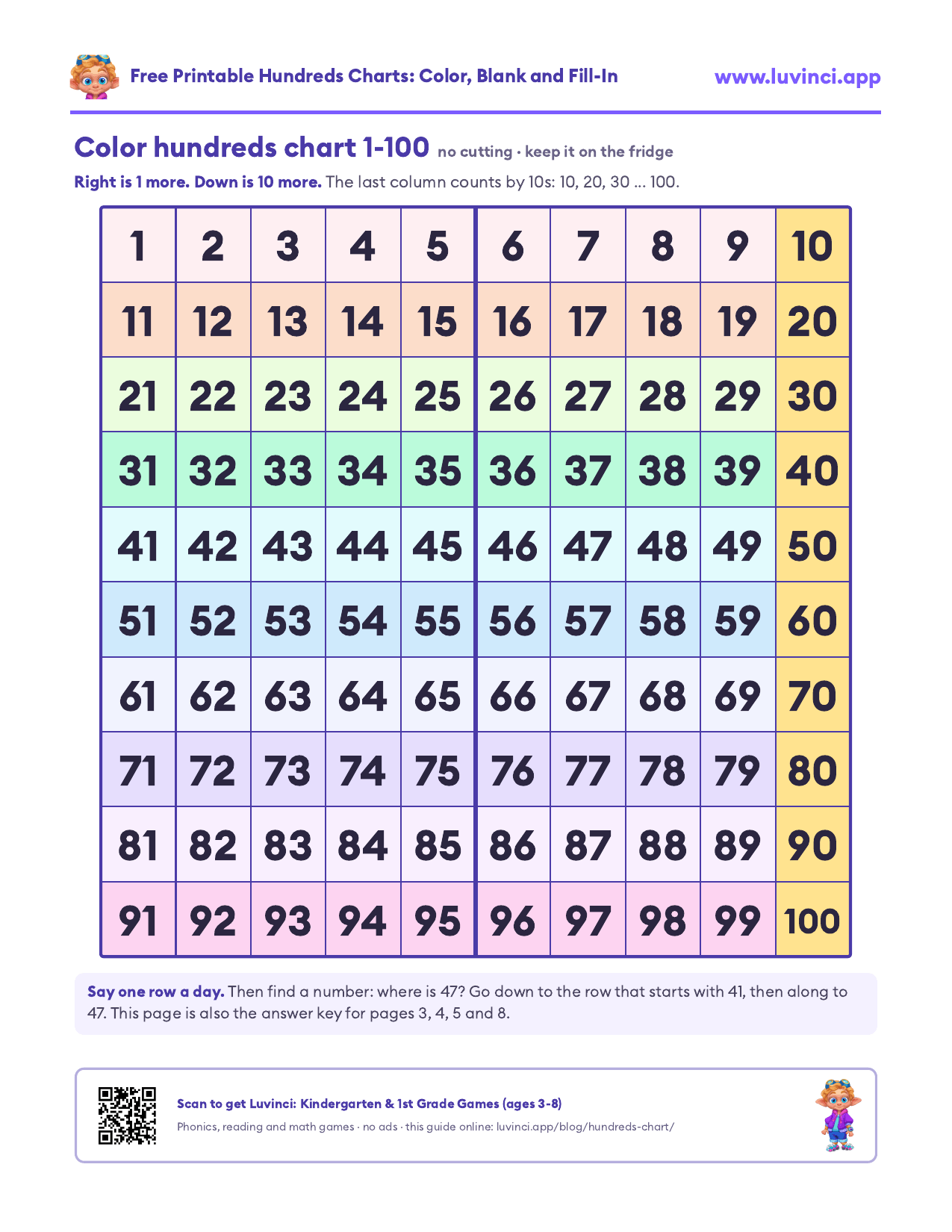
Page 1: a hundreds chart with numbers 1 to 100, and the answer key for the fill-in pages.
Print the 100 chart PDF on US Letter. A few tips:
- Black and white prints fine. The row colors turn into light and lighter gray. For an ink-only chart, use page 2.
- Make it dry-erase. Slide page 3, 4 or 5 into a sheet protector and use a dry-erase marker. Wipe it and start again tomorrow.
- Use cardstock for the puzzle. Page 7 on thick paper makes pieces that last.
What is a hundreds chart?
A hundreds chart is a grid of the numbers 1 to 100 in 10 rows of 10. One step right is 1 more. One step down is 10 more. It’s also called a hundred chart, a 100 chart, a 1-100 chart or a number chart 1-100.
Once your child knows where to look, patterns fill the chart:
- Each column shares a ones digit. 3, 13, 23, 33 … 93 all end in 3.
- The last column counts by 10s. 10, 20, 30 … 100 run straight down the right side.
- Most of a row shares a tens digit. 21 to 29 all start with 2. Only the last number, 30, belongs to the next ten.
- The rows wrap like reading a book. After 30 comes 31, at the start of the next row, not to the right of 30.
How to use a hundreds chart at home
Five minutes a day is plenty. Leave page 1 out on the table.
- Say one row a day. Touch each number as you say it. Monday is 1 to 10, Tuesday 11 to 20, and so on. Go back to row 1 whenever it feels shaky.
- Find a number. “Where is 47?” Help your child go down to the row that starts with 41, then along to 47. Then swap: they pick a number for you.
- Cover-up. While your child looks away, cover a number in the middle of the chart, like 45, with a small square of paper. “What’s above it? What’s below it?” Above is 35, 10 less. Below is 55, 10 more. So the hidden one is 45.
- 1 more and 10 more. Put a finger on 23. “What’s 1 more?” Step right to 24. “What’s 10 more?” Step down to 33. Say the answer before you move.
Keep it playful, not a test. There’s a dice game for the 10 more idea too, 10 More, 10 Less, for 1st graders.
How to teach counting to 100
In the Common Core standards, counting to 100 by ones and by tens is an end-of-kindergarten goal (K.CC.1). It isn’t a skill kids need on the first day of school (see what a child should know before kindergarten).
Counting to 100 isn’t 100 new words. The teens are the odd row out, with eleven, twelve and the -teen words. After that, you get 8 new decade words (twenty, thirty … ninety), then hundred, and the same 1 to 9 over and over. The chart shows the pattern. From 21 on, every row does the same thing.
The decade switch: 29 and 39. A study of more than 800 kindergartners in Australia (Gould, 2016) checked how far children could count. Ten weeks into the year, 39 and 29 were the two most common places to stop. The count is fine until the row ends and a new decade word is needed.
“Twenty-nine, twenty-ten.” This is the classic slip, and the Common Core progression document, written by the standards’ authors, names it. When you hear that slip, the ones pattern is already solid. Only the decade word is missing. Point to the yellow box right after 29 and say “thirty”.
Potholes. Some kids skip the same number, like 15 or 70, every time. That one number was never learned. Teach that one number on its own.
Reciting vs counting. Reciting 1 to 100 is a string of words. Counting 12 real things is a different skill. Both matter, and neither one proves the other. Our one to one correspondence guide explains why.
Counting by 10s to 100
To count by 10s, run a finger down the last column: 10, 20, 30 … 100. Say each number as you touch it. Next, try it without the chart. After that, try it with fingers: flash ten fingers for each ten.
Page 6 shows why counting by 10s works. Each ten frame holds 10 red counters, so a full frame is 10. Touch the frames one by one and count on: 10, 20, 30. Ten full frames make 100. A fill-in line at the bottom has a few tens missing.
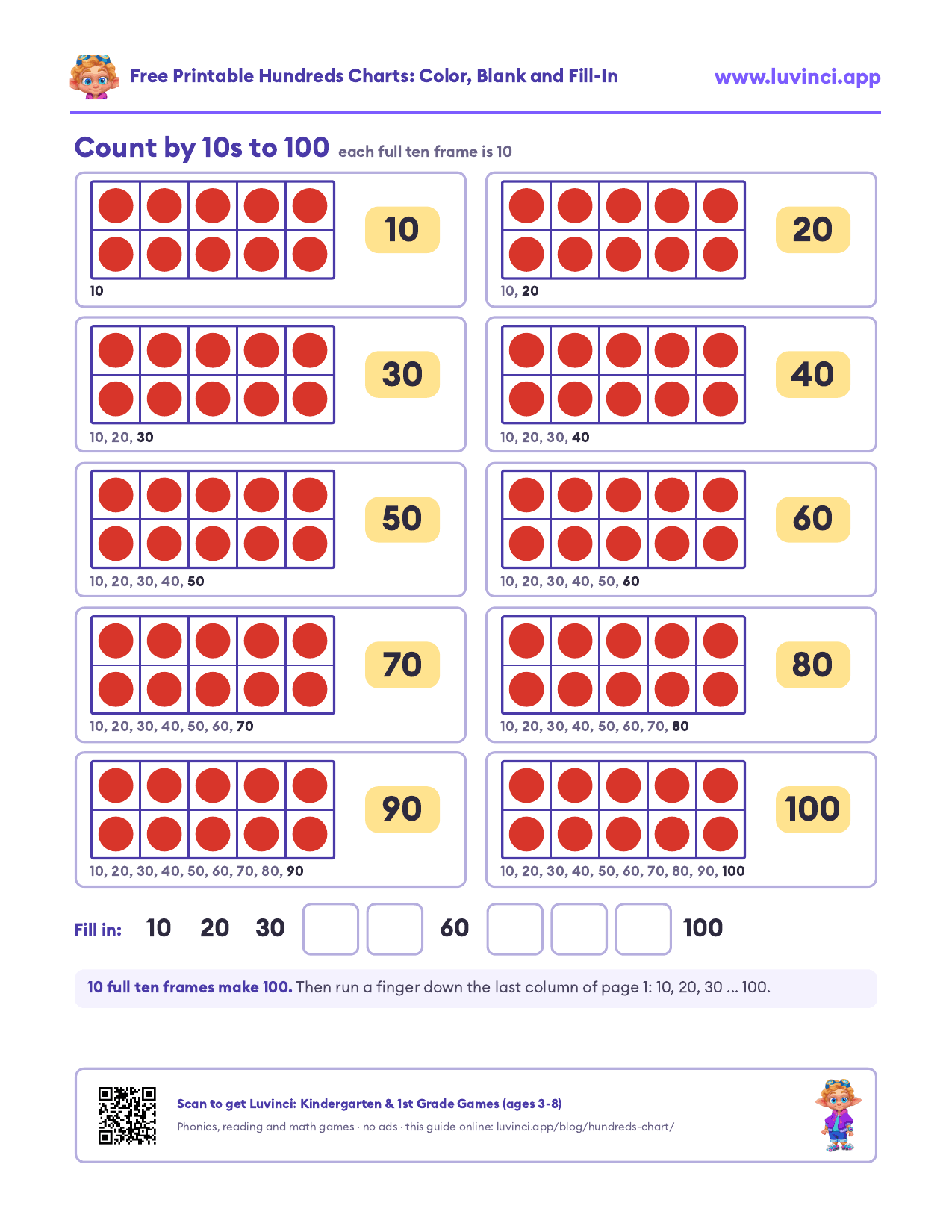
Page 6: counting by 10s, one full ten frame at a time.
In 1st grade, start from somewhere else. Put a finger on 4 and go down the column: 4, 14, 24, 34. Each step is 10 more. Finding 10 more without counting by ones is a 1st grade goal (1.NBT.5), and the chart makes it easy to see.
Blank hundreds chart and missing numbers
A blank hundreds chart and a mostly full chart do different jobs. Pick the page that fits your child.
Kindergarten: page 3. It’s a counting to 100 worksheet with 20 numbers missing. Your child points and says the missing number, then checks with page 1. Kindergartners count to 100 out loud but only write numbers to 20 (K.CC.3), so saying is the whole job. The circles are for writing later, in 1st grade or when your child asks to. The missing numbers include 30, 40, 50, 70, 90 and 100 on purpose. Those decade numbers are the hurdles.
If writing 0 to 20 is still new, start with number tracing first.
1st grade: pages 4 and 5. In 1st grade, kids read and write numbers to 120 (1.NBT.1). Page 4 is a fill-in hundreds chart: only 1, 11, 21 … 91 are printed, and your child writes the rest of each row. Page 5 is the blank 100 chart. Nothing is printed on it at all.
Tip: fill the last column first. Write 10, 20, 30 … 100 down the right side before anything else. Now every row has a start and an end, and the numbers in between follow the pattern. That’s also how to make your own hundreds chart. Print page 5, write 10, 20, 30 … 100 down the last column, then fill in each row.
A missing numbers hundreds chart makes a good check-in once a month. Keep the old pages so you can see how far your child has come.
Hundreds chart puzzles
Hundreds chart puzzles get kids thinking about where numbers live, not just what comes next.
Page 7 (kindergarten and up). It’s the color chart from page 1 with thick dashed lines. Cut on the lines to get 8 chunky pieces. Mix them up and build the chart again on the blank chart on page 5. The pieces are the same size as the boxes, so they sit right on top. The colors help at first. The numbers do the rest.
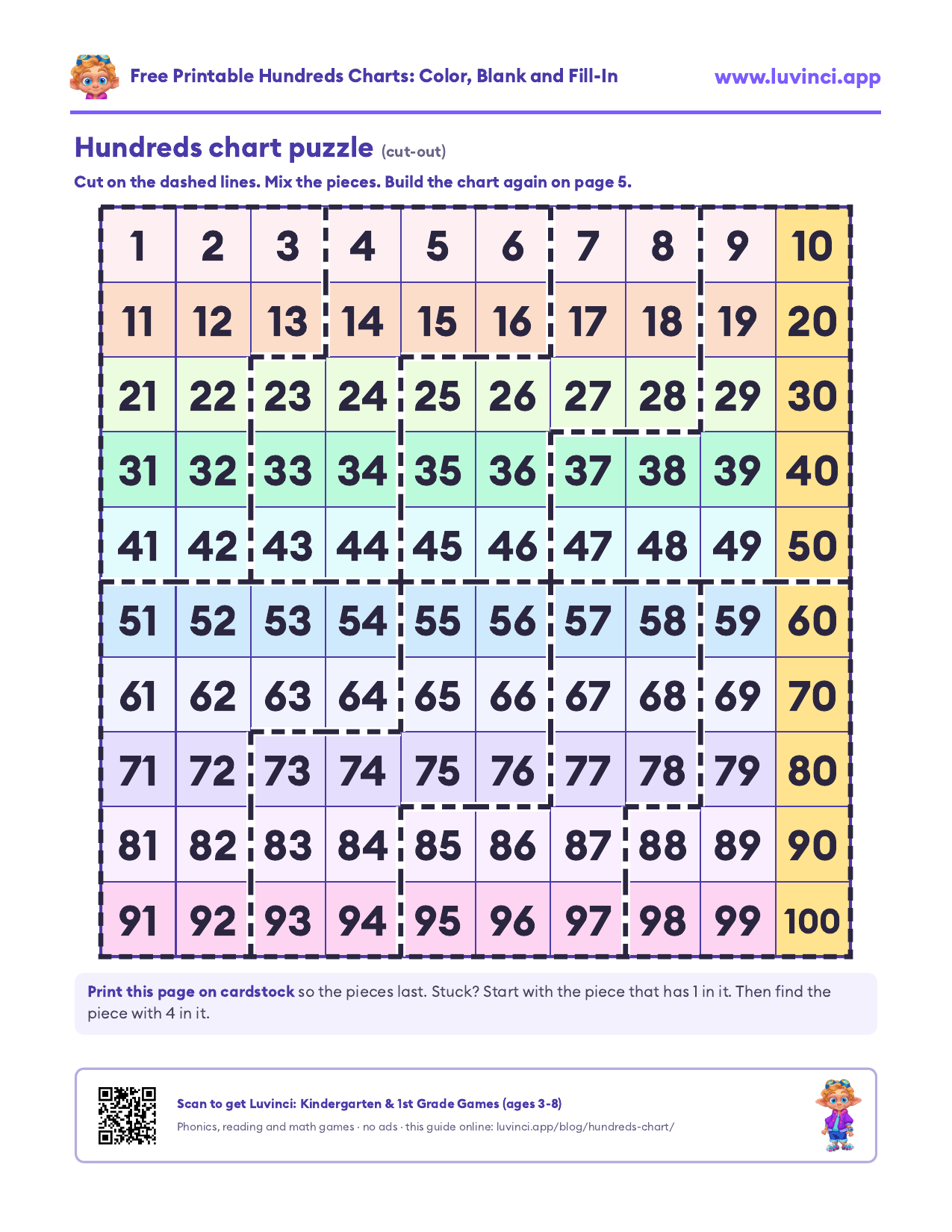
Page 7: cut on the dashed lines, then build the chart again on page 5.
Page 8 (1st grade). Eight small shapes from the chart: a plus, an L, a T, a square and some strips. Each shape has one number filled in. Your child writes the rest using the moves: right is 1 more, left is 1 less, down is 10 more, up is 10 less. Then they check with page 1. The plus around 45 is a good first one. The square with 88 in its bottom right corner is the hardest, because you work backwards: 1 less and 10 less.
Hundreds chart games and activities
These hundreds chart activities use page 1 or 2, a die and a few small things to move.
1. Count-On Race. Each player puts a token next to 1. Roll a die and move. The rule that matters is how you count. Say each number as you step on it, not “1, 2”. On 17, roll 2, say “18, 19”. First to 100 wins, and you don’t need an exact roll to get there. For kindergarten, keep it small. A roll of 4 counts as 1, 5 as 2 and 6 as 3, and the race ends at 50. Start at 51 the next day. 1st graders use the die as it is.
Why counting on? In one study, kindergartners played a game on a 10 by 10 board of the numbers 1 to 100 (Laski and Siegler, 2014). Kids who counted on from where they were learned more than kids who counted from 1 each turn. Same board, same moves. What taught them was the counting.
2. Find My Number. Give riddles. “I’m 1 more than 29.” “I’m 10 more than 45.” “I’m in the last column, and I’m right after 69.” Your child finds it and puts a token on it. Then they make up riddles for you.
3. Skip-count coloring. On one copy of page 2, color every 10th number: 10, 20, 30 … 100. That’s one stripe down the right side. On a second copy, color every 5th number: 5, 10, 15, 20. Now there are two stripes. Counting by 10s is a kindergarten goal (K.CC.1). Counting by 5s comes in 2nd grade (2.NBT.2), so for now it’s just a pattern to notice. When it’s time, our skip counting chart has a row for the 5s, and for the 2s too.
A safety note: small counters, coins and buttons are choking hazards for young children, so a grown-up stays close. Paper squares or crayon dots work fine as tokens.
Common hundreds chart mistakes
| What you see | What to try |
|---|---|
| Stops at 29 or 39, or says “twenty-ten” | Count down the last column (10, 20, 30 … 100) until the decade names come easily |
| Always skips the same number | Find that one number and teach just that one |
| Finds 14 when you say “forty” | Forty ends in 0. Point to the last column and find 40 there |
| Looks to the right of 30 for 31 | The rows wrap like a book. 31 starts the next row |
| Counts by ones to find 10 more | Go straight down one row. That’s 10 more |
FAQ
What age is a hundreds chart for?
Most kids use a hundreds chart from the end of kindergarten (about age 5 or 6) into 1st grade. A 100 chart in kindergarten is for counting out loud and finding numbers. In 1st grade, kids also read and write numbers to 120, so that’s where the fill-in and blank pages belong.
At what age should a child count to 100?
Kindergarten is the year for it. Most kids get there in the spring, around age 6. Counting to 100 by ones and by tens is a kindergarten goal in the Common Core standards (K.CC.1). Nobody expects it on the first day of kindergarten.
Should a hundreds chart start at 0 or 1?
Both work. The 1-100 chart is the most common one in US classrooms. A 0-99 chart puts each ten in its own row, so 20 to 29 sit together. Some teachers also flip the chart so bigger numbers go up. One small study with kindergarten and 1st-grade kids found the usual top-down chart did as well or better than a bottom-up one. Pick one chart and stay with it.
What is the difference between a number chart and a hundreds chart?
A hundreds chart is a number chart 1-100. Number charts also come in smaller sizes, like 1-20 or 1-50, and bigger ones like a 120 chart. For younger kids, try our number chart 1-20 or number chart 1-50. A number line to 100 puts the same numbers on one long line instead of rows.
What comes after 100?
101, 102 and on up. In 1st grade, kids count to 120. Our 120 chart shows the tricky spots from 100 to 120. The 10 More, 10 Less game board in our first grade math games goes from 1 to 120.
The takeaways
- A printable hundreds chart is 1 to 100 in 10 rows of 10. Right is 1 more. Down is 10 more.
- Counting to 100 is an end-of-kindergarten goal. 29 and 39 are where kids get stuck, so teach the next decade word.
- Kindergartners say the missing numbers. 1st graders write them.
- Count on, not from 1. It’s the part of the game that teaches.
- Print the free hundreds chart PDF: a color chart, black and white, missing numbers, fill-in, blank, counting by 10s, a puzzle and chart pieces.
Counting to 100 happens on paper. The app’s math boards work on the numbers inside it: counting, adding and taking away within 10, with pictures and ten frames. The first counting board is free. See how Luvinci’s math games work.
More free math worksheets: ten frames, number charts, addition and subtraction, daily practice workbooks and more, all in one place. See the math printables →
