 Luvinci
October 4, 2026
Number Tracing Worksheets 1-20 (Free Printable PDF)
Free printable · PDF · 1746 KB
Number Tracing Worksheets 1-20 (Free Printable PDF)
No signup needed. Just print it.
Download PDFThese free number tracing worksheets walk your child through 0 to 20, one numeral at a time. Each number begins at a green dot and follows arrows. The tracing is there to lock in the right habit (top first, the right way round), not a neat copy on its own.
Tracing numbers works best in small doses. One row a day, about five minutes, then stop while it’s still fun. This guide is for parents and teachers using number tracing worksheets for kindergarten and 1st grade. It covers how to teach number formation, why kids write numbers backwards, and when writing 0 to 20 is expected.
Our free number tracing worksheets PDF has 8 pages: a number formation chart, tracing pages for 0-10 and 11-20, number words and a count-and-trace page. US Letter, black-and-white friendly. No signup, no email.
Jump to: what’s in the pack · 0 to 10 · 11 to 20 · number formation · number words · count and trace · FAQ
Free number tracing worksheets (PDF)
The pack is laid out so you can see what each page does. Page 1 needs no prep at all. Pages 2 to 7 are trace-then-write sheets, and page 8 is a count, trace and match page.
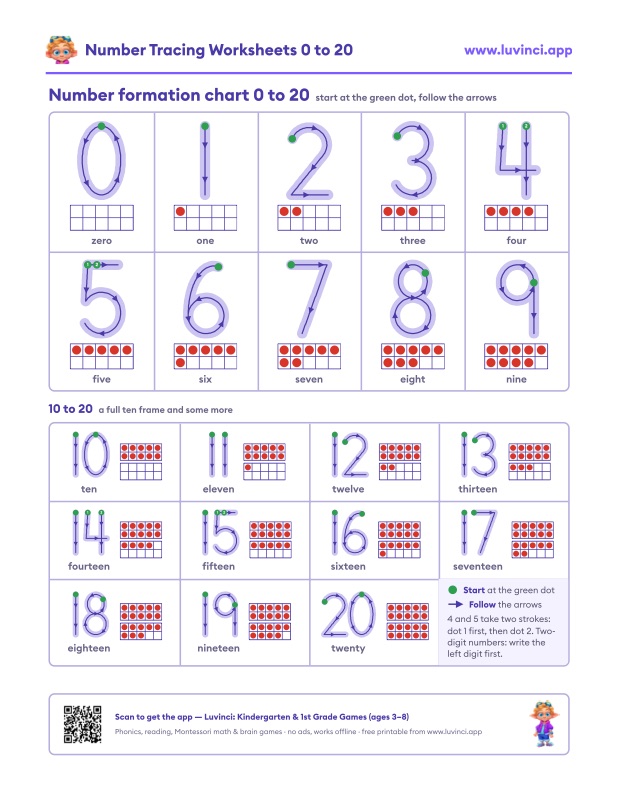
- Number formation chart 0 to 20 (page 1). Every numeral with a green start dot and arrows for each stroke, plus a ten frame that shows how many. Numbers 11 to 20 show a full ten frame and some more. Pin it on the fridge or next to homework.
- Number tracing 0 to 5 (page 2). One row per number: a big model with arrows, its ten frame, four dotted copies to trace, then space to write it alone.
- Number tracing 6 to 10 (page 3). The same rows, then a strip to write 0 to 10 in order.
- Tracing numbers 11 to 15 (page 4) and 16 to 20 (page 5). Three dotted copies per row, and a strip to write 11 to 20 in order.
- Number words zero to ten (page 6) and eleven to twenty (page 7). Each word in dots next to its numeral, then a line to write it.
- Count, trace and match (page 8). Count the strawberries on each ten frame, trace the numbers, and draw a line to match.
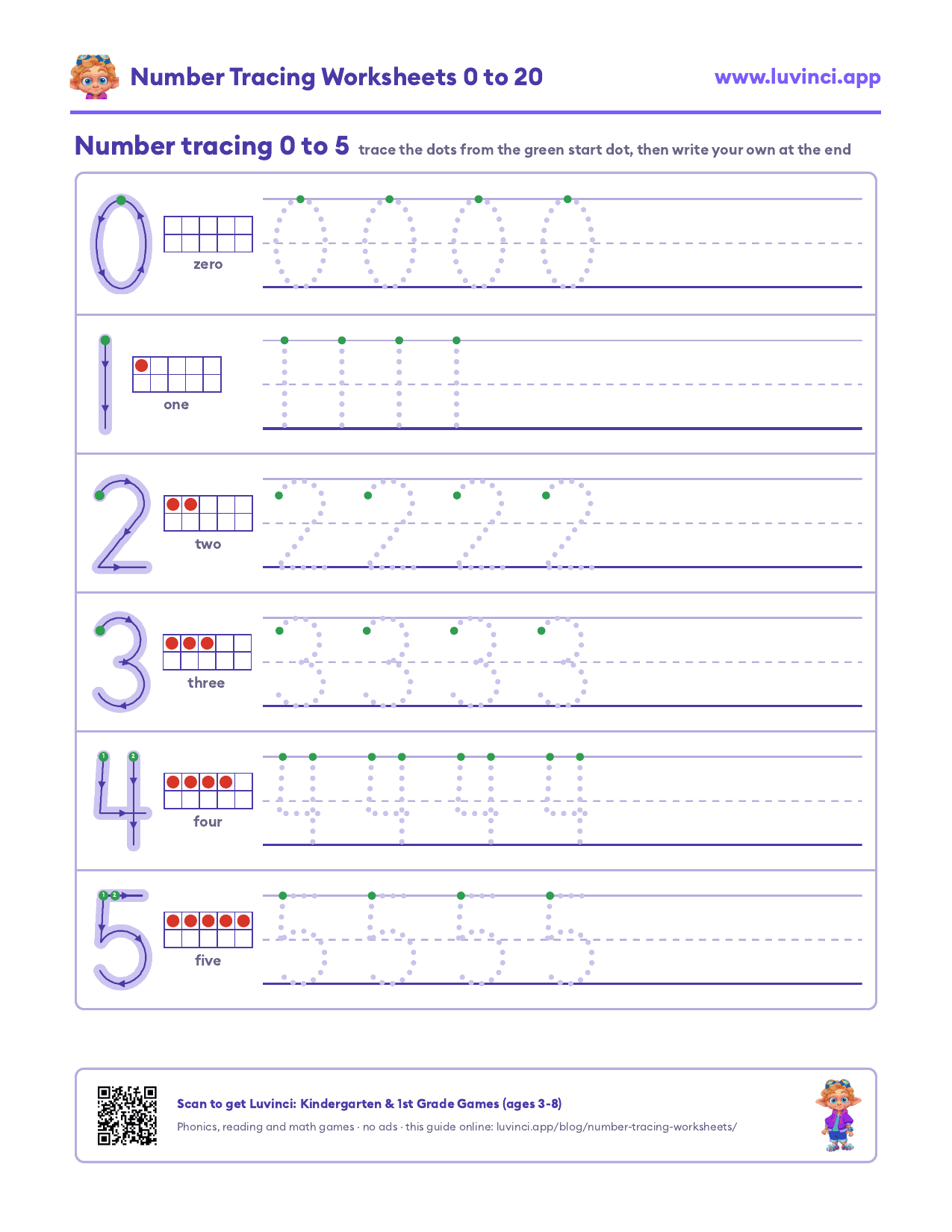
Page 2 of the free PDF: number tracing 0 to 5.
Printing tips:
- Slide a page into a sheet protector and use a dry-erase marker. One printout lasts all year.
- Black and white is fine. The green dots print as dark gray and still show where to start.
- Print page 1 on cardstock if you’d like it to last as a reference chart.
Number tracing 1-10 (and zero)
Most kids begin with number tracing 1-10, and zero belongs on the same page. A zero is how you write “none”, and kindergartners learn to write every number from 0 to 20.
Each row on pages 2 and 3 works the same way:
- Look at the model. Put a finger on the green dot and trace the big numeral with your finger first, following the arrows.
- Count the ten frame. The red counters show how many the number means. 7 is a full top row of 5 and 2 more. (Our ten frame printable has more on reading a ten frame.)
- Trace the dotted copies. Start at the green dot every time. Say the number out loud.
- Write it alone in the empty space at the end of the row.
Start with 1 and 0, then 4. Save 2, 3, 7 and 9 for later. They all face left, and those are the numbers kids most often write backwards.
Page 3 ends with a strip for writing 0 to 10 in order with no dots. That’s the real test. Stay on 0 to 10 until your child can do it from memory, then move on to the teens.
Tracing numbers 11-20
Tracing numbers 1-20 isn’t much harder than 1-10. The teens reuse the same digits. Every number from 11 to 19 starts with a 1, and 20 starts with a 2. What’s new is writing two digits in the right order.
- Write the left digit first. For 14, that’s the 1 and then the 4, always left to right.
- Watch for 41 instead of 14. Thirteen to nineteen say the second digit first (“four-teen”), so kids sometimes write it first too. Point to the 1 and say “the 1 goes first”.
- Look at the two ten frames. On pages 4 and 5, each teen number shows a full ten frame and some more. 14 is a full frame and 4 more. Saying “ten and four more, fourteen” while tracing ties the numeral to the amount.
Pages 4 and 5 use smaller numerals, because two digits need more room. If a row feels cramped for your child, trace with a finger first and write the rest on a whiteboard.
How to teach number formation
Number formation is how a numeral is made. Where the pencil starts, which way it goes, and in what order all matter. Solid formation makes writing faster later, and it helps with reversals.
Start at the dot: top first
Every numeral starts at or near the top. What trips kids up is the direction after that:
- 0 goes round to the left (counterclockwise), from the top.
- 2 and 3 start by curving to the right.
- 4 and 5 take two strokes. For 4, go down and across, lift, then make the long line down. For 5, go down and round the belly, lift, then add the hat on top.
- 8 is one stroke: make an S, then go back up to the start.
- 9 is a ball, then a line down. Round to the left first, then straight down the right side.
The chart on page 1 shows all of these with numbered dots for 4 and 5.
Number formation rhymes 0-9
A short saying for each number helps a child remember the path without you. Say it while they trace:
| Number | Say it while you write |
|---|---|
| 0 | Start at the top and round we go, back to the start to close the zero. |
| 1 | Start at the top and down you run. One straight line makes number 1. |
| 2 | Hook at the top, slide down to the floor, zoom to the right. That’s 2 for sure. |
| 3 | Round to the middle, then round again, see? Two bumps make the number 3. |
| 4 | Down and across, then lift, there’s one more. One long line down makes 4. |
| 5 | Down, round the belly, then add the hat. 5 is finished, just like that. |
| 6 | Curve down and round, then close it up quick. A loop at the bottom makes a 6. |
| 7 | Across the top, then down you go, one long slide makes 7, you know. |
| 8 | Make an S, then don’t be late. Go back up to close the 8. |
| 9 | A ball at the top, then a line so fine. Straight down from the ball makes 9. |
If your child’s school uses its own rhymes, use those. Hearing the same words at home and at school helps.
Why kids write numbers backwards
Reversals are very common in pre-K and kindergarten, and often into 1st grade. The usual ones are 2, 3, 7 and 9, the numbers that face left. 4, 5 and 6 get reversed less often. For years a young child’s brain has treated a cup as a cup whichever way it faces. Letters and numerals are the first things where turning them around changes what they mean.
What helps:
- Always start at the dot. A fixed starting point and direction make the right way round a habit.
- Use a reference. Keep the page 1 chart where your child writes and let them check it.
- Fix one number at a time. Pick the one they reverse most and practice only that one for a week.
- Stay relaxed. Most children grow out of reversals as they read and write more. If they’re still very frequent in 2nd grade, mention it to the teacher.
Number words with tracing
Number words are the written names, from zero to twenty. Kindergarten doesn’t ask kids to spell them. Number word tracing still helps once your child is reading simple words, and those words show up on 1st grade worksheets.
Pages 6 and 7 put each numeral next to its word in dots, then leave a line to write it. Read the word together first, then trace. A few words are worth pointing out:
- “eight” and “eighteen” have a silent “gh”.
- “twelve” and “twenty” both start with “tw”, like “two”.
- “thirteen” and “fifteen” don’t say “three-teen” and “five-teen”, so they’re trickier to spell.
Count, trace and match activities
A traced 6 only helps if your child knows what 6 means. Page 8 puts the two together. Count the strawberries on each ten frame, trace the numbers, then draw a line from each frame to its number. The frames are in a mixed order, so your child has to count, not just follow the pattern.
Point to each strawberry as your child counts, one number for each. On the 6 to 10 frames, count the full top row as 5, then keep going.
No printer? These work just as well:
- Sand or salt tray. Pour a thin layer on a tray and write numbers with a finger. Shake to erase.
- Sky writing. Write a giant number in the air with a straight arm, starting at the top.
- Chalk on the sidewalk. Big numbers, then hop along them in the right direction.
- Count and write. Put out 1 to 10 snacks, count them together and write the number on a sticky note. (Small snacks can be a choking hazard, so a grown-up stays close. Skip whole grapes, nuts and popcorn, and keep snacks away from toddlers.)
When should kids write numbers?
Pre-K: many children write a few numbers, often their own age, and some write none. Tracing with a finger and recognizing written numbers 1 to 10 matter more. Our kindergarten readiness checklist lists “recognizes written numbers 1-10”, not writing them.
Kindergarten: in the US Common Core standards (K.CC.3), kindergartners learn to write numbers from 0 to 20 by the end of the year, and to write the number that matches a group of objects (0 for none). That’s exactly the 0-20 range in this pack.
1st grade: children write numbers to 120. Formation should be automatic by now, so the effort goes into the math.
Pencil grip comes first. If holding a pencil is still hard work, start with the hand-strength games in our fine motor skills guide, and use crayons or chunky markers for tracing.
Counting in the Luvinci app
Number tracing stays on paper. The Luvinci app doesn’t do it. When the numerals are familiar, the free counting board (Counting 1, in the Early Math row) asks your child to match each group to its numeral. They drag a card of strawberries onto its number, 1 to 10, while a voice counts along.
Try the free counting board. The ten-frame, addition and subtraction boards are in the full app. You’ll find them all on our early math games page.
FAQ
How do you teach a child to trace numbers?
Show where the number starts (the green dot) and trace it with a finger first, saying its rhyme. Then trace the dotted copies with a crayon or pencil, always from the dot. Finish by writing it once without dots. Keep it to a few minutes a day.
What numbers should a kindergartener be able to write?
By the end of kindergarten, 0 to 20 (Common Core K.CC.3). Most children start the year with a few numbers and build up. Writing 0 to 10 comes first, then the teens.
Should kids start number tracing at 0 or at 1?
Start with 1, because it’s the easiest shape, and add 0 early. Zero means “none”, and it’s part of the kindergarten range, so it belongs with 1 to 10 rather than being left out.
Why does my child write numbers backwards?
It’s normal. Young children have spent years learning that objects are the same whichever way they face, and letters and numerals are the first things where direction matters. Starting at the dot every time and keeping a chart nearby help, and most children grow out of reversals as they read and write more.
What is the best way to practice number tracing?
Start big and forgiving: a finger in a sand tray or in the air. Then chunky crayons on paper. A sheet protector and a dry-erase marker let your child trace the same page again and again. Move to a pencil once their grip is steady.
Are these number tracing worksheets free to print?
Yes. The PDF is free for home and classroom use, with no signup and no email. Print as many copies as you need.
The takeaways
- Start at the dot, top first. Formation matters more than neatness.
- 0 to 10 first, then 11 to 20. Zero belongs in the first set.
- One row a day beats a whole page once a week.
- Tie each number to an amount. The ten frames and the strawberry page do this.
- Reversals are normal. Fix one number at a time, with the chart nearby.
- Kindergarten goal: write 0 to 20 by the end of the year.
- Print the free number tracing worksheets PDF: a formation chart, tracing pages 0 to 20, number words and a count-and-trace page, 8 pages.
More free math worksheets: ten frames, number charts, addition and subtraction, daily practice workbooks and more, all in one place. See the math printables →
