 Luvinci
October 1, 2026
Ten Frame Printable: Free Blank, Double and Dot Cards (PDF)
Free printable · PDF · 582 KB
Ten Frame Printable: Free Blank, Double and Dot Cards (PDF)
No signup needed. Just print it.
Download PDFA ten frame printable gives your child a simple grid of 10 boxes, two rows of five, so they can count, add and see numbers up to 10.
This guide is for parents whose child brought a ten frame home in their math homework.
Our free ten frame printable PDF has 6 templates in one file. You get a ten frame chart for 1 to 10, a large blank ten frame, 4 small frames with cut-out counters and a double ten frame for numbers to 20. There are also dot cards 0 to 10 and an adding page. That’s 7 pages, US Letter, and you don’t need to sign up or leave an email.
Jump to: the free printables · what is a ten frame · how to use it · adding · double ten frame · games
Free ten frame printables (PDF)
What’s on each page is below. The ten frame is the base of every sheet, and a sheet protector lets you reuse any of them.
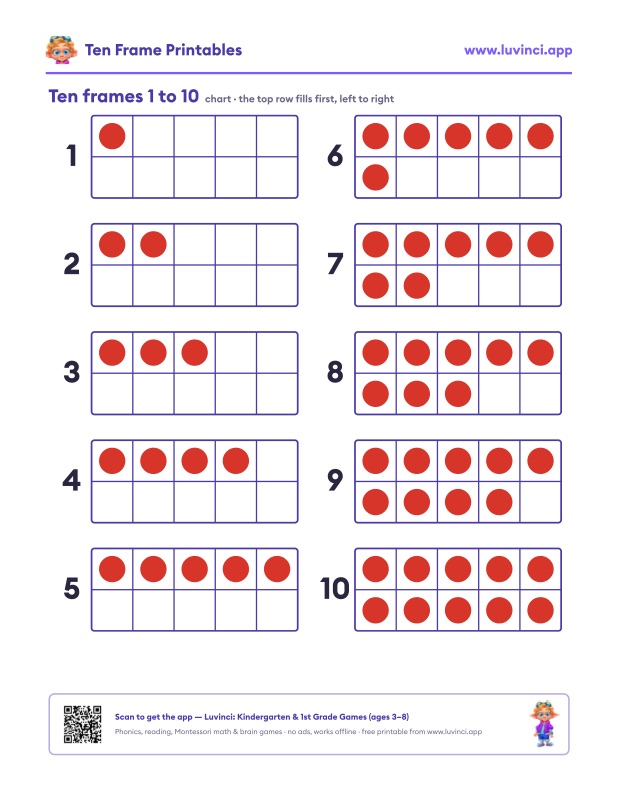
- Ten frame chart 1 to 10 (page 1). Every number from 1 to 10 on its own frame, 1 to 5 on the left and 6 to 10 on the right. No cutting. Keep it on the fridge or next to homework.
- Large blank ten frame (page 2). A work mat with big boxes (about 1.7 inches) for toy cars, blocks or big snacks, plus a “How many? ___” line to write the number.
- 4 small blank ten frames and 40 cut-out counters (page 3). One frame per number, or cut them apart so each child gets one. The 20 red and 20 yellow counters match the two-color counters kids use at school, for when you don’t have any at home.
- Double ten frame, 0 to 20 (page 4). Two double frames on one page, one for each player in a race to 20.
- Ten frame cards 0 to 10 (pages 5 and 6). Each card is a dot card: the dots fill the top row first, and the number sits on a tab you can cut off. Page 6 ends with a blank “make your own” card.
- Adding on a ten frame (page 7). Four sums within 10, each on one frame: red for the first number, yellow for the number you add. Plus two take-away rows. The first of each is worked, and the answers are at the bottom.
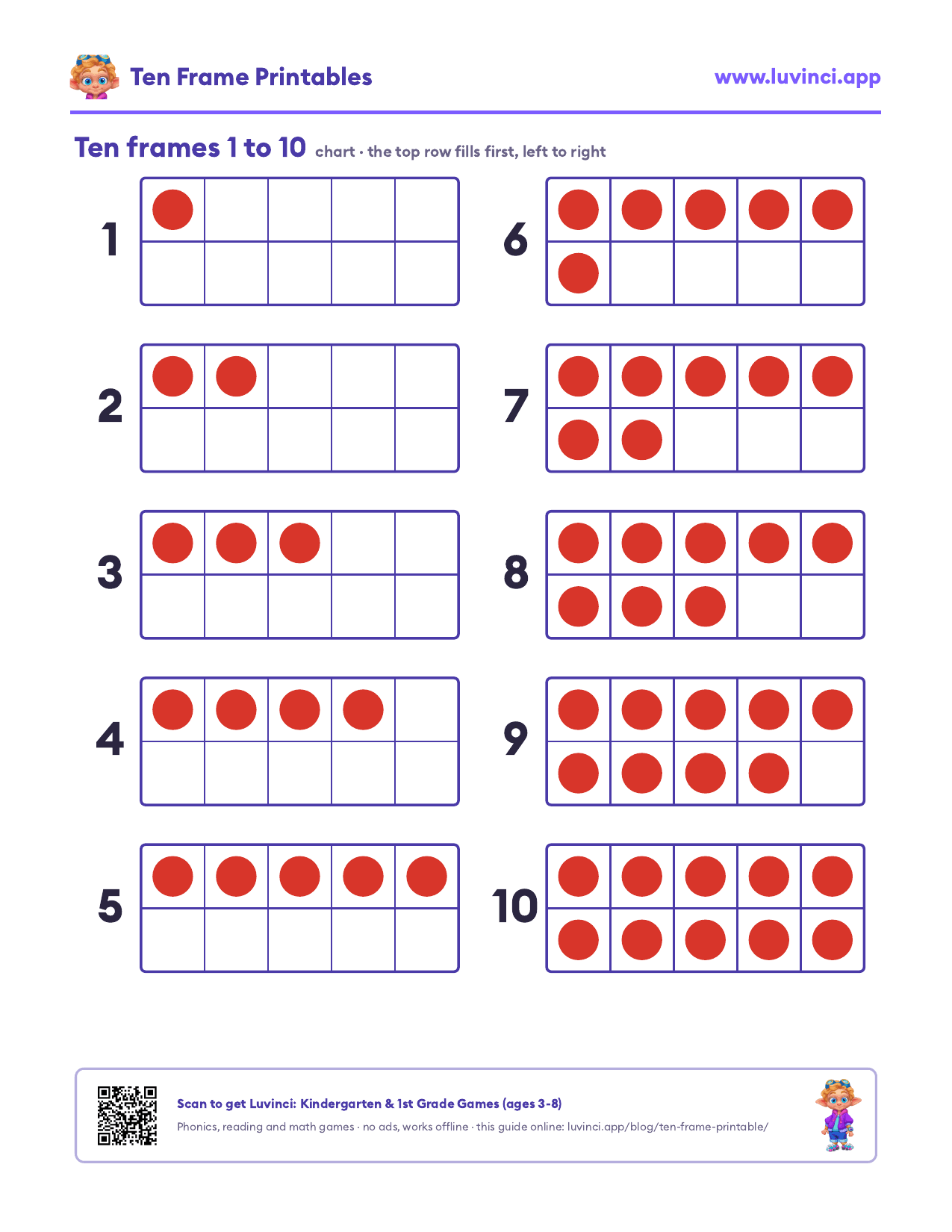
Page 1 of the free PDF: a ten frame chart for 1 to 10.
A few tips for printing:
- Print on cardstock if you have it. It lasts longer.
- Slide a page into a sheet protector and use a dry-erase marker. Draw, wipe, go again.
- Black and white is fine. Red and yellow still look different in gray.
What is a ten frame?
A ten frame is a rectangle with 2 rows of 5 boxes. One counter or dot goes in each box, so the frame can show any number from 0 to 10. Ten splits into two rows of 5, which is why kids start to see 7 as “5 and 2 more” and “3 away from 10”. Counting one by one isn’t needed.
The frame ties every number to 5 and 10. Most kids find 6 to 9 easier to recognize at a glance. 9 is a full frame with one box empty.
The five frame is what many kids meet first. It’s a single row of 5 boxes, usually in pre-K and early kindergarten. Put two five frames together and you have a ten frame.
Ten frames have been in classrooms for many years, and US programs like Illustrative Mathematics and Eureka Math treat them as a staple. You may also see “10 frame”, “10-frame” or “tens frame”. Those names are the same tool.
How do you fill a ten frame?
Most US programs fill the top row first, left to right, then the bottom row. That keeps 5 easy to see. 7 is a full row and 2 more. Some programs fill in pairs instead, to show doubles. Whichever you choose, stay with it so the pictures stay familiar. Top row first is how every card and example in our PDF is drawn. The chart on page 1 shows all ten numbers that way.
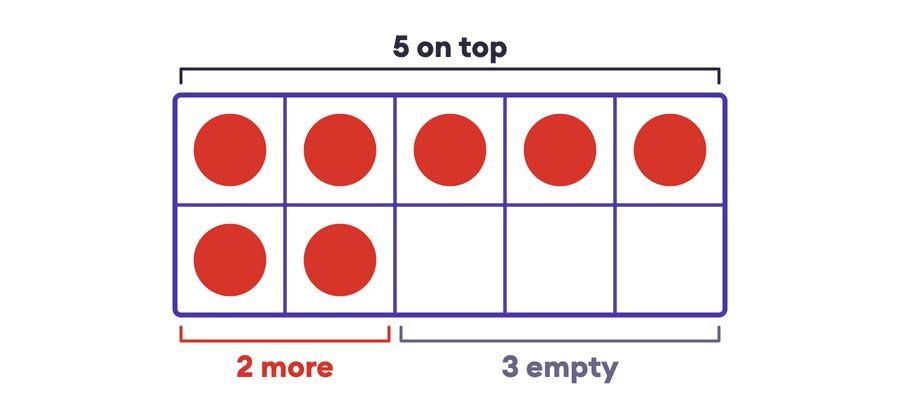
7 on a ten frame: 5 on top, 2 more, 3 empty.
How to use a ten frame at home
- Start with the large mat and 3 to 5 big objects. Put one object in each box and count together. Counting 10 objects is something kids are expected to do when they start kindergarten.
- Fill the top row first, then the bottom. Show it once. After a few tries, your child won’t need reminding.
- Say the number two ways. “7. That’s 5 and 2 more.”
- Ask “How many empty boxes?” That’s how many more make 10. Each answer is a pair that makes 10, like 7 and 3. Quick answers mean your child is learning those pairs. Our ways to make 10 guide turns that into a game.
- When the mat is easy, move on. Use the small frames and the dot cards, and try the games below.
Counters that work well:
- The paper counters on page 3 of the PDF
- Toy cars or small blocks (great on the large mat)
- Big pasta shapes, like shells or wheels
- Pennies
A safety note: small counters like dried beans, coins, buttons and cereal are choking hazards, so a grown-up stays close. If a toddler is around, stick to the paper counters or draw the dots with a crayon.
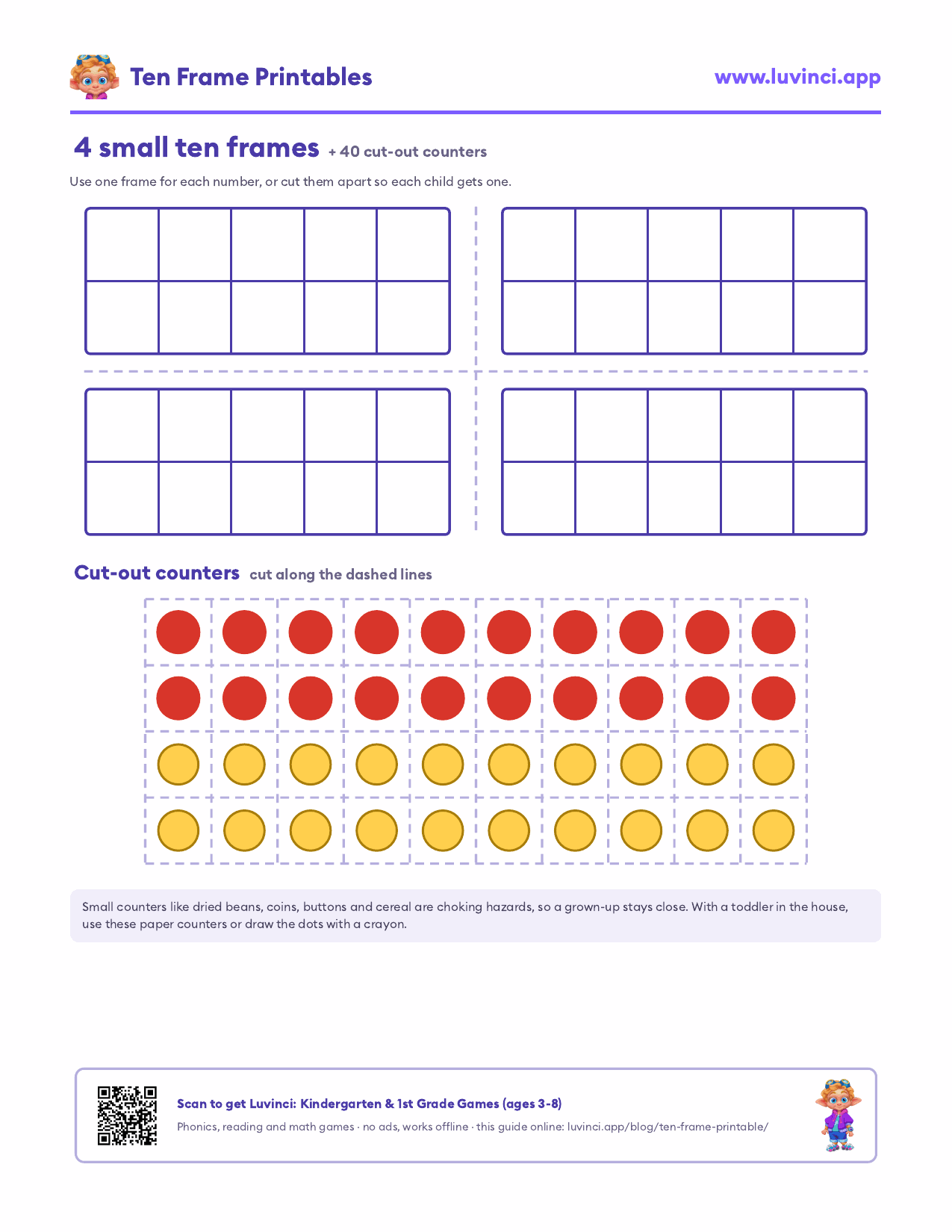
Page 3: 4 small blank ten frames and 40 cut-out counters.
Bigger numbers can wait. Before kindergarten, counting real things matters more than counting high. Ten objects counted beats one hundred recited.
Ten frame math: adding and taking away
Adding belongs in kindergarten, so there’s no rush before then. Once counting to 10 feels easy, the frame lets your child see a small sum.
To add, use one frame and two colors. For 3 + 2, put 3 red counters in the first boxes, then 2 yellow counters right after them. Count them all. That’s 5. Write 3 + 2 = 5. Most classrooms do it this way, with red and yellow two-color counters. The empty boxes show one more thing. 5 more would make 10.
Doubles like 4 + 4 are good practice too. 4 red, 4 yellow, 2 boxes left. See our doubles facts guide.
Ten frame subtraction: take away
Start with the whole number on one frame and take away from the end. For 7 take away 2, fill 7, then remove the last 2 counters (or cross out the last 2 dots on paper). Those are the 2 on the bottom row. Count what’s left. That’s 5.
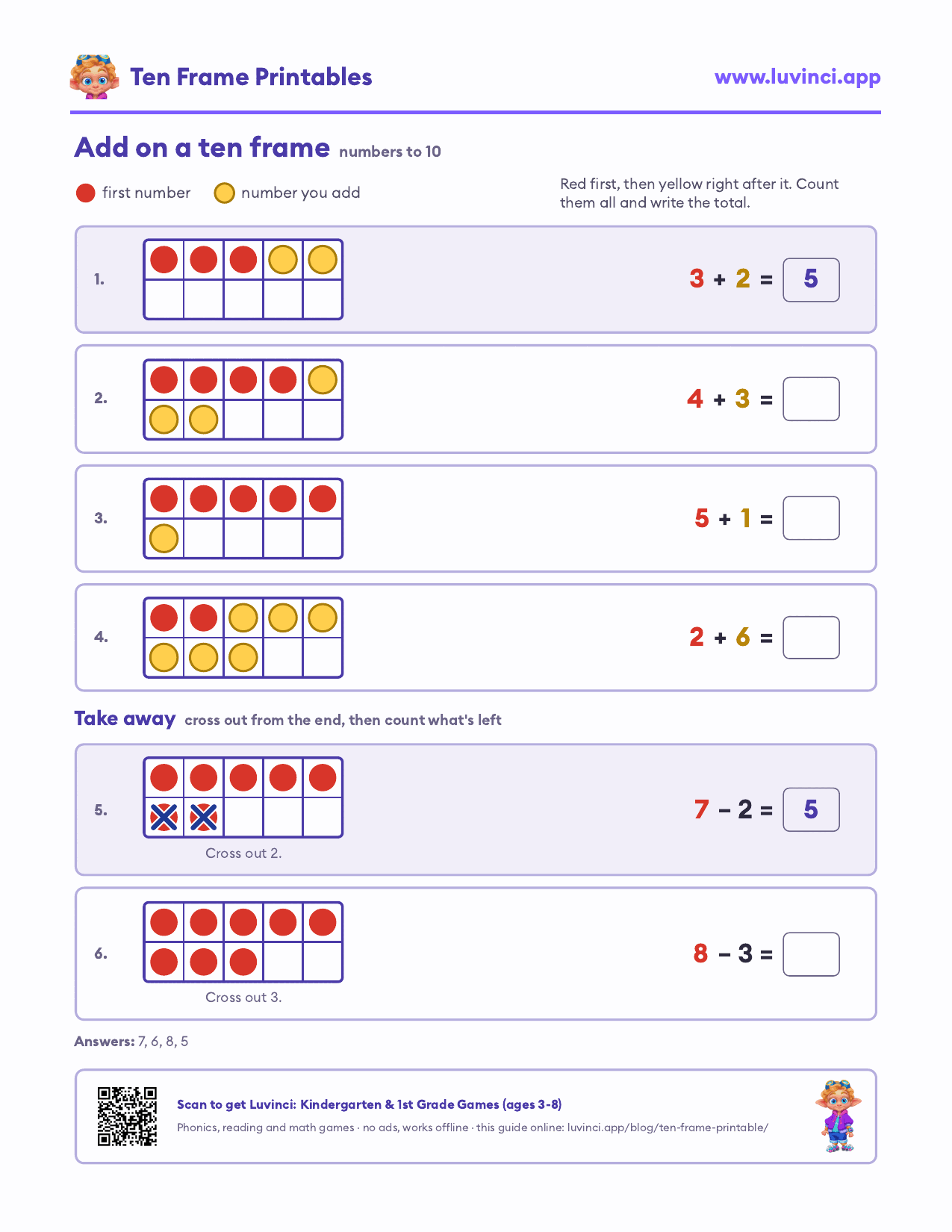
Page 7: add on one ten frame in two colors, then take away by crossing out.
Adding and taking away within 10 is kindergarten work in Common Core (K.OA.2), and the ten frame is one common way to practice it.
Double ten frame: numbers to 20
A double ten frame (also called a twenty frame) is two ten frames side by side. That’s 20 boxes. Fill the left frame first, then start on the right.
A full left frame means your child already has a ten. So 14 is a full ten and 4 more. That’s also how 14 is written, with the 1 first for the full ten.
Teen numbers start in kindergarten (K.NBT.1) and keep going in 1st grade. The double ten frame usually shows up in late kindergarten and 1st grade. In 1st grade, kids also use two frames to add past 10 by making a ten first. Our ways to make 10 guide has a page for it.
Page 4 has two double frames, one per player, each with a “10 and ___ make ___” line. At 14, your child writes “10 and 4 make 14.”
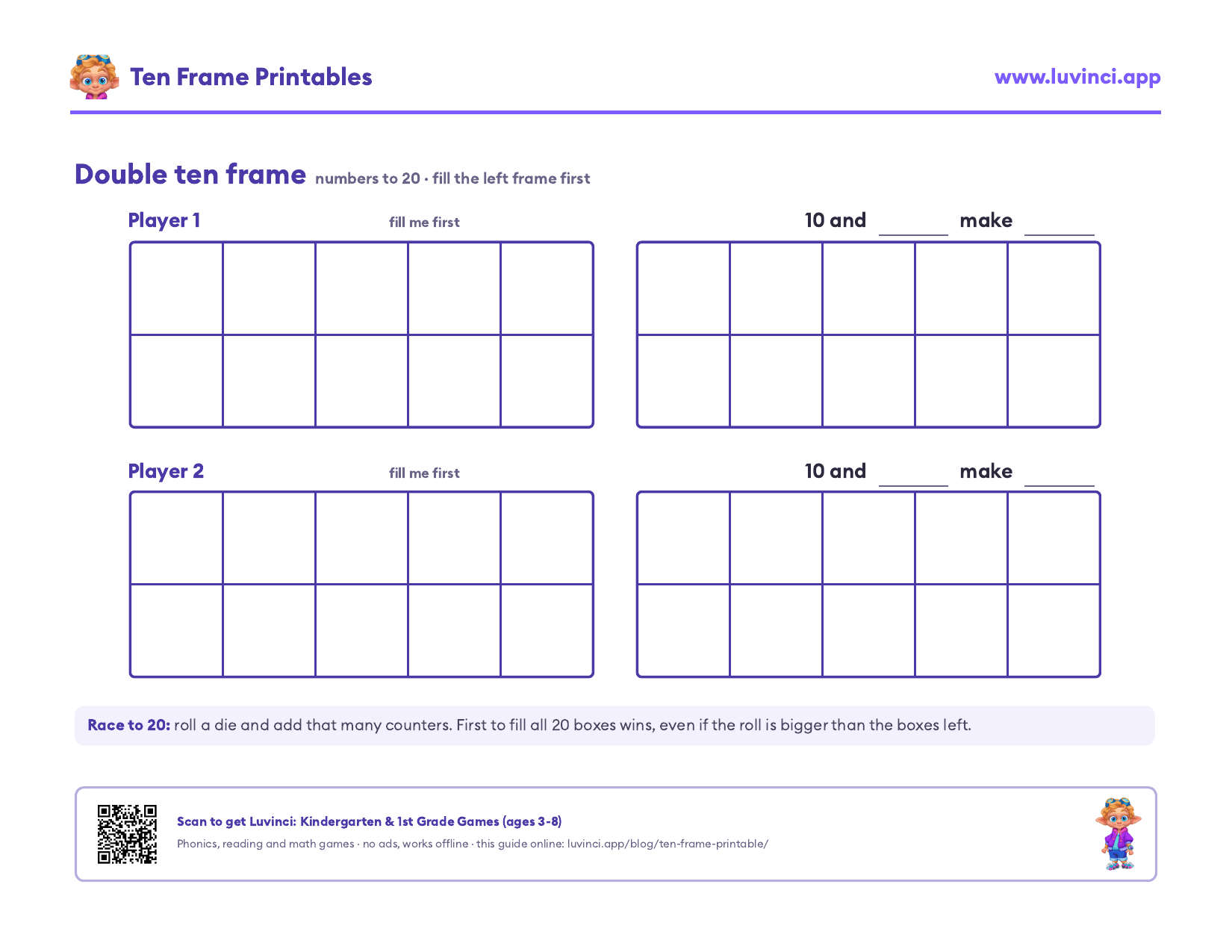
Page 4: two double ten frames, one for each player in Race to 20.
Ten frame games
A few minutes is all each of these ten frame activities takes. One or two a day is plenty.
- Flash it. Show a dot card for about 2 seconds, then hide it. Ask, “How many?” For a harder round, your child copies the card on a blank frame from memory.
- Picture it. Build 7 on a frame. Ask how many are on top, how many on the bottom and how many boxes are empty. Then ask the same questions with eyes closed.
- Shake and spill. Put 10 pennies in a cup, shake and spill. Put them on the frame, heads first, then tails. Say the split out loud: “6 heads and 4 tails make 10.” Pennies are a choking hazard, so a grown-up plays too.
- Race to 20. Each player gets a double ten frame from page 4 and one color of the page 3 counters (20 red or 20 yellow). Take turns rolling a die and adding that many counters. First to fill all 20 boxes wins, even if the roll is bigger than the boxes left.
- War. Take out the blank card, then deal the dot cards face down between two players. Each player flips a card, and the bigger number wins both.
- Match it. Cut the number tabs off the cards. Turn the dots and the numbers face down, then take turns finding a dot card and its number.
The card pages also print Flash it, Match it and War. For a 2-player deck and War in four levels, see math card games for kindergarten.
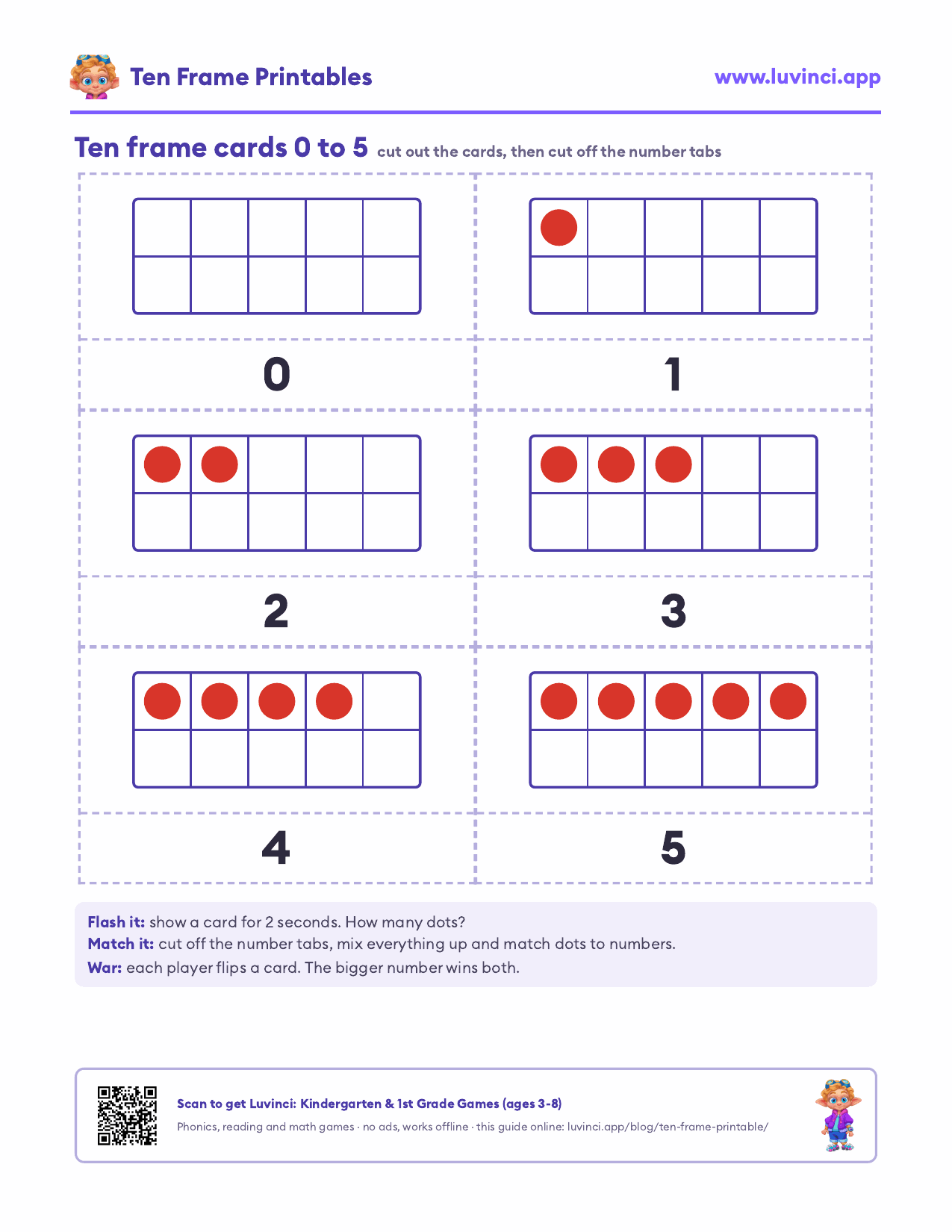
Page 5: ten frame cards 0 to 5 (page 6 has 6 to 10).
Ten frames in the Luvinci app
On Luvinci’s Singapore Math boards, each sum sits on two ten frames of pictures, and take-away is one ten frame with the taken-away items crossed out. One board has sums that make 8 and 10, like 6 + 4 and 5 + 3. Your child looks at the two frames and picks the answer from three numbers.
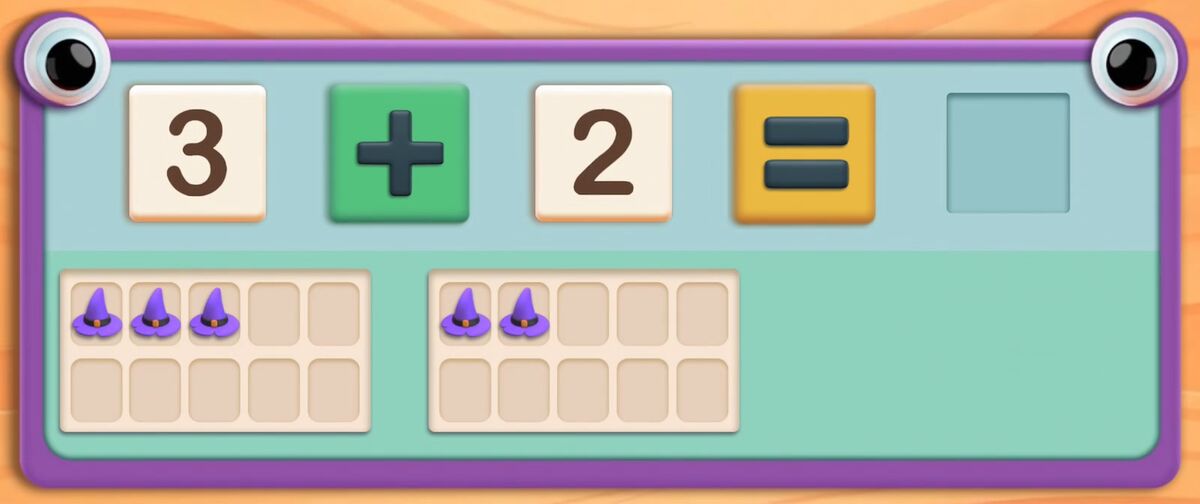
Luvinci’s Singapore Math boards show each sum on two ten frames of pictures.
The Singapore Math boards are in the full app. The first counting board (Counting 1) is free. Your child matches strawberry cards to the numbers 1 to 10 while a voice counts along. See how Luvinci’s math games work.
Questions parents ask
Where can I find free ten frame templates? Right here. One 7-page PDF, US Letter, with no signup or email.
How can I make a ten frame at home? Draw a rectangle and split it into 2 rows of 5 boxes. Or cut 2 cups off an egg carton to leave 10. Toys or paper dots work as counters.
How can I explain ten frames to a kindergartener? Keep it short: “Ten boxes, one counter in each. Fill the top row first.” Then count together and name the number both ways: “8. That’s 5 and 3 more.”
What is the point of a ten frame? It helps kids see numbers in 5s and 10s instead of counting one by one. The empty boxes also show how many more make 10.
What age is a ten frame used for? Usually ages 4 to 7. Kids often start with a five frame in pre-K (about age 4). The ten frame comes in kindergarten (ages 5 to 6). The double ten frame shows up in late kindergarten and 1st grade (ages 6 to 7). Follow your child, not the calendar.
Are ten frames effective? Teachers use them widely because they show 5 and 10 so clearly. Keep plenty of real counting in the mix too.
Are ten frames part of Common Core? The standards never name ten frames. But they’re one common way to practice kindergarten counting, breaking numbers up to 10 into pairs and finding the number that makes 10. They also help with teen numbers, and with adding and subtracting within 20 in 1st grade. (Common Core K.CC.4-5, K.OA.3-4, K.NBT.1, 1.OA.6.)
Next: Ways to make 10: friends of ten
Illustrative Mathematics and Eureka Math are named for reference only. This guide and PDF are our own work and are not affiliated with or endorsed by either.
More free math worksheets: ten frames, number charts, addition and subtraction, daily practice workbooks and more, all in one place. See the math printables →
