Luvinci
July 15, 2026
Fine Motor Skills for Kindergarten: 24 Playful Activities (Free Bingo PDF)
Free printable · PDF · 661 KB
Fine Motor Skills for Kindergarten: 24 Playful Activities (Free Bingo PDF)
No signup needed. Just print it.
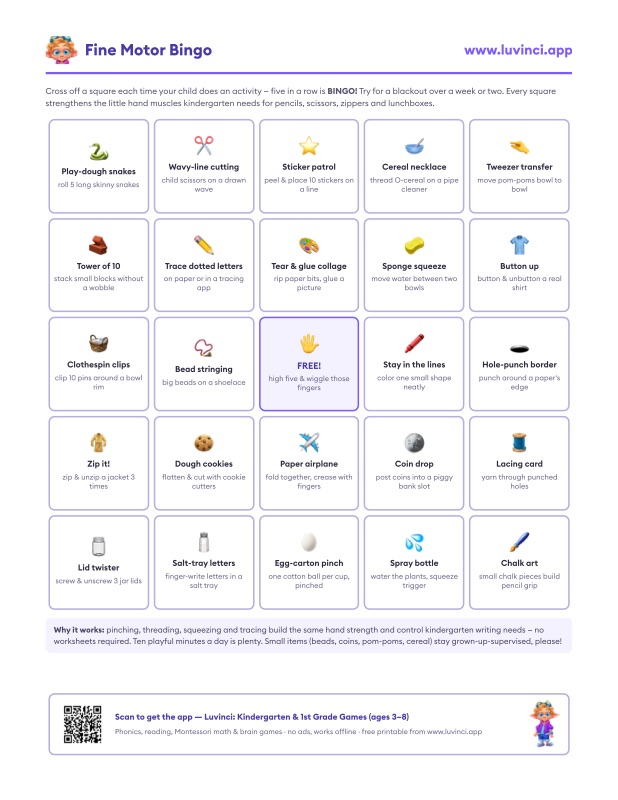
Download PDFFine motor skills for kindergarten are built through play, not worksheets — the pinching, threading, squeezing and tracing that strengthen the small hand muscles behind pencil grip, scissors, zippers and lunchbox latches. To make that play automatic, we turned 24 of the best activities into a game: download the free Fine Motor Bingo PDF, stick it on the fridge, and cross off a square each time your child does one. Five in a row is bingo; a blackout over a week or two means those little hands are genuinely kindergarten-ready.
No email address required, no signup. Print it and start with whichever square makes your child laugh.
Why teachers watch little hands so closely
A kindergarten day is quietly a fine-motor obstacle course: crayons and pencils in the morning, scissors and glue sticks after that, then zippers at recess, buttons after the bathroom, and a lunchbox that must be opened without help while everyone else is already eating.
There’s more at stake than convenience. In a well-known 2010 study, researchers following thousands of children found that fine motor control at school entry predicted reading and math achievement years later (Grissmer and colleagues, Developmental Psychology). Hands that manage a pencil without effort free the brain to think about letters and numbers instead of gripping.
That’s why fine motor sits alongside literacy, math and social readiness as one of the four domains on our kindergarten readiness checklist. And a reassurance before the activities: teachers expect a wobbly range in September. The goal is a workable grip and mostly-on-the-line scissors — not perfection.
How to build fine motor skills for kindergarten: the 24 activities
Every square on the bingo card earns its place by building one of four things:
- Hand and finger strength — play-dough snakes and cookie-cutter cookies, sponge squeezes between two bowls, spray-bottle plant watering, and the egg-carton pinch (one cotton ball per cup, pinched, never grabbed).
- Finger precision — tweezer pom-pom transfers, threading O-cereal onto a pipe cleaner, big beads on a shoelace, sticker patrol, posting coins into a piggy bank, clothespins clipped around a bowl rim, lacing cards, and a hole-punch border.
- Pencil-adjacent control — tracing dotted letters, coloring one small shape neatly, chalk art (small pieces force a proper grip), finger-writing letters in a salt tray, tear-and-glue collages, and folding a paper airplane with sharp creases.
- Real-life independence — buttoning a real shirt, zipping a jacket three times, twisting jar lids, and stacking a tower of ten small blocks without a wobble.
Ten playful minutes a day is plenty — little and often beats a long Saturday session, because small hand muscles tire fast and recover overnight. One supervision note: beads, coins, pom-poms and cereal stay grown-up-supervised, please.
The tracing bridge: from bingo squares to a written name
Somewhere around the blackout stage, you’ll notice the pencil-adjacent squares getting easier — darker crayon lines, steadier waves under the scissors. That’s the moment to aim the new strength at the most motivating word your child will ever meet: their own name.
Start big and forgiving: finger-trace letters in the salt tray, then dotted abc tracing sheets, then a name written in highlighter for your child to trace over. Wobbly counts. Our step-by-step name-writing guide comes with a free practice sheet built around exactly that highlighter method, and our summer prep plan folds it all into the weeks before school.
Where apps fit (and where they honestly don’t)
Tapping a screen does not build hand strength — the bingo card is deliberately screen-free, and no app replaces play-dough. What a good app can do is carry the other readiness lanes while the hands rest: letter-sound games build the letter knowledge that tracing turns into writing, and a coloring studio keeps the creative habit alive on car rides where crayons roll away.
“Our 4 yr old had a great time with this app! She loved the stories and coloring.” — Sagelytiff, App Store review (US)
That’s the honest division of labor: real-world objects for the muscles, well-chosen screen time (ad-free and offline, built for ages 3–8) for letters, numbers and puzzles.
Fine motor skills FAQ
What fine motor skills does a child actually need for kindergarten? A workable (not textbook) pencil grip, cutting roughly along a line with child scissors, managing zippers and buttons, and opening their own lunchbox and snack containers. That last one is the skill teachers mention most.
How quickly can fine motor skills improve? With ten minutes of daily play, most parents notice steadier scissors and darker pencil lines within a few weeks. Skills at this age arrive in bursts — a square that’s hard this week is often easy next month.
When should a child hold a pencil correctly? Most children settle into a comfortable three-finger (tripod) grip somewhere between ages four and six. An awkward, still-immature grip at three is normal — build strength through play rather than drilling the “right” hold.
Do tracing apps count as fine motor practice? Only partly. Finger-tracing on glass builds letter recognition and shape memory, but paper tracing, salt trays and chalk do far more for the hand strength writing needs. Use apps for the letters, real materials for the muscles.
The takeaways
- Download the bingo card — 24 activities on one page, no signup
- Ten minutes a day — little and often beats marathon sessions
- Strength before neatness — play-dough and clothespins now, tidy handwriting later
- Real objects beat screens for hands — save the app for letters, numbers and rest-time coloring
- Wobbly is normal — teachers expect a range; aim for workable, not perfect
Teachers, therapists and homeschool groups: you’re welcome to print and share the bingo card freely — a link back to this page is appreciated.