 Luvinci
October 3, 2026
One to One Correspondence: Activities and Free Worksheets
Free printable · PDF · 779 KB
One to One Correspondence: Activities and Free Worksheets
No signup needed. Just print it.
Download PDFOne to one correspondence means your child says one number for each object they count, and touches each object only once. Real counting rests on this skill, and most kids build it between about age 3 and the start of kindergarten.
Our free Touch and Count Mats PDF has 5 pages for numbers 1 to 10. Page 1 is a touch and count chart you can keep out with no cutting. Then there’s a ten frame counting mat with cut-out strawberry counters, a “one for each” matching page, count and circle cards, and a count out just enough page with a parent quick check. No signup, no email.
Jump to: what it is · rote counting · activities · free worksheets · FAQ
What is one to one correspondence?
In math, one to one correspondence means pairing each object with exactly one number word as you count. Touch the first grape, say “one”. Touch the next, say “two”. Nothing is skipped or counted twice. Pair that with saying the numbers in the same order every time. The last step is cardinality: knowing that the last number you say tells how many there are.
So when a child counts 5 toy cars, three things have to happen at once:
- Stable order. The number words come out in the same order every time: 1, 2, 3, 4, 5.
- One to one. Each car gets exactly one number. One touch, one word.
- Cardinality. When asked “How many?”, they answer “5” without counting again.
Researchers Rochel Gelman and Randy Gallistel called these the one-one, stable-order and cardinal principles (1978). The names don’t matter at home. Watch for all three.
Kids use one to one correspondence outside counting too. One plate for each person, one sock for each foot, one cookie for each friend. The idea is the same every time.
Why it matters more than counting to 100
Plenty of preschoolers can recite 1 to 20, or even to 100. Reciting is a bit like singing the alphabet song. It shows memory, not understanding.
The rest of early math is built on counting real things. To add 3 + 2, a child counts 3 things, then 2 more, then all of them. To see that 7 is more than 5, they need to know each number stands for a real amount. Without one to one correspondence, the numbers are just words.
That’s why kindergarten teachers care more about counting 10 objects correctly than counting high. Our kindergarten readiness checklist and our guide to what a child should know before kindergarten set the same starting goal: count to 10, touching one object per number. Counting to 100 is not expected on day one.
In the US Common Core standards, one to one correspondence is part of kindergarten counting (K.CC.4). By the end of the year, kindergartners count up to 20 things in a line, and up to 10 things scattered around, to answer “How many?” (K.CC.5). They also learn to count out a number: “Give me 6.” Counting to 100 (K.CC.1) comes too, but separately.
Rote counting vs one-to-one counting
Rote counting is saying the numbers in order from memory: “1, 2, 3, 4, 5…” No objects needed. This is the first step, and it matters, because you can’t count things without the number words.
One-to-one counting is using those words to count real objects, one word per object. Some teachers call it rational counting, the opposite of rote counting.
The difference shows up the moment you put some toys on the table. A child who can only rote count often does one of these:
- Counts faster than they touch. The words run ahead of the finger, so 5 toys become “8”.
- Skips one or counts one twice. Most common when the toys are scattered.
- Keeps going. They run out of toys but keep saying numbers.
- Counts again when you ask “How many?” They counted, but didn’t know the last number was the answer.
All of these are normal. They show your child is still joining the words to the objects.
A 2-minute quick check. Grab 10 small toys and try these, in order:
- Ask your child to count to 10 out loud. (Rote counting.)
- Put 5 toys in a line. “Can you count these?” Watch the finger and the words.
- Put 10 toys in a line and count again.
- Scatter 7 toys on the table. Scattered sets are harder, because there’s no line to follow.
- After any count, ask “So how many are there?” A quick answer with the last number, no recount, shows cardinality.
- Put a pile of toys down and say “Give me 6.” Counting out, and stopping at the right number, is the hardest step.
Page 5 of the free PDF has this checklist as a strip with three tries, so you can see progress over a few weeks.
One to one correspondence activities
These one to one correspondence activities use things you already have at home. Each takes a few minutes. Start with 3 to 5 objects and go up to 10 when that feels easy.
- Egg carton count. Cut the end off a 12-egg carton (one cup from each row) to leave 10 cups in two rows of 5, just like a ten frame. Your child puts one pom-pom, bead or small toy in each cup and counts as they go.
- Ice cube tray. Same idea as the egg carton. Cover the extra spots with tape so 10 are left (two rows of 5). One object in each spot. Ask “How many spots are full?” and “How many are empty?”
- Set the table. One plate for each person, then one fork for each plate. Setting the table is one-to-one correspondence in disguise, and it’s real help too.
- Snack count. Count out 6 crackers or apple slices. Move each one from the plate to a bowl as you say its number, so none gets counted twice.
- Stair count. One step, one number, going up and coming down. Big body movements make the one-to-one match easy to feel.
- Toy car parking lot. Draw 8 parking spaces on paper. Your child parks one car in each space and counts the cars. If there are more cars than spaces, some have to wait. Which is more?
- Clothespins on a plate. Write a number on a paper plate and clip that many clothespins around the rim. Counting and a hand workout in one.
- Drop and count. Drop pom-poms or pennies into a jar, one at a time. Say one number for each drop. The clink helps kids who count faster than they move.
- Feed the monster. Cut a mouth in a small box. “The monster is hungry for 5.” Your child feeds 5 pom-poms, one at a time, and then stops. That’s counting out.
- Hop and count. Tape a line on the floor. Your child hops and you count one number per hop. Then swap: they count your hops.
A safety note: pom-poms, beads, pennies, cereal and raw apple pieces are choking hazards for young children, so a grown-up stays close. With a toddler in the house, use bigger toys like blocks, and keep the paper counters and small pieces out of reach after play.
When a count goes wrong, keep it light. Line the objects up first, since a line is easier than a pile. Move each object as you count it, so the “done” pile can’t be counted again. Slow the words down to match the finger. And if your child recounts when you ask “How many?”, say “The last number tells us. 5!” and move on.
To make these harder for a kindergartner, scatter the objects instead of lining them up, or ask “Give me 8” from a bigger pile.
Free one to one correspondence worksheets: touch and count mats 1 to 10
The free Touch and Count Mats PDF is 5 pages, US Letter, and stops at 10. This is what each page holds:
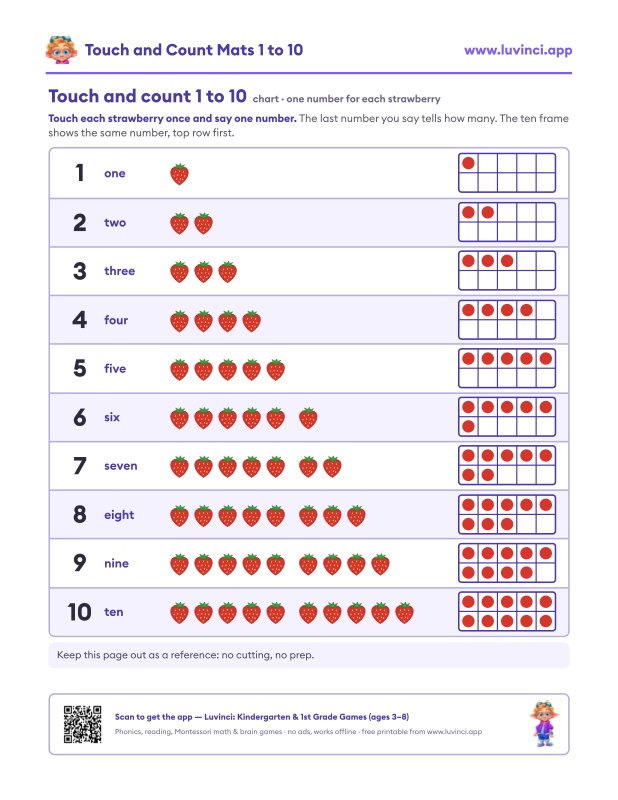
- Touch and count chart 1 to 10 (page 1). Each number with its word, a row of strawberries to touch and a ten frame with the same number of red counters. No cutting, no prep: keep it on the fridge.
- Ten frame counting mat (page 2). A big ten frame, 20 cut-out strawberry counters and cut-out number cards 1 to 10. Pick a card, put that many strawberries on the frame (top row first), touch each one as you count, then check the card.
- One for each (page 3). Draw a line from each bowl to a spoon and each cup to a straw. Is there one for every one? (Not always!) Then draw one candle on each cupcake and color one box for each strawberry.
- Count and circle (page 4). Ten cards with 1 to 10 scattered strawberries, mixed up. Touch each one, then circle how many. Answers are at the bottom.
- Count out just enough (page 5). “Color 3”, “Color 8”: your child has to stop at the number. Below it is the quick-check strip from this post.
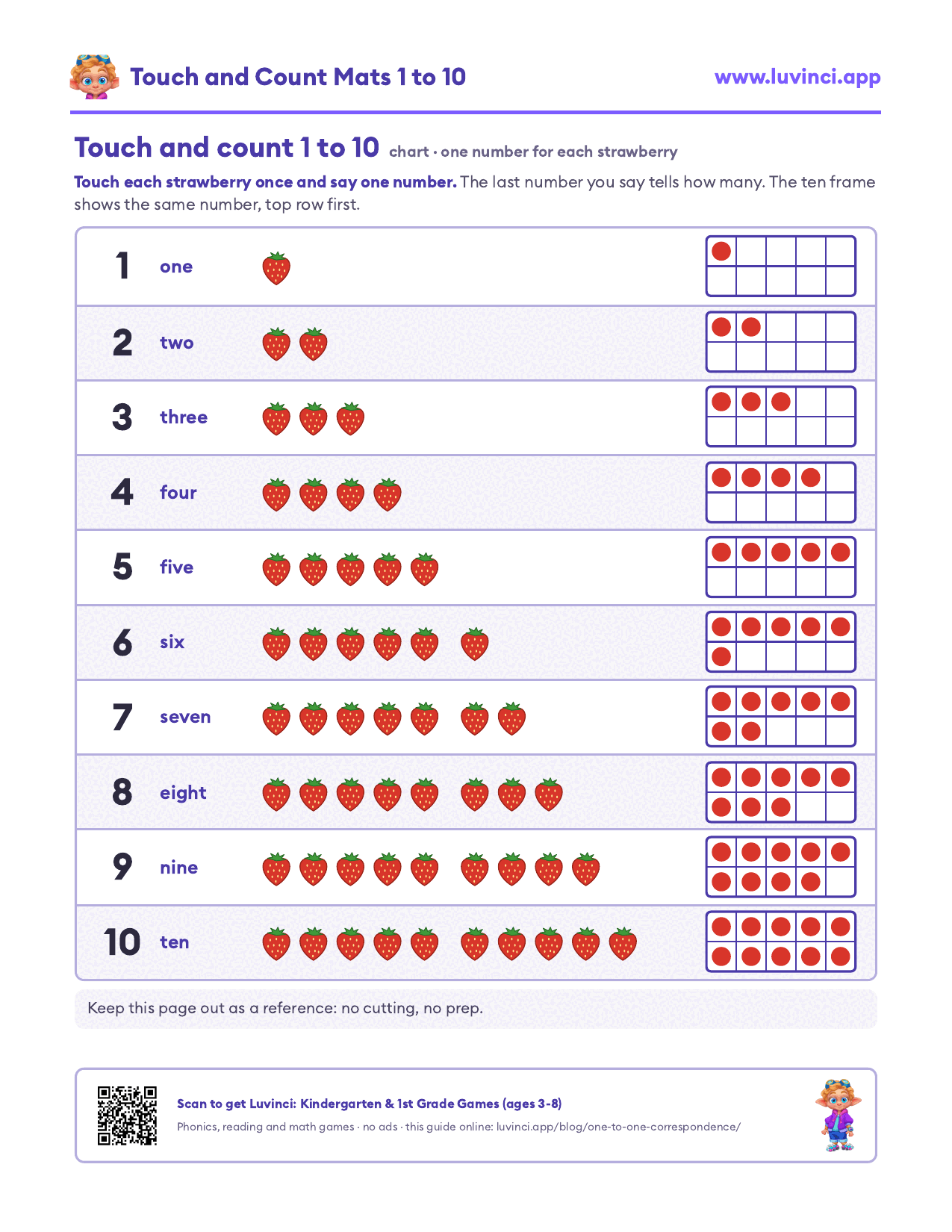
Page 1 of the free PDF: touch and count 1 to 10, no cutting.
Why a ten frame? Your child will meet this tool in kindergarten math: ten boxes, two rows of five. It makes one to one correspondence visible, because every box holds one strawberry. For more frames and dot cards, see our ten frame printable.
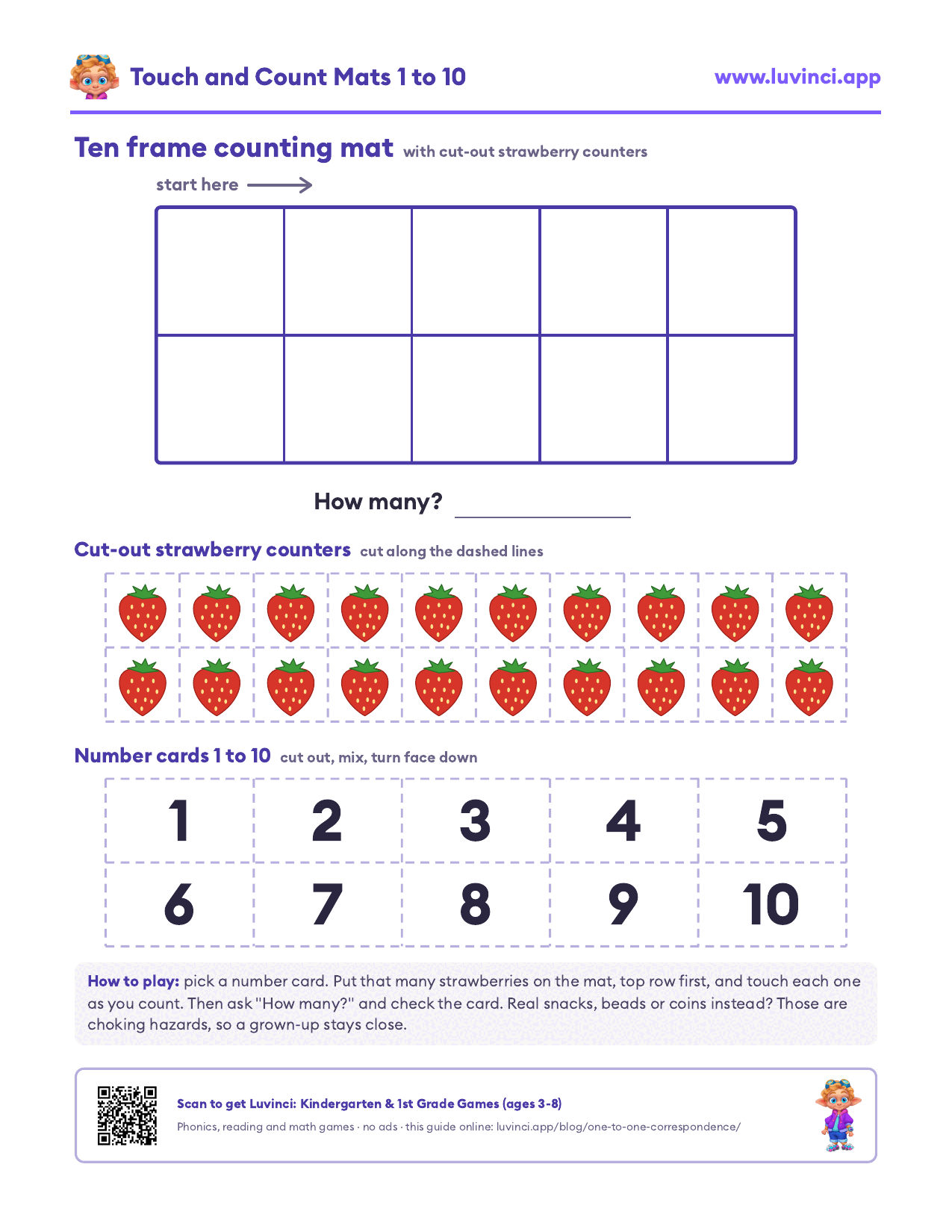
Page 2: the counting mat, cut-out strawberry counters and number cards.
Printing tips: cardstock makes the counters last. A sheet protector and a dry-erase marker let you reuse pages 3 to 5. Black and white is fine.
On the count and circle page, the strawberries are scattered on purpose. One to one correspondence really gets tested here, because there’s no line to follow. Show your child how to make a small pencil dot on each strawberry as they count it.
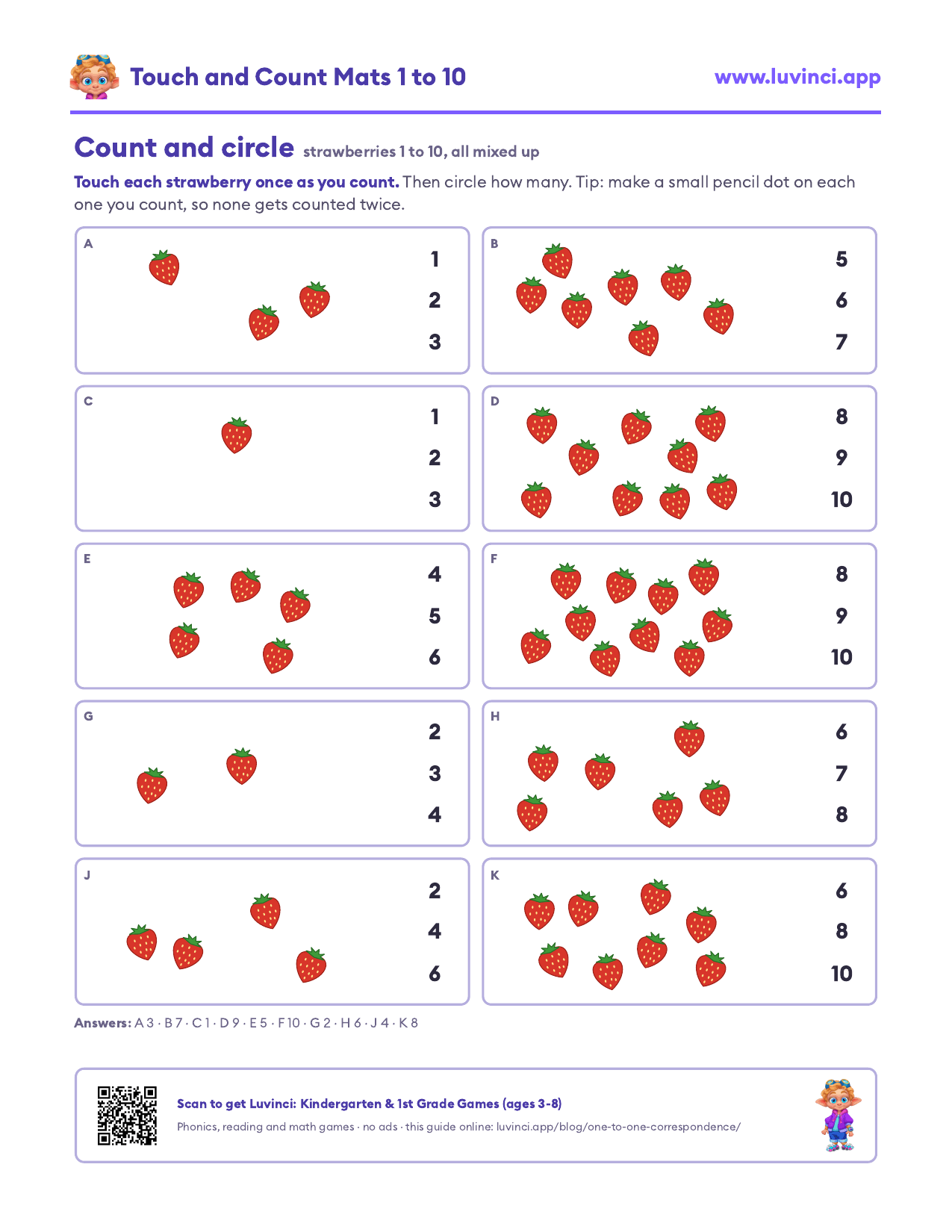
Page 4: count and circle, 1 to 10 in a mixed-up order.
Next step: matching groups to numerals
When your child counts objects reliably, the next job is linking a group to its written number. They see 7 strawberries and find the 7. They see the 7 and count out 7 things. That’s where page 2’s number cards come in.
Once your child can touch-count, the free counting board in the Luvinci app (Counting 1, in the Early Math row) asks them to match a group to its numeral while a voice counts along. They drag a card of 1 to 10 strawberries onto its matching number. That board is numeral matching, not a touch-each-one counting game, so keep the hands-on counting going on paper and with real objects. The ten-frame, addition and subtraction boards are in the full app. See how Luvinci’s math games work.
Once matching groups to numerals is easy, number bonds show how each number up to 10 splits into two parts.
FAQ
What are examples of one-to-one correspondence?
Counting 5 blocks by touching each one once and saying one number. Giving each person one plate. Putting one sock on each foot. Placing one counter in each box of a ten frame. Matching each cup to one straw. In each case, every object is paired with exactly one number or one partner.
What is the difference between rote counting and one-to-one correspondence?
Rote counting is saying the numbers in order from memory, like a song. One-to-one correspondence is pairing each number word with one object when you count real things. A child can rote count to 20 and still not count 6 toys correctly. Both are needed, and rote counting usually comes first.
What age do children learn one-to-one correspondence?
Many children start touch-counting small sets of 2 to 5 things around age 3 or 4. Counting 10 objects reliably is a common goal at the start of kindergarten, around age 5. Scattered sets and counting out (“Give me 8”) keep improving through kindergarten. Children vary a lot, so follow your child rather than the calendar.
What is another way of saying one-to-one correspondence?
You may hear one-to-one counting, 1:1 correspondence, 1-to-1 matching or simply “one number for each object”. In higher math the same idea shows up as a one-to-one match between two sets, which mathematicians call a bijection. For young children it just means one touch, one number.
What is an IEP goal for one-to-one correspondence?
Goals are written by your child’s team, but a typical one reads like this: “Given a set of up to 10 objects, the student will count them, touching each object once and stating the total, in 4 out of 5 trials.” A next goal might add scattered objects, or counting out a number from a larger set. The count and circle page and the quick-check strip in our PDF work well for this kind of practice.
The takeaways
- One to one correspondence means one number word for each object, each object counted once.
- Counting has three parts: the numbers in order, one-to-one, and cardinality (the last number tells how many).
- Rote counting comes first, but counting real things is what kindergarten math needs.
- Use everyday things: egg cartons, ice cube trays, the dinner table, snacks, stairs.
- Line up, move, touch: those fix most counting mistakes. Then work up to scattered sets and “Give me 6”.
- Print the free Touch and Count Mats PDF: a touch and count chart, a ten frame mat with cut-out strawberry counters, matching, count and circle, and count out just enough with a parent quick check.
More free math worksheets: ten frames, number charts, addition and subtraction, daily practice workbooks and more, all in one place. See the math printables →
