 Luvinci
September 22, 2026
Number Bonds for Kindergarten: Every Pair to 10 (Free PDF)
Free printable · PDF · 1155 KB
Number Bonds for Kindergarten: Every Pair to 10 (Free PDF)
No signup needed. Just print it.
Download PDFNumber bonds for kindergarten show how one number splits into two parts. 7 is 5 and 2, and it’s also 3 and 4. This page lists every number bond from 5 to 10, including the number bonds to 10, with a picture for each pair, so your child can see the split instead of memorizing it. 1st graders use the same pairs for every addition and subtraction fact within 10.
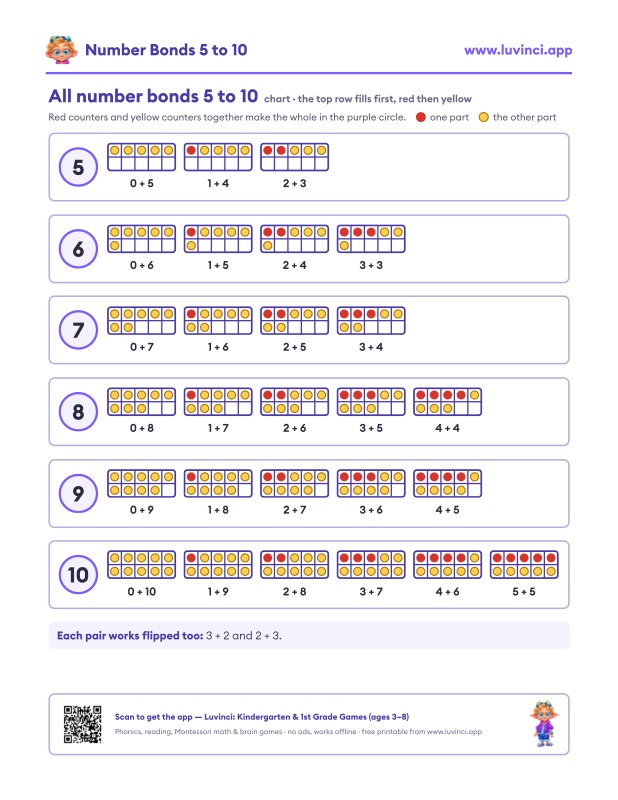
Our free Number Bonds 5 to 10 printable opens with an at-a-glance chart of every bond, then has one page per number, from 5 to 10. Every pair is drawn as a bond with a ten frame beside it, and each number page has cut-out answer tiles. Page 8 is a blank number bond template. No signup, no email.
Bonds of 10: 1 and 9, 2 and 8, 3 and 7, 4 and 6, 5 and 5 (and the same pairs flipped, plus 0 and 10).
What are number bonds?
A number bond is a picture of a number and the two parts that make it. The whole goes in the top circle and the parts go in the two circles below it, joined by lines. 3 and 5 make 8, so 8 sits on top with 3 and 5 underneath. Add by putting the parts together. Subtract by taking one part away from the whole.
You may also hear the pairs called “number partners” or, for 10, “friends of ten”. The bond works in every direction, which is why schools use it:
- 3 and 5 make 8 (3 + 5 = 8)
- 5 and 3 make 8 (5 + 3 = 8)
- 8 take away 3 is 5 (8 - 3 = 5)
- 8 take away 5 is 3 (8 - 5 = 3)
One picture holds up to two addition facts and two subtraction facts (a double like 4 and 4 gives one of each). Once your child knows the bond, those facts aren’t separate things to learn.
Number bonds for kindergarten and first grade
In kindergarten, number bonds are about breaking numbers apart. The US Common Core standards ask kindergartners to split numbers up to 10 into pairs in more than one way, using objects or drawings, and to find the number that goes with any number from 1 to 9 to make 10. By the end of the year they’ll add and subtract within 5 quickly and easily.
So the kindergarten goal isn’t a worksheet of sums. It’s a child who can hold up 5 fingers, fold some down, and tell you “3 and 2”. Stay with real objects until they can do it with their hands. Then bring in the bond diagram.
In 1st grade, number bonds become a tool for addition and subtraction. The bonds within 10 turn into facts your child recalls quickly, and each bond gives a subtraction fact for free. If 6 and 4 make 10, then 10 - 4 is 6.
Here’s a simple order that works at home:
- Bonds to 5, with objects and fingers
- Bonds of 6 and 7, with a ten frame
- Bonds of 8 and 9
- Bonds to 10, until they’re quick
- Missing parts: “I have 10, and 6 are here. How many are hiding?”
Once the bonds of 5 are by heart, 10 gets much easier.
Bonds to 5
Five is the best place to start, because it’s one hand. Every number bond to 5 fits on your fingers:
- 0 and 5, 1 and 4, 2 and 3, 3 and 2, 4 and 1, 5 and 0
That’s 6 pairs (or 3 if you count 2 and 3 the same as 3 and 2). Hold up one hand and fold down 2 fingers. How many are up? How many are down? Together they’re still 5. Then hide the hand behind your back and ask “I folded down 1. How many are still up?”
If 5 is a stretch, warm up with smaller numbers first. Bonds of 3 are 0 and 3, 1 and 2, 2 and 1, 3 and 0. Bonds of 4 are 0 and 4, 1 and 3, 2 and 2, 3 and 1, 4 and 0.
Number bonds of 6
- 0 and 6, 1 and 5, 2 and 4, 3 and 3, 4 and 2, 5 and 1, 6 and 0
That’s 7 pairs. Watch for 5 and 1. On a ten frame, 6 is a full top row plus one more. Once they can see that, they stop counting those 6 counters one by one. 3 and 3 splits 6 into two equal parts.
Number bonds of 7
- 0 and 7, 1 and 6, 2 and 5, 3 and 4, 4 and 3, 5 and 2, 6 and 1, 7 and 0
That’s 8 pairs, or 4 if you count 3 and 4 the same as 4 and 3. 5 and 2 is the one to point out on a ten frame. It’s a full row and 2 more. 7 is odd, so there’s no pair of equal parts.
Number bonds of 8
- 0 and 8, 1 and 7, 2 and 6, 3 and 5, 4 and 4, 5 and 3, 6 and 2, 7 and 1, 8 and 0
That’s 9 pairs. 4 and 4 is the double. 5 and 3 is the ten-frame picture. It’s a full row and 3 more.
Number bonds of 9
- 0 and 9, 1 and 8, 2 and 7, 3 and 6, 4 and 5, 5 and 4, 6 and 3, 7 and 2, 8 and 1, 9 and 0
That’s 10 pairs. 5 and 4 is the ten-frame picture. It’s a full row and 4 more. 9 is also one empty square short of a full frame, which is why 9 and 1 make 10 (see the bonds to 10 below).
Number bonds to 10
The bonds to 10 are the ones your child will use most, in adding, subtracting and later with bigger numbers. There are 11 pairs:
| Part | Part | Whole |
|---|---|---|
| 0 | 10 | 10 |
| 1 | 9 | 10 |
| 2 | 8 | 10 |
| 3 | 7 | 10 |
| 4 | 6 | 10 |
| 5 | 5 | 10 |
| 6 | 4 | 10 |
| 7 | 3 | 10 |
| 8 | 2 | 10 |
| 9 | 1 | 10 |
| 10 | 0 | 10 |
A ten frame shows them best. It’s two rows of five squares, filled with counters in two colors. You see both parts and the whole at once, and the frame is always full, so the whole is always 10.
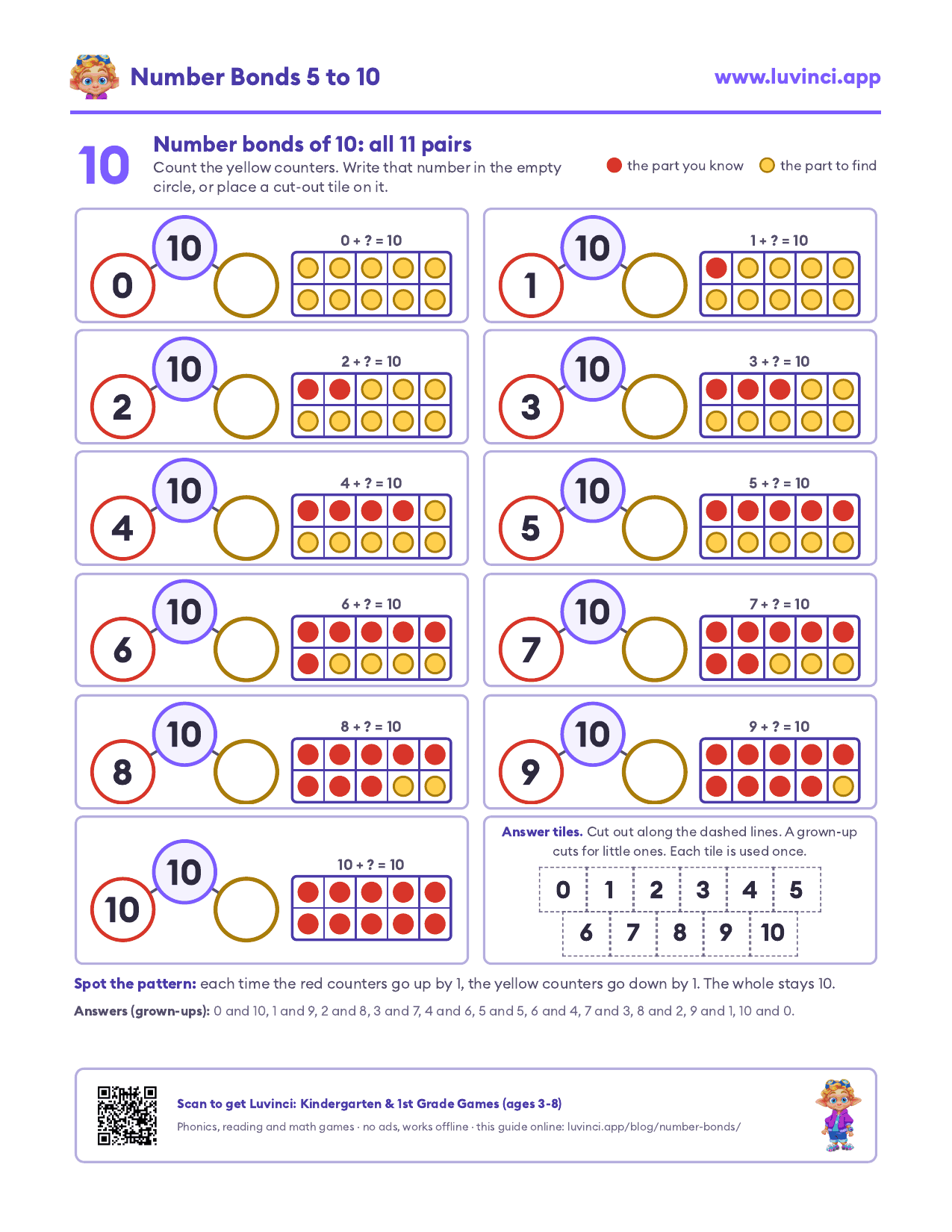
In the printable, the part you’re given is red and the part to find is yellow, like the two-color counters used in class (red and yellow still look different in gray). Your child counts the yellow counters and writes the missing part, or places a cut-out tile on the empty circle.
One of the app’s Singapore Math boards is sums that make 8 and 10 (7+3, 6+4, 5+5, 8+2), each shown on ten frames. That board is in the full app, and the counting board is free. You can see the rest of the math games on our early math page.
For more about the pairs that make 10, see our ways to make 10 post. Equal parts like 5 and 5 are the doubles facts, which have their own page: doubles facts. And for blank frames to use with counters, grab our ten frame printable.
Part-part-whole and decomposing numbers
You’ll see two other names for the same idea on school papers.
Part-part-whole is the language behind number bonds. Two parts make a whole. Some worksheets draw it as a box split in two (the whole on top, the parts below) instead of circles. It’s the same thing, and the numbers don’t change.
Decomposing numbers means breaking a number into parts. “Decompose 7” just means “show two numbers that make 7”. Composing is the reverse. When a kindergarten report card uses these words, think number bonds.
You can decompose numbers at home with no worksheet needed:
- Two hands. Hide 6 small toys, some in each of your hands. Open one hand. Your child works out how many are in the other.
- Snack split. Put 8 crackers on a plate. “Let’s share them between two bowls. How many ways can we do it?” Write each way down.
- Two-color counters. Drop 7 counters that are red on one side and yellow on the other. Count each color. Drop them again and see how the parts change while the whole stays 7.
Small objects like counters need an adult nearby, especially with younger children.
Decomposing shows a child that 7 is also 4 and 3, 6 and 1, 5 and 2. Numbers can be split and put back together, and that idea makes later math easier.
Free number bond template
The Number Bonds 5 to 10 PDF is 8 pages (US letter size):
- Page 1: an at-a-glance chart of every number bond from 5 to 10, each pair on a mini ten frame in red and yellow. Nothing to cut, so it works as a poster.
- Pages 2 to 7: number bonds of 5, 6, 7, 8, 9 and 10. Each page shows every pair, from 0 and the number to the number and 0. The whole and one part are filled in, and a ten frame shows both parts. Your child finds the missing part.
- Answer tiles on pages 2 to 7: the numbers from 0 up to that page’s number, to cut out and place on the empty circles. Nothing gets stuck down, so if your child uses the tiles instead of a pencil, the page can be used again.
- A “spot the pattern” line (as the red counters go up by 1, the yellow go down by 1) and a grown-up answer line listing all the pairs.
- Page 8: a blank number bond template, 8 empty bonds with empty ten frames. Your child picks a whole, draws counters in two colors, and writes the parts.
How to use it:
- Start with the chart on page 1, then page 2 (5), even in 1st grade. It builds the habit of reading the picture.
- Count the yellow counters, then write. The ten frame holds the answer. If your child guesses, count the yellow counters together.
- Tiles before the pencil. A tile is quick to move, so mistakes are cheap.
- Read each bond out loud: “4 and 3 make 7.”
- Move on when it’s easy. One page a day is plenty.
Print page 8 a few times. It works for any whole up to 10.
FAQ
What are number bonds in simple terms?
A number bond shows a number and two parts that make it, like 5 and 3 making 8. The whole goes in the top circle and the parts go in the two circles below.
How many number bonds to 10 are there?
There are 11 if you count the order and the zero pairs: 0 and 10, 1 and 9, 2 and 8, 3 and 7, 4 and 6, 5 and 5, 6 and 4, 7 and 3, 8 and 2, 9 and 1, 10 and 0. If you count 3 and 7 the same as 7 and 3, there are 6.
When do kids learn number bonds?
Most children meet them in kindergarten, where they split numbers up to 10 into parts with objects and drawings. First graders use them to add and subtract within 10 without counting, and then to reach sums up to 20.
Do number bonds include 0?
Yes. 0 and 10 make 10, and 5 and 0 make 5. The zero pairs help children see that “nothing added” leaves the number the same. Our printable includes them on every number page.
The takeaways
- A number bond is a whole and two parts, like 8 made of 5 and 3. One bond holds up to two addition facts and two subtraction facts (a double like 4 and 4 gives one of each).
- Start with bonds to 5 on one hand, then 6 to 9, then the bonds to 10.
- Use a ten frame: two colors show both parts and the whole at the same time.
- Objects come before worksheets in kindergarten. Part-part-whole and decomposing numbers are the same idea with school names.
- Print the free Number Bonds 5 to 10 PDF: a chart of every bond, every pair from 5 to 10 on ten frames, answer tiles to cut out, and a blank bond template.
More free math worksheets: ten frames, number charts, addition and subtraction, daily practice workbooks and more, all in one place. See the math printables →
