Luvinci
November 23, 2026
Free Color by Letter Printables: Capitals, Lowercase and b, d, p, q
4 free PDFs in this post
More color by letter
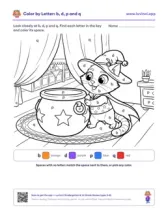
Color by letter is a coloring page with a letter in each space. Your child looks that letter up in the crayon key, fills the space to match, and the picture comes together. This is letter recognition practice that still feels like coloring.
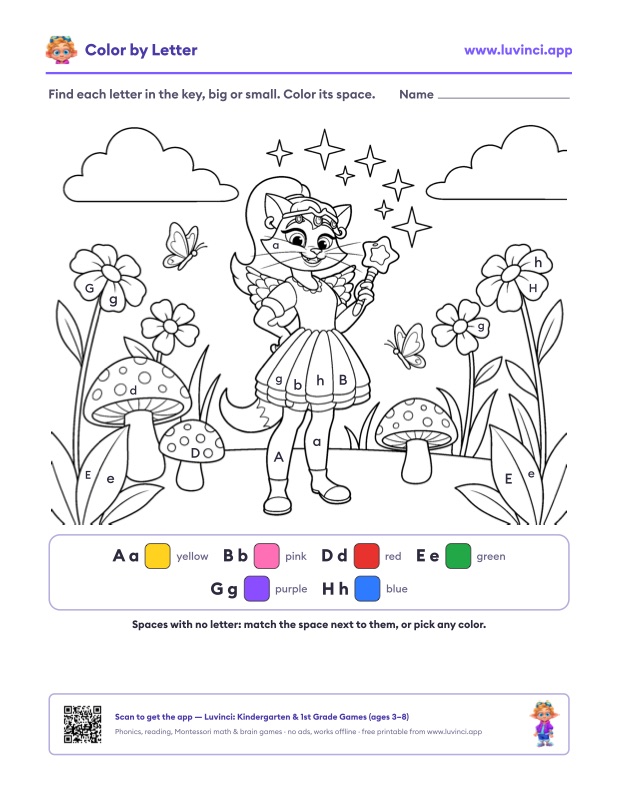
The key says B b is pink, so every space with a big B or a small b turns pink.
Our free color by letter worksheets match big and small letters. Fairy Cat, Caterpillar and Pawitch from the Luvinci app wait under the letters. Three more packs cover capital letters, lowercase letters, and the look-alikes b, d, p and q. Colored answer keys close out every pack.
Jump to: the packs · how to use them · b, d, p and q · printing tips · FAQ
Which color by letter pack fits your child
Start with capitals, then lowercase, then mix them. Save b, d, p and q for when your child knows most lowercase letters.
| Pack | Letters | Pictures | Try it when |
|---|---|---|---|
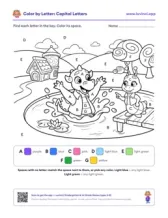
| Capital letters | 25 capitals, A to Z without I | Dragon splashing in his pond, Sparky and a little fish folding paper birds, Pawitch with red balloons, Sparky and a shark | Your child is just learning letter names |
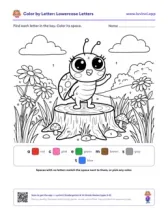
| Lowercase letters | a, c, e, m, s, t, f, g, h, k, r, w, j, n, o, u | Ladybug on a tree stump, the mouse on a woodland path, Space Beaver on his scooter | Your child knows most capitals |
| Big and small letters | 18 pairs, like A a, G g and Q q | Fairy Cat in a flower garden, Caterpillar by her cocoon, Pawitch with three little flame creatures | Your child is matching capitals to lowercase |
| b, d, p and q | b, d, p and q only | Pawitch hugging his star cauldron, Sparky swimming home, the chameleon with two little bugs | Your child mixes up the look-alikes |
Why capitals first? Most children pick up capital letters before lowercase ones. Lowercase letters matter more for reading, though, because almost every word in a book is lowercase. Don’t wait long to move on.
You’ll notice there is no capital I. In print, a capital I looks almost exactly like a small l, so a child can’t tell them apart on a coloring page. The big and small pack leaves out both.
How to use color by letter worksheets
- Read the key together first. Point to each letter and say its name. Then say the color. “A is yellow.”
- Hunt one letter at a time. “Let’s find every A.” Searching for one letter keeps your child looking at letter shapes instead of coloring at random.
- Say the letter before coloring the space. Add the sound when your child is ready. “B. B says /b/.” Knowing the name and the sound together is what helps with reading later.
- On the big and small pages, name both. “That’s a big G, and that’s a small g. Same letter.” Letters like C c, K k and U u look alike in both sizes, so start there. A a, G g and R r change shape, so they take longer.
- Leave blank spaces for last. Spaces with no letter are free choice. Your child can match the space next to it or pick any color.
- Check against the key. The last page shows each picture colored in, with one idea for the free spaces.
Keep each sitting short. For most 4 and 5 year olds, one picture is plenty.
Help for b, d, p and q reversals
Mixing up b, d, p and q is normal in pre-K and kindergarten, and often into 1st grade. Those four letters share one shape, turned and flipped. Children also flip letters that face left, like J and Z, more often than letters that face right.
Our b, d, p and q color by letter pack uses only those four letters. Each one has its own crayon, and the crayons change on every page. On page 1, b is orange. On page 2, b is purple. Your child reads each letter to pick the crayon.
These cues help:
- b is a line first, then the bump. d is a c first, then the line.
- p is a line, then a bump. q is a c, then a line.
- b and d are tall. p and q hang below the line.
- Say the sound as you color. /b/ for b and /d/ for d. The sound gives your child a second way to check.
- Teach the sounds apart first. When your child first learns these sounds, b and d go in different weeks. Our post on the order to teach letter sounds explains why. This pack comes later, once your child knows all four and needs practice telling them apart.
Want a hands-on version? The b, d, p and q letter sort has a cut and paste sort for each pair. Our letter tracing post also explains why kids write letters backwards.
Reversals on their own are not a sign of dyslexia. If your child is still reversing letters a lot by the end of 2nd grade, mention it to the teacher.
Printing tips
- Color printing is nice but not needed. Each crayon box in the key has its color name printed next to it, like “yellow” or “brown”. A child who can’t read the word yet can follow a key you colored in.
- Light blue means any light blue, and light green means any light green. Tan means any light brown.
- Only need the pictures? Skip the last page. It holds the answer keys.
- Crayons or colored pencils work best. Markers can cover the letter before your child has read it.
Quick takeaways
- Color by letter hides letter recognition practice inside a coloring page.
- Start with capitals, then lowercase, then big and small pairs.
- Hunt one letter at a time, and say its name before coloring.
- The b, d, p and q pack changes the crayons on every page, so your child reads each letter.
Want more letter practice? Our letter recognition worksheets give every letter its own find the letter page, and the uppercase and lowercase letter matching cards pair well with the big and small pack. Once the letters feel steady, move on to letter tracing worksheets and building words with printable letter tiles.
If your child loves color by code, try color by number, color by shape and color by sight word next. Every picture lives in our coloring pages library. Our reading games say each letter’s sound out loud when your child taps it, a nice screen partner for these pages.
Common questions
What age is color by letter for? Most 4 to 6 year olds, in pre-K and kindergarten, can use these pages. Start with the capital letters pack. The b, d, p and q pack also helps 1st graders who still mix up those letters.
Should kids learn capital or lowercase letters first? Most children learn capitals first, and that’s a fine place to start. Bring lowercase in soon after, since books are mostly lowercase. The big and small pack connects the two.
Why are some letters missing? Each picture has room for four to seven letters, and every key lists the letters on that page. The lowercase pack skips b, d, p and q, since they get their own pack. Capital I is left out on purpose, because in print it looks like a small l.
Are these color by letter printables free? Yes. All four packs are free PDFs.
Sources
- National Early Literacy Panel (2008). Developing Early Literacy: Report of the National Early Literacy Panel. National Institute for Literacy.
- Worden, P. E. and Boettcher, W. (1990). Young children’s acquisition of alphabet knowledge. Journal of Reading Behavior 22(3), 277-295.
- Turnbull, K. L. P., Bowles, R. P., Skibbe, L. E., Justice, L. M. and Wiggins, A. K. (2010). Theoretical explanations for preschoolers’ lowercase alphabet knowledge. Journal of Speech, Language, and Hearing Research 53(6), 1757-1768.
- Treiman, R., Gordon, J., Boada, R., Peterson, R. L. and Pennington, B. F. (2014). Statistical learning, letter reversals, and reading. Scientific Studies of Reading 18(6), 383-394.
- Understood.org. FAQs about reversing letters, writing letters backwards and dyslexia.