Luvinci
July 25, 2026
SATPIN: The Best Order to Teach Letter Sounds (and What Comes Next)
Free printable · PDF · 812 KB
SATPIN: The Best Order to Teach Letter Sounds (and What Comes Next)
No signup needed. Just print it.
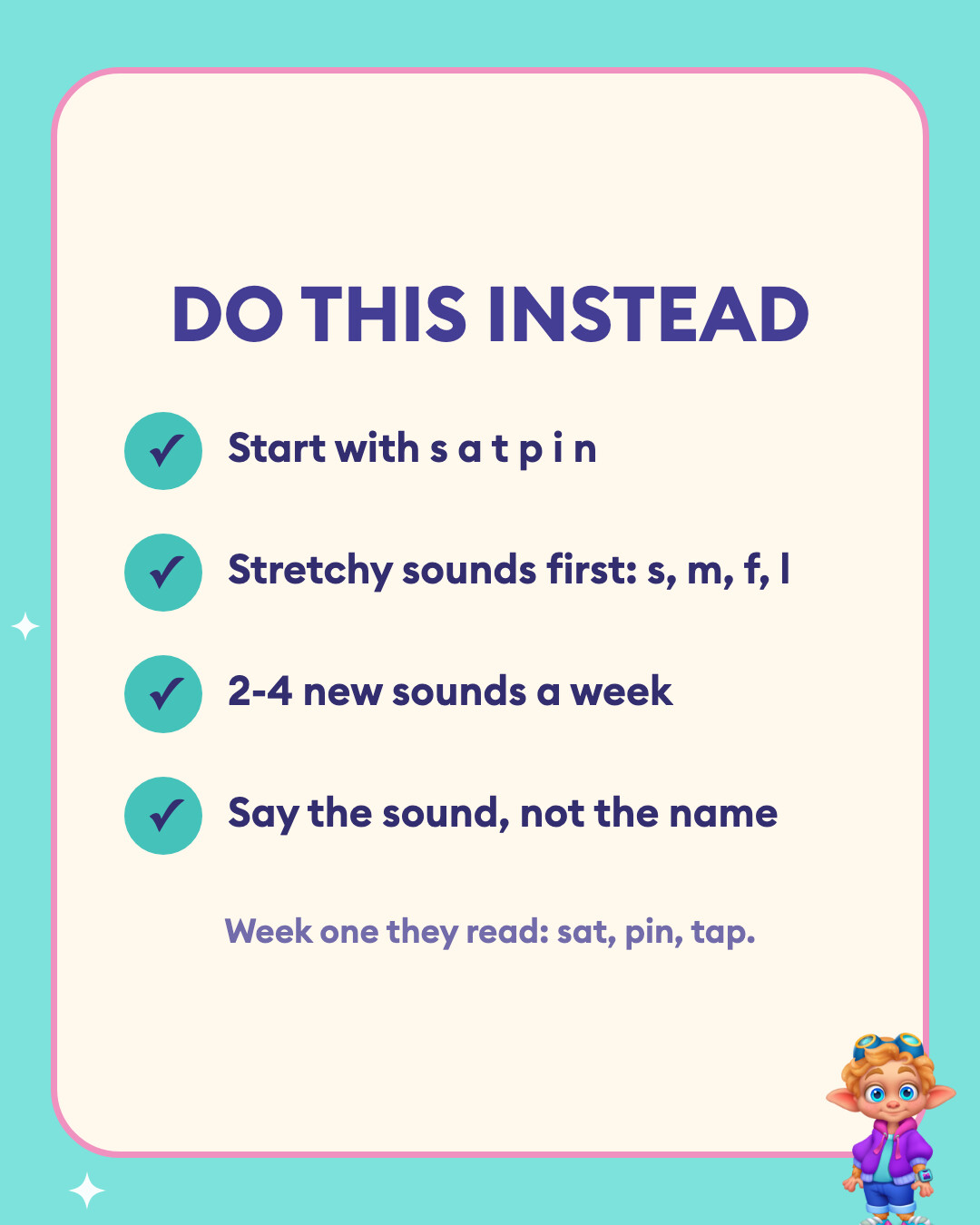
Download PDFThe best order to teach letter sounds is not alphabetical. Many phonics programs start with the same six letters — s, a, t, p, i, n, known as SATPIN — because that combination makes real words straight away: sat, pin, tap, nip, tin, pit, sit, ant, pan, spin. A child who learns those six reads actual words in their first week; A, B, C gets you cab and not much else.
The SATPIN letter order
The SATPIN letter order is the one the name spells: s → a → t → p → i → n, taught one at a time, each new letter making words with the ones already learned. After s, a and t your child can read at and sat; p adds tap, pat and sap; i adds sit, pit, tip and sip; n adds pin, nip, tin, ant and pan. Some programs shuffle the middle — Jolly Phonics teaches s, a, t, i, p, n — and it makes no practical difference: what matters is that every new letter pays off in real words the same day.
Programs vary, and there’s no single correct sequence. But the good ones obey the same four rules.
Rule 1: high-utility letters first
Pick letters that combine into words fast. The classic first group is s, a, t, p, i, n; group two is usually m, d, g, o, c, k, which opens up dog, cat, mad, kid and dozens more. Reading a word you’ve never seen before is the moment a child decides they can read — get there in week one.
Rule 2: continuous sounds before stop sounds
Some sounds you can hold: s, m, f, l, n, r, v, z and all the vowels — say “ssssss” for as long as your breath lasts. Others stop instantly: b, d, g, k, p, t.
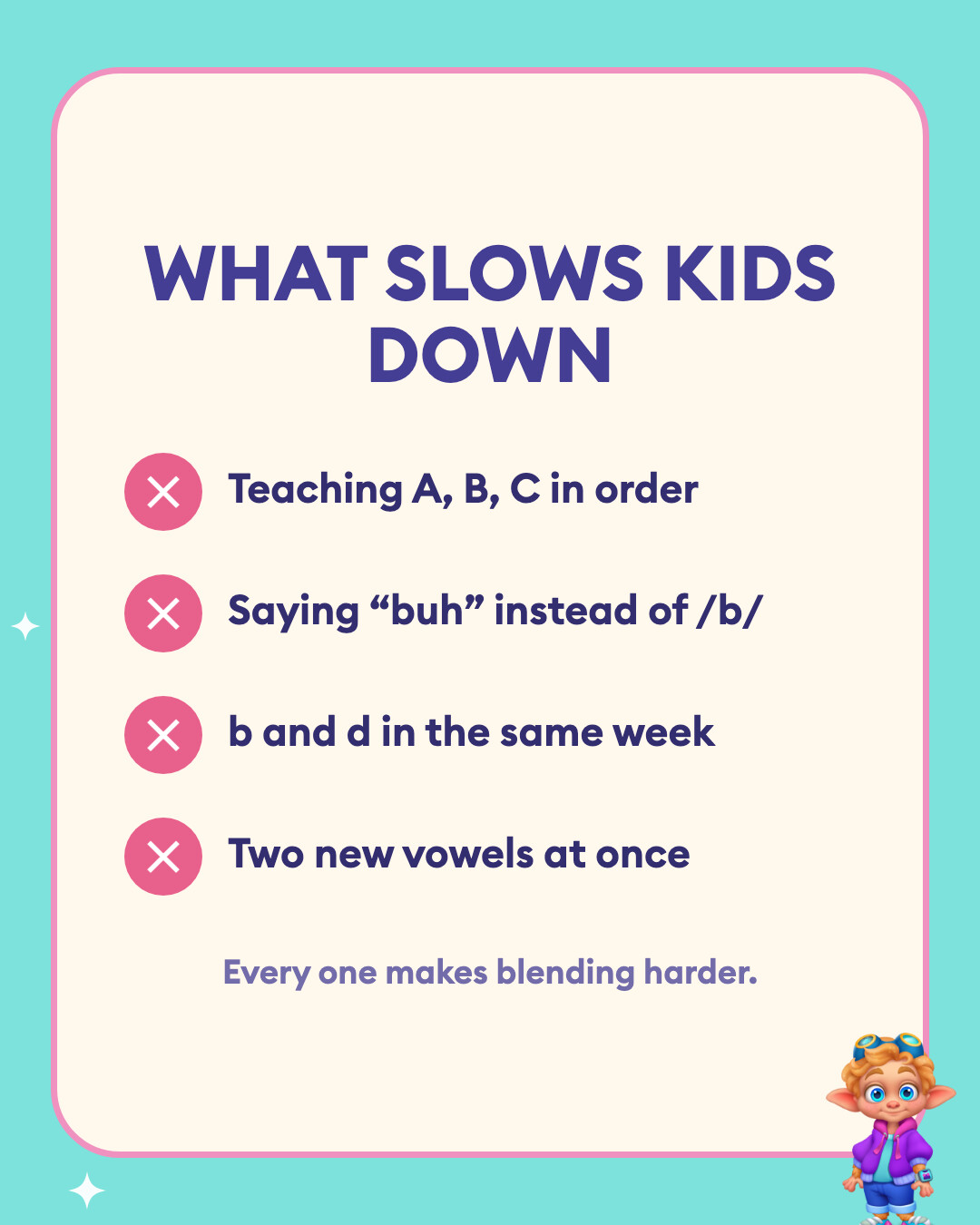
Continuous sounds are far easier to blend, because “sssss-aaaa-t” flows in a way “b-a-t” doesn’t. Front-load the stretchy ones and blending gets easier for free. Stop sounds also tempt adults to add a vowel — “buh,” “duh” — turning c-a-t into “cuh-a-tuh.” Say the shortest sound you can.
Rule 3: separate the look-alikes and sound-alikes
Don’t teach b and d together — they’re mirror images, and the confusion can last months. Same for m and n (similar sound), p and q (mirror shapes) and e and i (similar short-vowel sounds). Space each pair several weeks apart; SATPIN contains none of them, which is part of why it works.
Rule 4: one vowel early, then space them out
Every word needs a vowel, so one has to arrive immediately — that’s the a and i in SATPIN. But short vowel sounds are the hardest thing in early phonics to hear apart, so introduce them slowly and never two in the same week.
What comes after SATPIN: the full sequence
Once SATPIN is solid, group two is m, d, g, o, c, k. Programs draw the lines differently, but this is a common sequence. Teach each group until it’s secure, then move on:
- s, a, t, p, i, n — sat, tap, pin, nip, sit, pan
- m, d, g, o, c, k — mad, dog, cat, kid, mop
- ck, e, u, r, h, b — duck, red, run, rock, hat, bed
- f, l, ff, ll, ss — fun, lip, huff, bell, mess
Group 4 ends on something new: ff, ll, ss are one sound written twice — “huff” ends in a single /f/, not two. Children meet these constantly at the ends of short words.
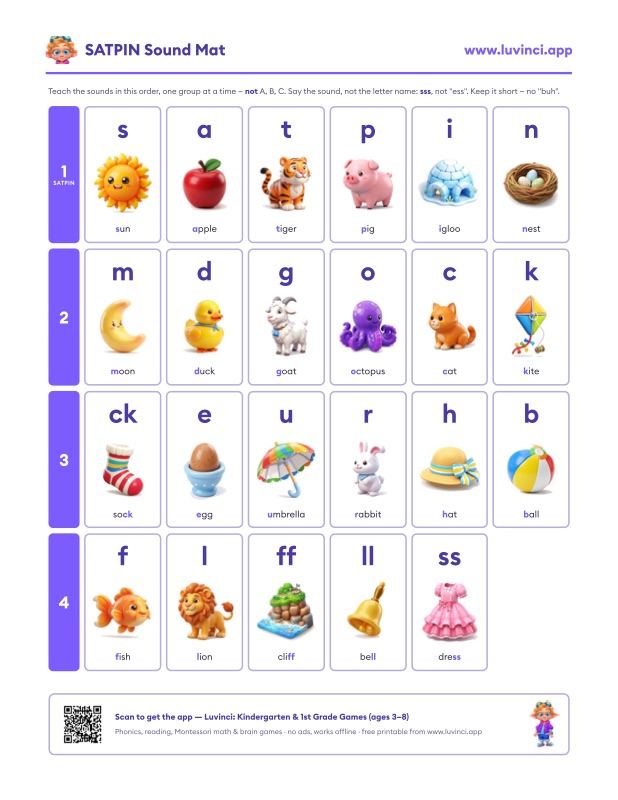
All four groups sit on one page in our free SATPIN Sound Mat — every sound with a picture cue, in this order. No signup. To build real words as each group arrives, print our free letter tiles: 77 cut-out sound tiles and a word-building mat that stand in for magnetic letters.
Those four groups read hundreds of simple words. Then come j, v, w, x, y, z, the consonant digraphs sh, ch, th, ng (plus qu, taught with them though /kw/ is really two sounds), blends, magic e, vowel teams and finally bossy r. None of it comes before three-letter words are comfortable. Not sure your child is ready for letters at all? Start with the sound-only games in our guide to phonics.
How fast should we go?
Two to four new sounds a week is the usual range — introduce a new one when the previous one is secure, not on a schedule. Slow down if the sound vanishes inside a word, if yesterday’s is gone today, or if sessions end in frustration. Speed up if they’re bored and reading ahead of your finger. Five to ten minutes a day beats an hour on Sunday.
“Reading games are super valuable because they help children learn blends by hearing letter sounds, a feature missing from paper workbooks. They make studying fun!” — t laper, App Store review (US)
Sounds, not names — and lowercase first
Teach the sound, not the letter name. “Ess” doesn’t help you read “sun.” /sss/ does — names can come later, and most children pick them up from the alphabet song anyway. And teach lowercase first: almost everything your child meets in print is lowercase.
Hearing each sound accurately is where a screen earns its place — our reading games sound out every letter and build to CVC words for ages 3–8, no ads, offline.
Questions parents ask
What comes after SATPIN? Group two is m, d, g, o, c, k — it opens up dog, cat, mad and kid. Then ck, e, u, r, h, b, and on through the four groups above. Move on when the current group is secure, not on a fixed schedule.
My child already learned the alphabet in order. Have we done it wrong? Not at all — knowing letters is useful. Just switch to teaching sounds in the sequence above rather than continuing alphabetically.
How many letter sounds should a child know before kindergarten? Teachers typically hope for most letters recognized and some sounds known — not all 26. The readiness checklist has the realistic expectations by area.
What about b and d reversals? Extremely common through age 7 and usually not a concern; teaching the two weeks apart prevents most of it. Persistent reversals alongside broader reading difficulty are worth raising with your child’s teacher.
The takeaways
- Start with s, a, t, p, i, n — real words in week one beats alphabetical order.
- Stretchy sounds before stop sounds — blending gets easier for free.
- Never pair b/d, m/n, p/q, e/i — space them weeks apart.
- Two to four new sounds a week, five to ten minutes a day.
- Say the sound, not the name, and keep it clean — no “buh.”
- Print the free SATPIN Sound Mat — all 23 letter-sounds in teaching order, one page.
- What to print next — 8 free word-family worksheets (at, et, in, og) that turn these letters into the first real words.