 Luvinci
October 10, 2026
Letter Tracing Worksheets A-Z (Free Alphabet Tracing PDF)
Free printable · PDF · 2872 KB
Letter Tracing Worksheets A-Z (Free Alphabet Tracing PDF)
No signup needed. Just print it.
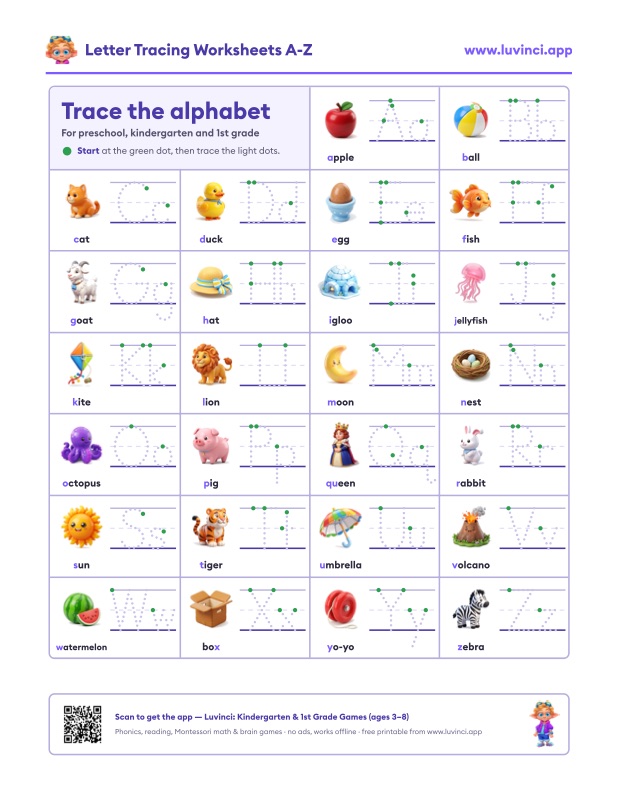
Download PDFThese free printable letter tracing worksheets take your child through the alphabet from A to Z, one letter per page, capital and lowercase. Green start dots sit on every letter (numbered when a letter takes more than one stroke), plus arrows, and the dots fade row by row until your child writes the letter alone.
Parents and teachers of preschool, kindergarten and 1st grade children can use this guide.
Start at the green dot. Follow the arrows. Trace two, then write it alone.
Our free letter tracing worksheets PDF has 33 pages: an alphabet tracing page with pictures, a page for every letter with start dots and arrows, matching, b and d mazes, a cut-and-paste sort and two letter charts. US Letter, black-and-white friendly. No signup, no email.
Jump to: the pack · how to use a sheet · start at the top · uppercase or lowercase · which letters first · every letter’s path · backwards letters · FAQ
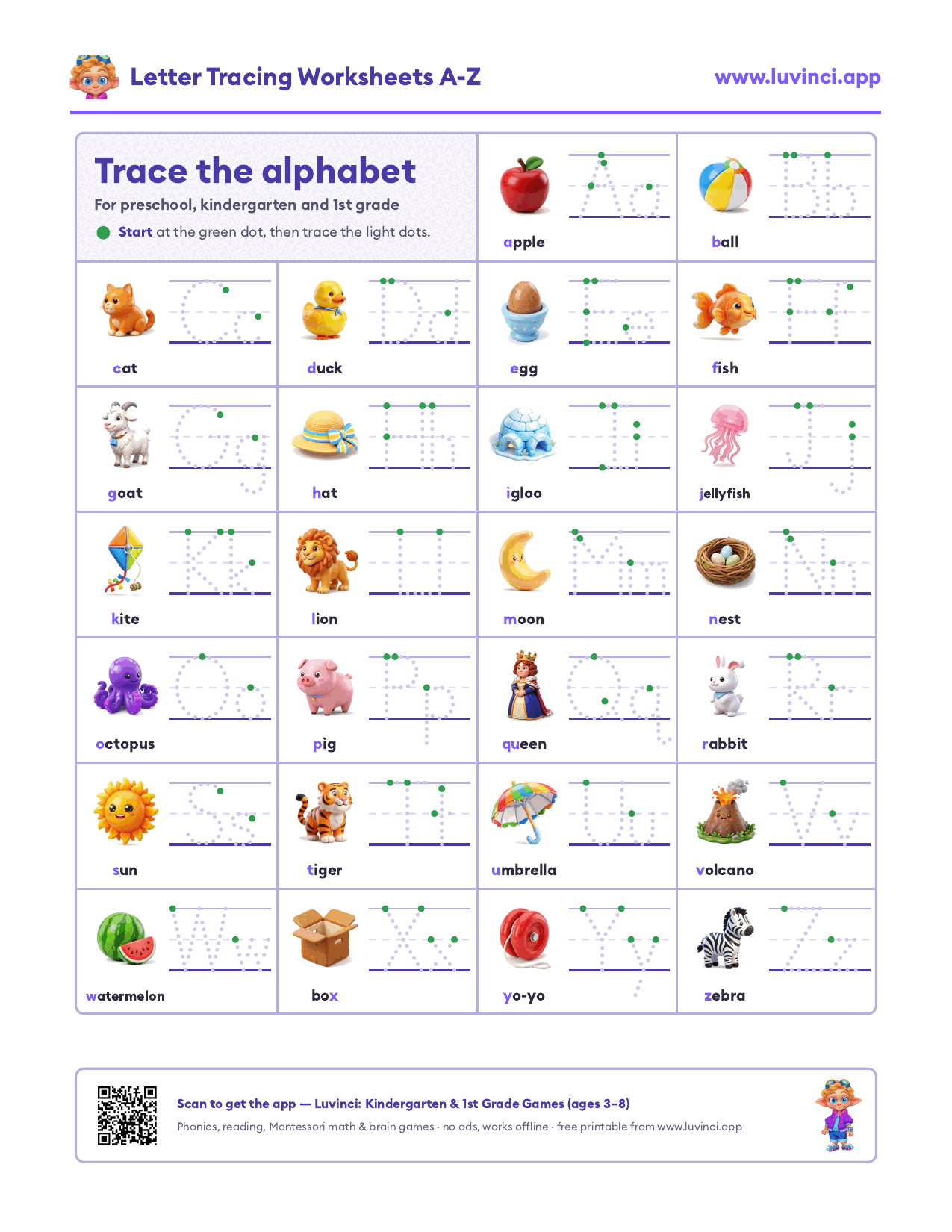
Page 1 of the free PDF.
Free letter tracing worksheets A-Z (PDF)
- Page 1: trace the alphabet, with a picture for every letter.
- Pages 2 to 27: one letter per page, A to Z, capital and lowercase, with a picture, green start dots and arrows, fading dotted rows, a row to write it alone and a find-and-circle line.
- Pages 28 to 31: capital and small letter matching; b and d mazes; a cut-and-paste sort (tall, small or tail?); write the alphabet.
- Pages 32 and 33: capital and lowercase letter charts with start dots and arrows.
These ABC tracing pages are letter tracing worksheets with arrows on every stroke. Our number tracing worksheets use the same green dots. More writing pages sit in our printables library.
Printing tips:
- Slide a page into a sheet protector and use a dry-erase marker. One printout lasts all year.
- Black and white is fine. The green dots print darker than the tracing dots.
- Print the two charts on cardstock.
How to use a letter tracing sheet (5 minutes a day)
Each letter page starts with lots of help and ends with none.
- Finger-trace the big model along the arrows. You say the path (“line down, back up, bump”); your child says the letter’s sound (and its name, once they know it).
- Trace the dotted letters, starting at the green dot every time.
- Write on the spaces with only a start dot.
- Cover the top of the page and write the letter from memory.
- Circle the best one, then find and circle the letter in the strip at the bottom.
Two or three letters a day is plenty. These tracing letters worksheets have just two copies of each to trace, because careful beats fast. Tomorrow, come back to today’s letters.
Have your child write the letter in short words they can read (cat, sun) and in their own name (see our name-writing guide).
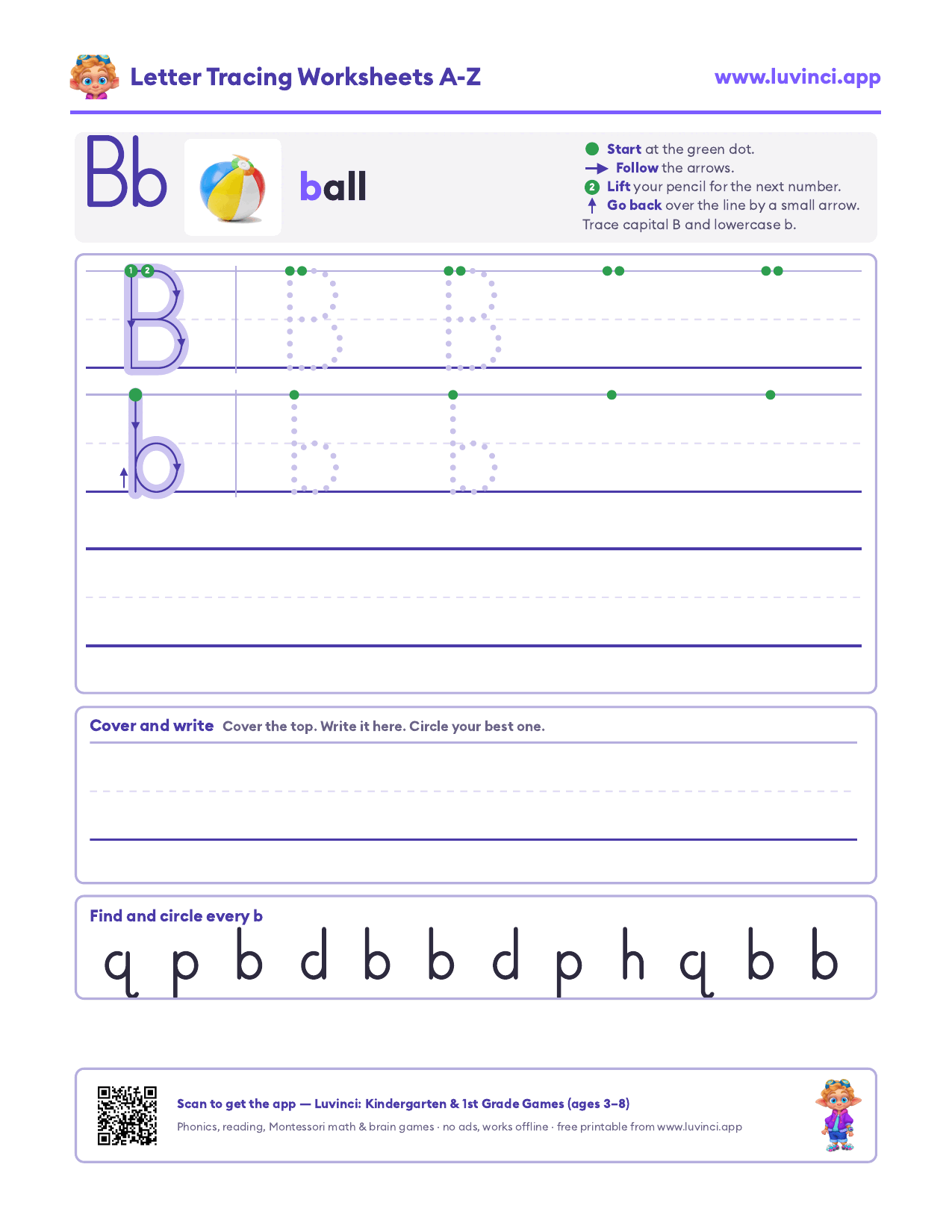
Page 3 of the free PDF: the letter b.
How to trace letters the right way
Good letter formation hangs on two things. Where the pencil starts, and which way it goes.
Writing paper for kids has a top line, a dashed middle line and a bottom line. Tall letters (b d f h k l t) reach up toward the top line, tail letters (g j p q y) dip below the bottom line, and the rest sit between the middle and bottom lines.
Pull down from the top on most strokes. Capitals and tall letters start at the top line (f and t a little below it), small letters at the middle line. C, G, S, c and s begin just under the line, on the right. Letters that start with a curve go round to the left.
The traceable letters use simple upright print, with the one-story a and g that most children learn to write. Many books print a two-story a and g. It’s the same letter. If your child’s school uses another style, follow the school.
A relaxed three-finger grip is the goal. Many children hold the pencil a little differently and still write well. Left-handers can turn the page a little clockwise.
Uppercase and lowercase letter tracing: which first?
Teach both. Give lowercase the most practice, because almost everything your child reads is lowercase. Many children write capitals first, and that’s fine as a start.
When you write your child’s name, write one capital and then lowercase (Maya, not MAYA), the way they’ll see it at school.
This page is about writing letters. For which sounds to teach first, see our order to teach letter sounds.
Which letters to trace first
You don’t have to trace A to Z. Letters made with the same moves are easier to learn together. If your child is learning sounds in an order like s, a, t, p, i, n, trace each letter as they learn its sound. The groups below help most when you’re choosing letters yourself.
| Capitals, by shape | Letters |
|---|---|
| Straight lines only | L T I E F H |
| A line, then bumps on the right | P R B D |
| A curve from the top, going left | C O Q G S |
| Down and turn | U J |
| Slants | V W X Z Y |
| Lines and slants | A K M N |
| Lowercase, by shape | Letters |
|---|---|
| Same shape as the capital | c o s v w |
| Straight down | l i t |
| Start like c | a d g |
| Down, back up and over | r n m h b p |
| Turns, slants and e | u y k e |
| Save for last | f j q x z |
Keep b and d in different weeks, and p and q. Capital J and Z come last too.
Tracing letters A to Z: the path for each letter
While your child traces, read the path out loud and let them say the letter’s sound. “Lift, top” means lift the pencil and go back to the top.
| Letter | How to write it |
|---|---|
| A a | A: Top center, slant down left. Lift, top: slant down right. Lift: across on the middle line. a: Start like c, round, up to the middle line, back down. |
| B b | B: Line down. Lift, top: bump to the middle line, bigger bump to the bottom. b: Tall line down, back up to the middle line, bump round to close at the bottom. |
| C c | C: Just under the top line on the right, curve left, stop near the bottom. c: The same, from just under the middle line. |
| D d | D: Line down. Lift, top: big bump to the bottom. d: Start like c, round, up to the top line, back down. |
| E e | E: Line down. Lift each time: across the top, middle and bottom lines. e: Start halfway down, slide right, curve up and round like c. |
| F f | F: Line down. Lift: across the top line. Lift: across the middle line. f: Just under the top line on the right, curve over left, line down. Lift: cross on the middle line. |
| G g | G: Curve like C, up to the middle line, short line in. g: Start like c, round, up to the middle line, down below the bottom line, hook left. |
| H h | H: Line down. Lift: line down on the right. Lift: across the middle line. h: Tall line down, back up to the middle line, hump over, down. |
| I i | I: Line down from the top center. Lift: across the top. Lift: across the bottom. i: Short line down. Lift: dot. |
| J j | J: Line down on the right, hook left at the bottom. Lift: across the top. j: Short line down, below the bottom line, hook left. Lift: dot. |
| K k | K: Line down. Lift, top right: slant in to the middle line, slant out to the bottom. k: Tall line down. Lift, middle line on the right: slant in, slant out. |
| L l | L: Line down, across the bottom. l: Tall line down. |
| M m | M: Line down. Lift, top: slant down to the middle line, slant up, line down. m: Short line down, back up, hump, down, back up, hump, down. |
| N n | N: Line down. Lift, top: slant down to the bottom right, line up. n: Short line down, back up, hump over, down. |
| O o | O: Top center, round left, all the way to close. o: The same, from the middle line. |
| P p | P: Line down. Lift, top: bump to the middle line. p: Short line down below the bottom line, back up, round right to close. |
| Q q | Q: Round like O. Lift: short slant tail at the bottom right. q: Start like c, round, up to the middle line, line down below the bottom line, little turn to the right. |
| R r | R: Line down. Lift, top: bump to the middle line, slant leg out. r: Short line down, back up, small hump over, stop. |
| S s | S: Just under the top line on the right, curve left, slide across, curve right, stop near the bottom on the left. s: The same, from just under the middle line. |
| T t | T: Line down from the top center. Lift: across the top. t: Line down from just under the top line. Lift: cross on the middle line. |
| U u | U: Line down, round the bottom, up to the top. u: Short line down, round, up to the middle line, back down. |
| V v | V: Slant down to the bottom center, slant up. v: The same, from the middle line. |
| W w | W: Slant down, up, down, up. w: The same, from the middle line. |
| X x | X: Slant down right. Lift, top right: slant down left. x: The same, from the middle line. |
| Y y | Y: Slant down to the middle line at the center. Lift, top right: slant in to meet it, line down. y: Short slant down. Lift, middle line on the right: long slant down past it, below the bottom line. |
| Z z | Z: Across the top, slant down left, across the bottom. z: The same, from the middle line. |
Some schools cross the T before the line down. Either is fine; keep it the same every time.
Why kids write letters backwards (b and d)
Writing a backwards b, d or J is normal in pre-K and kindergarten and often into 1st grade. Cues that help:
- b is a line first, then the bump. d is a c first, then the line.
- p is a line, then a bump. q is a c, then a line.
- J and Z face left, toward the start of the line. They’re the capitals children flip most.
Keep the charts on pages 32 and 33 nearby and fix one letter at a time. The b and d mazes help with look-alikes.
Reversals on their own are not a sign of dyslexia. If your child is still reversing letters a lot by the end of 2nd grade, mention it to the teacher. Numbers flip too: see why kids write numbers backwards.
Letter practice without a pencil
A finger in a salt tray works, as do playdough snakes on a laminated page, giant letters in the air or chalk on the sidewalk.
Our fine motor skills guide has hand-strength games, and the name-writing guide has more ideas. Once your child can write a few letters, build cat and sun with our printable letter tiles.
When should kids write letters?
Writing a few letters before kindergarten is typical, often from their own name, and some children write none yet.
- Pre-K: around 4, lines and circles that look like writing. By about 5, some letters and a first name.
- Kindergarten: children learn to print many capital and lowercase letters.
- 1st grade: all of them.
Our kindergarten readiness checklist asks children to recognize most letters, not write them all.
Letter tracing in the Luvinci app
The Letters row in the Luvinci reading games has capital and lowercase letter tracing. Your child hears the sound and follows each stroke from its start dot. It’s in the full app. This printable pack is free. Use the app as a warm-up. Paper and pencil build the hand.
FAQ
At what age should children start tracing letters?
Finger-tracing letters often starts around 3 or 4, and pencil tracing around 4 or 5, once lines, circles and a cross are easy. Start with the letters in their name.
Should preschoolers learn uppercase or lowercase letters first?
Both. Capitals are easier to write, so many children start there, but lowercase is what they read, so it gets the most practice from kindergarten on.
Which letters should my child trace first?
Straight-line capitals like L, T, I, E, F and H, and small letters that start like c (a, d, g). Keep b and d apart. See which letters to trace first.
Is tracing good for handwriting?
Yes, as a first step. It teaches where a letter starts and which way it goes. Writing it alone, from memory, is what makes it stick, so every letter page has a cover-and-write row.
How do you trace uppercase and lowercase letters?
Capitals and tall letters start at the top line, small letters at the middle line. Start at the green dot, follow the arrows in number order, then write the letter alone.
How to trace an s?
Start just under the top line on the right, curve left, slide across, curve right and stop near the bottom on the left. Lowercase s is the same, from just under the middle line (every letter’s path).
Where can I find free worksheets for alphabet tracing?
Our free letter tracing worksheets PDF: 33 pages, A to Z, no signup, no email.
The takeaways
- Start at the dot, top first. Formation matters more than neatness.
- A few letters a day beat a page of fast copies.
- Let the help fade, then write the letter from memory.
- Lowercase gets the most practice.
- Group letters by shape, not A to Z.
- Reversals are normal. Fix one letter at a time.
- Print the free letter tracing worksheets PDF: 33 pages, A to Z.
Sources
- Graham, S. (2009-2010). Want to improve children’s writing? Don’t neglect their handwriting. American Educator.
- Berninger, V. W., Vaughan, K. B., Abbott, R. D., Abbott, S. P., Rogan, L. W., Brooks, A., Reed, E. and Graham, S. (1997). Treatment of handwriting problems in beginning writers: Transfer from handwriting to composition. Journal of Educational Psychology 89(4), 652-666. ERIC EJ560297.
- Graham, S., Harris, K. R. and Fink, B. (2000). Is handwriting causally related to learning to write? Journal of Educational Psychology 92(4), 620-633. ERIC EJ621003.
- Santangelo, T. and Graham, S. (2016). A comprehensive meta-analysis of handwriting instruction. Educational Psychology Review 28(2), 225-265. ERIC EJ1100680.
- James, K. H. and Engelhardt, L. (2012). The effects of handwriting experience on functional brain development in pre-literate children. Trends in Neuroscience and Education.
- Fischer, J.-P. and Tazouti, Y. (2012). Unraveling the mystery of mirror writing in typically developing children. Journal of Educational Psychology 104(1), 193-205.
- Common Core State Standards. Language, Kindergarten and Grade 1.
- Understood.org. FAQs about reversing letters, writing letters backwards and dyslexia.
- Olsen, J. Z. (2008). Handwriting Without Tears 1st Grade Printing Teacher’s Guide: developmental teaching order. Learning Without Tears.
- Institute of Education Sciences (2012). Teaching Elementary School Students to Be Effective Writers, Recommendation 3.
- California Department of Education (2008). California Preschool Learning Foundations, Volume 1: Language and Literacy, Writing.
