Luvinci
September 23, 2026
Dolch Sight Words List: All 220 by Grade (Free PDF)
Free printable · PDF · 1313 KB
Dolch Sight Words List: All 220 by Grade (Free PDF)
No signup needed. Just print it.
Download PDFThe Dolch sight words list is the 220 high-frequency words Edward Dolch published in 1936, plus 95 common nouns. Dolch words are usually grouped by grade today. The levels run pre-primer (40), primer (52), 1st grade (41), 2nd grade (46) and 3rd grade (41). When a Dolch sheet shows up in the school folder, the whole Dolch sight words list by grade is here in one place. You’ll find all of it on our free printable Dolch sight words list. Free download, no signup, no email.
The sheet may tell you to memorize these words. Most of them don’t need that. Once your child knows the pattern, 152 of the 220 service words (Dolch’s name for the words that aren’t nouns) sound out. The other 68 are heart words. In most of those, one part breaks the rules, and that part alone gets learned by heart.
The full Dolch word list by grade
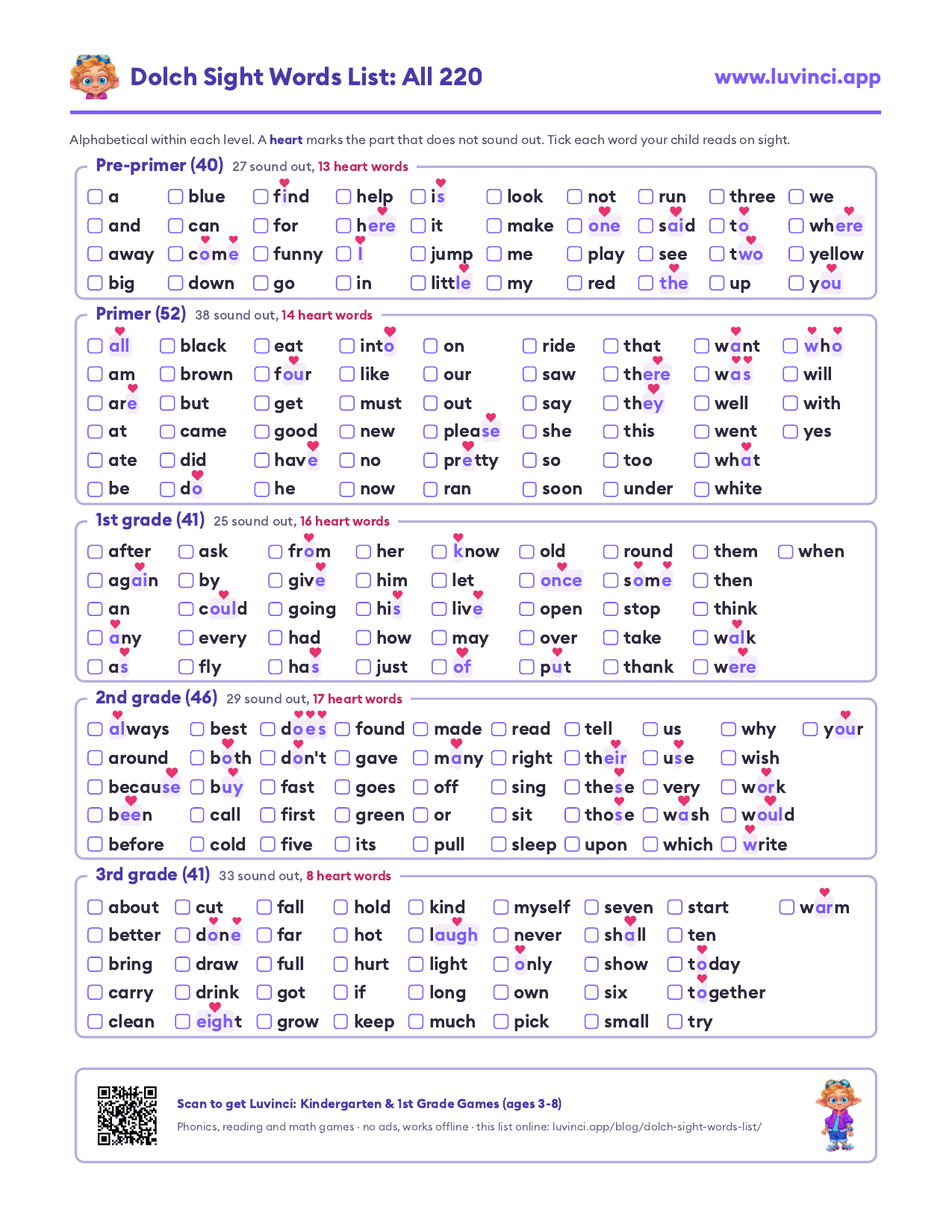
All 220 Dolch words by grade, alphabetical within each level. The tricky part of a heart word is in parentheses. Every other word sounds out.
Pre-primer (40)
a, and, away, big, blue, can, come (o, e), down, find (i), for, funny, go, help, here (ere), I (whole word), in, is (s), it, jump, little (le), look, make, me, my, not, one (whole word), play, red, run, said (ai), see, the (whole word), three, to (o), two (wo), up, we, where (ere), yellow, you (ou)
Our Dolch pre-K sight words sorted by stage shows which to teach first.
Primer (52), usually taught in kindergarten
all (whole word), am, are (e), at, ate, be, black, brown, but, came, did, do (o), eat, four (ou), get, good, have (e), he, into (o), like, must, new, no, now, on, our, out, please (se), pretty (e), ran, ride, saw, say, she, so, soon, that, there (ere), they (ey), this, too, under, want (a), was (a, s), well, went, what (a), white, who (w, o), will, with, yes
Pre-primer plus primer make the full list of 92 Dolch kindergarten sight words. That post sorts them in the order your child can read them.
1st grade (41)
after, again (ai), an, any (a), as (s), ask, by, could (oul), every, fly, from (o), give (e), going, had, has (s), her, him, his (s), how, just, know (k), let, live (to live) (e), may, of (whole word), old, once (whole word), open, over, put (u), round, some (o, e), stop, take, thank, them, then, think, walk (al), were (ere), when
For each missed word, the first grade list by stage shows which phonics pattern it needs.
2nd grade (46)
always (al), around, because (se), been (ee), before, best, both (o), buy (uy), call, cold, does (o, e, s), don’t (o), fast, first, five, found, gave, goes, green, its, made, many (a), off, or, pull, read, right, sing, sit, sleep, tell, their (eir), these (s), those (s), upon, us, use (to use) (s), very, wash (a), which, why, wish, work (or), would (oul), write (w), your (ou)
A five-minute spelling routine is on the second grade list by stage.
3rd grade (41)
With its 8 hearts, the last level is in its own section below.
Can Dolch sight words be sounded out?
Mostly, yes they can. Many Dolch sheets call these “words you can’t sound out.” Most of them follow the phonics your child is already learning. Can, jump and went are regular. Make, ride and white work the same way. The silent e is doing its normal magic e job.
The split across the 220 service words:
| Level | Sound out | Heart words |
|---|---|---|
| Pre-primer (40) | 27 | 13 |
| Primer (52) | 38 | 14 |
| 1st grade (41) | 25 | 16 |
| 2nd grade (46) | 29 | 17 |
| 3rd grade (41) | 33 | 8 |
| All 220 | 152 | 68 |
You don’t memorize a heart word as a whole. The heart goes only on the part that breaks the rules:
- said (ai): the s and d sound out. The ai says /e/.
- eight (eigh): the t sounds out. The eigh says long a.
- was (a, s): two odd parts, so two hearts. Only the w sounds out. Most kids try “wass” first, because was looks like a CVC word.
Six words need two or more hearts: come, was, who, some, does and done.
Hearts can come off, too. Seven of the 68 lose theirs once the pattern is taught: find (-ind), little (-le), all (the -all chunk), know (kn), write (wr), work (or after w) and eight (eigh). The other 61 stay. That’s why kind, fall and small sound out on the 3rd grade list.
When your child can’t sound a word out, check whether it is hearted or the pattern just hasn’t been taught yet. The method for the hearted part is in heart words.
The Dolch 3rd grade list (41 words)
about, better, bring, carry, clean, cut, done (o, e), draw, drink, eight (eigh), fall, far, full, got, grow, hold, hot, hurt, if, keep, kind, laugh (augh), light, long, much, myself, never, only (o), own, pick, seven, shall (a), show, six, small, start, ten, today (o), together (o), try, warm (ar)
By 3rd grade, most words on the Dolch list follow the rules, so it works as a spelling list too. A heart goes on only 8 of the 41. Shall is one of them. A child who knows ball and hall will read it as “shawl.” Today and together heart the o, the same as to. Warm (ar) keeps its heart too. After w, the ar says /or/.
The 95 Dolch nouns
Dolch printed his nouns separately, under the heading “95 nouns common to the three word lists but not recommended for a basic sight vocabulary.” His reason was that nouns are “local” to what a book is about. A farm story is full of cow and pig, and the next book has neither. When a book brings them up, read them then.
Animals (15): bear, bird, cat, chicken, cow, dog, duck, fish, horse, kitty, pig, rabbit, robin, sheep, squirrel
People (12): baby, boy, brother, children, farmer, father, girl, man, men, mother, Santa Claus, sister
Home (8): bed, chair, door, floor, home, house, table, window
Food (6): apple, bread, cake, corn, egg, milk
Nature and weather (15): fire, flower, garden, grass, ground, hill, nest, rain, seed, snow, sun, tree, water, wind, wood
Time and holidays (8): birthday, Christmas, day, goodbye, morning, night, party, time
Things (31): back, ball, bell, boat, box, car, coat, doll, eye, farm, feet, game, hand, head, leg, letter, money, name, paper, picture, ring, school, shoe, song, stick, street, thing, top, toy, watch, way
Some copies print good-bye. Dolch spelled it goodbye. Santa Claus counts as one noun.
Where the Dolch list came from
Edward W. Dolch published “A Basic Sight Vocabulary” in the Elementary School Journal in 1936. He started from three word lists of the day: the International Kindergarten Union list (1928), the first 500 words of the Gates list (1926) and the Wheeler-Howell list (1930). He kept the words, other than nouns, that were common to all three. Then he added 27 that appeared on two of them. Those, which, always, eight and together are among the 27.
He came back to the list in his 1948 book Problems in Reading. There he reported that the 220 made up more than half of children’s reading matter and over two-thirds in grades 1-2. A 1974 recount (Johns et al.) still found about 55% in books for grades 3-9 and 51% in adult text.
The Dolch list was built on frequency, not on whether a word can be sounded out. That’s how and, can and jump ended up on it next to said and once.
The free Dolch PDF: 220 cut-out cards, the list and the nouns
The free Dolch sight words PDF has three parts:
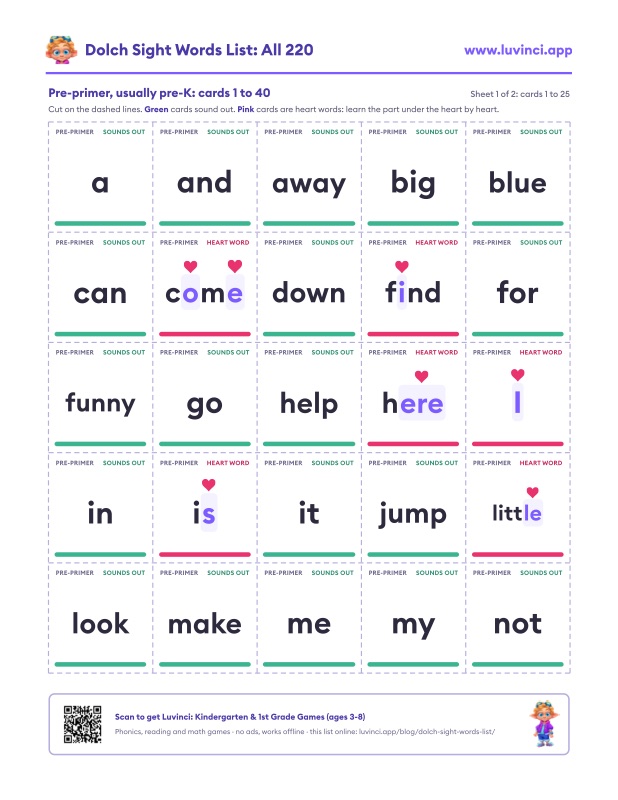
- Pages 1-11: 220 cut-out Dolch sight word cards, 25 to a page. Each level starts on a new page: pre-primer on pages 1-2, primer on 3-5, 1st grade on 6-7, 2nd grade on 8-9 and 3rd grade on 10-11. Each card is tagged with its level. Green cards sound out. Pink cards are heart words, with the heart on the tricky part only. The last page of each level ends with blank cards for words of your own.
- Page 12: the list. All 220 words by level, alphabetical, with a tick box by each one.
- Page 13: the 95 nouns, grouped by theme.
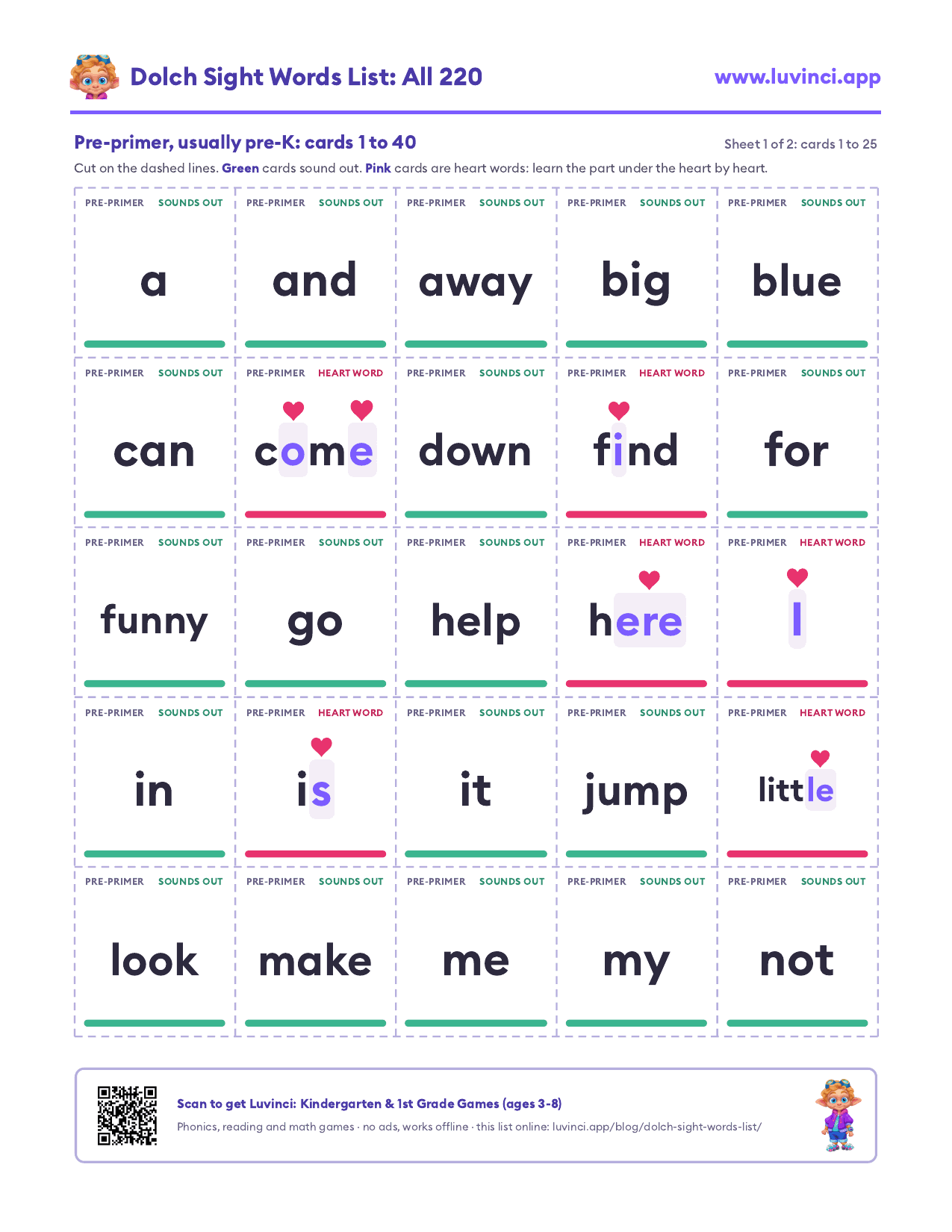
The first page of Dolch sight word cards, pre-primer.
Want bigger cards in teaching order? Our flash cards page has the Dolch sight word flash cards by level, plus a big-card deck for each grade, pre-K to 2nd.
Print the list page twice to check where your child is. Tick the words they read now, and again next month. Three to five new words a week is plenty. The same day, read each one in a sentence. The routine is in how to teach sight words.
“Overall, I feel it covers many areas of reading. From ABC to fluency, it builds confidence and can change kids’ ability to read.”
CGN Keanu, App Store review (US)
Questions parents ask
What are Dolch words? Dolch words are 220 high-frequency words (like the, said and because) plus 95 common nouns, published by Edward W. Dolch in 1936. Today they are usually grouped by grade, pre-primer to 3rd grade.
What does Dolch stand for? Nothing. Dolch isn’t an acronym. It’s the surname of Edward W. Dolch, the education professor who published the list.
How many Dolch sight words are there? 315 in all. That’s 220 service words plus 95 nouns. The 220 are usually grouped 40, 52, 41, 46 and 41, pre-primer to 3rd grade.
What is the difference between Dolch words and sight words? Dolch is one fixed list. A sight word is any word your child reads instantly, without sounding it out. Most Dolch words become sight words the ordinary way. Your child sounds them out a few times, then just knows them. More in heart words.
How many Dolch words should a first grader know? As the list is usually grouped, 133 by the end of 1st grade. That’s pre-primer, primer and 1st grade together. The first grade sight words list sorts that year’s 41 by phonics pattern.
Which is better, Fry or Dolch? Neither one is better, really. 86 of Fry’s first 100 words are on the Dolch 220, 4 more are Dolch nouns, and only 10 are on neither. Use the list your child’s school sends. More in Fry or Dolch?
Is there a free printable Dolch sight words list? Yes. Download the Dolch sight words PDF. It has 220 cut-out cards, all 220 on one checklist page and the 95 nouns. Free download, no signup, no email.
Is there a 4th grade Dolch list? No. The Dolch list is usually grouped pre-primer to 3rd grade and stops there.
Why do some 2nd grade lists have 47 words? Some printed copies add left. It isn’t one of Dolch’s 1936 words, so the 2nd grade list is 46.
Are Dolch words still relevant today? Yes, as high-frequency words. A 1974 recount still found them in about half of what older children and adults read. Teach them with phonics, not by memorizing word shapes.
Stories in our reading games are read aloud with each word highlighted, so your child sees the same words in real sentences. More free sheets, from letter sounds to sentence building, are on our printables page. Some schools also send home Dolch phrases. Those are short phrases built from these same words.