 Luvinci
October 4, 2026
Second Grade Spelling Words: 36 Weekly 2nd Grade Spelling Lists (Free PDF)
Free printable · PDF · 777 KB
Second Grade Spelling Words: 36 Weekly 2nd Grade Spelling Lists (Free PDF)
No signup needed. Just print it.
Download PDFSecond grade spelling words are the weekly lists a child learns to spell in 2nd grade. They cover new vowel spellings, silent letters, and the endings and prefixes that change how a word is written. This list of spelling words for 2nd graders continues from our first grade spelling words and runs 36 weeks in the order phonics is taught. By its week, a pattern word uses only spellings your child has already been taught. Heart words (the Tricky line) are the planned exceptions, and the part to learn by heart is marked. Two Friday new words a week show whether the pattern stuck, or which spellings to look up. Tick a week off once your child has mastered it.
Our free second grade spelling words PDF has all 36 weeks plus a spelling test sheet. That’s 5 pages, no signup, no email.
Jump to: the 36 weeks · what a 2nd grader should spell · the Friday test · the PDF
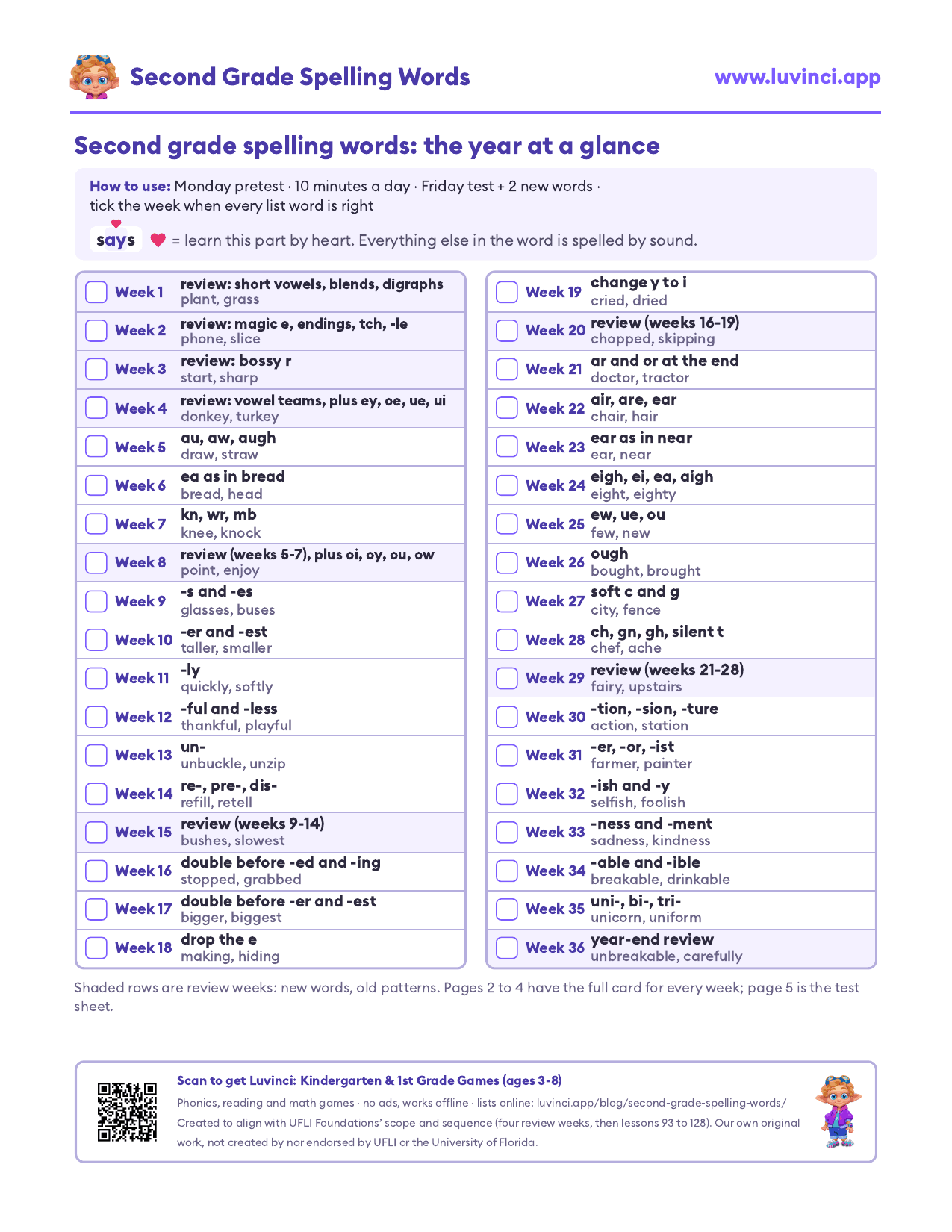
Page 1 of the PDF shows all 36 weeks on one sheet.
What should a 2nd grader be able to spell?
A second grader is usually 7 or 8 years old. By the end of the year, the words 2nd graders should know how to spell most of the time are:
- Everything from first grade: frog, cake, bird, rain
- Endings that don’t change the word: glasses, taller, quickly, helpful
- Prefixes: unhappy, retell
- The tricky words they write most: because, always, laugh
Your child will be taught these this year too. Expect mistakes on them for a while:
- The three spelling-change rules: hopping, making, cried
- Less common spellings: chair, eight, bought
- Bigger word parts: vacation, picture, happiness
That’s normal. Reading researcher Louisa Moats says the three spelling-change rules “should be introduced one at a time, beginning in second grade, and practiced for several years” (Moats, 2005/06).
Second grade standards also ask children to “generalize learned spelling patterns when writing words (e.g., cage → badge; boy → boil)” (CCSS L.2.2d). The two Friday new words check exactly that, in the weeks where a rule picks the spelling.
Second grade spelling words list by week
This list of spelling words for second graders was created to align with UFLI Foundations’ scope and sequence. UFLI’s suggested second grade sequence starts with review lessons and runs to lesson 128. This list does the same: four review weeks, then lessons 93 to 128 (lesson numbers for reference). A few short lessons share a week. Every week has ten words (8 or 9 pattern words and 1 or 2 heart words) and two Friday new words (all but week 35).
A week at a glance: a pretest on Monday, about 10 minutes a day on the words your child missed, then a Friday test of the 10 words plus the 2 new ones. Tick the week once all ten are right. The full test routine is below the list, and page 5 of the PDF has it too.
Your child brings a spelling list home from school? Keep that list for the Friday test and use this page to teach it. Find the week each school word belongs to and borrow that week’s tip and sentence: neighbor is in week 24 (eigh), and because is a Tricky word in week 5, with au and the last e learned by heart. A word with no week here, like community, gets the Tricky treatment: say it in beats (com-mu-ni-ty), spell each beat, and mark any part that isn’t spelled the way it sounds.
How to read a week:
- Tricky: this week’s heart words. The letters in parentheses are the part to learn by heart. The rest is spelled by sound.
- [Brackets]: a phrase you say aloud so your child knows which word you mean (hair, not hare).
- Tip: the spelling choice to watch for that week.
- Say it, write it: the dictation sentence.
- Friday new words: two words your child hasn’t practiced that use the week’s pattern. Don’t practice them. In most weeks a rule picks the spelling, so a miss means the rule needs another week. In a look-up week the sound has more than one spelling and no rule picks one, so a miss means you look the word up together.
Joining partway through the year? Use the first week of each group below as a pretest, and begin at the first one your child can’t spell yet. If the review weeks are hard, the first grade list comes first.
Weeks 1-4: review, plus ey, oe, ue and ui
Four weeks of new words with the first grade patterns show what stuck. Week 4 adds the rarer vowel teams ey, oe, ue and ui.
Week 1 · review: short vowels, blends, digraphs: plant, grass, smell, check, crash, branch, strong, shrimp · Tricky: says (ay), other (o)
Say it, write it: He says the other branch is strong.
Friday new words: stamp, crunch
Week 2 · review: magic e, endings, tch, -le: phone, slice, stage, sunshine, switch, told, silly, pickle · Tricky: done (o, e), move (o, e)
Tip: done and move look like magic e words, but the e does not make the o say its name: the o and the e are both tricky.
Say it, write it: Move the pickle so I can slice it.
Friday new words: drive, wiggle
Week 3 · review: bossy r: start, sharp, sport, third, burn, sister, worm, work · Tricky: warm (ar), learn (ear)
Tip: work is not tricky any more: after w, or says /er/ (worm). In warm, ar says /or/.
Say it, write it: My sister and I learn a new sport.
Friday new words: north, word
Week 4 · review: vowel teams, plus ey, oe, ue, ui: donkey, turkey, toe [your big toe], glue, fruit, juice, dream, brain · Tricky: door (oor), floor (oor)
Tip: ey ends a longer word (donkey), oe and ue end a word (toe, glue), ui sits inside (fruit). Other spellings make these sounds too: learn which.
Say it, write it: The donkey left fruit on the floor by the door.
Friday new words (look-up week): hockey, true
Weeks 5-8: au and aw, ea as in bread, kn, wr and mb
New spellings of sounds your child knows: aw and au, ea that says short e as in bread (a short e trap), and the silent letters in kn, wr and mb.
Week 5 · au, aw, augh: draw, straw, crawl, yawn, hawk, sauce, launch, caught · Tricky: because (au, e), laugh (augh)
Tip: aw can go anywhere and is the spelling at the end (draw, straw); au never ends a word (sauce, launch); augh is the rare one (caught).
Say it, write it: We laugh because my cat can crawl in the straw.
Friday new words: paw, claw
Week 6 · ea as in bread: bread [a slice of bread], head, ready, heavy, feather, weather [rain or sun], sweater, breath · Tricky: wash (a), heart (ear)
Tip: ea says /e/ in a few words (head); ea saying /ee/ (eat, clean) is more common. After w, a says /o/ (wash, want): still tricky on our lists.
Say it, write it: The bread is ready, so wash your hands.
Friday new words (look-up week): thread, health
Week 7 · kn, wr, mb: knee, knock, knife, write [write a note], wrong, wrist, lamb, thumb, crumb · Tricky: answer (w)
Tip: kn and wr start a word, mb ends it. write and know are not tricky any more.
Say it, write it: Write your answer, then knock on the door.
Friday new words (look-up week): knit, wreck
Week 8 · review (weeks 5-7), plus oi, oy, ou, ow: point, enjoy, mouth, proud, flower [a red flower], dawn, wrote, instead · Tricky: hour (h) [one hour], because (au, e)
Tip: ou inside a word (mouth); ow at the end or before n, l or er (flower, down); oi inside (point), oy at the end (enjoy).
Say it, write it: We will enjoy the flower show in an hour.
Friday new words: boil, south
Weeks 9-15: suffixes and prefixes
Endings and prefixes that go on a whole word without changing it (glass + es, un + happy); your child will meet the same endings in 2nd grade reading worksheets.
Week 9 · -s and -es: glasses, buses, kisses, peaches, inches, brushes, keys, snacks · Tricky: these (s), those (s)
Tip: Add -es after s, x, z, ch or sh: you hear an extra beat (glass-es). Most other words just take -s (keys); y after a consonant waits for week 19.
Say it, write it: These peaches are sweet, but those are not.
Friday new words: classes, couches
Week 10 · -er and -est: taller, smaller, faster, longest, coldest, softest, loudest, deepest · Tricky: always (a), almost (a)
Tip: -er compares two, -est three or more. No change to the word this week (big and hot wait for week 17).
Say it, write it: My brother is always taller than me.
Friday new words: brighter, sweetest
Week 11 · -ly: quickly, softly, slowly, sadly, gladly, neatly, nicely, bravely, kindly · Tricky: early (ear)
Tip: -ly goes on the whole word: nice + ly = nicely (the e stays).
Say it, write it: We got up early and spoke softly.
Friday new words: brightly, deeply
Week 12 · -ful and -less: thankful, playful, joyful, hopeful, helpful, endless, spotless, harmless, toothless · Tricky: nothing (o)
Tip: -ful has one l (thankful). -less means without (toothless).
Say it, write it: The playful puppy had nothing to chew.
Friday new words: painless, graceful
Week 13 · un-: unbuckle, unzip, unfold, unhappy, untie, unwell, unwrap, unplug, unkind · Tricky: don’t (o)
Tip: un- means not, or undo. The word after it does not change (un + happy).
Say it, write it: Don’t unzip the tent in the rain.
Friday new words: unpack, unload
Week 14 · re-, pre-, dis-: refill, retell, replay, remake, rewrite, repaint, preheat, pretest, dislike · Tricky: minute (u, e)
Tip: re- means again, pre- means before, dis- means not. The word after it does not change.
Say it, write it: Can you retell the story in a minute?
Friday new words: reheat, rerun
Week 15 · review (weeks 9-14): bushes, slowest, unlucky, retold, replant, greenest, untidy, spoonful · Tricky: says (ay), nothing (o)
Say it, write it: She says the bushes look untidy.
Friday new words: helpless, freshest
Weeks 16-20: double, drop the e, change y to i
The three rules that change a word before an ending: double the last letter (see closed syllables), drop the magic e, and change y to i.
Week 16 · double before -ed and -ing: stopped, grabbed, dropped, tapped, running, swimming, sitting, digging, hopping · Tricky: busy (u)
Tip: One vowel and one last consonant: double it before -ed or -ing (stop, stopped). jump ends in two consonants, so just add the ending (jumped).
Say it, write it: The busy dog was digging in the sand.
Friday new words: spotted, petting
Week 17 · double before -er and -est: bigger, biggest, hotter, sadder, thinnest, flattest, runner, swimmer · Tricky: build (ui), built (ui)
Tip: Same rule as week 16: big, bigger. The ui in build says /i/; in fruit (week 4) it says /oo/.
Say it, write it: Dad will build a bigger pen for the hens.
Friday new words: wetter, reddest
Week 18 · drop the e: making, hiding, waving, joking, saved, liked, wider, nicest · Tricky: sure (s, u, e), use (s)
Tip: A word that ends in e drops it before an ending that starts with a vowel (make, making).
Say it, write it: I was sure he was joking.
Friday new words: biking, latest
Week 19 · change y to i: cried, dried, babies, puppies, cherries, flies, happier, funniest, luckiest · Tricky: eye (whole word) [your eye]
Tip: y after a consonant turns into i before -es, -ed, -er and -est (cry, cried), but not before -ing (crying).
Say it, write it: The puppies cried until we fed them.
Friday new words: pennies, tiniest
Week 20 · review (weeks 16-19): chopped, skipping, patted, baker, bravest, rider, ponies, carried · Tricky: busy (u), sure (s, u, e)
Tip: Ask: one short vowel and one last consonant? double. An e at the end? drop it. y after a consonant? change it to i.
Say it, write it: The busy baker chopped the apples.
Friday new words: jogging, nicer
Weeks 21-29: less common spellings
More ways to spell sounds your child knows: ar and or at the end, air and ear, are, eigh, ough, ew and ue, and silent letters. Even with the soft c and g rule, more than one spelling fits, so these are look-up weeks. Learn which spelling each word uses.
Week 21 · ar and or at the end: doctor, tractor, sailor, motor, actor, mirror, dollar, collar, harbor · Tricky: water (a)
Tip: At the end of a longer word /er/ is usually er, but some words use or (doctor) or ar (dollar): learn which.
Say it, write it: The doctor said to drink more water.
Friday new words (look-up week): favor, pillar
Week 22 · air, are, ear: chair, hair [brush your hair], airplane, share, square, prepare, bear [a big bear], wear [wear a hat] · Tricky: their (eir) [their house], there (ere) [over there]
Tip: /air/ has three spellings: air (chair), are (share), ear (bear). Learn which one each word uses.
Say it, write it: Their bear is in my chair.
Friday new words (look-up week): repair, dare
Week 23 · ear as in near: ear, near, year, clear, fear, gear, beard, hear [I hear you], nearby · Tricky: earth (ear)
Tip: ear can say /ear/ (near), /air/ (bear, week 22) or /er/ (learn, earth): say the word, then check.
Say it, write it: This year we will learn how the earth spins.
Friday new words (look-up week): spear, teardrop
Week 24 · eigh, ei, ea, aigh: eight [the number 8], eighty, sleigh [a sleigh ride], weigh [weigh the apples], neighbor, reindeer, great [a great day], break [take a break], straight · Tricky: they (ey)
Tip: eight is not tricky any more: eigh is a pattern now (sleigh, weigh). The word they keeps its mark on our lists.
Say it, write it: Our neighbor has eight reindeer and a sleigh.
Friday new words (look-up week): neigh [a horse says neigh], steak [a juicy steak]
Week 25 · ew, ue, ou: few, new [a new toy], nephew, rescue, argue, value, soup, group · Tricky: young (ou), touch (ou)
Tip: ew and ue can say /oo/ (new) or /yoo/ (few, rescue). ou says /oo/ in a few words (soup) and /u/ in young and touch.
Say it, write it: A few young kids made soup for the group.
Friday new words (look-up week): stew, continue
Week 26 · ough: bought, brought, thought, fought, though, dough [pizza dough], doughnut, thoughtful · Tricky: through (ough) [go through], enough (ou, gh)
Tip: ough says /aw/ (bought) or /oh/ (dough). In through and enough it says something else: learn those by heart.
Say it, write it: Dad bought enough dough for ten rolls.
Friday new words (look-up week): ought, sought
Week 27 · soft c and g: city, fence, center, circle, fancy, giant, gentle, ginger, gem · Tricky: guess (ue)
Tip: c says /s/ and g says /j/ before e, i or y (city, gem). In guess, the u keeps the g hard.
Say it, write it: Can you guess the number in the circle?
Friday new words (look-up week): decide, germ
Week 28 · ch, gn, gh, silent t: chef, ache, school, echo, sign, ghost, listen, castle, whistle · Tricky: hour (h) [one hour]
Tip: Some letters are silent (sign, listen, castle). ch can say /sh/ (chef) or /k/ (school, ache).
Say it, write it: Listen to the school bell ring at eight.
Friday new words (look-up week): anchor, fasten
Week 29 · review (weeks 21-28): fairy [the tooth fairy], upstairs, earmuffs, eighteen, newest, fancier, motorboat, chefs · Tricky: their (eir) [their house], through (ough) [go through]
Say it, write it: Their newest motorboat has eighteen seats.
Friday new words (look-up week): airport, polar
Weeks 30-36: word parts for longer words
Word parts that build longer words: -tion, -sion and -ture (where the schwa hides), person endings, and number prefixes.
Week 30 · -tion, -sion, -ture: action, station, vacation, motion, confusion, picture, nature, future, adventure · Tricky: month (o)
Tip: /shun/ is usually -tion (action); -sion often says /zhun/ (confusion). -ture says /cher/ (picture).
Say it, write it: Next month we go on vacation.
Friday new words: creature, invention
Week 31 · -er, -or, -ist: farmer, painter, singer, speaker, dentist, artist, cartoonist, inventor, conductor · Tricky: woman (o, a)
Tip: -er, -or and -ist make a person word (a painter paints). -er is the most common.
Say it, write it: That woman is a painter and a singer.
Friday new words: drummer, player
Week 32 · -ish and -y: selfish, foolish, bluish, sandy, bumpy, sleepy, frosty, crunchy, foggy · Tricky: another (a, o)
Tip: -ish means a bit like (bluish); -y means full of (sandy). Drop the e or double the letter, as with -ing (blue, bluish; fog, foggy).
Say it, write it: It was foggy and frosty, so I put on another coat.
Friday new words: rocky, sunny
Week 33 · -ness and -ment: sadness, kindness, goodness, happiness, brightness, enjoyment, basement, pavement, excitement · Tricky: friend (ie)
Tip: -ness and -ment go on the whole word with no change, except y to i (happy, happiness).
Say it, write it: My friend was full of excitement.
Friday new words: softness, freshness
Week 34 · -able and -ible: breakable, drinkable, enjoyable, chewable, foldable, terrible, horrible, possible · Tricky: because (au, e), would (oul) [would you?]
Tip: -able usually goes on a whole word you know (break + able); -ible usually does not (possible).
Say it, write it: Hold the cup with care because it is breakable.
Friday new words: printable, playable
Week 35 · uni-, bi-, tri-: unicorn, uniform, unicycle, bicycle, tricycle, triangle, biplane, tripod · Tricky: one (o, e) [the number 1], two (wo) [the number 2]
Tip: uni- means one, bi- means two, tri- means three (a tricycle has three wheels). In bicycle and tricycle, the y says /i/.
Say it, write it: The unicorn has one horn and two eyes.
Week 36 · year-end review: unbreakable, carefully, neighborhood, homework, notebook, lighthouse, classroom, birthday · Tricky: through (ough) [go through], enough (ou, gh)
Say it, write it: Do your homework carefully in your notebook.
Friday new words: unbeatable, homemade
Tricky words this year, and three that lose their marks
Moats puts the pace at about three to five irregular words (our Tricky words) a week, the most-written ones first. We keep it to one or two, so the week’s pattern stays in front. In one study of children who struggled with spelling, more than three new irregular words a day led to more mistakes (Bryant, Drabin and Gettinger, 1981).
The marks match our 2nd grade heart words. Only the letters in parentheses are learned by heart, and everything else is spelled by sound.
26 tricky words here are new to our heart word lists, such as answer (w), busy (u) and through (ough). UFLI teaches all of them as irregular too. Three lose their marks once the pattern is taught: work (week 3), write (week 7) and eight (week 24).
Moats suggests learning a tricky word next to a regular word it looks like, such as there with here. We put their in the /air/ week because it says /air/, like chair. For the reading side, see the ones still tricky in second grade.
Easy and hard 2nd grade spelling words
Easy spelling words for 2nd graders use first grade patterns. Those lists open the year.
10 easy 2nd grade spelling words: plant, grass, smell, crash, phone, slice, start, third, dream, glue
Hard spelling words for 2nd graders join two or three patterns in one word. Looking for 20 tricky words to spell? These aren’t Tricky-line words: each one follows the list’s patterns, just several at once:
20 hard words: straight, eighteen, reindeer, thoughtful, doughnut, whistle, castle, mirror, school, adventure, vacation, confusion, picture, happiness, excitement, possible, terrible, unicycle, neighborhood, unbreakable
If a word stalls, return to its week.
How to give a second grade spelling test at home
Treat a spelling test for 2nd graders as two quick checks, one on Monday and one on Friday, rather than a grade. Page 5 of the PDF has the same four steps.
- Monday pretest. Say each word, use it in a short phrase, and say it once more. Your child writes it, compares it with the list, and corrects any mistake in another color. A word spelled right on Monday is done for the week.
- Tuesday to Thursday, about 10 minutes. Take each missed word apart: say it, split off the base word and the ending, spell the base by sound, add the ending, mark the tricky part, then check and fix. Finish with the week’s sentence. Skip copying words over and over.
- Friday test. The 10 list words, then the 2 Friday new words (never practiced), then the dictation sentence. Check and fix on the spot.
- Carry and tick. A missed list word joins next week’s list. Tick the week on page 1 once every list word is right on a Friday (or a missed one is right by the next Monday). Friday new words never carry over: a miss means the rule needs another week, or, in a look-up week, that you look the word up together. If one pattern misses two weeks in a row, slow down instead of adding words.
The review weeks (1-4, 8, 15, 20, 29 and 36) bring new words with old patterns. A pass means the pattern held.
Missing a word in the doubling, drop-the-e or y-to-i weeks is normal this year. Practice the rule, not the word. The same goes for a word your accent says differently from the list, such as caught in a family where it rhymes with cot.
When your child isn’t sure, check the list or a beginning dictionary together. Second grade standards ask children to “consult reference materials, including beginning dictionaries, as needed to check and correct spellings” (CCSS L.2.2e).
Correcting the test straight away is one of the oldest-supported spelling methods (T. D. Horn, 1947, via Pan, Rickard and Bjork, 2021). The same review describes a study in which first graders learned several times as much from words they wrote from memory and checked straight away as from words they copied in rainbow colors. Children in 1st and 2nd grade liked the write-and-check way better, about 3 to 1 (Jones et al., 2016).
How to help a 2nd grader with spelling
Second grade spelling is mostly word parts. For a long word, take it in this order:
- Say it.
- Find the base word and the ending (hopping = hop + ing).
- Spell the base word by sound.
- Add the ending, using the week’s rule (double, drop the e, or y to i).
- Mark the tricky part, if there is one.
- Check it against the list and fix any slip.
Moats suggests starting by taking the ending off a word your child knows (hoping = hope + ing), then putting words back together. Stay on one rule at a time until it feels easy.
A review of 22 studies found that teaching word parts helps, including for younger children (Bowers, Kirby and Deacon, 2010). A review of 53 studies found that teaching spelling directly lifts both spelling and reading (Graham and Santangelo, 2014). The word sticks for reading and spelling when each letter is tied to its sound (Ehri, 2014).
At home, about 10 minutes a day is plenty. If writing is slow, build long words with letter tiles first, and read the same patterns in our reading passages for 2nd graders.
Spelling practice for 2nd graders (5-10 minutes)
Pick one a day as part of those 10 minutes, and stop while it’s still fun.
- Word sums. hop + p + ing = hopping; make, take off the e, + ing = making.
- Sort by spelling. In the air, are and ear week, or the -tion and -sion week, sort the words into piles.
- Fix my mistakes. You write three words wrong (stoped, makeing, babys); your child finds and fixes them.
- Dictionary detective. Pick a word from a look-up week, guess its spelling, then check it in the dictionary together.
- Spelling games outside. Chalk the week’s words on the sidewalk and have your child hop to the one you call, then spell it.
Free second grade spelling words PDF
- Page 1: all 36 weeks on one sheet, each with a box to tick once it’s mastered.
- Pages 2-4: 36 week cards, 12 to a page: pattern words, tricky words with the heart part marked, tips, a dictation sentence for every week, and the Friday new words.
- Page 5: a spelling test sheet: Monday pretest, Friday test with room for the two new words, and words to carry over.
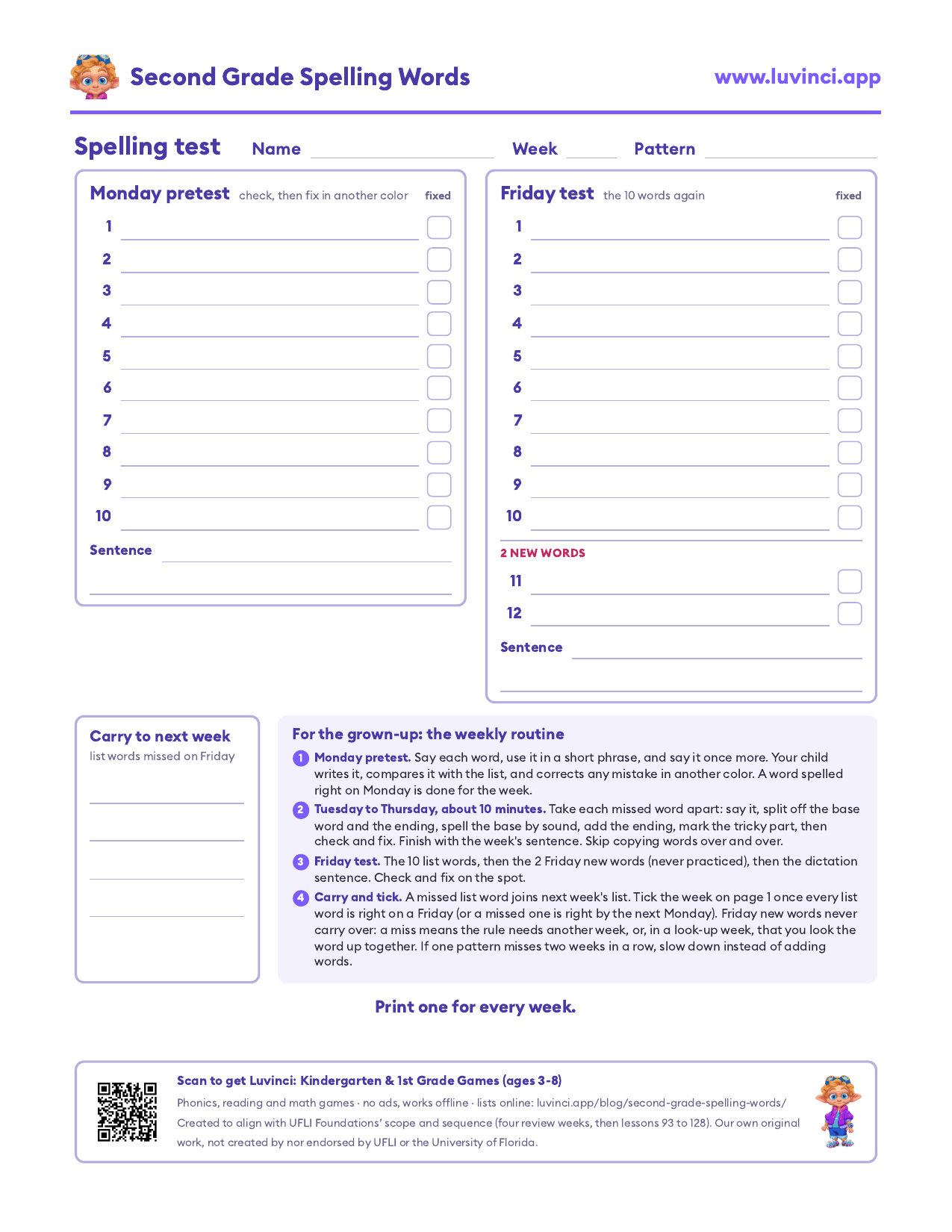
Page 5: print a fresh copy each week.
The week cards work as spelling worksheets for 2nd graders, at home or in class. You can also keep the whole file as a printable grade 2 spelling words PDF for the year. Get the free second grade spelling words PDF, with no signup and no email. Parents, tutors and teachers may print as many copies as they need. Practice pages for single patterns are in our printables library, which is also sorted as worksheets by lesson band.
The short version:
- One pattern a week, ten words, in the order phonics is taught.
- For a long word, take the ending off, spell the base, then put the ending back.
- Sound out the regular letters. Only the marked part is learned by heart.
- Monday pretest, ten minutes a day, then a Friday test plus two new words, with mistakes fixed on the spot.
- A missed list word moves to next week. Tick a week once all ten words are right.
Questions parents ask
What are 10 words for 2nd grade? One per big pattern: draw, bread, knee, glasses, hopping, making, cried, chair, school, picture.
How many words should a 2nd grader be able to spell? There is no official number. This list teaches 10 a week, 343 new words over the year, plus two Friday new words a week that use the pattern. Words right on the Monday pretest need no practice.
What are some good spell check words for a 2nd grader? Words your child hasn’t practiced that use a pattern they have learned. The two Friday new words each week are exactly that: paw in the au and aw week (aw ends a word), boil in review week 8 (oi sits inside one). A miss doesn’t join the list; the test section above says what it means.
Are spelling bee words for 2nd graders the same as a spelling list? No. A bee list is built to find the best speller in the room, so its words come from everywhere. A weekly list sticks to one pattern so your child can learn it. For a class bee, the 20 hard words above make a fair warm-up, since each one follows a pattern on the list.
What if my child isn’t ready for second grade words? Start with our first grade spelling words at the first week your child misses on a pretest. Many second graders need the vowel team weeks again first.
What about contractions like don’t? Only don’t is on the list, as a tricky word. Second grade standards add contractions: “Use an apostrophe to form contractions and frequently occurring possessives” (CCSS L.2.2c). Teach each one as two words squeezed together: do + not = don’t, and the apostrophe sits where the o was.
Our reading games sound out every letter and have your child pick the missing letter, ages 3 to 8, no ads, offline. Next: how kids learn to read, or the second grade sight words list for the words to read on sight.
Created to align with UFLI Foundations’ scope and sequence; lesson numbers are cited for alignment only. This post and its PDF are our own original work, not created by nor endorsed by UFLI or the University of Florida.
