Luvinci
August 8, 2026
Magic E Words: Silent E Words List by Vowel (Free PDF)
Free printable · PDF · 987 KB
Magic E Words: Silent E Words List by Vowel (Free PDF)
No signup needed. Just print it.
Download PDFMagic e words (also called silent e words or CVCe words) are words ending in silent e. That e makes the vowel before it say its long sound: cap becomes cape, kit becomes kite, hop becomes hope. The e itself is never pronounced.
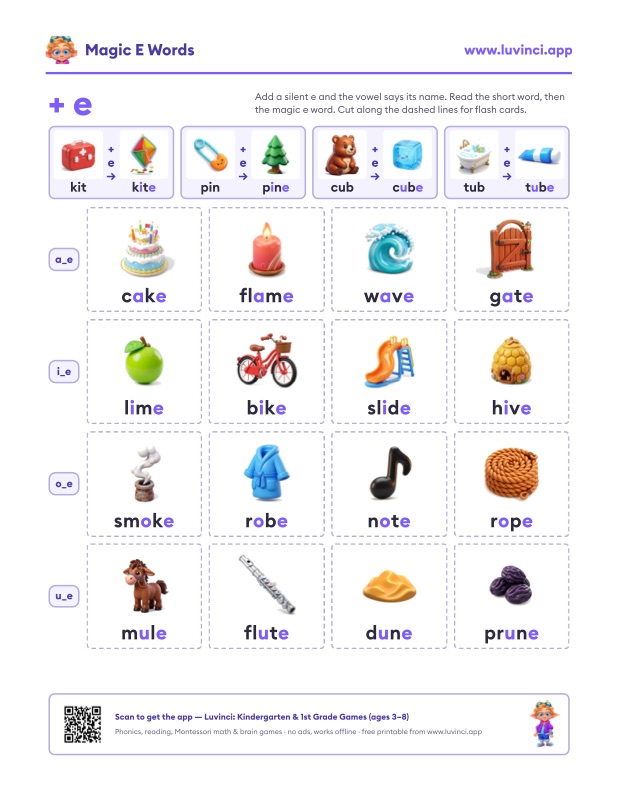
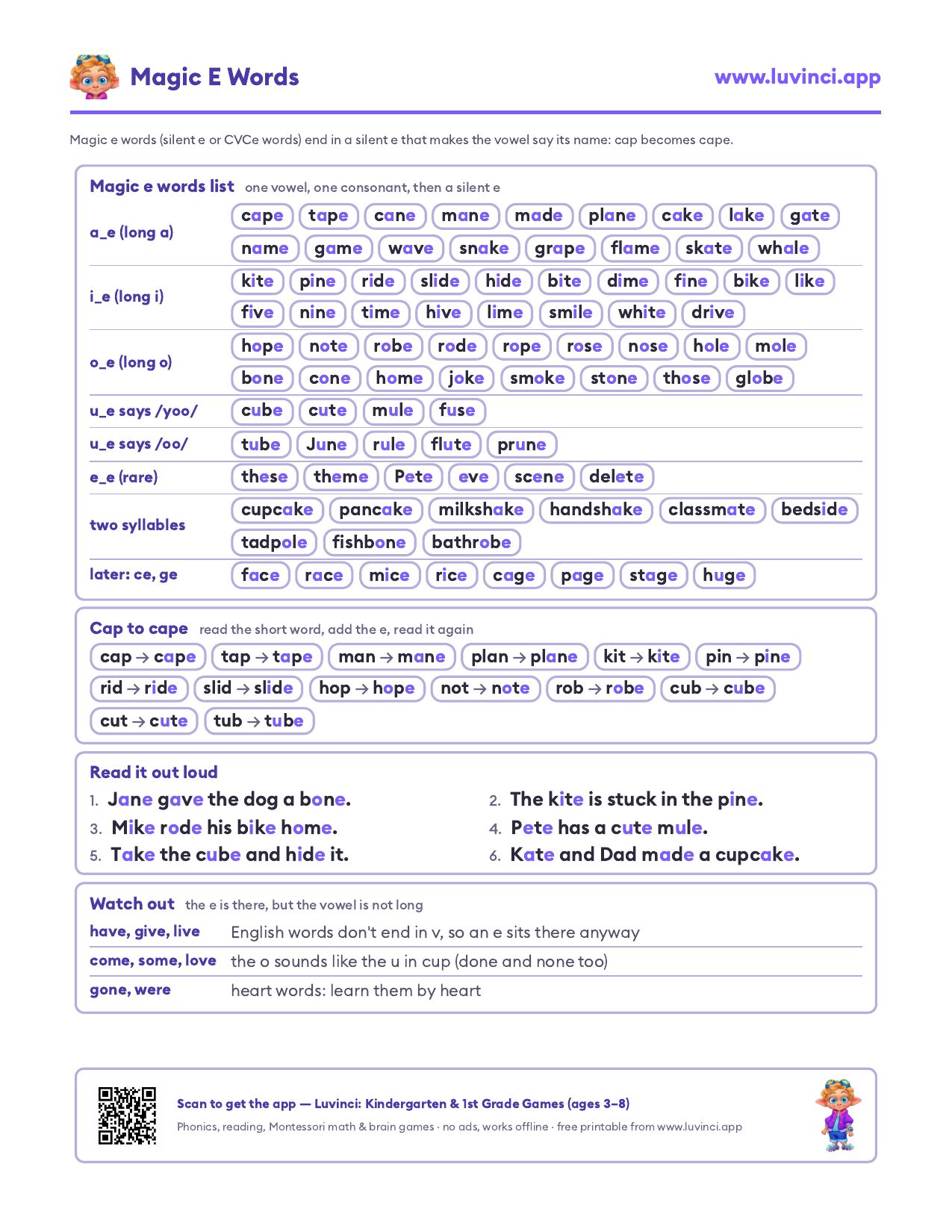
You’ll find a magic e words list sorted by vowel below, the cap to cape pairs that teach it best, the words that break the rule, and our free magic e words list PDF. It has 16 picture flash cards, 4 “add the e” pairs and the full list on page 2. No signup, no email.
What are magic e words?
A magic e word has one vowel, one consonant, then an e on the end: vowel-consonant-e. Teachers write the pattern as a_e, i_e, o_e, u_e. The underscore stands in for the consonant. So cake is a_e, bike is i_e, rope is o_e and cube is u_e.
The magic e rule: when a word ends in one vowel, one consonant and a silent e, the vowel says its name and the e says nothing. Four examples for each vowel:
- a_e: cake, gate, name, wave
- i_e: bike, kite, time, five
- o_e: rope, home, nose, bone
- u_e: cube, mule, June, flute
This pattern holds up as well as any in English. A 2008 study counted the vowel-consonant-e spelling in 954 words and found it gives the long vowel in about 95% of them. The misses tend to be longer words like palace and chocolate. The one-syllable words your child meets first follow the pattern.
Magic e words list by vowel: a_e, i_e, o_e, u_e
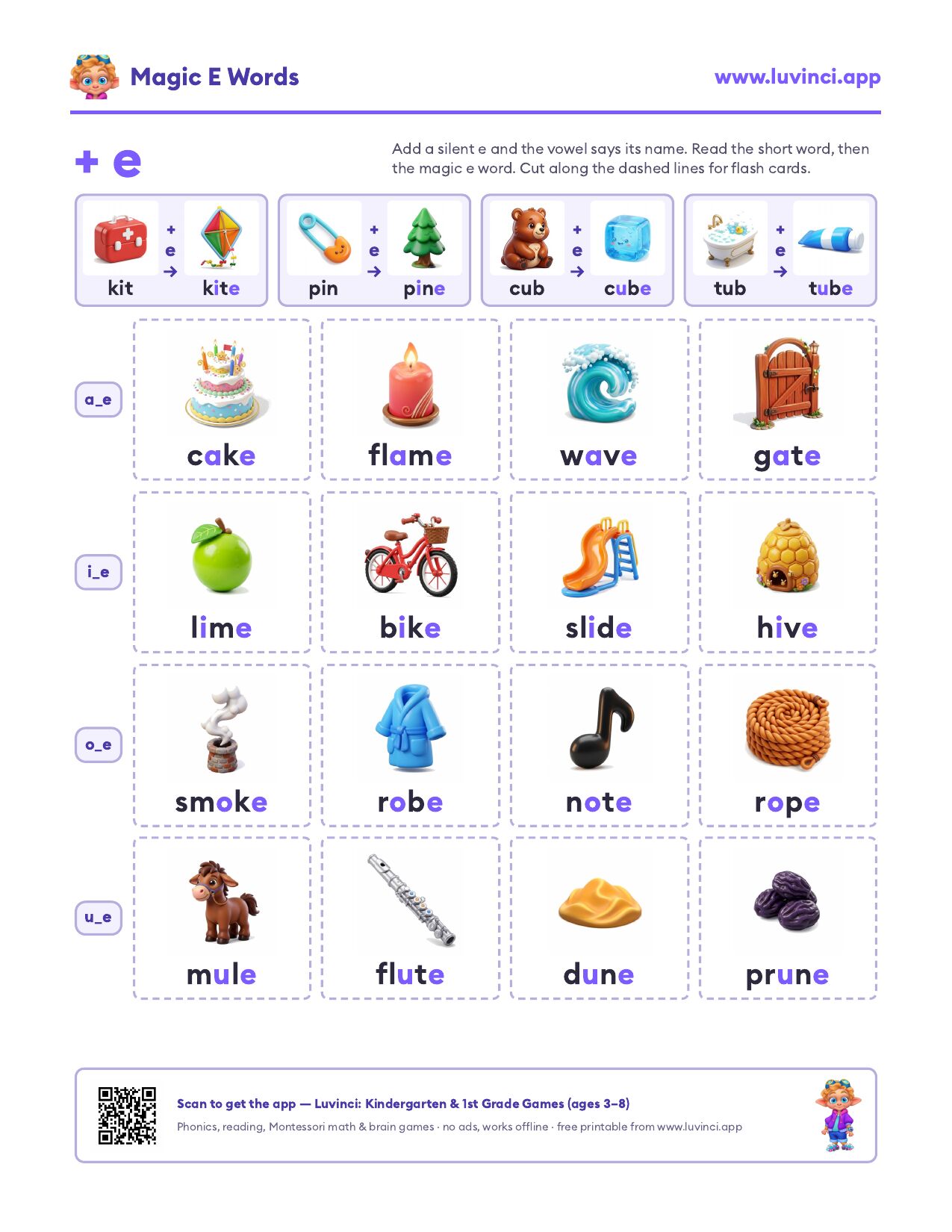
These are words with a silent e, grouped by vowel. Each vowel list is one-syllable words your child can sound out. One vowel, one consonant, then the e. Pair words sit first in each list. Reading cap and then cape is how the pattern clicks.
a_e words (long a)
cape, tape, cane, mane, made, plane, cake, lake, gate, name, game, wave, snake, grape, flame, skate, whale.
For ai, ay and every other way to spell the sound, see all long a words.
i_e words (long i)
kite, pine, ride, slide, hide, bite, dime, fine, bike, like, five, nine, time, hive, lime, smile, white, drive.
The igh, ie and y spellings are in all long i words.
o_e words (long o)
hope, note, robe, rode, rope, rose, nose, hole, mole, bone, cone, home, joke, smoke, stone, those, globe.
For oa, ow and oe, see all long o words.
u_e words: two sounds
The u says its long sound. That sound comes in two versions, and both count.
- /yoo/: cube, cute, mule, fuse
- /oo/: tube, June, rule, flute, prune
More, including ue and ew, in all long u words.
e_e words (rare)
these, theme, Pete, eve, scene, delete.
That’s nearly the whole list at this level. Point e_e out when it turns up in a book. Don’t drill it. Long e is mostly ee and ea, covered in all long e words.
Two-syllable magic e words
cupcake, pancake, milkshake, handshake, classmate, bedside, tadpole, fishbone, bathrobe.
Read them in two chunks, cup + cake. The first chunk is a short-vowel word your child already knows. The magic e only changes the second.
Later, words ending in ce and ge (face, mice, cage, huge) are still magic e words. The e has a second job there: it softens the c or g, so they’re also soft c and soft g words.
Cap to cape: CVC to CVCe word pairs
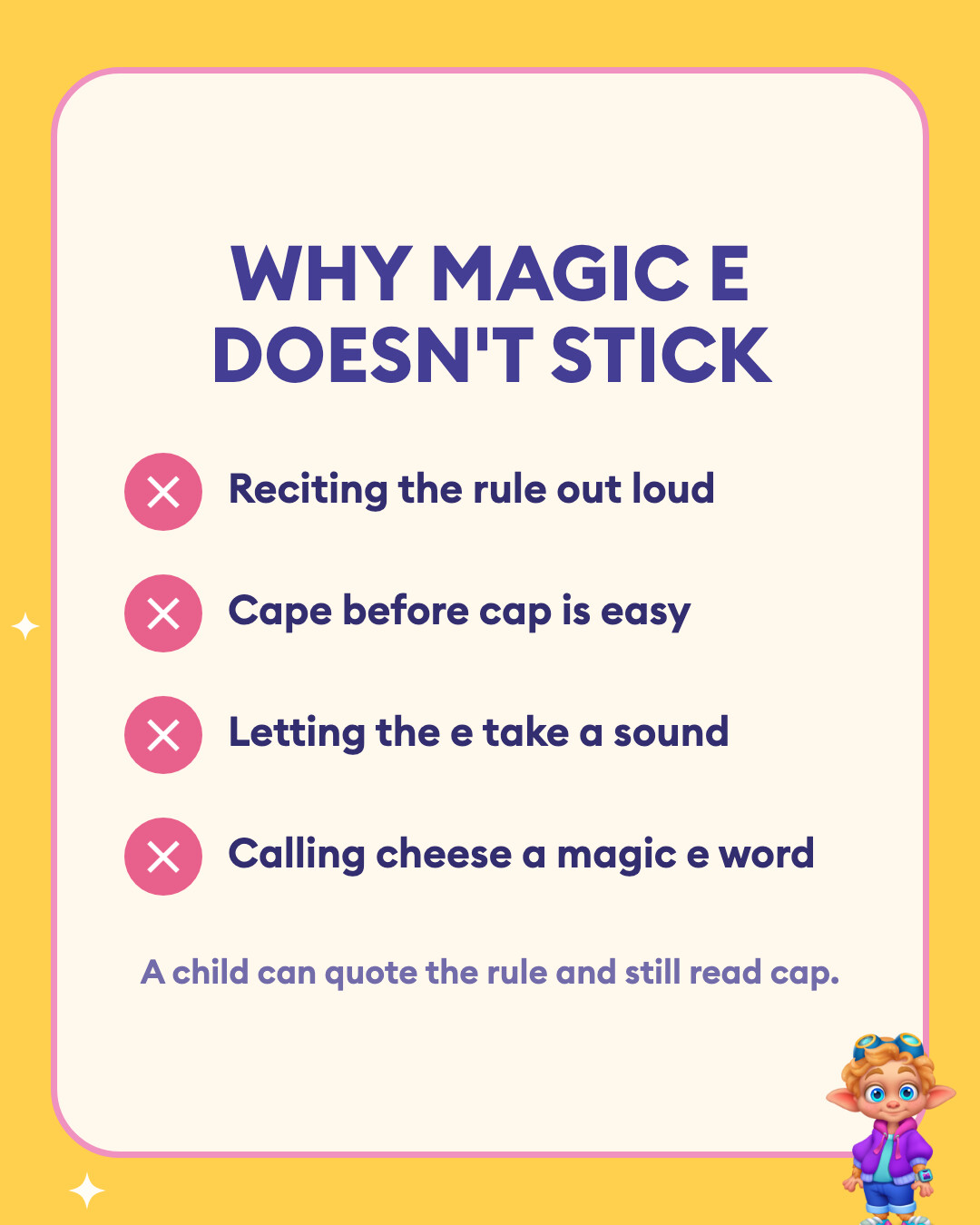
The lesson lives in the pair. A five-year-old can recite “silent e makes the vowel long” and still read cape as cap. Watching one word turn into another is what sticks.
| CVC word | Add the e | Vowel sound |
|---|---|---|
| cap | cape | long a |
| tap | tape | long a |
| man | mane | long a |
| plan | plane | long a |
| kit | kite | long i |
| pin | pine | long i |
| rid | ride | long i |
| slid | slide | long i |
| hop | hope | long o |
| not | note | long o |
| rob | robe | long o |
| cub | cube | long u |
| cut | cute | long u |
| tub | tube | long u |
How to use it at the table:
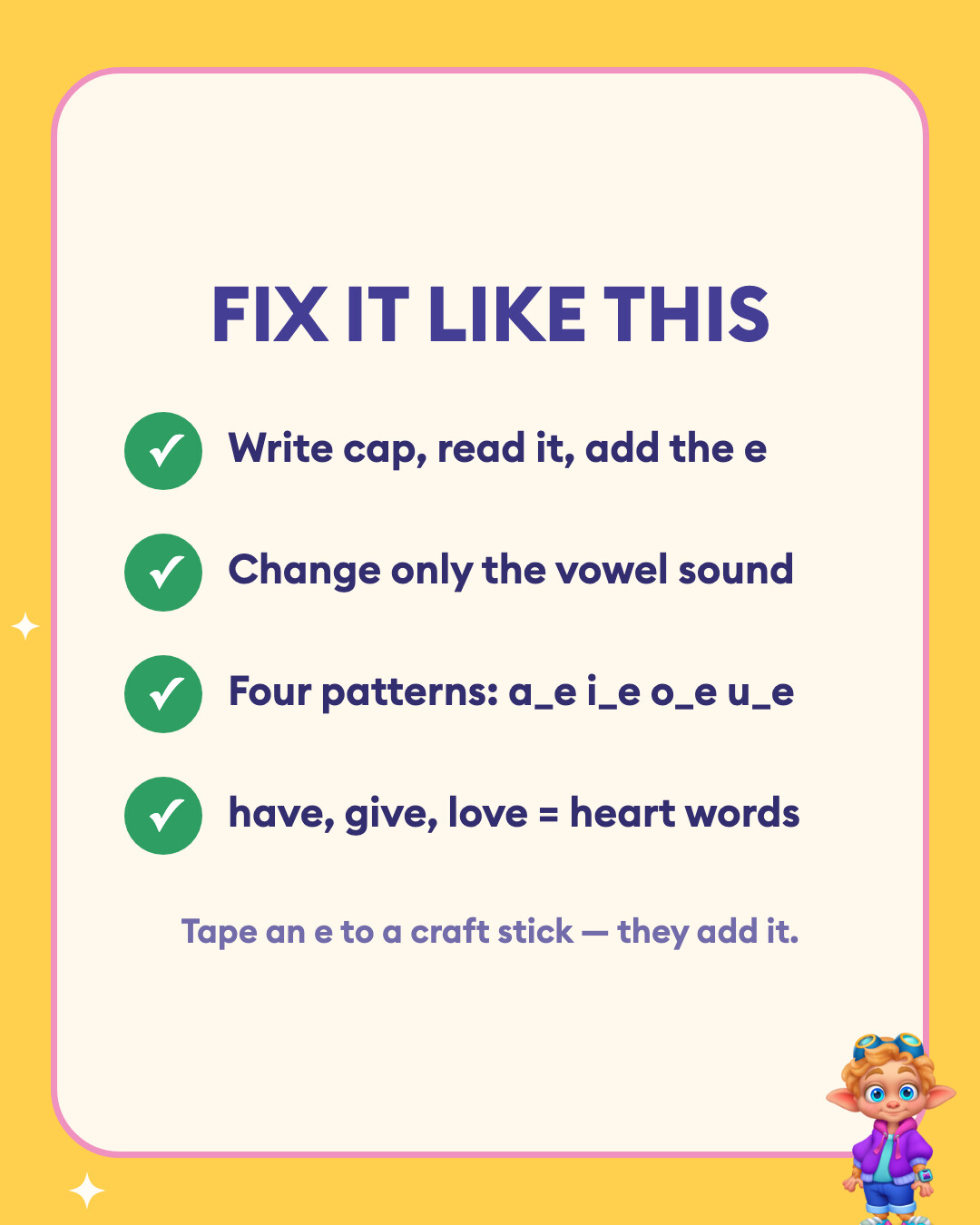
- Write the short word. Your child reads it: cap.
- Add the e. They read it again: cape.
- Ask what changed. Only the vowel did. The c and the p sound the same.
Tape a paper e to a craft stick so your child can add it themselves. The change happens in their hand. If you have our printable letter tiles, the purple magic e tile does the same job.
For the fridge, our free Magic E Sound Mat puts 22 magic e endings (ake, ime, ope, ute and more) on one page, each with a picture cue.
Your child has to tell short /a/ from long /ay/ to notice the switch. Our reading games sound out every word cleanly.
What are CVCe words?
CVCe words are magic e words by another name. The difference between CVC and CVCe words is one letter. A CVC word like hop ends in a consonant and has a short vowel. A CVCe word like hope adds a silent e and the vowel turns long. The letters stand for consonant-vowel-consonant-e.
You’ll also see VCe. That drops the first C because the pattern doesn’t need it (ate and ape are VCe words too). Reading programs call it the vowel-consonant-e syllable, one of the six syllable types children learn to spot in longer words.
Our library’s VCe worksheets were created to align with UFLI’s scope and sequence (lessons 54 to 62). They are our own original work, not created by nor endorsed by UFLI. Filter the library to those lessons.
Magic e, silent e, bossy e and split digraph: one pattern
“Silent e” says what the letter does (nothing). “Magic e”, “bossy e” and “sneaky e” say what it does to the vowel. US worksheets print VCe or CVCe, the Common Core standards say “final -e”, and UK schools call it a split digraph (Phase 5). Use the name your child’s school uses.
When magic e doesn’t work
Tell them this before they hit it cold. The e is sitting right there, and the vowel still isn’t long:
| Words | Why |
|---|---|
| have, give, live (the verb) | English words don’t end in v, so an e gets added whatever the vowel does |
| come, some, done, none | The o sounds like the u in cup |
| love, glove, dove | Both at once: a v ending, and an o that sounds like u |
| gone, were | Just odd. Learn them by heart |
Teach these as heart words. Sound out the letters that play fair and put a heart on the part that breaks the rule.
A silent e has other jobs too, in words that aren’t magic e words at all. It softens the c in dance and fence (the vowel stays short), keeps house from looking plural, and gives little a vowel in its last syllable. And the e in cheese isn’t a magic e. The pattern needs a single vowel letter before that one consonant, and ee is a vowel team.
Magic e sentences to read
Each sentence is decodable once a few heart words (the, a, is, his, has) are known:
- Jane gave the dog a bone.
- The kite is stuck in the pine.
- Mike rode his bike home.
- Pete has a cute mule.
- Take the cube and hide it.
- Kate and Dad made a cupcake.
To build their own, try our free cut-out sentence building worksheets, Long Vowels I and Long Vowels II.
When to teach magic e
Go by readiness. Your child should read CVC words like cap, hop and kit comfortably and know the short vowels cold. Magic e only makes sense once they know the “before” half of each pair. In the US that usually lands at the end of kindergarten or in 1st grade, where the Common Core standard (RF.1.3c) asks children to know the “final -e” convention.
In our teaching order, magic e comes after the short vowels, digraphs and blends, and before the vowel teams. It’s the first long-vowel spelling. It builds straight on words your child already reads. Many US programs use the same order. Some, and UK phonics, teach the vowel teams first. Either way works. Just don’t start both in the same week.
Magic e is one long-vowel spelling. Our long vowel words guide has all five sounds and every spelling.
Free magic e printables
- Magic E Words List PDF: picture flash cards, pairs, the full list and sentences.
- Magic E Sound Mat: 22 endings with picture cues.
- Magic e worksheets: read-and-write sheets for a_e, i_e, o_e and u_e.
- Letter tiles: build cap, add the e, read cape.
Questions parents ask
What is magic e called now? Many US reading programs say silent e, CVCe or VCe. “Magic e” is still common at home and in early grades. UK schools say split digraph. They all mean the same pattern.
Is silent e the same as magic e? For this pattern, yes. The silent e at the end of cape is the magic e. But not every silent e is doing the magic e job. In dance, house and little it’s there for other reasons, and the vowel doesn’t change.
Is some a magic e word? No. It has the shape, but the o sounds like the u in cup, not like the o in home. Some, come, done and love are heart words.
What grade is magic e taught? Usually 1st grade, often starting at the end of kindergarten. It follows solid CVC reading, not a birthday. A child still sounding out cap isn’t ready for cape.
What are 10 words that contain the magic e? Cake, gate, name, kite, bike, five, rope, home, cube and flute. Start with words that have a short partner, like kit and kite.
Does every silent e make the vowel long? No. In have and love it’s there because English words don’t end in v. In dance it softens the c. Magic e needs one vowel, one consonant, then the e.
My child reads “cape” as “cap-ee.” The e is getting a sound of its own. Cover it with a finger, read the short word, then uncover it and change only the vowel. A magic e is never pronounced.
Print the free Magic E Words List: 16 picture flash cards, the pairs and the full list, two pages.