 Luvinci
October 2, 2026
First Grade Spelling Words: 36 Weekly 1st Grade Spelling Lists (Free PDF)
Free printable · PDF · 717 KB
First Grade Spelling Words: 36 Weekly 1st Grade Spelling Lists (Free PDF)
No signup needed. Just print it.
Download PDFFirst grade spelling words are the short weekly lists a child learns to spell in 1st grade, usually ten words that share one phonics pattern. This list of spelling words for first graders runs 36 weeks in the order phonics is taught. Short vowels come first, then blends, digraphs, magic e, endings, bossy r and vowel teams. Every pattern word uses only spellings taught by that week. Heart words (labeled Tricky on the list) are the planned exceptions, and the tricky part of each is marked. The checklist shows which weeks are mastered.
Print all 36 weeks and a reusable spelling test sheet in our free first grade spelling words PDF. That’s 5 pages, no signup, no email.
Jump to: the list by week · what they should spell · the weekly test · free PDF
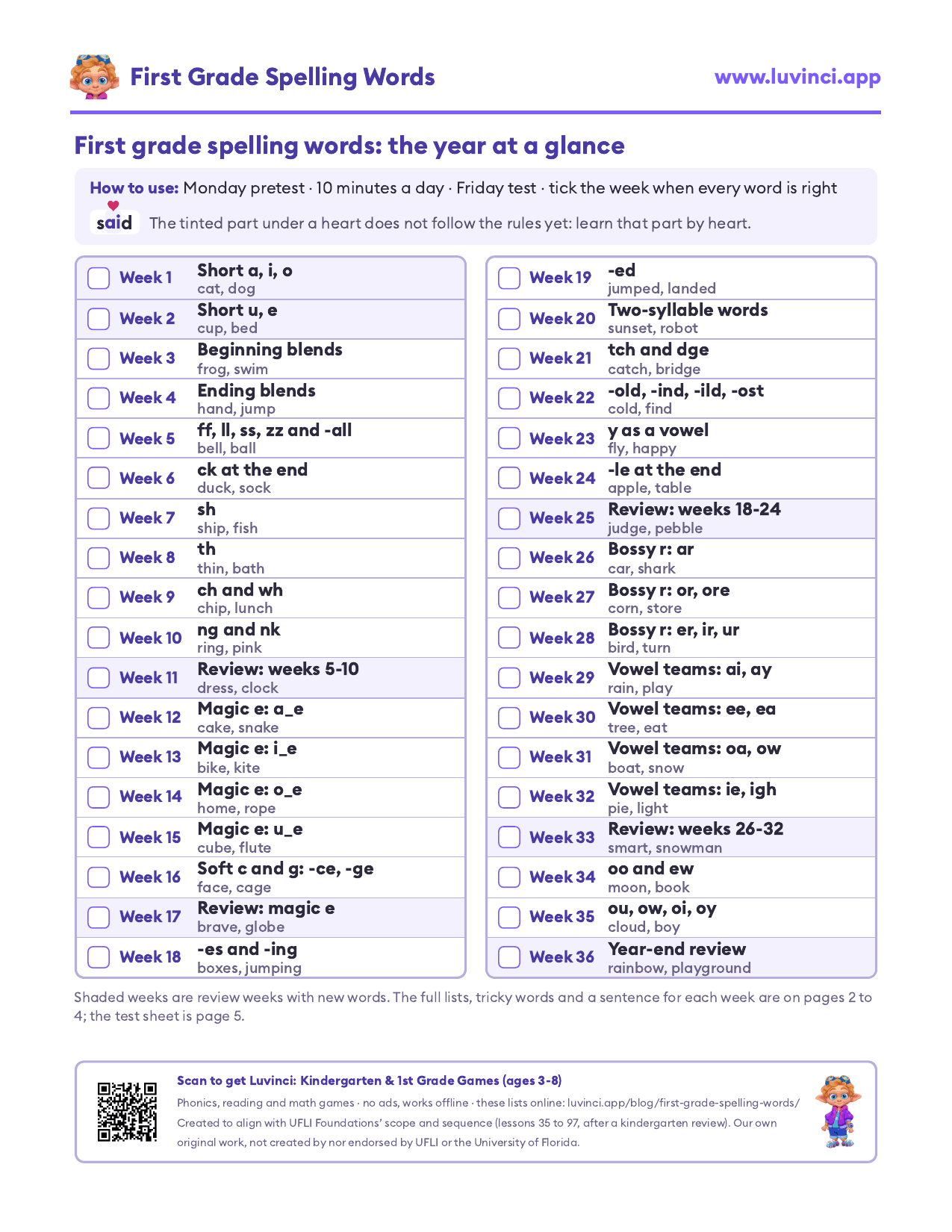
Page 1 of the free PDF shows the whole year on one page.
What should a 1st grader be able to spell?
By the end of the year, a first grader should know how to spell these reliably:
- Short vowel words with blends and digraphs: frog, ship, lunch
- Double letters and ck: bell, duck
- The tricky words they write most: the, said, they
They will also have been taught these, but don’t expect them right every time yet:
- Magic e: cake, bike, home
- Endings on words that don’t change: wishes, jumped, singing
- Bossy r: car, fork, bird
- The common vowel teams: rain, tree, boat, moon
- The rest of about 50 tricky words: could, friend, mother
That’s normal. Magic e may not be solid until 2nd or 3rd grade (Moats, 2005/06).
Reading gets a lift from spelling too. “Spelling and reading build and rely on the same mental representation of a word” (Snow et al., quoted by Moats). So spelling practice builds the same memory of a word that reading uses.
First grade spelling words list by week
This list of spelling words for 1st graders was created to align with UFLI Foundations’ scope and sequence, lessons 35 to 97 (lesson numbers for reference; au/aw and ea as in bread come later), after a two-week review of kindergarten. Each week has ten words: 8 or 9 that follow the week’s pattern and 1 or 2 heart words.
How to read a week:
- Tricky: the week’s heart words. Hearts mark the part in parentheses. Your child spells the rest by sound.
- [Brackets]: a hint you say aloud, so your child knows which word you mean (two, not to).
- Tip: a spelling choice the week asks for.
- Say it, write it: the dictation sentence.
Starting partway through the year? Pretest the first week of each group below and start at the first week your child can’t spell yet. Skip practice on any word your child already gets right on the Monday pretest. Carry Friday misses onto next week’s list.
Weeks 1-2: short vowel review
Use these two weeks to check kindergarten CVC words and the short vowels. Skip ahead if the pretest is clean.
Week 1 · short a, i, o: cat, map, bag, pig, sit, lid, dog, hot · Tricky: the (whole word), of (whole word)
Say it, write it: The lid of the pot is hot.
Week 2 · short u, e: cup, mud, rug, tub, bed, hen, wet, leg · Tricky: said (ai), was (a, s)
Say it, write it: He said the rug was wet.
Weeks 3-4: blends
Every sound in a consonant blend gets its own letter, and ending blends are the ones kids drop.
Week 3 · beginning blends: frog, crab, drum, flag, sled, step, swim, spot · Tricky: to (o) [I want to go], do (o)
Say it, write it: Do not swim to the flag.
Week 4 · ending blends: hand, nest, jump, milk, tent, lamp, gift, best · Tricky: from (o), want (a)
Say it, write it: I want a lamp from the tent.
Weeks 5-11: double letters, ck and digraphs
ff, ll, ss and zz double after a short vowel at the end of a short word (the floss rule), and sh, th, ch and wh are two letters for one sound (digraphs).
Week 5 · ff, ll, ss, zz and -all: bell, hill, miss, off, buzz, ball, tall, small · Tricky: you (ou), have (e)
Say it, write it: You will have a big red ball.
Week 6 · ck at the end: back, duck, kick, lock, neck, sock, truck, stick · Tricky: has (s), his (s)
Tip: ck right after a short vowel (duck, kick); after a consonant, just k (milk, week 4).
Say it, write it: His duck has a black neck.
Week 7 · sh: ship, shop, fish, dish, wish, shell, brush, shut · Tricky: could (oul), should (oul)
Tip: could and should share oul; would joins them in week 18.
Say it, write it: Should we fish from the ship?
Week 8 · th: thick, that, them, then, with, bath, thin, moth · Tricky: they (ey), there (ere) [over there]
Say it, write it: They said there is a moth in the bath.
Week 9 · ch and wh: chip, chin, chick, chop, much, lunch, bench, when · Tricky: what (a), where (ere) [where is it?]
Say it, write it: Where can we sit when we get lunch?
Week 10 · ng and nk: sing, ring, long, swing, pink, drink, think, thank · Tricky: who (wh, o), two (wo) [the number 2]
Say it, write it: Who has two pink rings?
Week 11 · review (weeks 5-10): spell, dress, clock, fresh, chest, cloth, string, blank · Tricky: said (ai), they (ey)
Say it, write it: They said the dress was in the trunk.
Weeks 12-17: magic e
The silent e makes the vowel say its name (magic e words), and in week 16 it also makes c say /s/ and g say /j/ (soft c).
Week 12 · a_e: cake, game, lake, name, gate, plate, snake, shape, grape · Tricky: are (e)
Tip: The ar in are is bossy r (week 26); until then, learn the whole word by heart.
Say it, write it: The grapes are on the plate.
Week 13 · i_e: bike, kite, five, ride, time, smile, slide, white · Tricky: give (e), live (e) [to live]
Say it, write it: I will give him a white kite.
Week 14 · o_e: home, bone, rope, stone, note, joke, hope, broke · Tricky: come (o, e), some (o, e) [some of it]
Say it, write it: The dog will come home with some bones.
Week 15 · u_e: cube, cute, mule, tube, flute, rule, tune, rude · Tricky: here (ere) [come here], were (last e)
Tip: u_e says /yoo/ in cube, cute and mule, /oo/ in tube, rule, flute, tune and rude.
Say it, write it: The cute mules were here.
Week 16 · -ce and -ge: face, race, space, rice, mice, nice, page, cage · Tricky: one (o, e) [the number 1], once (o)
Say it, write it: Once, one of the mice ran in a race.
Week 17 · review (weeks 12-16): flame, brave, shine, stripe, globe, smoke, huge, price · Tricky: come (o, e), were (last e)
Say it, write it: We were brave on the huge slide.
Weeks 18-25: word endings and longer words
-ed comes a week after -ing here, because -ed has three sounds. Long words split into two syllables, and tch follows a short vowel (tch words).
Week 18 · -es and -ing: dishes, boxes, foxes, wishes, lunches, jumping, fishing, singing · Tricky: does (o, e, s), would (oul) [would you?]
Tip: would has the same oul as could and should (week 7).
Say it, write it: Does he help with the dishes?
Week 19 · -ed: jumped, helped, kicked, filled, spilled, landed, planted, melted · Tricky: walk (al), as (s)
Tip: -ed comes a week after -ing here: it has three sounds, so it gets its own week.
Say it, write it: As we walked, I kicked the ball.
Week 20 · two-syllable words: sunset, bathtub, sandbox, cupcake, backpack, napkin, basket, robot · Tricky: into (o), again (a, ai)
Say it, write it: The robot fell into the bathtub again.
Week 21 · tch and dge: catch, match, fetch, stretch, sketch, badge, bridge, edge, fudge · Tricky: friend (ie)
Tip: tch after a short vowel; much, such, rich and which break this rule.
Say it, write it: His friend can catch a fish from the bridge.
Week 22 · -old, -ind, -ild, -ost: old, cold, gold, hold, find, kind, child, wild, most · Tricky: both (o)
Say it, write it: Both of the kids can find the gold.
Week 23 · y as a vowel: my, by [sit by me], fly, cry, sky, happy, puppy, funny · Tricky: any (a), many (a)
Tip: my and fly end in y; pie and tie (week 32) end in ie.
Say it, write it: My funny puppy has many friends.
Week 24 · -le: little, apple, bubble, puzzle, table, candle, giggle, middle, jungle · Tricky: people (eo)
Say it, write it: Some people sat at the little table.
Week 25 · review (weeks 18-24): patches, judge, behind, sticky, crying, rested, pebble, buzzing · Tricky: does (o, e, s), again (a, ai)
Say it, write it: The puppy is crying behind the bench again.
Weeks 26-28: bossy r
When r follows the vowel, the sound changes (bossy r). er, ir and ur sound the same, so week 28 is learned word by word.
Week 26 · ar: car, star, jar, park, farm, barn, shark, yard, dark · Tricky: pretty (e)
Say it, write it: The farm has a pretty red barn.
Week 27 · or, ore: for [a gift for you], fork, corn, horn, storm, short, more, store, snore · Tricky: your (ou) [your hat]
Tip: At the end, /or/ is usually ore (more, store, snore); for is the odd one out.
Say it, write it: Can you get more corn for your pet?
Week 28 · er, ir, ur: her, after, over, bird, girl, first, shirt, turn · Tricky: mother (o), brother (o)
Tip: er, ir and ur sound the same: learn which one each word uses.
Say it, write it: Her brother and mother came first.
Weeks 29-36: vowel teams, oo, ou and oi
Two letters spell one vowel sound (vowel teams). Where a sound has two spellings, its place in the word usually decides (which spelling goes where).
Week 29 · ai, ay: rain, train, paint, snail, chain, play, stay, tray, clay · Tricky: today (o)
Tip: ai inside a word (rain, paint), ay at the end (play, clay).
Say it, write it: We can play in the rain today.
Week 30 · ee, ea: green, tree, sheep, sleep, three, teeth, eat, clean · Tricky: please (se), been (ee) [I have been]
Tip: ee and ea sound the same: learn which one each word uses.
Say it, write it: Please clean your teeth before bed.
Week 31 · oa, ow: boat, coat, goat, soap, toast, snow, grow, slow, bowl · Tricky: know (kn) [I know]
Tip: oa inside a word (boat, soap); ow at the end or before n or l (snow, bowl).
Say it, write it: Do you know where my coat is?
Week 32 · ie, igh: pie, tie, light, bright, tight, flight, might, flashlight, sunlight · Tricky: buy (uy) [buy at a store]
Tip: igh in the -ight words; pie and tie end in ie, but my and fly end in y (week 23); kite and white use i_e (week 13).
Say it, write it: I might buy a pie.
Week 33 · review (weeks 26-32): smart, porch, winter, chirp, spray, sweet, float, snowman · Tricky: your (ou) [your hat], know (kn) [I know]
Tip: For er, ir, ur, ee and ea words, a miss means learn that word, not reteach the pattern.
Say it, write it: I know your snowman is on the porch.
Week 34 · oo and ew: moon, spoon, zoo, book, look, good, foot, grew, chew · Tricky: put (u)
Tip: oo and ew both come at the end (zoo, grew): learn which one each word uses.
Say it, write it: Put the spoon by the good book.
Week 35 · ou, ow, oi, oy: out, round, cloud, how, down, brown, coin, boy, toy · Tricky: four (our) [the number 4]
Tip: ou inside a word (out, cloud), ow at the end or before n (how, down); oi inside (coin), oy at the end (boy, toy).
Say it, write it: The boy has four round coins.
Week 36 · year-end review: splash, rainbow, teacher, starfish, goldfish, thunder, toothbrush, playground · Tricky: were (last e), could (oul)
Say it, write it: We could see a rainbow from the playground.
The tricky words on the list
One or two words each week have a part that doesn’t follow the patterns taught so far. Moats suggests introducing about three to five irregular words a week, starting with the ones children write most often. We keep it to one or two here, so the week’s pattern stays the focus, and reading practice adds more.
The marks work like our 1st grade heart words. Your child spells the regular part by sound and learns only the marked part. In said, the s and d are regular; only the ai is learned. Correct a tricky word on the spot, so “sed” never settles in.
Four tricky words here are new to our heart word lists: should (oul), friend (ie), mother (o) and brother (o). First graders write them often.
Because spelling comes after reading, a few words your child already reads on sight (as, has, his, once, put, again) show up later here. For the reading side, see first grade sight words: read it, then spell it. The marks follow American speech: in some accents been and again spell by sound.
Easy and hard 1st grade spelling words
Easy spelling words for 1st graders have one short vowel and three sounds. They open the year.
10 easy 1st grade spelling words: cat, map, pig, sit, dog, hot, cup, rug, bed, hen
“Hard” here means late in the order, not rare. These 20 hard words to spell at the end of first grade join two patterns or two syllables:
20 hard words: splash, rainbow, teacher, starfish, goldfish, thunder, toothbrush, playground, snowman, sunlight, patches, behind, bridge, stretch, pebble, puzzle, buzzing, crying, spray, chirp
If a word stalls, go back to its week and practice that pattern.
How to give a first grade spelling test at home
A spelling test for first graders works best as a quick check at the start and end of the week, not a grade. You’ll find the same four steps on page 5 of the PDF.
- Monday pretest. Say the word, say it in a short phrase, say the word again. Your child writes it, then checks each word against the list and fixes it in a different color. Words right on Monday need no practice this week.
- Tuesday to Thursday, about 10 minutes. For each missed word: say it, tap the sounds, write a letter or chunk for each sound, mark the tricky part, check, fix. Then the week’s sentence. No copying words out ten times.
- Friday test. All 10 words again, same say-phrase-say routine, then the dictation sentence. Check and fix right away.
- Carry and tick. Missed words go onto next week’s list. A week is mastered when every word is right on a Friday (or a missed word is right the next Monday): tick it on page 1.
Review weeks (11, 17, 25, 33, 36) use new words with old patterns, so a pass shows the pattern stuck. If one pattern fails, go back to that week, not the whole unit. For er, ir, ur, ee and ea words, a miss means learn that word, not reteach the pattern. If the same pattern misses two weeks running, slow down instead of adding words.
One of the oldest-supported spelling methods is fixing the test right away (T. D. Horn, 1947, via Pan, Rickard and Bjork, 2021). Testing beats copying, too. First graders who practiced by trying, checking and fixing gained several times more than children who did rainbow writing, and children preferred it about 3 to 1 (Jones et al., 2016, in the same review).
The best way to teach spelling to a 1st grader
Spelling is encoding. Hear a word, break it into sounds, write a letter or chunk for each sound. Reading runs the other way. That’s why a list built by pattern works better than ten words to memorize by shape. A classic 1966 analysis found that about half of English words can be spelled from their sounds and patterns alone, and another 34% with one error, usually the vowel; only about 4% are truly irregular (Hanna et al., via Moats).
For each new word:
- Say it.
- Tap the sounds.
- Write a letter or chunk for each sound.
- Mark the tricky part, if there is one.
- Check against the list, and fix it.
Tie each letter to its sound and the spelling, sound and meaning bond in memory, so the word sticks for reading too (Ehri, 2014). A review of 53 studies found that teaching spelling directly improves spelling and reading (Graham and Santangelo, 2014).
At home, about 10 to 15 minutes a day is plenty. If writing is slow, start by building the word with letter tiles, then write it. Tricky words get the same steps: map it, don’t memorize it.
Spelling activities for first graders (5-10 minutes)
Pick one. Stop while it’s still fun.
- Build and swap. Build ship with tiles, then change one letter: shop, shot.
- Sort by spelling. In the ee/ea and er/ir/ur weeks, sort the words into piles by spelling.
- Fix my mistakes. You write three words wrong (sed, fishe, jumpt). Your child finds and fixes them.
- Spelling games outside. Write the week’s words in chalk, or with a finger in sand.
Free first grade spelling words PDF
- Page 1: the year at a glance, with a box to tick when a week is mastered.
- Pages 2-4: all 36 week cards, with the pattern words, the tricky words with the part marked, the tips and a dictation sentence for every week.
- Page 5: a reusable spelling test sheet: Monday pretest, Friday test and words to carry over.
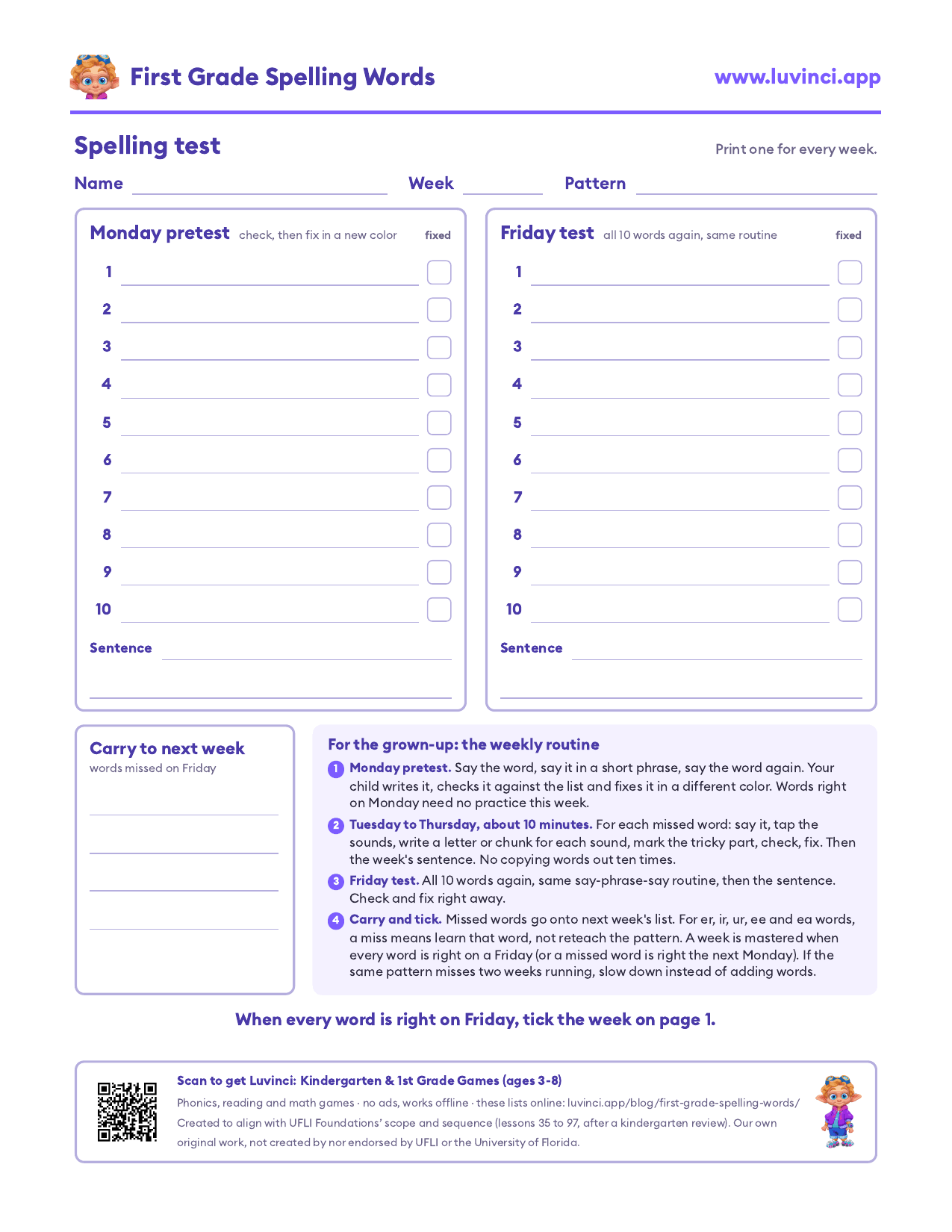
Page 5. Print one test sheet a week.
Use it as spelling worksheets for first graders all year, at school or at home, and as a printable grade 1 spelling words PDF. Download the free first grade spelling words PDF. No signup, no email. For practice pages by pattern, see our printables library, sorted as worksheets by lesson band.
The short version:
- Ten words a week, one pattern at a time, in phonics order.
- Spell the regular part by sound; learn only the marked part by heart.
- Pretest on Monday, practice 10 minutes a day, test on Friday, fix right away.
- Missed words carry over. Tick a week when every word is right.
- Try, check and fix beats copying a word out ten times.
Questions parents ask
Do first graders take spelling tests? Many classes give a weekly test. Programs that dictate sentences every lesson (UFLI does) check spelling daily without calling it a test. At home, a 5-minute Monday and Friday check is plenty.
What are 10 words for 1st graders? One per big pattern: cat, frog, bell, ship, cake, jumped, car, rain, moon, boy.
What words should a 7 year old spell? A 7-year-old is usually in 1st or 2nd grade. By then, aim for short vowel words with blends and digraphs, magic e words, common endings, and tricky words like said, they and could. Magic e and vowel teams are often still shaky, and that’s normal.
Can you give me a list of spelling words for 1st grade? Yes. The list by week above has 350 words in 36 weeks, and the PDF has all of them on week cards.
Is there a spelling quiz for first grade? The test sheet on page 5 of the PDF is the quiz. You say the word, your child writes it, then checks and fixes it right away.
Are spelling bee words the same as a spelling list? No. Bee lists are hard words for a contest, picked to be tricky. A weekly list teaches one pattern at a time.
What if my child is in kindergarten? Weeks 1-2 are short vowel words like cat and bed, the spelling many kindergartens finish with. Start there, a few words a week, and skip the test.
Our reading games sound out every letter and have your child pick the missing letter, ages 3 to 8, no ads, offline. Next: how kids learn to read, or the first grade sight words list for the words to read on sight. Ready for more? Our second grade spelling words pick up where this list stops.
Created to align with UFLI Foundations’ scope and sequence; lesson numbers are cited for alignment only. This post and its PDF are our own original work, not created by nor endorsed by UFLI or the University of Florida.
