 Luvinci
September 21, 2026
Ways to Make 10 and the Make 10 Strategy (Free PDF)
Free printable · PDF · 611 KB
Ways to Make 10 and the Make 10 Strategy (Free PDF)
No signup needed. Just print it.
Download PDFThere are 11 ways to make 10 with whole numbers, from 0 + 10 all the way to 10 + 0. Once those pairs are in your child’s head, a lot of adding and subtracting gets easier. 7 and 3 make 10, so 7 + 5 is an easy sum. The same pair turns 10 take away 4 into a quick fact. You’ll get the pairs for kindergarten here, plus the make 10 strategy for 1st grade.
0 + 10, 1 + 9, 2 + 8, 3 + 7, 4 + 6, 5 + 5, 6 + 4, 7 + 3, 8 + 2, 9 + 1, 10 + 0
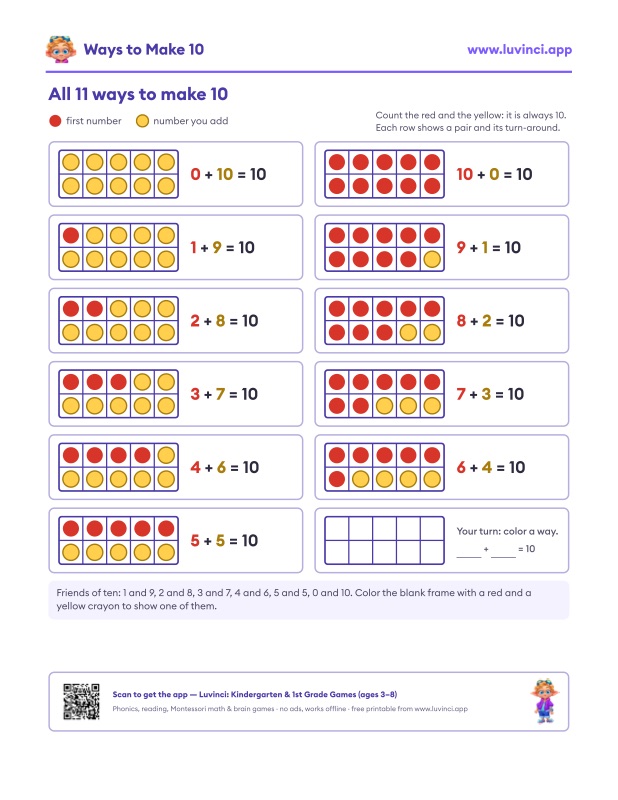
Our free Ways to Make 10 PDF has three pages. Page 1 shows all 11 ways on two-color ten frames. Page 2 has cut-out cards for two make 10 card games. Page 3 practices the make 10 strategy. No signup, no email.
All the ways to make 10
A ten frame is a box of 10 squares, two rows of five. Fill it with counters in two colors and you can see a way to make 10. Three red and seven yellow is 3 + 7. Swap the colors and it’s 7 + 3. The frame is always full, so the total is always 10.
Here are all 11, with each pair next to its turn-around:
| A way to make 10 | Its turn-around |
|---|---|
| 0 + 10 | 10 + 0 |
| 1 + 9 | 9 + 1 |
| 2 + 8 | 8 + 2 |
| 3 + 7 | 7 + 3 |
| 4 + 6 | 6 + 4 |
| 5 + 5 | 5 + 5 (it is its own turn-around) |
So how many ways are there? 11 if order counts (3 + 7 and 7 + 3 are two different ways). 6 if you count each pair once. Both answers are right.
Page 1 of the free PDF draws all 11 on ten frames. The first number is red and the second is yellow, like the two-color counters kids use at school. Red and yellow still look different on a black-and-white printer. A blank frame at the bottom lets your child color a way of their own.
Here’s why the ten frame works so well. Your child doesn’t have to count every dot. The top row is 5, so they learn to see 7 as “five and two more”. The empty squares show what’s missing. Put in 6 counters, and the 4 empty squares are the number that makes 10. If you’d like blank frames to fill with real counters, our ten frame printable has a big work mat and small frames.
One of the app’s Singapore Math boards has sums that make 8 and 10. Its make-10 sums are 7 + 3, 6 + 4, 5 + 5 and 8 + 2, each on two ten frames of pictures. That’s four of the 11 ways, so the full set lives on paper.
These pairs are also called number bonds to 10. 10 is the whole and the two numbers are its parts.
Friends of ten
Many classrooms call two numbers that make 10 “friends of ten”. They’re a pair, like best friends: 1 and 9, 2 and 8, 3 and 7, 4 and 6, 5 and 5 (and 0 and 10).
You’ll know the friends of ten are in place when your child answers without counting. You say “6”, and they say “4” straight away. In the US Common Core standards, kindergartners learn to find the number that makes 10 with any number from 1 to 9. First graders then use it to add bigger numbers.
5 and 5 is a special pair. It fills the ten frame with two equal rows, and 5 + 5 is also a doubles fact. The other doubles are in our doubles facts guide.
Fingers are a ten frame too. You’ve got two hands and ten fingers. Hold up 7 and ask how many fingers are down. That’s 3, the friend of 7. You can do it anywhere.
A quick way to practice:
- Start with 5 and 5, and 9 and 1. They’re the easiest to see. 9 is one away from a full frame.
- Add 8 and 2. Two empty squares are easy to spot.
- Then 7 and 3, and 6 and 4. These take the longest. Use the ten frame until your child “just knows” them.
- Mix them up. Say a number from 0 to 10, and your child says its friend. A minute or two a day is plenty.
Subtraction from 10 comes almost free once the friends of ten are quick. If 6 and 4 make 10, then 10 take away 4 is 6.
The make 10 strategy
The make 10 strategy is a way to add two numbers that go past 10. It’s a 1st grade skill for sums up to 20, and it only works once the friends of ten are solid.
Here’s how it goes, with 8 + 5:
- 8 needs 2 to make 10. (8 and 2 are friends of ten.)
- Split the 5 into 2 and 3. Give the 2 to the 8.
- Now it’s 10 + 3. That’s 13.
So 8 + 5 = 8 + 2 + 3 = 10 + 3 = 13. Teachers call this “making a ten” or “bridging through ten”.
More examples:
- 9 + 4: 9 needs 1. Split 4 into 1 and 3. 10 + 3 = 13.
- 7 + 5: 7 needs 3. Split 5 into 3 and 2. 10 + 2 = 12.
- 9 + 8: 9 needs 1. Split 8 into 1 and 7. 10 + 7 = 17.
- 8 + 6: 8 needs 2. Split 6 into 2 and 4. 10 + 4 = 14.
If the small number comes first, turn it around. 4 + 9 is the same as 9 + 4, and 9 is closer to 10. So start with the 9.
Here’s why it helps. Adding to 10 is easy, because 10 + 3 is just “thirteen”. Counting on one at a time is slow and easy to get wrong. A hard fact becomes two easy ones.
What your child needs first:
- Friends of ten, without counting.
- Splitting a small number. To split 5 into 2 and 3, they need the bonds of 5. Our number bonds guide has them all.
- Ten and some more. 10 + 3 is 13, 10 + 7 is 17. If teen numbers are still new, practice those first.
Show it on two ten frames. Put 8 red counters in the first frame and hold 5 yellow ones in your hand. Fill the first frame with 2 of them. It’s full, so that’s 10. The other 3 go in the second frame. Your child can see 10 and 3 at once. Page 3 of the PDF has six of these, with 7, 8 or 9 as the first number and answers from 11 to 17. The first one is worked for you, and the answers are in small print at the bottom for grown-ups.
Stick with the pairs that make 10 in kindergarten. Once those are automatic, the strategy clicks much faster.
Make 10 games
Make 10 games are the easiest way to practice ways to make 10 over and over without it feeling like drill. Here are five that need little or nothing to set up.
1. Make 10 Match (memory). You need the 12 cards on page 2 of the PDF: 0 to 10, plus a second 5. That’s six pairs exactly: 0 and 10, 1 and 9, 2 and 8, 3 and 7, 4 and 6, 5 and 5.
- Cut out the cards, mix them and lay them face down in rows.
- On your turn, flip two cards.
- If they make 10, keep them and go again.
- If not, turn them back over. It’s the next player’s turn.
- When every card is gone, the player with the most pairs wins.
Playing alone? Count your turns and try to beat it next time.
2. Make 10 Go Fish. Print page 2 twice for 24 cards.
- Deal 5 cards each. Put the rest face down as the fish pile.
- Lay down any pairs in your hand that make 10.
- On your turn, ask for the friend of one of your cards: “I have a 3. Do you have a 7?”
- If they have it, they hand it over. Lay down the pair and ask again.
- If not, they say “Go fish”. Take one card from the pile, and it’s the next player’s turn.
- If your hand runs out, take a card from the pile.
- When all the cards are paired up, the player with the most pairs wins.
Stuck? Count the empty squares on your card.
3. Make 10 with playing cards. Take out the face cards and the 10s, and count aces as 1. Lay 12 cards face up and keep the rest as a pile. Your child takes any two that make 10. Refill the gaps from the pile and keep going. When no pair works, slide the 12 under the pile and deal 12 new ones. Play until the pile runs out. More games for a deck of cards: math card games.
4. Hide and seek. Count 10 small toys together. While your child closes their eyes, hide some under a bowl. “There are 4 out here. How many are hiding?” Lift the bowl to check. (Keep small items away from children under 3, and stay close while you play.)
5. Clap to ten. You clap 6 times. Your child claps the rest to reach 10. Then swap. It’s a good one for the car or a waiting room, and it’s all by ear, with nothing to look at.
See the pairs in the app
On the Singapore Math board with sums that make 8 and 10, your child picks each answer from three choices. It has no sums past 10, so the strategy page is for paper practice. The Singapore Math boards are in the full app. The counting board is free. You’ll find all the math boards on our early math games page.
FAQ
How many ways are there to make 10?
There are 11 ways with whole numbers: 0 + 10, 1 + 9, 2 + 8, 3 + 7, 4 + 6, 5 + 5, 6 + 4, 7 + 3, 8 + 2, 9 + 1 and 10 + 0. If you count each pair only once (so 3 + 7 and 7 + 3 are the same), there are 6.
What are friends of ten?
Friends of ten are two numbers that add up to 10: 1 and 9, 2 and 8, 3 and 7, 4 and 6, 5 and 5, and 0 and 10. Teachers also call them ten friends or partners of ten.
What is the make 10 strategy?
It’s a way to add two numbers when the answer is more than 10. You move part of one number over to make a 10, then add what’s left. For 8 + 5, give 2 of the 5 to the 8 to make 10, and 3 are left: 10 + 3 = 13.
When do kids learn ways to make 10?
Most kids learn the pairs that make 10 in kindergarten. The make 10 strategy for adding past 10 usually comes in 1st grade, once the pairs are quick.
Can you make 10 with three numbers?
Yes. For example 1 + 2 + 7, 2 + 3 + 5, 3 + 3 + 4 and 1 + 1 + 8 all make 10. It’s a fun challenge once the two-number pairs are easy. Draw them on a ten frame with three colors.
Is this the same as number bonds?
For 10, yes: it’s the same set of pairs. A number bond shows them as a picture, with 10 as the whole and the two numbers as its parts. Number bonds work for other numbers too, and our number bonds guide covers every number from 5 to 10.
The takeaways
- There are 11 ways to make 10, from 0 + 10 to 10 + 0, or 6 pairs if you count each one once.
- Use a ten frame and two colors. The empty squares show the missing number.
- Friends of ten come first (kindergarten): practice until your child answers without counting.
- The make 10 strategy comes next (1st grade): 8 + 5 = 8 + 2 + 3 = 13.
- Play, don’t drill. Make 10 Match and Go Fish use the cards on page 2.
- Print the free Ways to Make 10 PDF: all 11 ways on ten frames, 12 game cards and a make 10 strategy page with answers.
More free math worksheets: ten frames, number charts, addition and subtraction, daily practice workbooks and more, all in one place. See the math printables →
