Luvinci
November 13, 2026
Tracing Lines Worksheets: Free Line Tracing PDF for Preschool
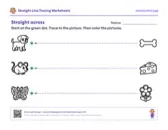
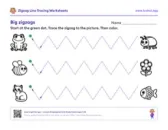
11 free PDFs in this post
One line at a time
Laminate and reuse
Show all 11 PDFsShow fewer
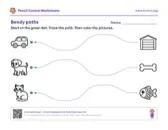
Bendy paths and corners
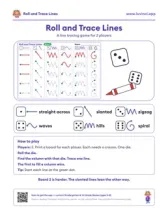
Roll and trace game
Next steps, letters and shapes
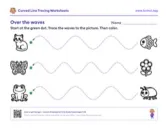
Tracing lines worksheets give your child a green dot, an arrow and a light dashed path to follow with a crayon. Our free tracing lines worksheets cover eight lines, from straight lines to spirals. Straight down, straight across, slanted, zigzag, waves, hills, loops and spirals. A picture sits at the end of most paths, so your child knows where to stop.
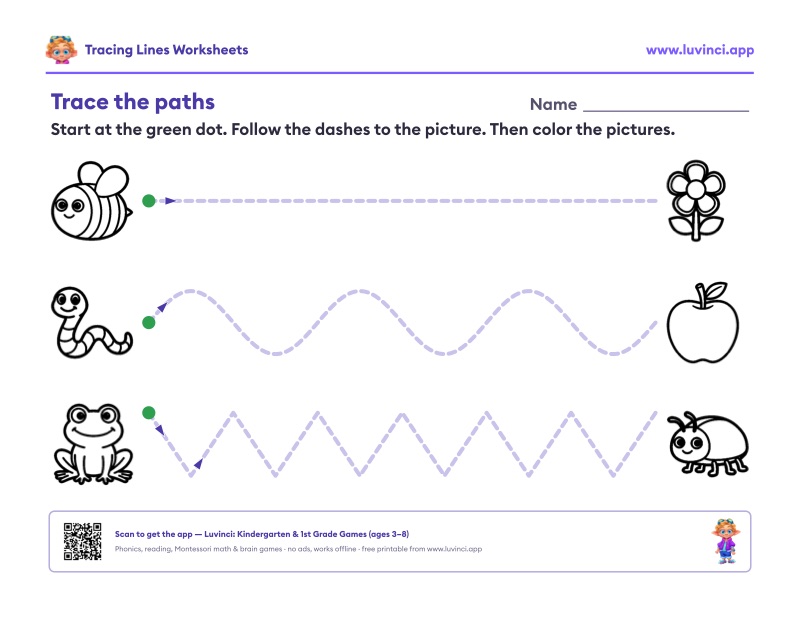
Start at the green dot. Follow the dashes to the picture. Then draw the line alone.
Small packs for one line at a time, pre-writing cards, dry-erase mats and a roll and trace game are free too. No signup, no email.
The pages suit preschool and pre-K, and work as a warm-up in kindergarten.
Jump to: the worksheets · one line at a time · strokes by age · how to start · the order of lines · ready for the next line · FAQ
Free line tracing worksheets (PDF)
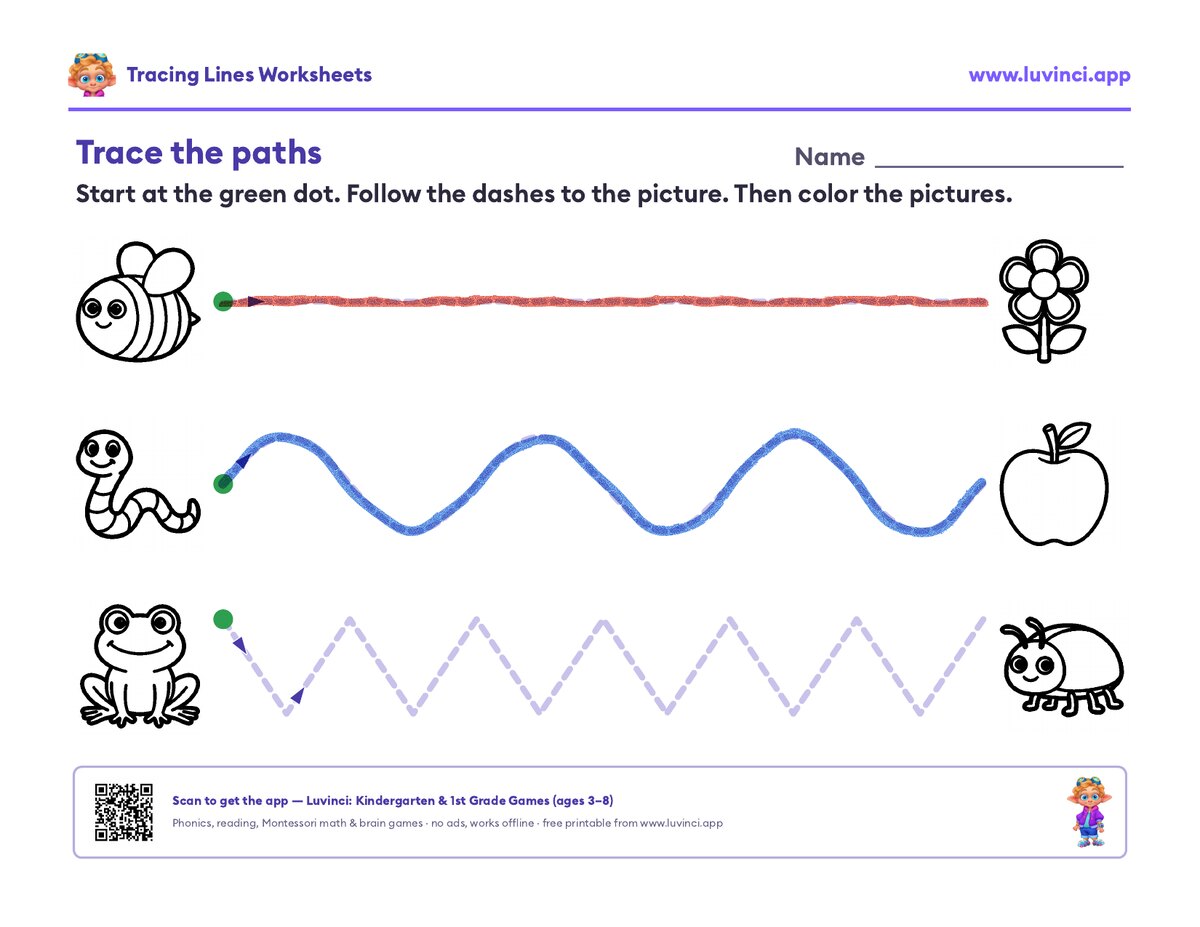
You’ll find 10 pages in the main PDF. Page 1 is the picture paths. Each line then gets its own page, and a chart comes last.
- Page 1: trace the paths to the pictures, then color them.
- Pages 2 to 9: one line per page, from straight down to spirals.
- Page 10: the line moves chart, with the letters each line helps make.
Dashed lines on most line pages start big and get smaller. A Your turn spot with no dashes sits at the end of every page.
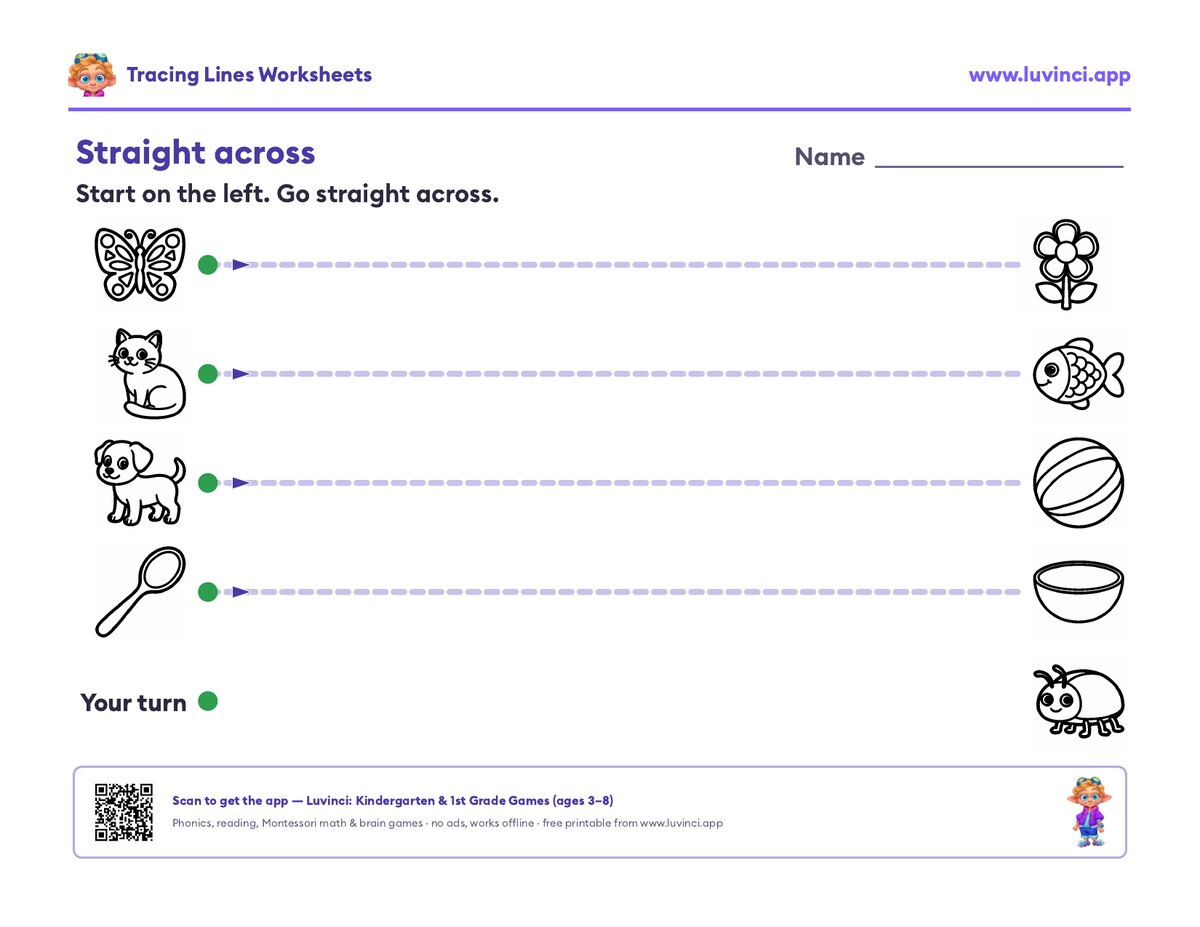
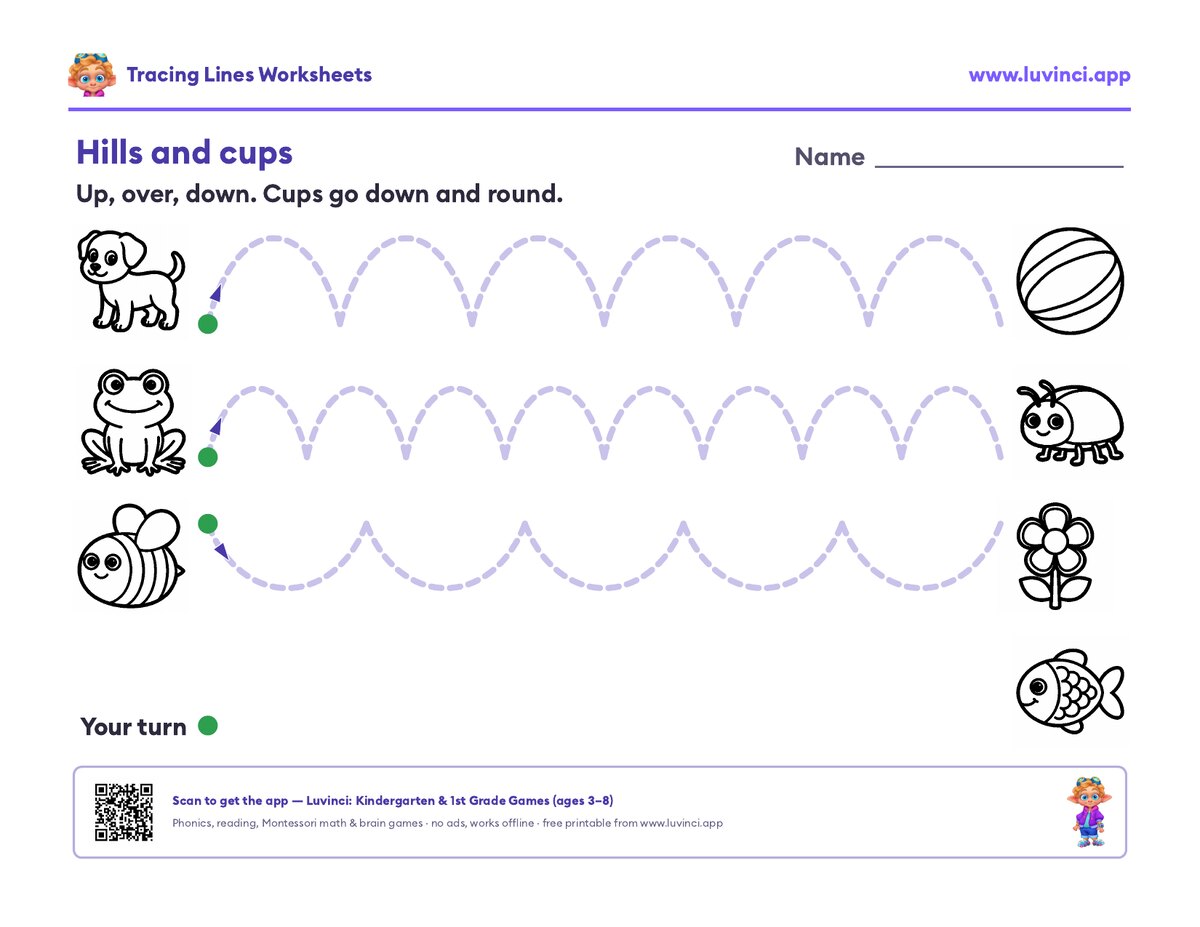
These line tracing worksheets for preschool start big. Kindergarten kids can go straight to the dashed rows.
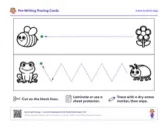
Black and white prints are fine. Slide a page into a sheet protector, trace with a dry-erase marker, wipe it clean, and go again.
One line at a time: small free packs
If one line is hard, print the small pack for just that line. Extra practice lives in the cards, mats, bendy path pages and dice game, which mix the lines.
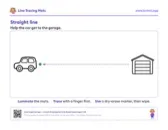
- Straight line tracing. Lines down, across and slanted, plus a rain picture and a draw the line page.
- Zigzag line tracing. Big zigzags, tall to short rows, zigzag grass and a page to draw them alone.
- Curved line tracing. Waves, hills and cups, plus waves under a boat.
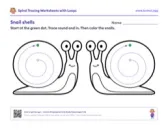
- Spiral tracing. Snail shells, spirals and loops, plus smoke loops from a chimney.
- Pre-writing tracing cards. 14 cards to cut out and laminate.
- Line tracing mats. Five big lines for a finger or a dry-erase marker.
- Pencil control worksheets. Bendy paths and sharp corners, then trace and glue.
- Roll and trace lines. A dice game for two.
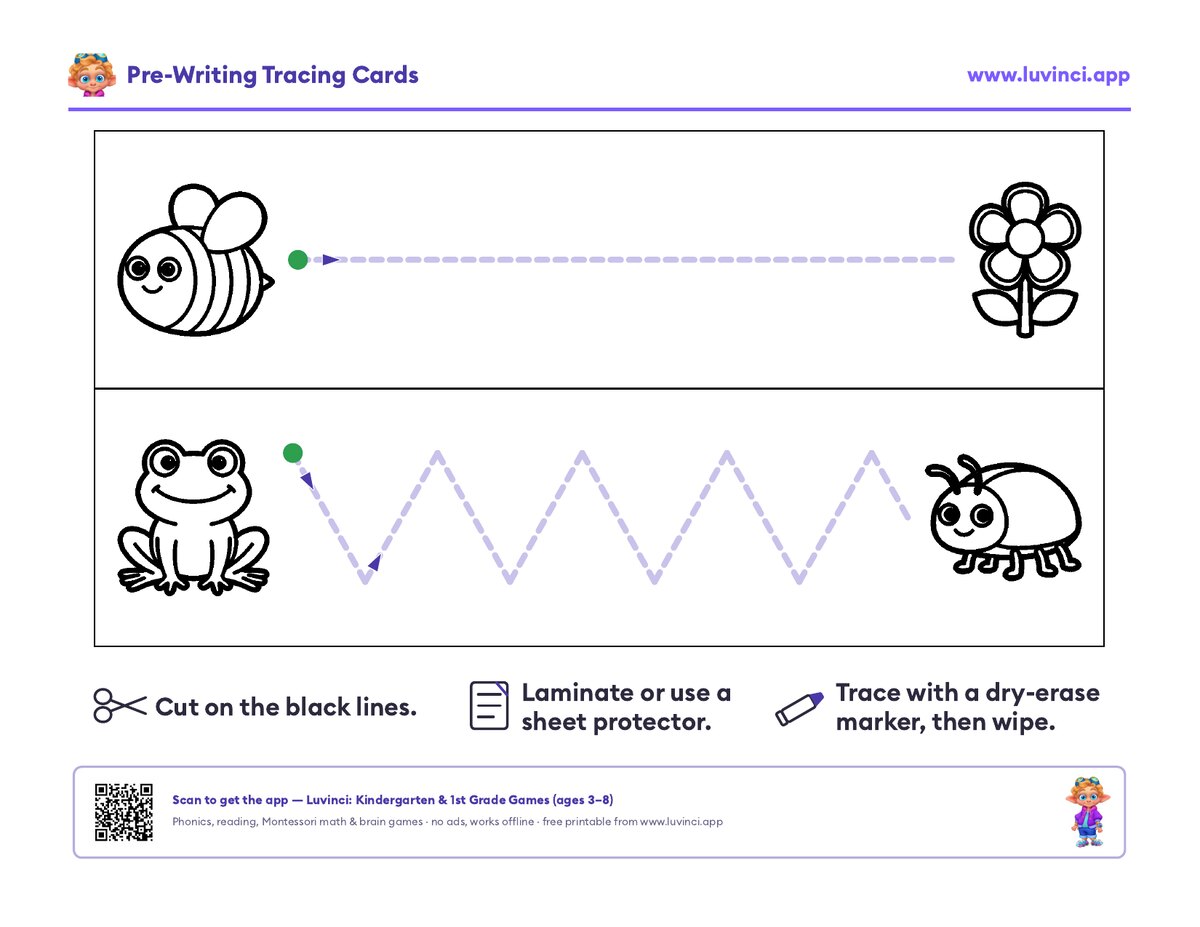
Print one pack, use it for a week, then switch.
Pre-writing strokes by age
Pre-writing strokes are the moves inside letters. Down, across, slant and curve.
| Line | Many children can copy it by about |
|---|---|
| Straight down | Age 2 to 3 |
| Straight across | Age 2 and a half to 3 |
| Slanted lines, both ways | Age 4 and a half |
| Zigzags | No set age. They are slants joined, so they come after slants |
| Waves and hills | No set age |
| Loops | No set age |
| Spirals | No set age. Save them for last |
Those ages are for copying a line alone by looking at one. Tracing over dashes comes sooner, so a younger child can start there. Every child gets there at their own pace.
Lists of the nine pre-writing strokes also include the circle, the cross, the square, the X and the triangle. Those are shapes, and our shape tracing worksheets cover them. These pre-writing worksheets stick to lines and curves.
Tracing lines for preschool: how to start
Big moves come before small ones.
- Draw lines in the air, in a sand tray or with chalk on the sidewalk.
- Run a finger along a big line on a mat before using a crayon.
- Draw the line while your child watches. Then they trace it. Then they draw it alone on the Your turn row.
- Trace with a finger, then a chunky crayon, then a pencil.
- Say the move. Down, across, slide down, up and over.
- Stop after a few minutes, while it’s still fun.
Tracing alone won’t teach handwriting. Use it as a short warm-up, then let your child draw the line with no dashes.
Building a strong hand takes more than fine motor tracing worksheets like these. For play that builds the hand first, see our fine motor skills for kindergarten ideas.
The order of lines, and the letters they build
Straight lines come first. Slants and curves come next.
- Straight down builds l, i and t.
- Straight across makes the bars on T, E, F and H.
- Slants build A, V and k.
- Zigzags are slants joined. They build v, w, M and N.
- Waves sit inside S and s.
- Hills build n, m, h and r.
- Cups build u, U and J.
- Loops look like a small e. They come back later in cursive.
- Spirals turn round to the left. That turn builds c, o, a, d and g.
The pages keep spirals last. If zigzags feel too hard, try the waves. Treat the order as a guide.
Kids who write with the left hand still trace across from left to right. A small turn of the page helps them see the line.
Next come the straight-line capitals L, T, I, E, F and H in our letter tracing worksheets. After letters comes a first name, and our guide to teaching your child to write their name shows how.
Ready for the next line?
Stay on a line until your child starts at the green dot without a reminder. Watch for these signs too.
- They go the right way, down or left to right.
- They stay close to the dashes. A wobble is fine.
- They draw the line in one go.
- They can draw it on the Your turn row with no dashes.
Two mistakes are common.
- Dashes too dark. The crayon line gets lost. Ours are light on purpose.
- Fixing the grip with force. Short crayons and play help more.
If drawing lines stays very hard, or your child stays away from crayons, talk to your child’s teacher or doctor.
FAQ
What do children learn from tracing?
Tracing lines teaches the moves inside letters, where to start and which way to go. The hand and eyes learn to work together too. It works best as a warm-up before your child draws the line alone.
When should kids start tracing lines?
Many children trace big lines with a finger or a chunky crayon around 3. Straight lines come first and slants later, often around 4 and a half for drawing them alone. Every child gets there at their own pace. Our kindergarten readiness checklist covers the other skills.
Can 2 year olds trace lines?
Most 2-year-olds scribble, and some can follow a big line with a finger. Paper tracing usually comes a bit later. Start with big play.
Can tracing improve handwriting?
Tracing helps a child learn where letters start and which way they go. On its own it won’t make neat handwriting. Pair it with drawing the line or letter alone.
The takeaways
- Start big, with play.
- Straight lines first, spirals last.
- Big dashes first, then small, then no dashes.
- A few minutes a day is plenty.
- Print the free tracing lines worksheets and the small packs, no email needed.
When lines feel easy, the Letters row in our reading games has letter tracing with start dots. It’s in the full app.
Sources
- American Occupational Therapy Association, Children and Youth Special Interest Section (2025). Pre-Writing and Handwriting Skills. Infographic.
- Solihull Children’s Occupational Therapy, University Hospitals Birmingham NHS Foundation Trust (2024). Pre-writing skills.
- NHS Fife (2020). Top tips for developing pre-writing skills.
- Somerset NHS Foundation Trust (reviewed 2026). Pre-writing activities.
- Griffin Occupational Therapy (updated 2026). Pre-writing shapes: what are they and how to teach them.
- Berninger, V. W., Vaughan, K. B., Abbott, R. D., Abbott, S. P., Rogan, L. W., Brooks, A., Reed, E. and Graham, S. (1997). Treatment of handwriting problems in beginning writers: Transfer from handwriting to composition. Journal of Educational Psychology 89(4), 652-666. ERIC EJ560297.
- Grajo, L. C., Candler, C. and Sarafian, A. (2020). Interventions within the scope of occupational therapy to improve children’s academic participation: A systematic review. American Journal of Occupational Therapy 74(2), 7402180030.
- Schwellnus, H., Carnahan, H., Kushki, A., Polatajko, H., Missiuna, C. and Chau, T. (2012). Effect of pencil grasp on the speed and legibility of handwriting in children. American Journal of Occupational Therapy 66(6), 718-726.