Luvinci
July 16, 2026
How to Teach Your Child to Write Their Name (Free Practice PDF)
Free printable · PDF · 518 KB
How to Teach Your Child to Write Their Name (Free Practice PDF)
No signup needed. Just print it.
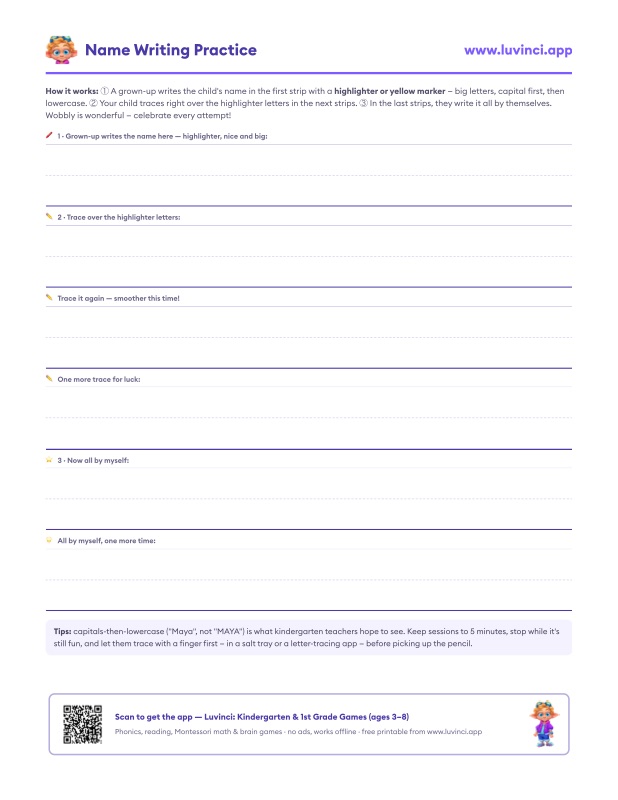
Download PDFThe easiest way to teach your child to write their name is also the gentlest: a grown-up writes it big in highlighter, your child traces right over the letters, and after a week or two of five-minute sessions the training wheels come off. We’ve turned that method into a free printable name-writing practice sheet — trace-over strips on page one, a hollow-letter alphabet warm-up on page two.
No email address required, no signup. Print one copy per week and watch the last strip change.
Why their name is the perfect first word
A child’s name is the most motivating word they will ever meet. It’s on their cubby, their artwork, their birthday cake — and unlike “cat” or “the,” it belongs to them. That ownership buys you something no worksheet can: a four-year-old who asks to practice.
Name-writing is also what schools quietly look for. Most kindergarten teachers hope to see a child who recognizes their name in print and makes a recognizable attempt at writing it — wobbly, oversized, missing a letter, all completely fine.
The highlighter method: teach your child to write their name in three steps
Step 1 — you write it. Big letters in highlighter or yellow marker across the first strip: capital first letter, lowercase for the rest (“Maya,” not “MAYA”).
Step 2 — they trace it. Right over the highlighter, three strips’ worth. The bright letters underneath do the guiding, so your child feels the letter shapes without the fear of getting them wrong.
Step 3 — they fly solo. The last strips have no highlighter. Expect wobble; celebrate it anyway. Yesterday’s trace is today’s solo.
Keep sessions to five minutes and stop while it’s still fun. Little hands tire fast — if the pencil grip collapses or the giggling stops, you’re done for the day, and that’s the method working, not failing.
Capitals first — but only the first one
All-capitals names (“MAYA”) are a completely normal stage: capitals are built from straight lines and big curves, which is why they come easier to young hands. Don’t scold it out — but when you write the model, always write it the way teachers hope to see it: one capital, then lowercase. Children copy the model they’re given far more than the rule they’re told.
If lowercase letters keep collapsing, it’s usually a hand-strength issue rather than a knowledge issue — a week of play-dough and clothespins from our fine motor bingo card often fixes more than extra pencil drills ever will.
Before the pencil: fingers, salt trays and hollow letters
If the pencil version keeps frustrating, step backwards, not forwards. Trace the letters with a finger first — in a tray of salt or sugar, on a steamy window, over the hollow alphabet on page two of the printable. Letter shapes learned through the fingertips stick better than letters learned by looking, which is why the warm-up page starts with the letters in your child’s own name.
Our summer prep plan uses exactly this progression — recognize the name, finger-trace it, then write it — spread gently across the weeks before school.
Where letter sounds fit in
Writing a name goes faster when the letters in it are old friends. A child who knows M says mmm isn’t drawing a mysterious zigzag — they’re writing a sound they can hear. That’s a lovely job for letter-sound games during rest time, since hearing letters spoken aloud makes them more memorable than silent flashcards.
“Useful supplement for kindergarten! I like how ABC games sound out the letters as you click on them, hearing makes them more memorable.” — MadLibsCrazy, App Store review (US)
Screen for the sounds, paper for the writing — each does what the other can’t.
Name-writing FAQ
When should a child write their name? Most children make their first recognizable attempt somewhere between ages 3½ and 5. Teachers hope for an attempt — not calligraphy — by the first day of kindergarten, and fluent, tidy name-writing typically arrives during the kindergarten year itself.
Is it bad that my child writes in all capitals? No — it’s a normal developmental stage. Keep modeling capital-then-lowercase and the switch follows. Pushing hard before the hand strength is there just breeds pencil avoidance.
What about reversed letters? Backwards letters are extremely common in preschool and kindergarten and usually straighten out with ordinary practice. Mention it to the teacher if it’s still frequent well into elementary school, but on its own it is not a red flag at this age.
My child is left-handed — does the method change? Same method, two tweaks: tilt the paper slightly clockwise so their wrist stays straight, and sit on their right side when you demonstrate so your hand never blocks their view of the letters.
The takeaways
- Download the practice sheet — highlighter strips + hollow-letter warm-up, no signup
- Highlighter first, solo last — tracing over your writing removes the fear of blank paper
- “Maya,” not “MAYA” — model one capital and lowercase from day one
- Five minutes, then stop — end while it’s still fun and they’ll ask for tomorrow
- Wobbly counts — teachers want an attempt, not perfection
Teachers and homeschool groups: you’re welcome to print and share the practice sheet freely — a link back to this page is appreciated.