Luvinci
August 8, 2026
Consonant Blends for Kids: Word Lists for Every Blend
Free printable · PDF · 997 KB
Consonant Blends for Kids: Word Lists for Every Blend
No signup needed. Just print it.
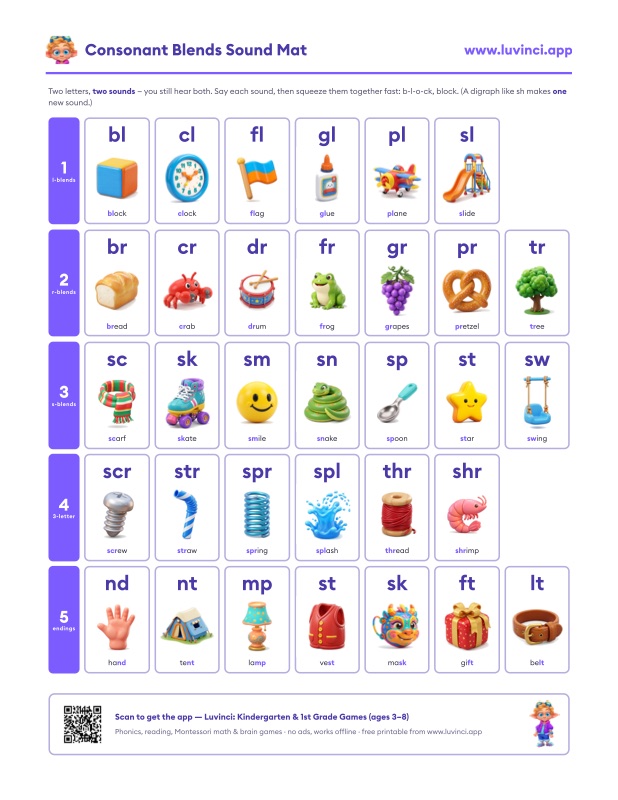
Download PDFA consonant blend is two or three letters side by side where you still hear every sound — b-l in black, s-t in stop. A digraph is two letters that make one sound: sh, ch, th. That difference is what parents get wrong most, and it changes how you teach them. Every blend below is on our free Consonant Blends Sound Mat — 33 tiles grouped on one page, no signup.
Blend or digraph? One question settles it
Ask: how many sounds do you hear — two, or one?
Two and it’s a blend — say flag slowly and /f/ and /l/ are both in there, like st in stop and nd in hand.
One and it’s a digraph. There’s no /s/ and no /h/ anywhere in ship. The same goes for ch, th, wh, ph, ck, ng and qu — eight in all, though qu is the loose one at /kw/. Note that the single sound isn’t always a new one: ck just says /k/ and ph just says /f/. What’s new is the spelling, not the sound.
So they get taught differently. A digraph is a new spelling to learn by sight; a blend is practice holding together two sounds your child already knows. If sh, ch and th are still shaky, start with digraphs. And if you’re after the skill of pushing sounds together — a blending sounds list for any words, not just blends — that’s how to teach blending sounds.
Every beginning consonant blend, with words to practice
L-blends: bl (black, blue, block, blow), cl (clap, clock, cloud, climb), fl (flag, flip, flat, float), gl (glad, glue, glass, glove), pl (plan, plus, plane, plant), sl (slip, sled, slam, slide).
R-blends: br (bread, brick, brush, brave), cr (crab, crib, cross, crayon), dr (drum, drip, dress, dragon), fr (frog, fresh, friend, front), gr (grab, green, grass, grapes), pr (press, prize, print, pretzel), tr (tree, trip, truck, train).
S-blends: sc (scab, scarf, scoop), sk (skip, skate, skunk), sm (small, smell, smile), sn (snap, snake, snow), sp (spin, spot, spoon), st (stop, star, stick), sw (swim, swing, sweet).
Three-letter blends: scr (scrap, scrub, screw, screen), str (strap, string, straw, strong), spr (spring, spray, sprout), spl (splash, split, splat), thr (three, throw, thread), shr (shrimp, shrub, shrug).
Thr and shr come last: they open with a digraph, then add a real second sound.
Ending blends: the ones kids drop
Blends at the end of a word are harder to hear, so they get skipped: nd (hand, sand, bend), nt (tent, ant, plant), mp (jump, lamp, stamp), st (vest, best, nest), sk (mask, desk, ask), ft (gift, soft, left), lt (belt, melt, salt).
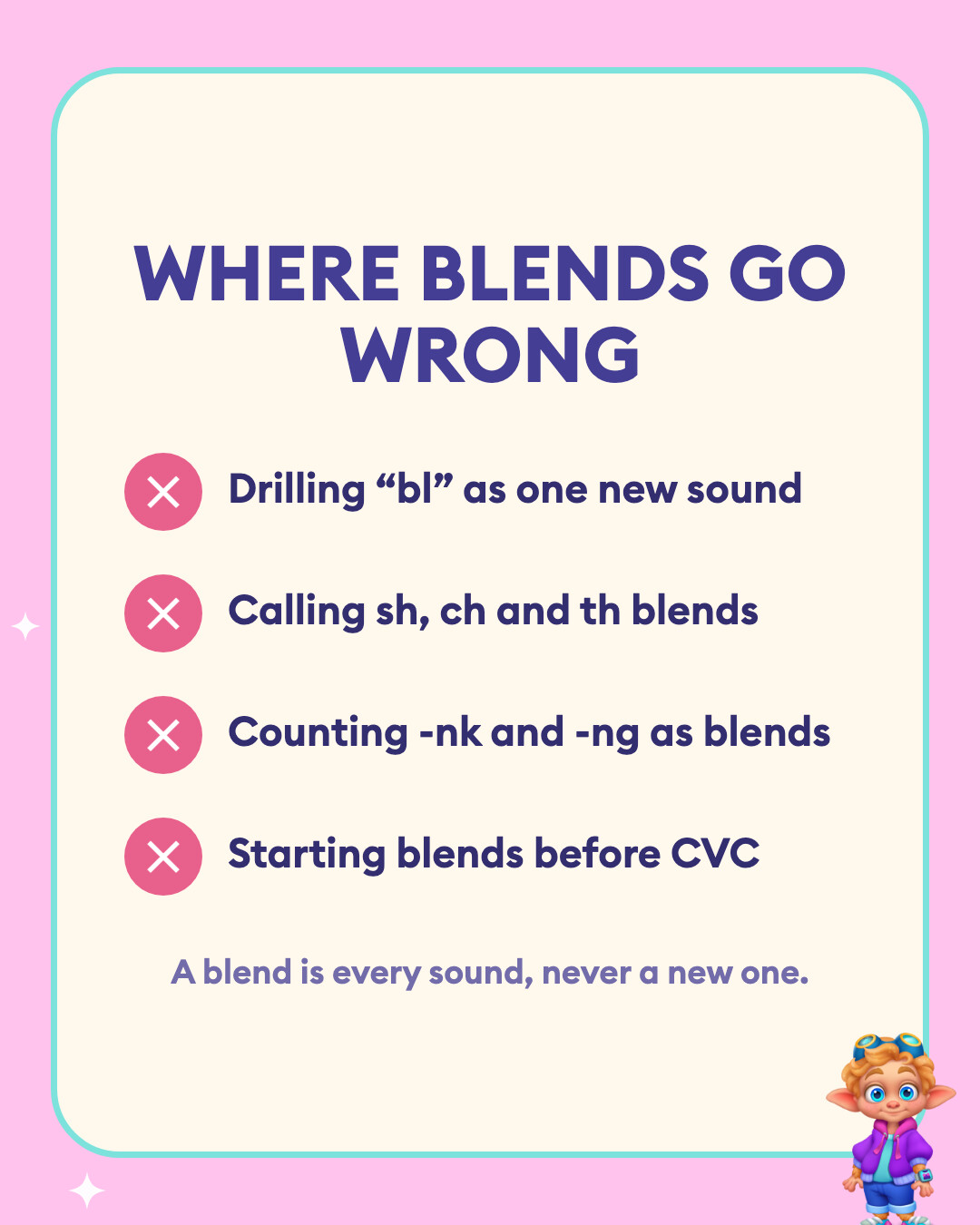
-nk and -ng aren’t blends — in pink and sing the n turns into /ng/, so there is no /n/ left to hear. -nk is a welded ending and -ng is a digraph; teach both whole, as one chunk.
The tell is “jup” for jump, “had” for hand, “tet” for tent — your child caught the vowel and the last consonant and lost the one in between. Two consonants collide with no vowel between them, so the first of the pair is easy to miss.
Teach the letters, not the pair
Never drill a blend as if it were a new sound. Don’t say “bl says /bl/.” The blending happens in the mouth, not on the page: a digraph’s spelling gets memorized, a blend gets sounded out.
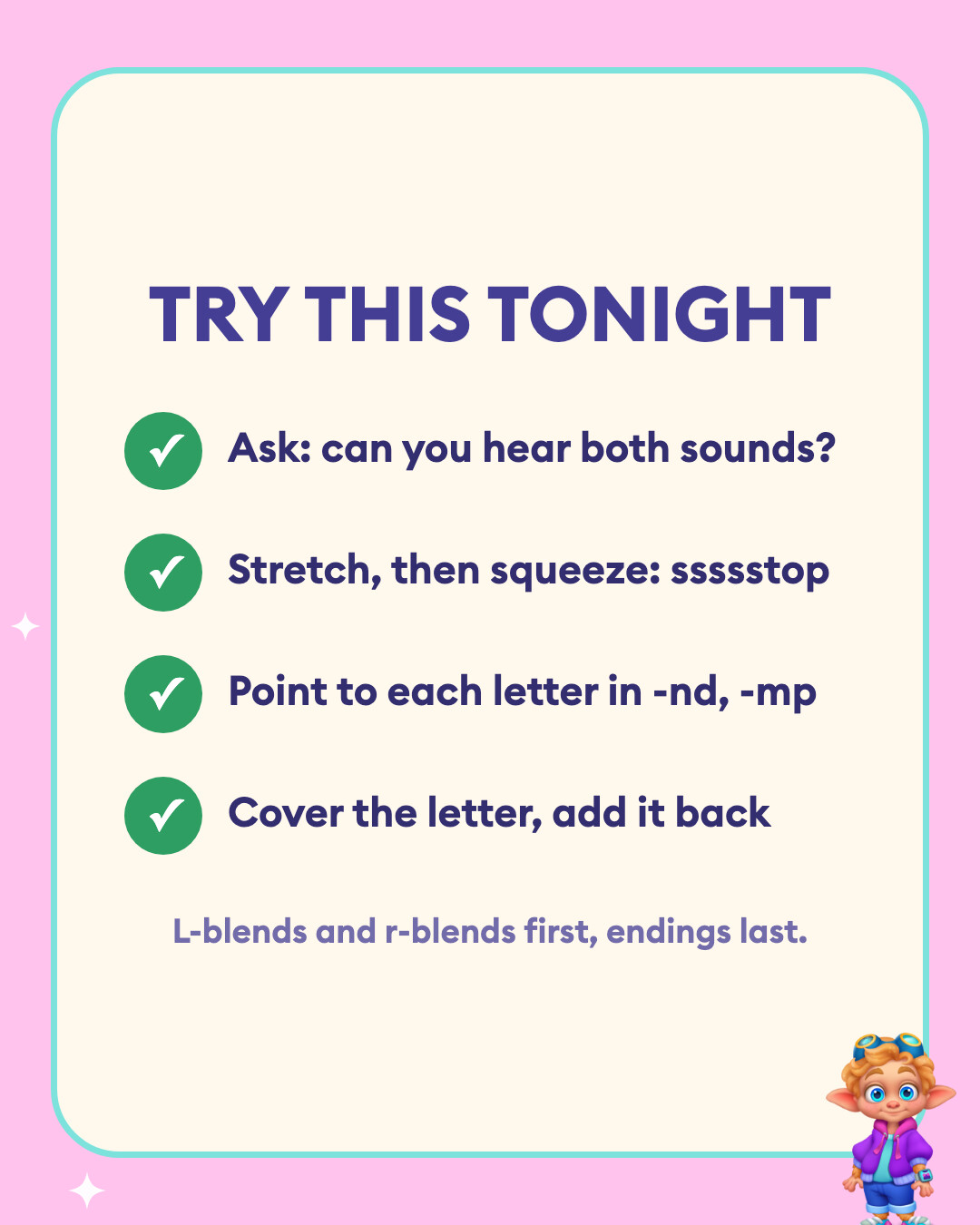
Stretch, then squeeze. Hold the first sound and slide into the next — “ssssstop” — then repeat it fast.
For ending blends, point to each letter as your child says it, exaggerating the dropped one.
Fix a dropped sound in place. “Top” for stop, “back” for black, “cab” for crab — don’t re-read the whole word. Cover the letter that went missing, read the rest, uncover, add the sound back.
Then put the words to work. Our free blends sentence building worksheet has your child pick WHO, DID WHAT and WHERE picture cards, lay them out as a silly sentence full of blends, then write it out. Two pages, no signup.
Hearing whether that second sound is really there is where a screen earns its place — our reading games sound out every letter, from single sounds to CVC words, ages 3–8, no ads, offline.
Where blends fit in the sequence
Blends come once your child reads CVC words — cat, pin, sun — comfortably. Our order: single letter sounds → digraphs → blends → magic e → vowel teams → bossy r. Some programs teach blends before digraphs, straight after CVC words, and either order works. Within blends: l-blends and r-blends first, s-blends next, three-letter and ending blends last. In US schools that lands late kindergarten into first grade. (UK schools call this Phase 4.)
Questions parents ask
Is “sh” a blend? No — it’s a digraph: two letters, one sound. You can’t hear /s/ or /h/ in ship; blends keep both sounds. Nor are ar, or and er blends — there the r changes the vowel, which is bossy r.
Should I teach blends or digraphs first? Digraphs, usually: they turn up in very common short words — ship, chip, that — and behave like one new sound to learn. Blends need no new sounds, only practice holding two together.
My child reads “top” for “stop.” What now? Normal, and more a listening problem than a reading one. Cover the s, read “top,” uncover, add the sound back, then say both words side by side.
When should a child know consonant blends? Most children work through them across kindergarten and first grade — beginning blends before ending blends, with three-letter blends often running into second grade.
The takeaways
- Blend = you hear every sound. Digraph = two letters, one sound — ask “can you hear both?”
- Never drill “bl” as a single sound — your child already has /b/ and /l/.
- A dropped sound is the tell — “top” for stop, “jup” for jump. Cover a letter, read, uncover.
- Print the free Consonant Blends Sound Mat — 33 tiles, grouped, one page.
- All 16 blends printables — this chart plus 15 read-and-write worksheets, beginning blends through review.