Luvinci
August 8, 2026
Digraph Words: Consonant Digraphs List (sh, ch, th, wh, ck)
Free printable · PDF · 711 KB
Digraph Words: Consonant Digraphs List (sh, ch, th, wh, ck)
No signup needed. Just print it.
Download PDFDigraph words contain two letters that make one sound, a consonant digraph like sh in ship. There are eight main ones: sh, ch, th, ng, qu, wh, ph, ck, as in ship, chip, thin, ring, quiz, when, phone, duck. Only qu is a loose fit: /kw/ is two sounds, but q is almost never written without u. (Your child has quietly met a few already: the doubled ff, ll, ss at the ends of short words, as in puff, bell, miss, are two letters making one sound too, though they’re usually counted separately as doubled letters rather than digraphs.) They’re the next step after the four SATPIN groups in the letter-sound teaching order, once a child reads simple three-letter words comfortably.
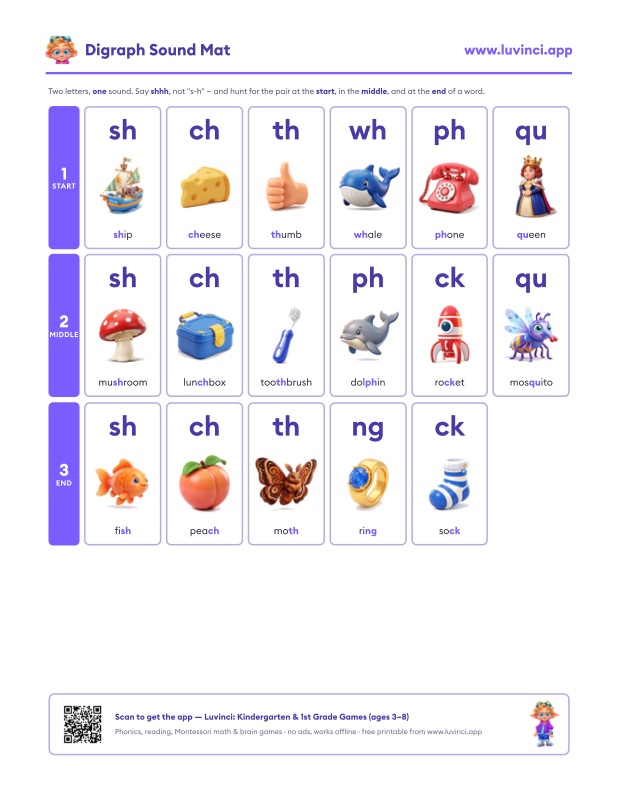
All eight sit on one page in our free Digraph Sound Mat, grouped by where each one turns up in a word: start, middle, end. Print it and point to the row you’re working on. No signup.
Consonant digraphs list: the 8 main digraphs with word lists
Say each digraph as one sound, then read the list across:
- sh: ship, shop, shell, fish, wish, brush, mushroom (all sh words)
- ch: chip, chin, cheese, chair, lunch, peach, much (all ch and tch words)
- th (voiceless): thin, thumb, thick, moth, bath, teeth, path
- th (voiced): this, that, then, them, there, feather, mother (all th words, voiced and voiceless)
- ng: ring, king, sing, song, wing, long, bang
- qu: quiz, quit, quick, queen, quilt, squid, squirrel
- wh: when, whip, wheel, whale, white, whisk
- ph: phone, photo, dolphin, graph, elephant
- ck: duck, sock, rock, back, kick, rocket
Three-letter teams come later: tch (catch, match) and dge (badge, bridge) follow a short vowel.
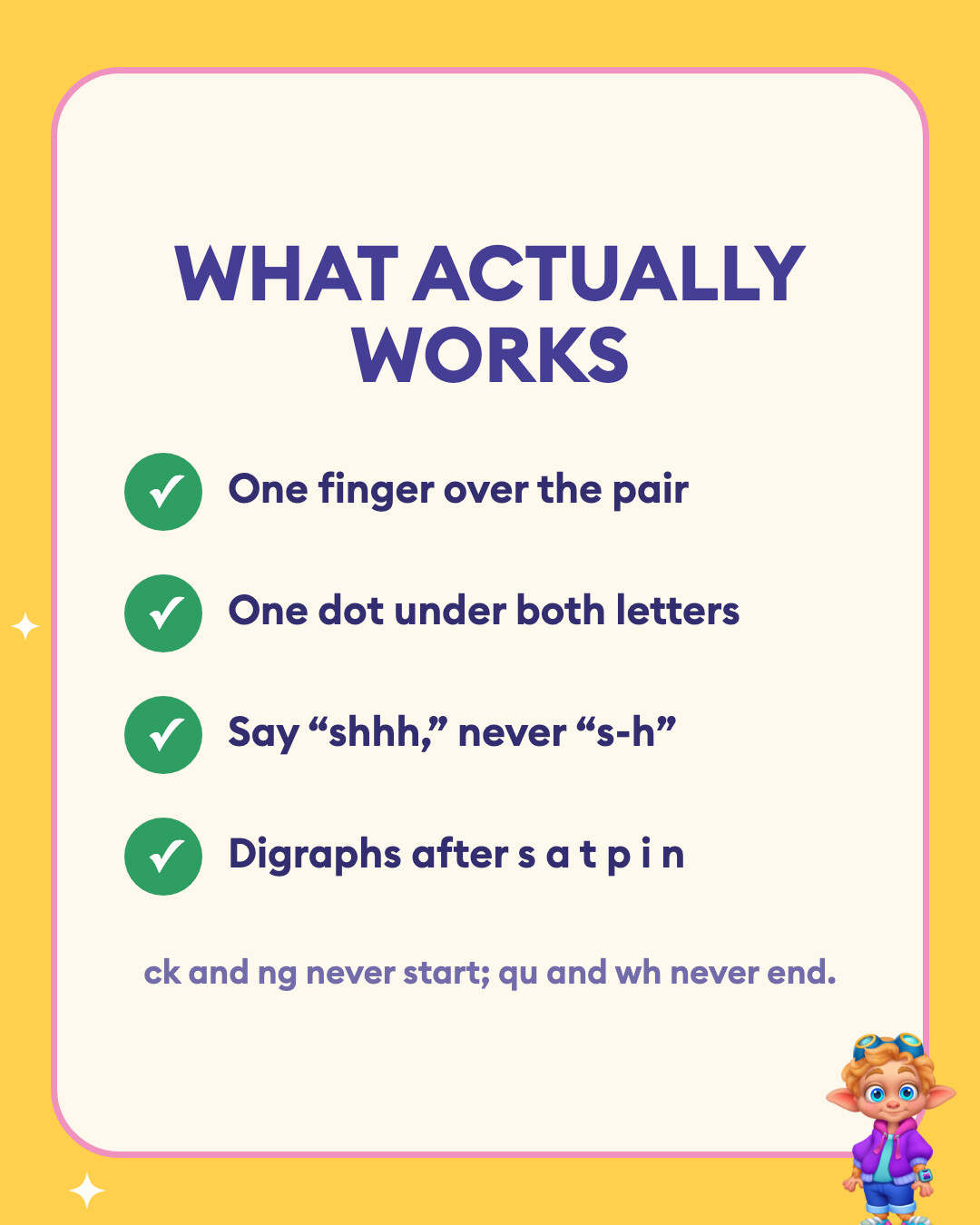
Position is more predictable than it looks: ck and ng never start a word, and qu and wh never end one. That’s the rule the mat’s three rows — start, middle, end — are built on.
th says two sounds
Both are normal and both are everywhere. The voiceless (also called unvoiced) /th/ is the quiet one: thumb, thin, moth. The voiced /th/ buzzes: this, that, mother.
Hand on the throat is the whole test. Stretch the start of “thumb” — thhh — nothing. Now the start of “this” — a buzz under your fingers.
Many programs teach them as two short lessons, voiced first (this, that), then voiceless (thin, thumb). Our th words page lists both.
Say it as one sound, not two letters
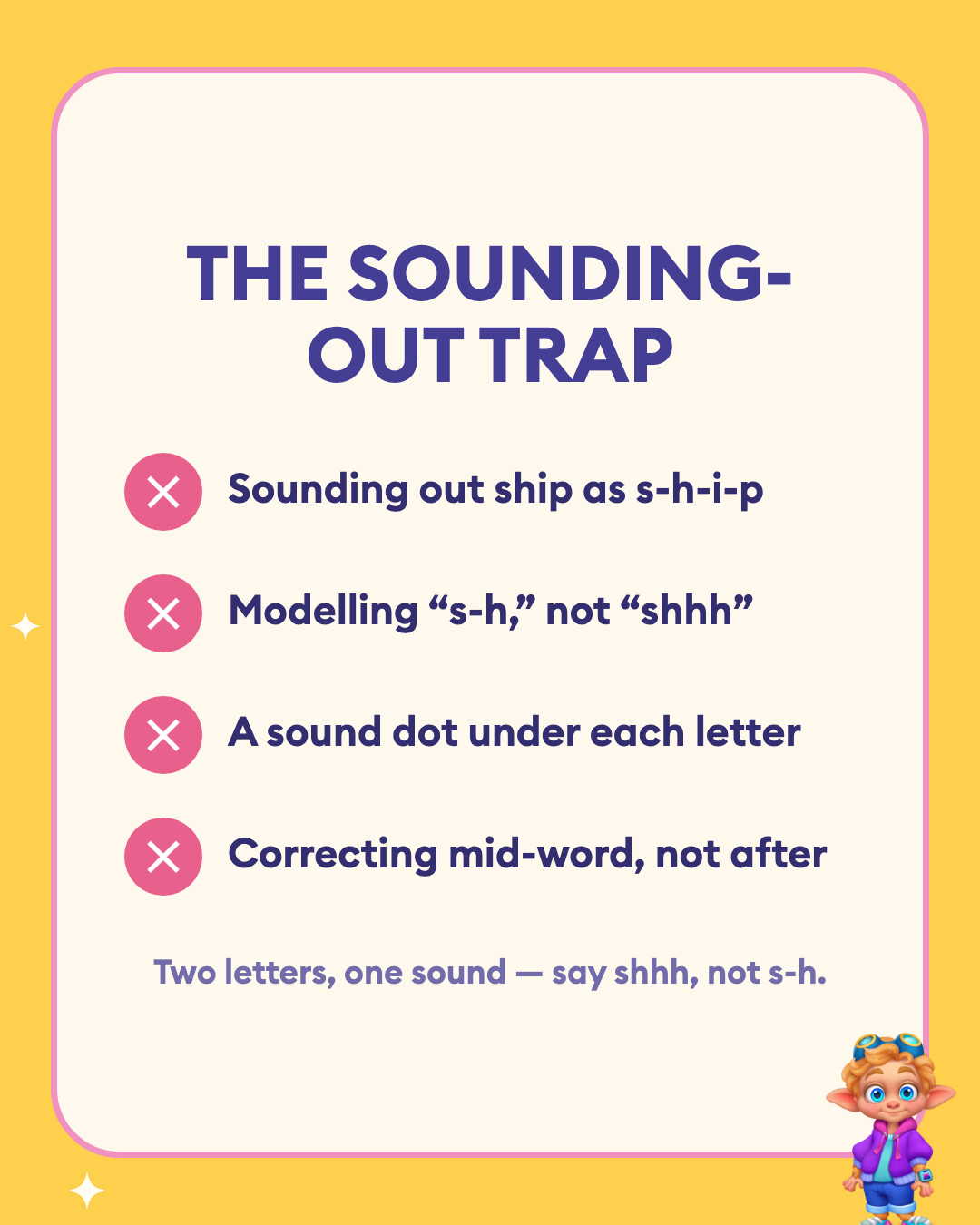
The commonest mistake at home is sounding out ship as s-h-i-p. Three fixes:
- Cover the pair with one finger so the two letters get read as a unit.
- Put one dot under both letters, not two — one sound button, one sound.
- Model “shhh,” never “s-h.” Say the digraph the way it sounds inside the word.
Hearing each sound accurately is where a screen genuinely earns its place — one clean sound, played on its own, removes the guesswork for a parent unsure whether it’s /ch/ or “chuh.” Our reading games sound out every letter as your child taps it, with no ads and offline play.
One distinction worth naming out loud: a digraph is one sound, whereas a consonant blend is two sounds said fast that you can still hear separately — shop starts with one sound, stop with two.
How many digraphs are there? 7, 8, 10 or 21
Lists you find online disagree, and they’re all counting something real. Short lists count the digraphs taught first: the seven or eight on this page (sh, ch, th, wh, ph, ck, ng, plus qu). Longer lists add the silent-letter pairs, like kn (knee), wr (write), gn (gnat) and mb (lamb), and rarer ones like gh (laugh) and rh (rhyme). That’s how a list grows to 10, 15 or 21.
Vowel digraphs, such as ee, ai, oa and oo, are usually counted on their own list as vowel teams. For a beginning reader, the eight above are the ones that matter. The rest can wait until your child reads longer words.
When to teach digraphs — and the six quick letters first
Digraphs land after the four SATPIN groups, usually around ages 4–6 (sh, ch, th and ng are UK Phase 3; ph and wh, Phase 5). Most children meet them in kindergarten or early 1st grade. Just before them come the leftover single letters: j, v, w, x, y, z. These six go fast — a week or two for all of them — with only v and w worth spacing apart. One warning: x is the odd one out. It says /ks/ — two sounds from a single letter, the exact reverse of a digraph. Fox is f-o-k-s. Say it that way and it clicks.
One exception: ck usually arrives earlier, riding along with short vowels in duck, sock and rock. If your child already reads those, they’ve met a digraph. Once digraphs are secure, blends come next, then magic e and the vowel teams. Before moving on, let the digraphs do some work: our free cut-out sentence worksheet has your child pick who, did what and where picture cards, build one silly digraph sentence, and write it out.
Questions parents ask
Is ck a digraph? Yes — two letters, one sound, /k/. It never starts a word; it sits right after a short vowel, either at the end of a short word (duck, sock, back, kick) or inside a longer one (rocket, pocket).
Why does qu count as a digraph when I hear two sounds? You do hear /k/ and /w/ — that’s a fair objection. But q is almost never written without u in English, so the pair is always taught, read and written as one unit.
Is ng a digraph? Yes. Two letters, one sound, as in ring and song. Like ck, it never starts a word.
Are ff, ll and ss digraphs? Some programs call them digraphs, others call them doubled letters. Either way it’s two letters, one sound, right after a short vowel: puff, bell, miss. The floss rule explains when to double them.
My child says “s-h” instead of “shhh.” What do I do? Cover the pair with your finger and model the single sound. Don’t correct mid-word — let them finish, then re-read the whole word together.
The takeaways
- Two letters, one sound — sh, ch, th, ng, wh, ph, ck, plus qu for /kw/.
- th says two sounds — thumb and this — and both are normal.
- One finger over the pair, one sound button under it — never “s-h.”
- Position is predictable — ck and ng never start a word; qu and wh never end one.
- j, v, w, x, y, z go in around here and go fast — a week or two, total.
- Print the free Digraph Sound Mat — all eight digraphs grouped by position in a word: start, middle, end, one page.
- All our digraph printables: this chart plus read-and-write worksheets and flash cards, sh through qu, in our free library.