Luvinci
August 15, 2026
Blending Words List: How to Teach Blending Sounds (Free PDF)
Free printable · PDF · 490 KB
Blending Words List: How to Teach Blending Sounds (Free PDF)
No signup needed. Just print it.
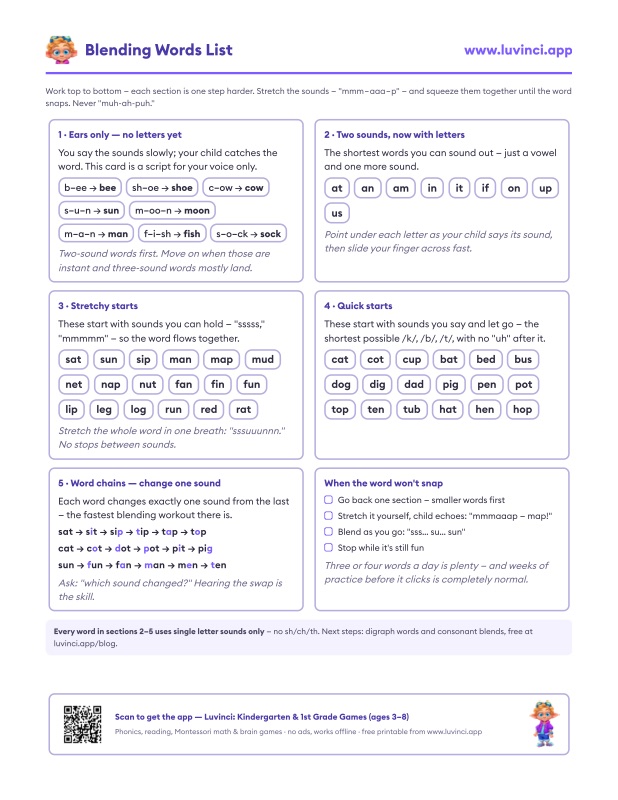
Download PDFBlending sounds is sliding separate sounds into one word: hearing /s/ /u/ /n/ and saying “sun.” It’s the skill that turns knowing letters into actually reading, and the step where home phonics most often stalls. Here’s how to teach blending sounds at home, in the order that works, starting with your voice, not letters. Every practice word below is on our free Blending Words List: 45 words plus 3 word chains, ordered easiest first, one page, no signup.
Blending sounds vs. consonant blends
The names collide, but they’re different things. Blending is a skill: pushing any sounds together into a word. Every word your child ever sounds out gets blended. Consonant blends are a sound pattern: two or three consonants side by side that each keep their own sound, like the st in stop. If you searched for a blending sounds list, you’re in the right place — the free printable here is exactly that. If you came for lists of st-, bl- and fr- words, you want our consonant blends guide instead. This page teaches the skill itself — which starts long before words like stop.
Start with your ears: oral blending
Blending begins as a listening game — teachers call it oral blending. You say a word in slow motion; your child says it at normal speed. “b–ee — what did I say?” “Bee!” No letters, no cards — the car and the bath are perfect.
Start with two-sound words: bee, shoe, cow. When those are easy, stretch to three: sun, moon, man, fish, sock. A robot voice helps — robots always talk in sounds.
A child who can’t yet catch “mmm–aaa–nnn” by ear will find written words much harder — that listening game is the sounds-first stage of teaching phonics at home, and it can keep running alongside the letter work.
Blending words list (easiest first)
Once your child knows a handful of letter sounds, work through written words in this order. Skip any word with a letter your child hasn’t met yet and come back to it — this order is about word difficulty, not letter order.
Two sounds first. The shortest words you can sound out: at, an, am, in, it, if, on, up, us. Two sounds are far easier to hold in memory than three.
Stretchy starts next. Words that begin with a sound you can hold — s, m, n, f, l, r: sat, sun, sip, man, map, mud, net, nap, nut, fan, fin, fun, lip, leg, log, run, red, rat. “Sssuuunnn” flows into a word by itself; that head start matters.
Quick starts last. Words that begin with sounds you say and let go: cat, cot, cup, bat, bed, bus, dog, dig, dad, pig, pen, pot, top, ten, tub, hat, hen, hop. Say the shortest possible /k/, /b/, /t/ — never “cuh.”
Then word chains. Change exactly one sound per step: sat → sit → sip → tip → tap → top, cat → cot → dot → pot → pit → pig, sun → fun → fan → man → men → ten. Ask “which sound changed?” — hearing the swap is the skill. Once blending clicks, a few nonsense words show it’s real decoding.
Every written word here uses single letter sounds only — no sh, ch or th, no tricky spellings — so everything after the ears-only warm-up is readable with basic letter-sound knowledge.
“The app does a good job with the spelling activities, specifically when it comes to helping the child sound out the letters and work with phonetics.” — Danielle Mardino, App Store review (US)
Stretch, don’t chop: continuous blending
The technique that makes all of this work has a name — continuous blending — and it fits in one sentence: say the whole word in one breath, with no silences between sounds.
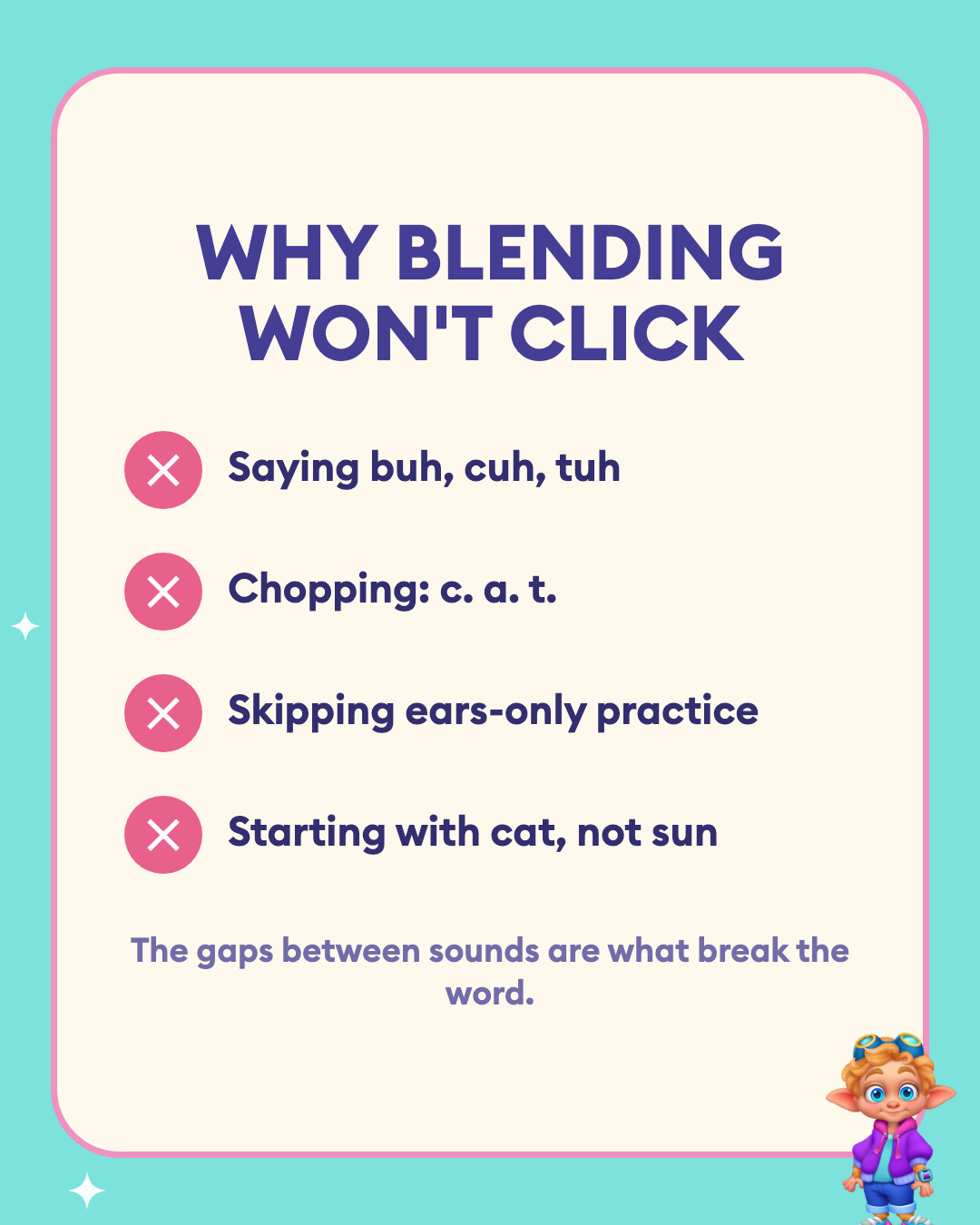
Saying “c. a. t.” leaves gaps for the word to fall into. “Caaat,” stretched and squeezed a little tighter each time, snaps into cat on its own. The gaps, not the sounds, are what make blending hard.
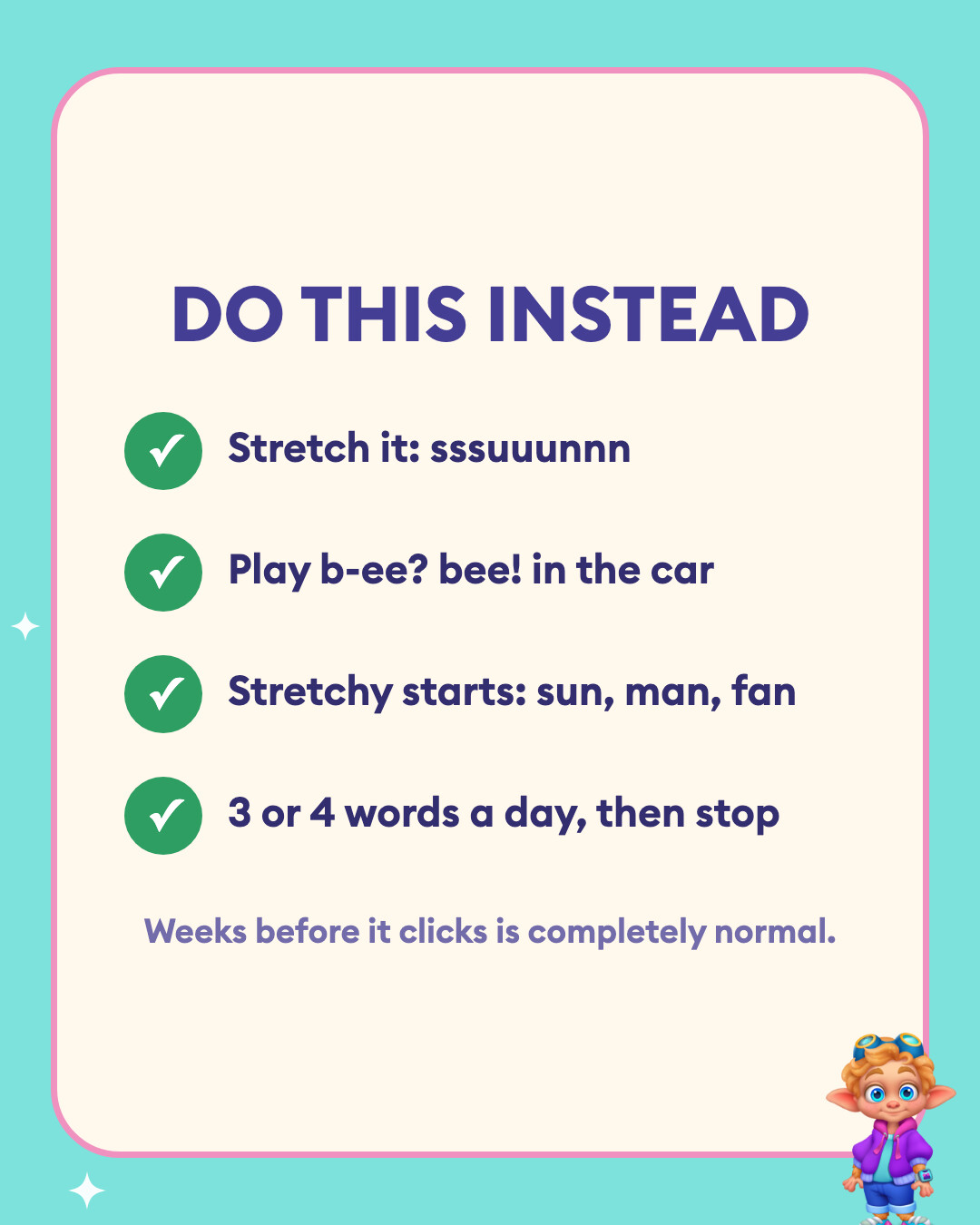
For a word that won’t come together, blend as you go: “sss… su… sun.” Three or four words a day is plenty; stop while it’s still fun.
Hearing clean sounds is half the battle, and it’s where a screen genuinely helps — our reading games sound out every letter cleanly and build from single sounds to CVC words, ages 3–8, no ads, offline.
My child says the sounds but can’t blend them
The most common wall in early reading — a child says /k/ /a/ /t/ perfectly, then guesses “dog.” It isn’t a letter problem — when a child can’t blend sounds they can say perfectly well, it’s a memory-and-listening problem, and the fix is always to shrink the task:
- Go back to ears only. Stay off the page until the listening game is easy again.
- Drop to two sounds. At and up before cat and cup.
- You blend, they echo. “Mmmaaap — map!” Your child repeats, then tries the next one.
- Check for “uh.” One extra “uh” from the grown-up is enough to break every word.
Most children need weeks of daily practice before blending clicks — the normal speed of the hardest step in learning to read.
Where blending fits
Sound play from about age three, then letter sounds, then blending, then CVC words — that’s the launch sequence. But blending isn’t a stage your child finishes: it returns with digraph words like ship, and again with consonant blends like stop.
Questions parents ask
What is blending in phonics? Pushing individual sounds together into one spoken word — hearing /m/ /a/ /p/ and saying “map.” It’s how a child reads any word they haven’t memorized.
At what age should a child blend sounds? The slow-motion game itself can start around three — catching the answer reliably comes later. Two-sound words by ear around four, three-sound words and the first written blending closer to 4½–5, reading CVC words around five. All averages, with wide normal ranges.
When is a child ready to blend written words? When two-sound words by ear (“b–ee” → bee) are instant, three-sound words mostly land, and they know a handful of letter sounds — the full alphabet isn’t required.
What are blending words? Any words picked for practicing pushing sounds together, ordered easiest first — building up to consonant-vowel-consonant, the classic blending words for kindergarten. The free list follows exactly that order.
Should I teach blending or segmenting first? They’re mirror images: blending turns sounds into a word (reading), segmenting breaks a word into sounds (spelling). Play both by ear, but expect blending to click first — most phonics programs lead with it.
Is trouble blending a sign of dyslexia? Slow blending by itself doesn’t tell you much — most children find it one of the hardest parts of learning to read, and weeks of practice are typical. If it stays stuck for months despite regular, playful practice, mention it to your child’s teacher.
The takeaways
- Blending = sliding sounds into one word. It’s the bridge between knowing letters and reading.
- Ears before letters. Play “b–ee → bee” in the car until it’s easy.
- Stretchy starts first. “Sssuuunnn” flows; cat has to snap.
- Stretch, don’t chop — and never add “uh.” The gaps are what make blending hard.
- Print the free Blending Words List — 45 words + 3 word chains, easiest first, one page.
- Worksheets to blend on — 8 free word-family sheets (at, et, in, og), where the vowel stays put and only the first sound changes. The full CVC word list by family has 139 words in teaching order.
- Build a silly sentence with our free cut-out sentence building worksheet: your child picks who, did what and where cards, lays them in a row, reads the sentence, and writes it. Every word blends with short vowels only.
- Push the sounds together by hand with our free printable letter tiles: 77 cut-out sound tiles and a map-build-write mat, so a child can slide s, u, n into sun before writing it.