Luvinci
September 25, 2026
Soft C and Soft G Words: Lists by Stage + Free PDF
Free printable · PDF · 1278 KB
Soft C and Soft G Words: Lists by Stage + Free PDF
No signup needed. Just print it.
Download PDFSoft c and soft g words are words where c says /s/ and g says /j/ because the next letter is e, i or y: face and city, cage and gem. Soft c words (ce, ci, cy) are the easy half; soft g words (ge, gi, gy) have a few famous rule breakers like get and girl. Children usually meet them in 1st grade, right after magic e, in words like face, mice, cage and page.
If your child reads city as “kitty,” the c isn’t the problem. They haven’t looked at the next letter yet. You can print our free soft c and soft g worksheet: an anchor chart, the full word list and a hard-or-soft sort, 3 pages. No signup, no email.
The soft c and soft g rule: look at the letter after it
- c before e, i or y says /s/, almost always. Otherwise it’s hard: /k/.
- g before e, i or y usually says /j/. Otherwise it’s hard: /g/.
“Otherwise” means before a, o or u, before a consonant like l or r, or at the very end of a word: cat, crab, magic; goat, glad, dog. The teams ch (chip, chance) and ng (sing, king) make their own sounds.
The soft g sound is /j/, like the j in jam; the soft c sound is /s/. Side by side:
- Hard c and soft c: c says /k/ in cat, cup and crab, and /s/ in cent, city and cycle.
- Hard g and soft g: g says /g/ in gate, goat and glad, and /j/ in gem, giant and gym.
The habit to teach: point at the letter right after the c or g, then read the word.
Hard and soft c and g aren’t equally reliable. g is dependable when a word ends in ge (cage, huge, large), but not at the start, where get, give, girl and gift stay hard. To keep /k/ before e, i or y, English uses k: kit, kite, keep, key, sky.
Why? Long ago, Latin speakers softened c and g before e and i, and English kept those spellings. Get, gift and give got their hard g from Old Norse, the Vikings’ language.
Hard c and hard g words (cat, go)
Children learn these sounds first, in the letter-sound order.
- Hard c: cat, cup, cot, cake, crab, clap
- Hard g: go, gas, gum, gate, goat, dog, bag, flag, glad, grass
The Gentle Cindy rule
Some classrooms call this the Gentle Cindy rule: in Gentle Cindy, the g comes before e and the c before i, so both are soft.
Soft c words: ce, ci, cy
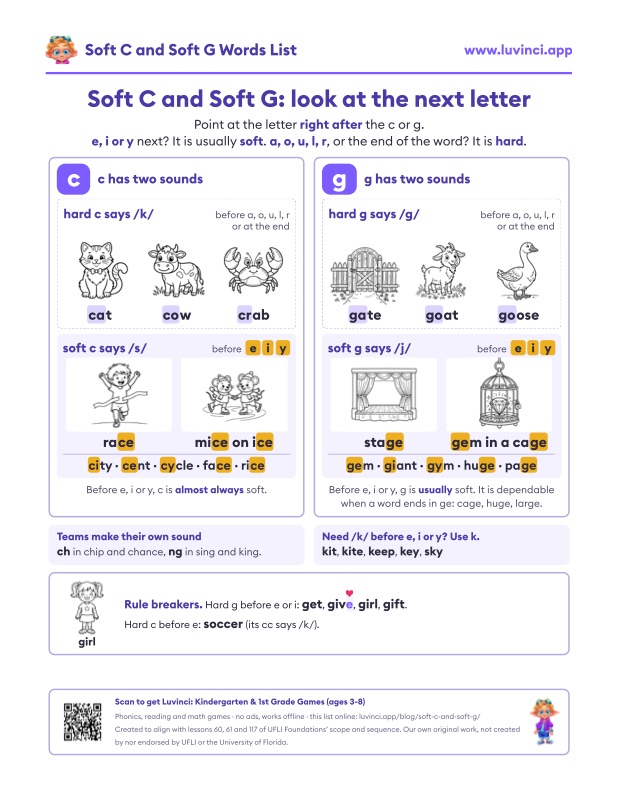
Page 1 of the free PDF.
Soft c word list, sorted by where the c sits. We’ve left out words that aren’t kid-friendly.
At the end, after a long vowel (face, mice)
- Long a: face, race, lace, space, place, grace, trace
- Long i: ice, mice, rice, nice, dice, slice, twice, price
At the end, after n (dance, fence)
dance, chance, glance, fence, prince, since
The vowel stays short. In chance, ch is its own team.
At the start (cent, city, cycle)
cent, cell, city, cycle, center
Longer soft c words (pencil, circus)
pencil, circle, circus, bicycle, fancy, cereal
circle, circus, cycle and bicycle have both sounds: soft before i or y, hard before l or u.
Soft g words: ge, gi, gy
Soft g word list, sorted by where the g sits.
At the end, after a long vowel (cage, huge)
age, cage, page, rage, wage, stage, huge, change, range, strange
In change, range and strange, the a stays long even though an n comes before the g.
At the end, after n or r (hinge, large)
hinge, fringe, plunge, large, charge
At the start (gem, gym, giant)
gem, gel, gym, germ, giant
In gym, the y acts as a short i. At the start of a word, g is less reliable; see the rule breakers below.
Longer soft g words (magic, giraffe)
giraffe, magic, gentle, ginger, orange, energy, danger, engine
At the end of a one-syllable word, right after a short vowel, /j/ is spelled -dge: badge, edge, bridge, fudge, judge, hedge, ledge, ridge. That’s a later lesson, with the other ending patterns. Two free sheets practice it: frogs on a bridge and fudge on a plate.
One e, two jobs: face and fence, rag and rage
In face, the e makes the a long and the c soft. In fence, the vowel is already short, so the e only softens the c. What did the e do?
- face / fence
- rice / prince
- cage / hinge
- huge / plunge
Now add an e:
- rag to rage
- hug to huge
- stag to stage (a stag is a male deer)
- wag to wage
Both sounds change at once: the vowel turns long, and the g turns from /g/ to /j/. That’s why soft c and soft g come right after magic e. Our long u words have hug and huge too.
Rule breakers: hard g before e and i (get, give, girl)
Here the risk is over-applying the new rule to words your child already reads. If they read get as “jet,” say: “Good check. This one’s a rule breaker.”
Hard g before e or i: get, give, gift, girl, begin, tiger, geese, gecko, giggle, forget, together, finger
- get: your child likely reads it already, next to net and pet in our CVC words. No heart.
- gift: a short i word with an ft blend. No heart.
- give: a heart word, give (e). The e is silent, and the i stays short. Children usually meet it right after the ge words.
- girl: comes later, with bossy r (ir). No heart.
forget is for + get, so it stays hard.
- Doubled gg stays hard: big to bigger, fog to foggy, dig to digging. The base word already has a hard g; the double letter only keeps the vowel short.
- A silent u keeps g hard: guess, guest, guide, guitar. UFLI Foundations teaches guess, guest and guide as irregular words in lesson 117.
- soccer: its cc says /k/, about the only word your child will meet where c before e does. In ocean and special, c says /sh/.
- once: still a heart word, once (whole word). The ce in once is the same soft c.
When are soft c and soft g taught?
Usually in 1st grade, right after magic e. Some programs place soft g at the end of 1st grade or the start of 2nd.
In UFLI Foundations, final -ce and -ge are lessons 60 and 61, inside the magic e unit, and give is an exception word in lesson 62. c and g at the start of a word (city, gem, gym) come in lesson 117, and -dge is lesson 70. See our worksheets in UFLI order.
Hard or soft? A 5-minute c and g sort at home
- Point at the next letter. Before reading a word with c or g, your child puts a finger on the letter right after it. If they misread one, don’t say the word; point there and wait.
- Read the pairs. One hard, one soft:
- cat / cent
- cot / city
- cup / cycle (cycle has both sounds: point at each c)
- gate / gem
- goat / giant
- Hard or soft? You say a word; your child says “hard” or “soft.” Slip in get now and then. If they say “soft,” praise the thinking, then tell them it’s a rule breaker.
- Read a sentence:
- Mice race on ice.
- Grace has a nice face.
- The stage is huge.
- Place the cage on the stage.
Free soft c and soft g worksheet (PDF)
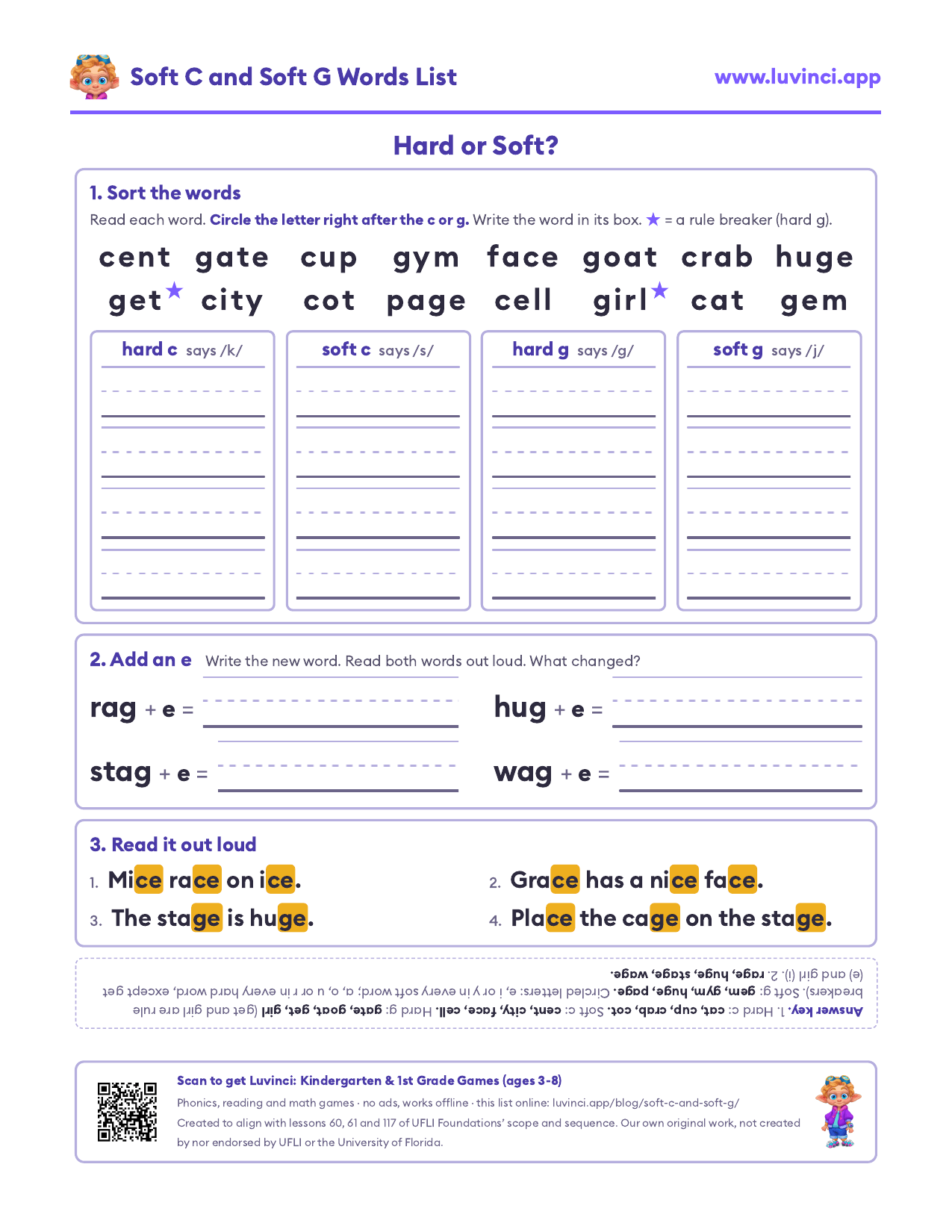
Page 3 of the free PDF.
Our soft c and g worksheet is a free 3-page PDF:
- Page 1: an anchor chart with the rule, pictures and the rule breakers.
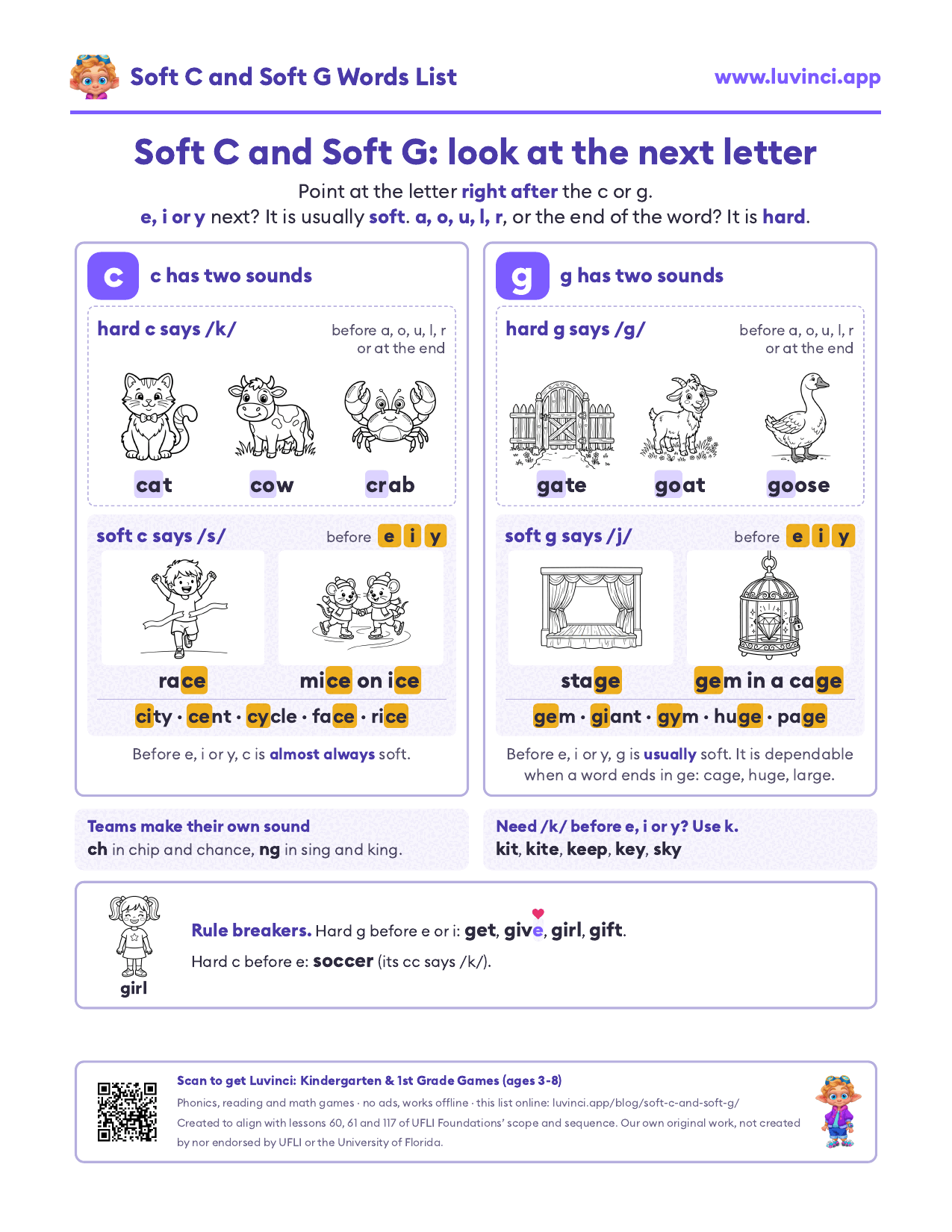
- Page 2: the soft c and soft g words list, with check boxes.
- Page 3: a hard-or-soft sort, add an e, four sentences and an answer key. No cutting, no glue.
It’s created to align with lessons 60, 61 and 117 of UFLI Foundations’ scope and sequence. Download the free soft c and soft g worksheet. No signup, no email. More practice: mice on ice, gem in a cage, the Sentence Builder Advanced and our printables library.
Questions parents ask
Is face a soft c or hard c? Soft. The c comes right before e, so it says /s/, like race and space.
Is page a hard g or soft g? Soft, because the g comes before e. So are cage, age, stage and huge.
Is giraffe a hard g or soft g? Soft: g before i says /j/. Gorilla and goat are hard, because o comes next.
Does girl have a soft g? No. girl keeps a hard g, like get, give and gift. Children usually meet it later, with bossy r (ir).
When does g make the j sound? Usually when e, i or y comes right after it (gem, giant, gym), and almost always when a word ends in ge (cage, huge, large). At the start, some common words stay hard (get, give, girl).
How do you know if c is soft or hard? Look at the next letter. c before e, i or y says /s/ (cent, city, cycle). Before a, o, u or a consonant, or at the very end of a word, it says /k/ (cat, cot, cup, crab, magic).
What words start with a soft c? Words like city, cent, cell, center, circle, circus, cycle and cereal.
Why does circle have two c sounds? The first c comes before i, so it’s soft. The second comes before l, so it’s hard. circus, cycle and bicycle work the same way.
Is the y in gym a vowel? Yes. In gym the y says a short i, and like e and i it makes the g soft.
What is the Gentle Cindy rule? A classroom memory trick for this rule: the name starts with a soft g (ge) and a soft c (ci).
What grade are soft c and soft g taught? Usually 1st grade, right after magic e: lessons 60 and 61 in UFLI Foundations. Some programs teach soft g at the start of 2nd grade.
Our reading games sound out every word cleanly, with no ads and no Wi-Fi needed. Next: all five long vowel words, or the floss rule, another rule that comes down to one small check.
Lesson numbers are cited for alignment only. This post and its PDF are our own original work, not created by nor endorsed by UFLI or the University of Florida.