 Luvinci
September 17, 2026
Fact Families for First Graders: Free Fact Family Triangles
Free printable · PDF · 1211 KB
Fact Families for First Graders: Free Fact Family Triangles
No signup needed. Just print it.
Download PDFFact families for first graders start with one simple picture, the fact family triangle. Three numbers belong together, like 3, 5 and 8, and the biggest one sits on top. Four facts come from those three numbers, two adding and two taking away. When your child sees that 3 + 5 = 8 also tells them 8 - 5 = 3, they can stop treating subtraction as a separate list to memorize.
3, 5, 8: 3 + 5 = 8 · 5 + 3 = 8 · 8 - 3 = 5 · 8 - 5 = 3
Our free fact family triangle PDF starts with a chart of every fact family within 10, then two write-the-facts pages, cut-out fact family triangle cards, fact family houses, a missing-number page and blank templates. 12 pages, no signup, no email.
Jump to: the triangle · the free PDF · games · every family within 10 · checks and mistakes · missing addends · houses · FAQ
What is a fact family?
A fact family is three numbers and the addition and subtraction facts they make. Two of the numbers are parts. Together they make the whole. Teachers also call these related facts, since every fact in the family is built from the same three numbers.
Take 3, 5 and 8. Add the parts and you get the whole: 3 + 5 = 8. Take a part away from the whole and the other part is left: 8 - 3 = 5. Math fact families rest on that one idea. Adding and taking away are one story, told in two directions.
3 + 5 and 5 + 3 are turn-arounds. Same two parts, different order, same answer. (The turn-around’s grown-up name is the commutative property of addition.) One fact your child already knows quickly becomes two, which is why turn-arounds are a gift. In one study (van Galen and Reitsma, 2011), children who practiced sums in one order improved just as much on the turn-arounds.
Fact family or number bond? A number bond is the picture: a whole and its two parts. A fact family is the four number sentences you can write from that picture. Same three numbers, two ways to show them.
Addition and subtraction fact families: examples
| Three numbers | Adding | Taking away |
|---|---|---|
| 2, 3, 5 | 2 + 3 = 5, 3 + 2 = 5 | 5 - 3 = 2, 5 - 2 = 3 |
| 4, 6, 10 | 4 + 6 = 10, 6 + 4 = 10 | 10 - 6 = 4, 10 - 4 = 6 |
| 3, 6, 9 | 3 + 6 = 9, 6 + 3 = 9 | 9 - 6 = 3, 9 - 3 = 6 |
| 4, 4, 8 | 4 + 4 = 8 | 8 - 4 = 4 |
| 0, 5, 5 | 5 + 0 = 5, 0 + 5 = 5 | 5 - 0 = 5, 5 - 5 = 0 |
Every fact family of 10 is one of the ways to make 10. A double like 4, 4, 8 has only 2 facts, because its turn-around is the same fact (doubles facts).
Fact families for first graders: what to teach and when
Kindergarten: children split numbers up to 10 into two parts, with fingers, counters and number bonds. The name “fact family” usually waits for 1st grade.
1st grade: the Common Core standards never say “fact family”. They say “the relationship between addition and subtraction”: to work out 10 - 8, find the number you add to 8 to make 10, and if you know 8 + 4 = 12, you also know 12 - 8 = 4. In parent words: the goal is quick, easy facts within 10, and the work goes up to 20. (Common Core 1.OA.4, 1.OA.6.)
Why bother? The Common Core writing team’s progressions document (2011) says thinking of subtraction as a missing part “makes subtraction as easy as addition (or even easier)”. That click can take a while. In one study (Nunes and colleagues, 2009), lessons on how adding and taking away undo each other helped 8-year-olds clearly and 5-year-olds a little, so don’t worry if it takes time to land.
2nd grade makes the facts to 20 quick and easy. 3rd grade does the same work with times and divide (see the end of this post).
A home order that works:
- Objects first. Make 8 crackers, split them into 3 and 5, and say all four facts.
- Dominoes. Page 7, or a real set (see the games below).
- Triangle cards. Cover a corner and say the fact (next section).
- Write the facts. Pages 2 and 3, then the houses.
- The hidden corner. Missing numbers, once the cards feel easy.
The fact family triangle
On a fact family triangle, the whole sits in the top corner and the two parts sit in the bottom corners. Plus and minus signs sit in the middle, to remind your child that the same three numbers add and take away. In our PDF the top corner also has a dot, so a card still works when it’s picked up upside down.
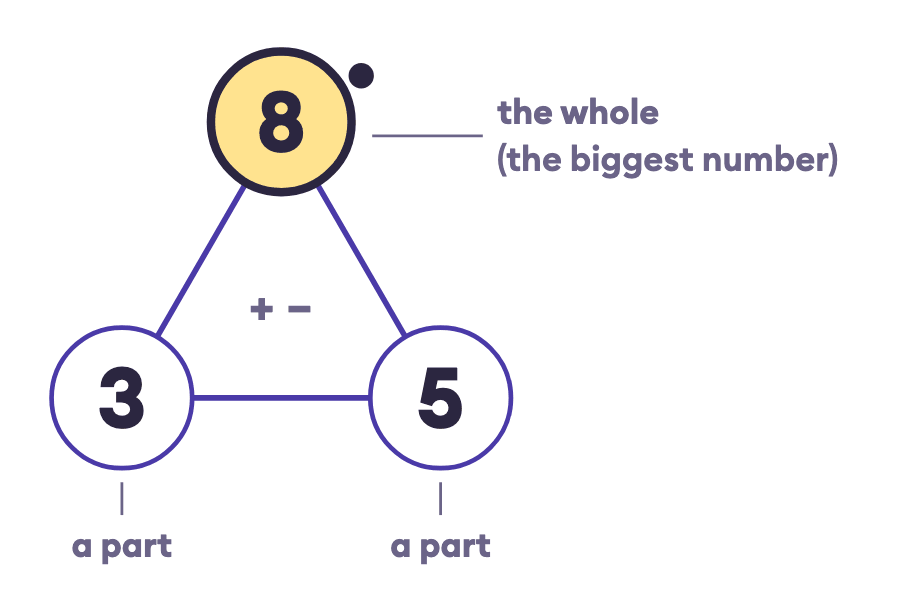
To make one, write the biggest number at the top. Then check that the two bottom numbers add up to it. If they don’t, it isn’t a fact family yet.
You’ll see these sent home as “fact triangles” in many US schools. Everyday Mathematics, a common school program, calls them Fact Triangles, and the cards in our PDF work the same way.
How to use fact family triangle cards: cover a corner
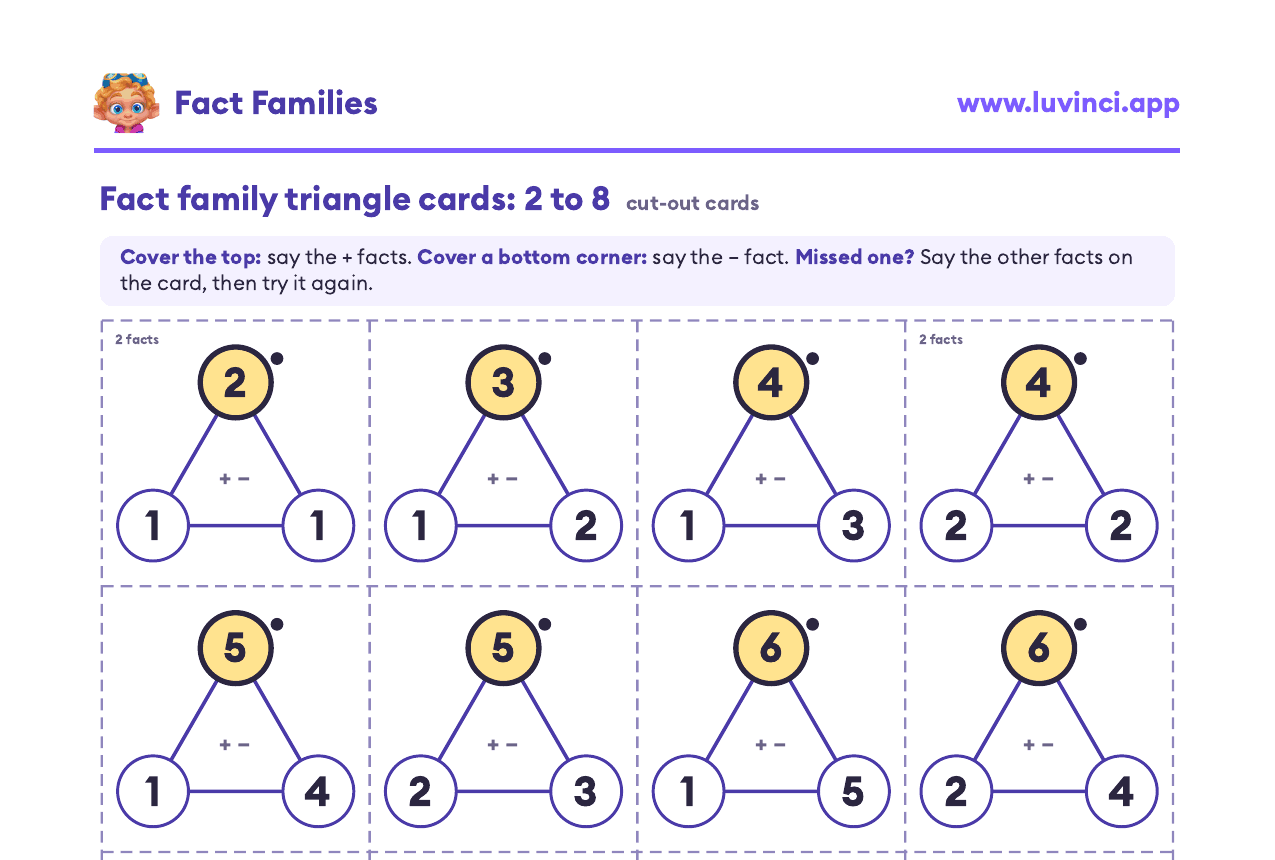
- Cover the top number with your thumb. Your child says the two adding facts (4 + 5 = 9, 5 + 4 = 9).
- Cover a bottom corner. Your child says the taking-away fact: the top number minus the part they can still see (9 - 5 = 4).
- Missed one? Say the other facts on the same card, then come back to the one they missed.
- Sort the cards into two piles, “know it fast” and “still thinking”. The second pile shrinks.
- A few minutes a day is plenty. Mix a few easy cards in with the hard ones.
They work like flash cards, but each of these fact family cards holds four facts.
Free fact family triangle printable (PDF)
The fact family triangle printable has 12 pages:
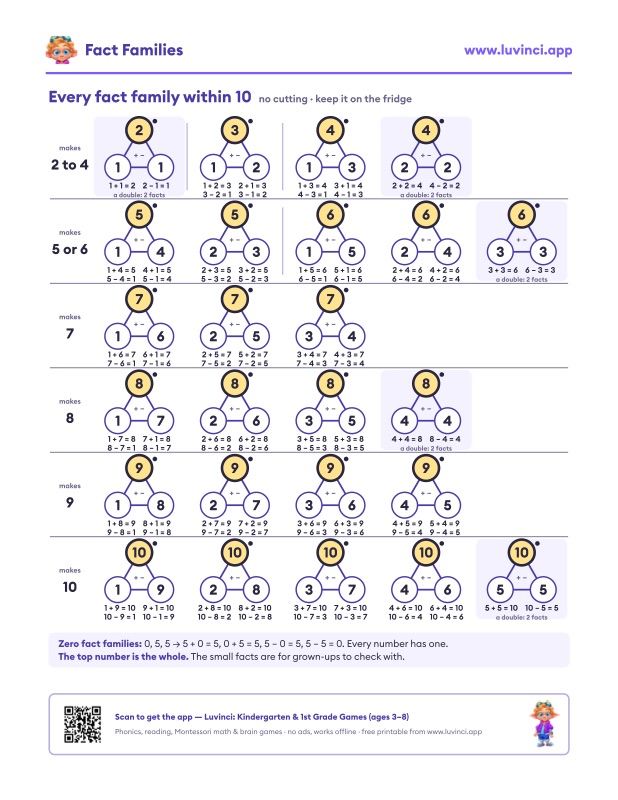
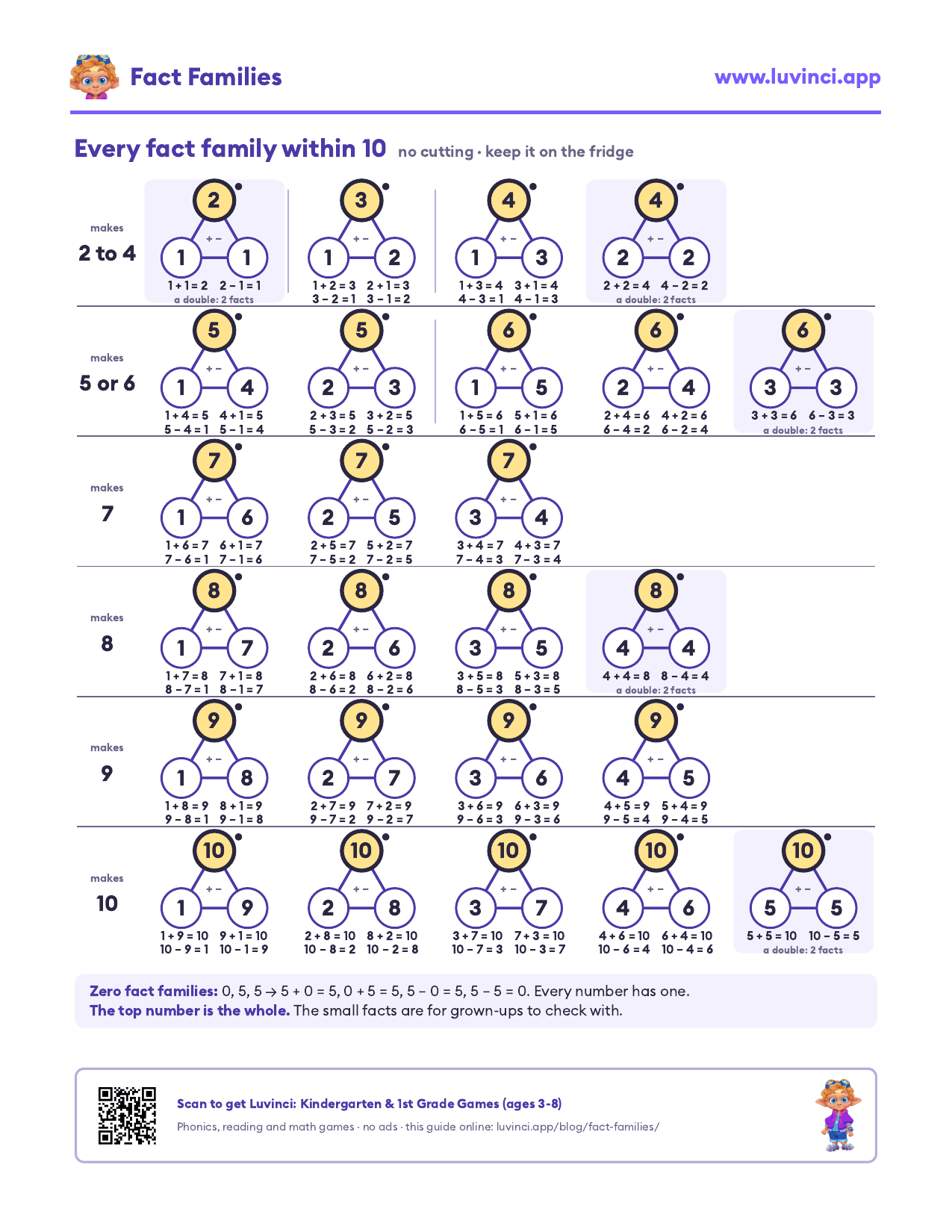
- Page 1: every fact family within 10, 25 triangles with their facts. No cutting.
- Pages 2-3: write the fact family. Three triangles a page, four fact lines each, so it can be two short sittings.
- Page 4: fact family triangle cards for wholes 2 to 8 (16 cards).
- Page 5: triangle cards for 9 and 10, plus 7 blank cards.
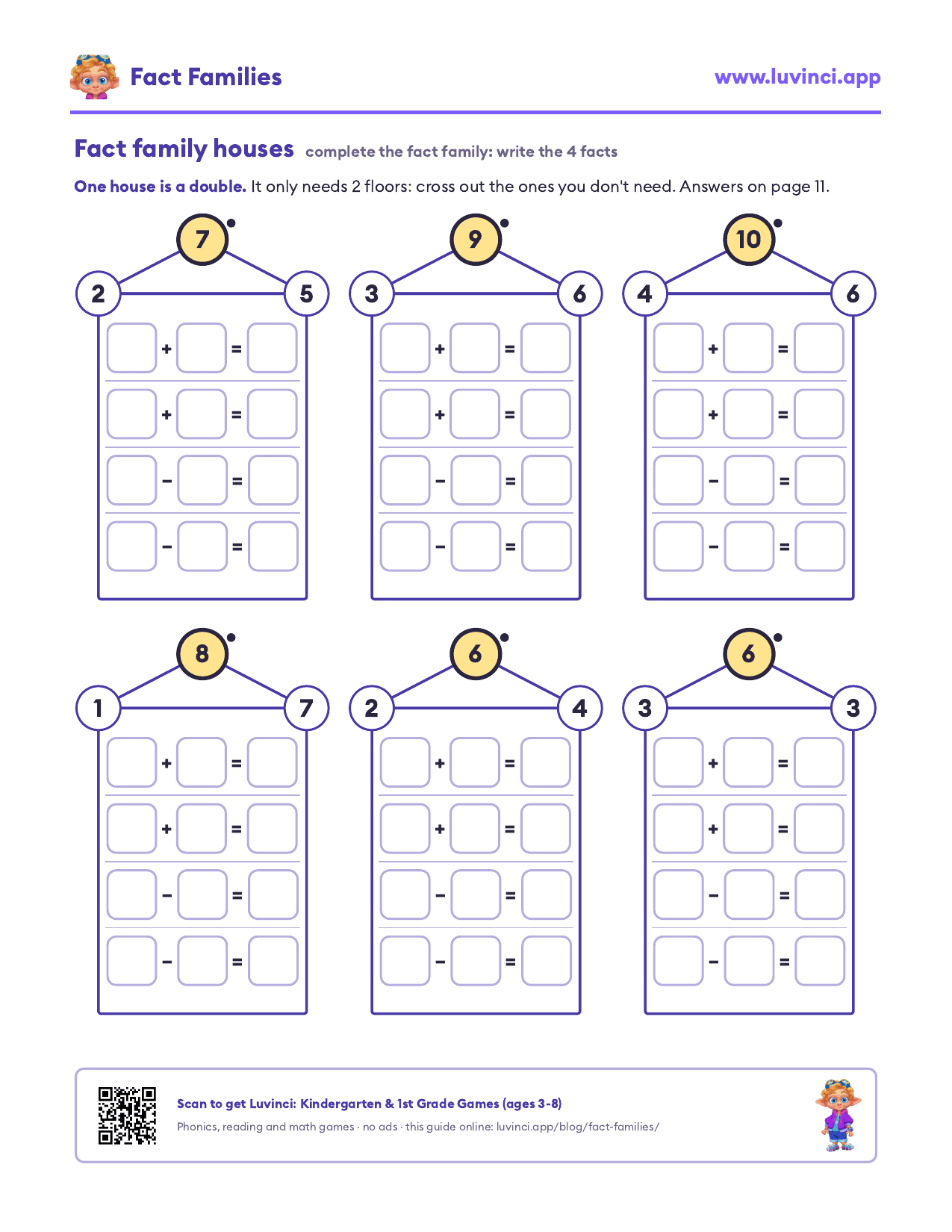
- Page 6: fact family houses. Six houses, four floors to fill.
- Page 7: domino fact families.
- Page 8: is it a fact family? Yes or no, then fix the mistake.
- Page 9: find the hidden number. Missing addends and missing numbers.
- Page 10: bigger fact families, 11 to 18 (20 cards for later in 1st grade).
- Page 11: blank triangles and houses for any numbers.
- Page 12: the answer key, for grown-ups.
Follow the home order above. Start with page 1, then pages 2 and 3, then cut out pages 4-5. Pages 6-10 come once the cards are easy.
Check answers with page 1. The answer key for pages 2-3 and 6-9 is on page 12. Free, no signup, prints in black and white.
Fact family games and activities
- Cover-a-corner race: use a deck of triangle cards (pages 4-5). Flip a card, cover a corner, say the fact. Keep the cards you get right.
- Domino fact families: pick a domino. The two halves are the parts and the total is the whole. Say all four facts (page 7 is the written version).
- Roll and build: roll two dice and build the triangle. The two dice are the parts, and the whole can reach 12.
- Who lives in the house? Write three numbers on a paper house; your child writes the floors. Then swap jobs.
- How Many Equations: game 8 in our math games for first graders. It’s a cousin of fact families: roll three dice and write as many true + and - sentences as you can in a minute.
Keep an adult nearby when younger children play with small objects like dice and dominoes.
Every fact family within 10
Count them. With two parts that aren’t zero, there are 25 fact families within 10, and 5 of them are doubles.
| Whole | Its fact families |
|---|---|
| 2 | 1, 1, 2 |
| 3 | 1, 2, 3 |
| 4 | 1, 3, 4 · 2, 2, 4 |
| 5 | 1, 4, 5 · 2, 3, 5 |
| 6 | 1, 5, 6 · 2, 4, 6 · 3, 3, 6 |
| 7 | 1, 6, 7 · 2, 5, 7 · 3, 4, 7 |
| 8 | 1, 7, 8 · 2, 6, 8 · 3, 5, 8 · 4, 4, 8 |
| 9 | 1, 8, 9 · 2, 7, 9 · 3, 6, 9 · 4, 5, 9 |
| 10 | 1, 9, 10 · 2, 8, 10 · 3, 7, 10 · 4, 6, 10 · 5, 5, 10 |
Plus zero: every number has a zero family, like 0, 7, 7.
Learn them in this order: the small wholes first, then the families of 10 (they’re the ways to make 10), then 6 to 9.
Page 1 of the PDF (pictured at the top) needs no cutting, so you can use it as a fact family anchor chart on the fridge.
Is it a fact family? Checks and common mistakes
Check 1: do the two small numbers add to the big one? 3, 5 and 7 is not a family, because 3 + 5 = 8. 15, 5 and 10 is one: 5 + 10 = 15.
Check 2: how many facts? Usually 4. A double has 2. Zero families have 4 (0, 5, 5: 5 + 0 = 5, 0 + 5 = 5, 5 - 0 = 5, 5 - 5 = 0).
Common mistakes:
- Starting a taking-away fact with a small number: 3 - 5 = 2. That doesn’t work with the numbers first graders use. Taking away always starts with the whole, the number on top.
- A stray number sneaks in: 3 + 5 = 8, then 8 - 2 = 6. That’s a different family. Only the three numbers in the triangle can be used.
- Forgetting the turn-around: writing 3 + 5 = 8 twice.
One last note that isn’t a mistake: some classes write 4 + 4 = 8 twice to fill a house. Either way, it’s really 2 facts.
Missing addends: find the hidden corner
A missing addend is the part you don’t know, as in 6 + ? = 10. On a triangle it’s the covered corner, so the fact family gives it away: 10 - 6 = 4.
The unknown can sit anywhere in the sentence. The Common Core’s own 1st-grade examples (1.OA.8) include “8 + ? = 11” and “5 = ☐ - 3”. Same idea each time. Find the family, then find the missing number.
This is also a handy way to subtract. When your child sees 13 - 8, they can think addition instead: 8 plus what makes 13? Our subtraction for kindergarten guide calls this “Think addition”.
Try it at home with crackers under a cup. “There were 9. I see 5. How many are hiding?”
Page 9 of the PDF has 10 of these, each with a little triangle that shows a ? in the hidden corner.
Fact family houses
Schools also draw a fact family as a house. The three numbers live in the roof and the four facts live on the floors.
When a worksheet says “complete the fact family”, it means filling the floors: two adding facts and two taking-away facts.
The double house needs only 2 floors. Your child writes those two and crosses out the others.
Fact families for multiplication and division
The same idea comes back in 3rd grade, with times and divide. The numbers 3, 4 and 12 make a family: 3 × 4 = 12, 4 × 3 = 12, 12 ÷ 4 = 3 and 12 ÷ 3 = 4.
The Common Core standard 3.OA.6 says: “Understand division as an unknown-factor problem.” That’s the missing addend idea again, with multiplying in place of adding.
The fact family for 15, 5 and 3 is 3 × 5 = 15, 5 × 3 = 15, 15 ÷ 5 = 3 and 15 ÷ 3 = 5.
The blank triangles on page 11 work for times-and-divide families too. If your child is in 1st grade, stay with adding and taking away. This comes two years later.
Spot a fact family in the app
The app has addition and subtraction boards within 10; a fact family is how the two connect. On the Singapore Math boards your child meets 6 + 3 and 3 + 6, and later 9 - 6 and 9 - 3, each on its own screen. Build the triangle for 3, 6 and 9 together and those four facts become one family. The Singapore Math boards are in the full app, and the counting board is free. All the math boards are on our early math games page.
FAQ
What is a fact family in math?
A fact family is three numbers and the addition and subtraction facts they make, usually 4 and sometimes 2. For 2, 7 and 9 the facts are 2 + 7 = 9, 7 + 2 = 9, 9 - 7 = 2 and 9 - 2 = 7.
At what grade level are fact families taught?
In 1st grade, through the relationship between addition and subtraction (Common Core 1.OA.4 and 1.OA.6). 2nd grade makes the facts to 20 quick, and by the end of the year kids know every sum of two one-digit numbers from memory (2.OA.2). 3rd grade does the same with multiplying and dividing (3.OA.6). Many kindergartens meet the idea through number bonds.
Is 5, 5, 10 a fact family?
Yes, with only two facts: 5 + 5 = 10 and 10 - 5 = 5. A double’s turn-around is the same fact, so there’s nothing new to write.
Can you write a fact family for 3, 5 and 7?
No. 3 + 5 = 8, not 7. 3, 5 and 8 works, and so does 3, 4 and 7.
Are related facts the same as a fact family?
Yes. Related facts are the facts in one family. You may also hear fact triangles or number families.
What property is a fact family?
Two ideas sit inside a fact family. The turn-around, whose real name is the commutative property of addition, and adding and taking away undoing each other (teachers say inverse operations). The Common Core says children don’t have to use the formal names: “Students need not use formal terms for these properties.” Still, say the real name now and then, next to “turn-around”. A US Department of Education practice guide for children who find math hard (Fuchs and others, 2021) warns that swapping the real name for a nickname like the “flip-flop property” “can cause serious confusion later” when children don’t connect the two.
How do you find a missing addend?
Think of the fact family. For 6 + ? = 10, take the part you know from the whole: 10 - 6 = 4. Check it by adding: 6 + 4 = 10.
The takeaways
- A fact family is three numbers and up to four facts: two adding, two taking away.
- On a fact family triangle the whole is on top. Cover a corner and say the fact.
- Taking away always starts with the whole.
- A missing addend is just the covered corner: 6 + ? = 10 is 10 - 6.
- 1st graders aim for every fact family within 10; 11 to 18 comes later in 1st grade and in 2nd.
- Print the free fact family triangle PDF: 12 pages, from a no-cut chart of every fact family within 10 to cut-out triangle cards, fact family houses and blank templates.
More free math worksheets: ten frames, number charts, addition and subtraction, daily practice workbooks and more, all in one place. See the math printables →
