 Luvinci
October 4, 2026
4 Easy Math Card Games for Kindergarten (Free Printable Cards)
Free printable · PDF · 513 KB
4 Easy Math Card Games for Kindergarten (Free Printable Cards)
No signup needed. Just print it.
Download PDFMath card games for kindergarten and 1st grade work without a long rule book. These 4 easy math card games are one game, Math War, in four levels. Learn the flip once, then change one thing.
Have a deck of cards? Print page 1 of the free printable math card games and play red cards against black. Don’t have a deck? Pages 2 and 3 are 22 cards 0 to 10 with a ten frame on each. No signup.
The short version:
| Level | What changes | Say it |
|---|---|---|
| Math War | Bigger number wins | “7 beats 4.” |
| Addition War | Flip two cards and add. Bigger sum wins. | “3 and 2 make 5.” |
| Ten War | More empty boxes wins, so the smaller number wins. Say the ten fact. | “3 and 7 make 10.” |
| Count-Up War | Bigger wins. Say how much bigger. | “8 is 3 more than 5.” |
Math card games for kindergarten: one game, four levels
Your child learns one routine. Take your color, flip, say the numbers. Each level changes only step 2, so the rest of play stays the same. There’s no dealing, no hidden hand and no race against a grown-up. In kindergarten, start with cards 0 to 5 from each color, then add the rest once those come fast.
1. Math War
It’s also called Top It.
2 players. Start with cards 0 to 5, then use all 11.
- Each player takes one color, mixes those cards and keeps them face down in a pile.
- Both flip the top card and say the numbers. The bigger number wins both cards: put them beside you.
- Same number? High five, and each keeps their own card. Won cards stay beside you, not back in your pile, so one trip through the pile is the whole game. Most cards wins. Same count? You both win.
Tip: When you aren’t sure which is bigger, count the counters, or find both towers on page 1.
2. Addition War
One of the classic addition card games.
2 players. Kindergarten: cards 0 to 5. 1st grade: take out the 0 and use cards 1 to 10.
Play Math War, but change step 2:
Both flip two cards and add them. The bigger sum wins all four.
Tip: Count every counter on both cards. Later, start at the bigger number and count on.
If you want adding games without cards (dice, dominoes, snacks), see our addition games for kindergarten.
3. Ten War
2 players. All 11 cards. Late kindergarten.
Play Math War, but change step 2:
Both flip the top card and count its empty boxes. More empty boxes wins both cards after saying the ten fact: “My 3 has 7 empty boxes. 3 and 7 make 10.”
Watch the switch: this time the smaller number wins, because it has more empty boxes.
Tip: If you’re unsure, count the empty boxes one by one, or find the tower on page 1.
You’ll find more ways to practice the pairs in our make 10 games.
4. Count-Up War
2 players. All 11 cards. 1st grade.
Play Math War, but change step 2:
Both flip the top card. The bigger number wins both cards after saying how much bigger: “8 is 3 more than 5.”
Tip: Count up from the smaller number: “5… 6, 7, 8. That’s 3 more.”
Classic Subtraction War has each player flip two cards. This one-card version is how 1st grade starts finding the difference. For dice games on the same 1st grade skills, see our first grade math games.
The free printable math card games PDF
There are three pages. With a deck of cards at home, print page 1 only.
| Page | What’s on it | Cutting |
|---|---|---|
| 1 | “Which card wins?” chart, Math War rules, the 4 levels, regular deck setup | none |
| 2 | Player 1: red cards 0 to 10 (circles) | 15 cuts |
| 3 | Player 2: blue cards 0 to 10 (squares) | 15 cuts |
Keep page 1 on the table. The taller tower is the bigger number, and its empty boxes make it 10.
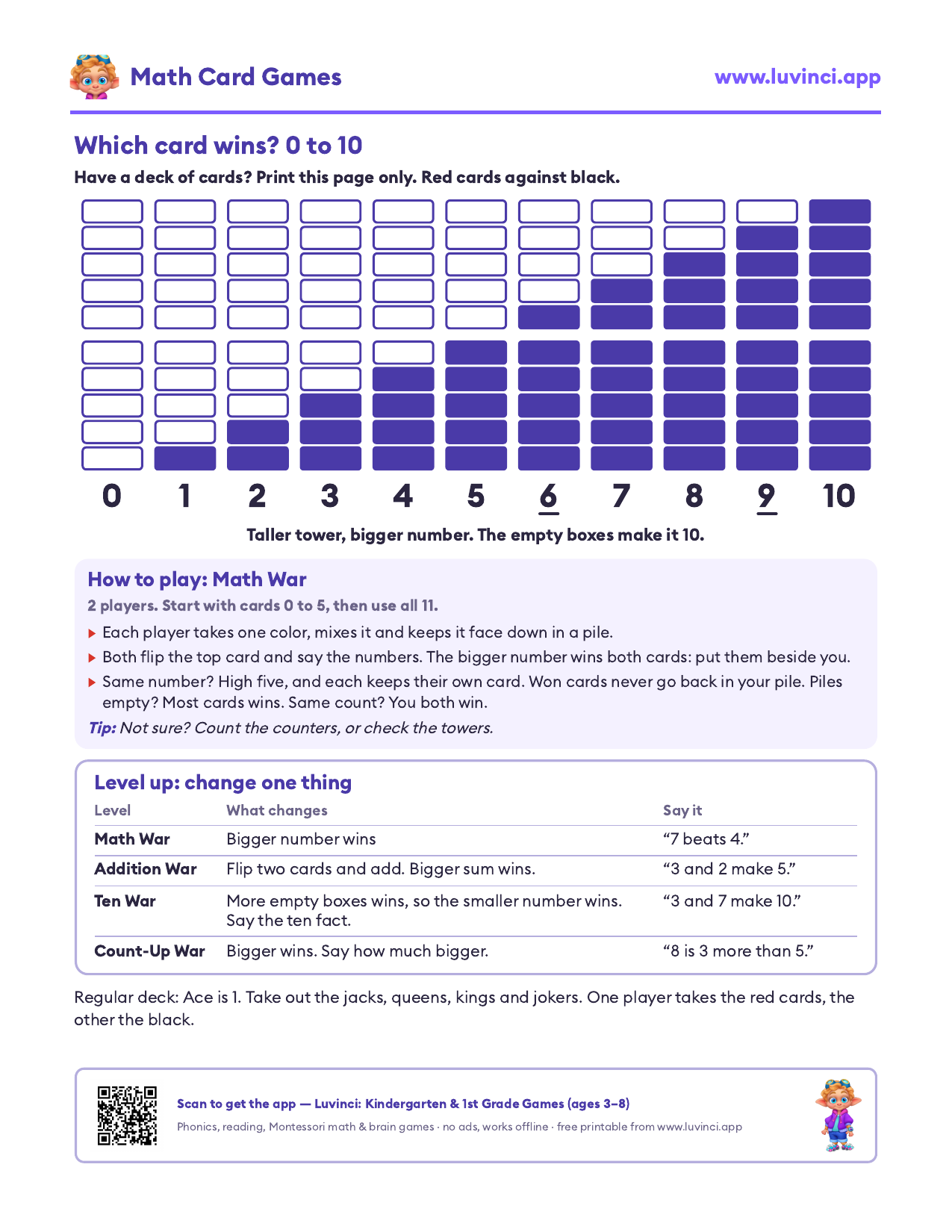
Page 1: which card wins, 0 to 10.
Each card shows its number and a ten frame with that many counters, nothing else, so every counter counts. Circles mark player 1 and squares mark player 2, so the sets stay apart in black and white.
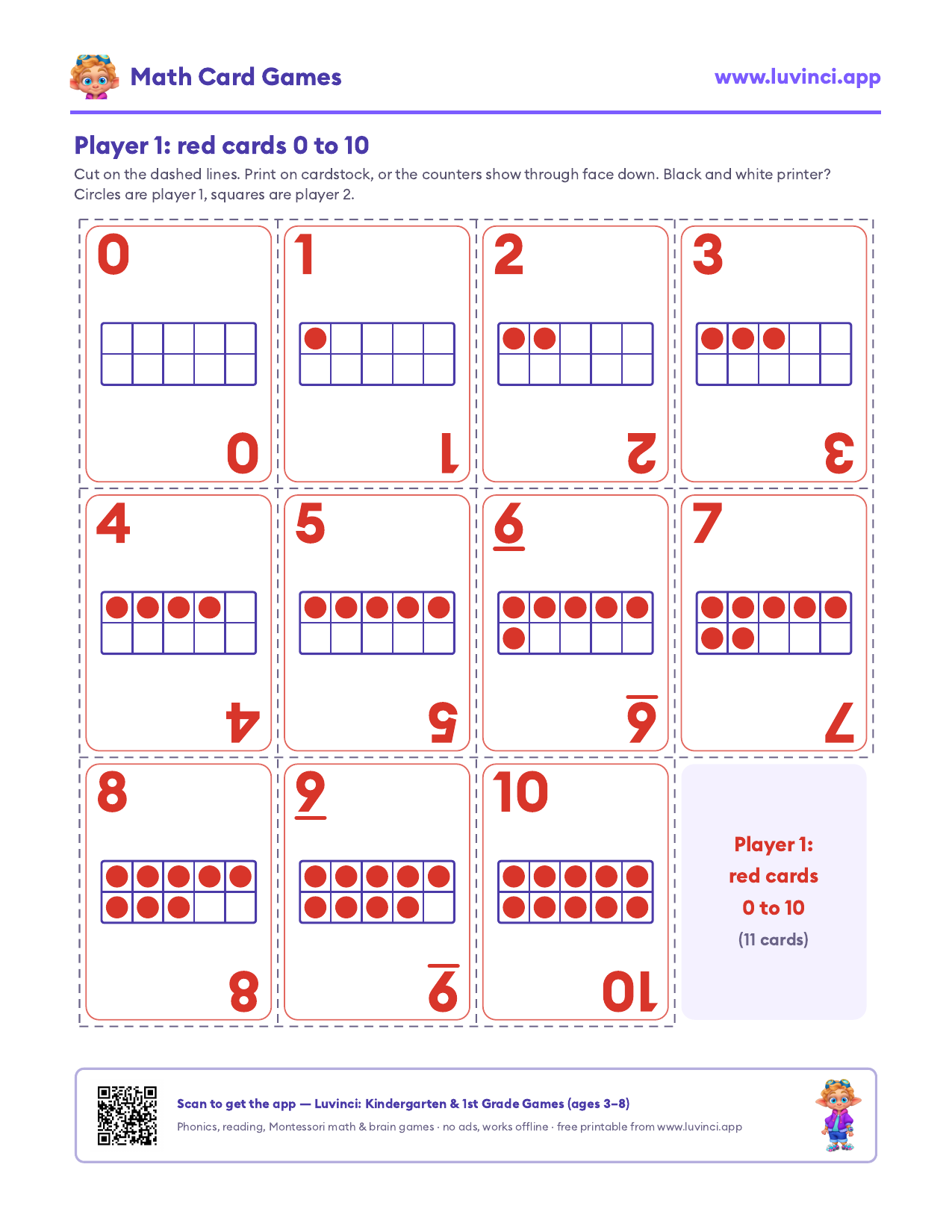
Page 2: player 1’s red cards.
Print on cardstock, or the counters show through once the cards sit face down.
Math games with playing cards: red cards against black
| Card | Counts as |
|---|---|
| Ace | 1 |
| 2 to 10 | its number |
| Jacks, queens, kings, jokers | take them out |
One player takes the red cards, the other the black. That’s 20 cards each, so Math War is 20 flips. For a kindergarten start, use Ace to 5 (10 each). For Ten War, find the card on page 1 and count the empty boxes above its tower.
Tips that keep math card games short and fair
- Count “1, 2, 3, flip!” so nobody peeks or flips early.
- Let the cards settle it. Count the counters or check page 1, so the grown-up never has to.
- Stay on a level while it’s fun. Going back down is fine any day.
- Lay your color out 0 to 10 at cleanup. A gap means a missing card.
FAQ
What is a good card game that involves math?
Math War. Both players flip a card, and the bigger number wins. Play it with our free printable cards or a regular deck.
How do you play Addition War with cards?
Each player flips two cards and adds them, and the bigger sum wins all four. Start with cards 0 to 5, then use 1 to 10 in 1st grade. Full rules: Addition War.
What card games can a kindergartner play?
Start with Math War. Then try Go Fish. Our 22 cards are 11 pairs of the same number. Go Fish for 10 works too: ask for the card that makes 10 with one of yours (“I have a 3. Do you have a 7?”). The 22 cards make exactly 11 of those pairs. Garbage, also called Trash, uses a regular deck. Each player lays 10 cards face down in two rows of 5, like a ten frame, as spots 1 to 10.
Can you play math card games with a regular deck?
Yes. Ace is 1, the face cards and jokers come out, and play is red cards against black. Setup is above.
Do card games help kids with math?
In one small study, low-income preschoolers who played a War-style card game for about an hour over 3 weeks got better at comparing written numbers (72% to 80% correct), while Memory players with similar cards barely changed (82% to 83%) (Scalise, Daubert and Ramani, 2017).
The takeaways
- Learn Math War once. Each level changes one step.
- The cards check the answer. Count the counters or look at page 1.
- Download the free printable math card games (3 pages, no signup).
The Luvinci app has no card games. Its closest match to these cards is the Singapore Math boards: each sum sits on two ten frames of pictures, and one board is sums that make 8 or 10, like 7 + 3 and 6 + 4. Those boards are in the full app; the counting board is free. None of the adding boards goes past 10. See the math boards.
More free math worksheets: ten frames, number charts, addition and subtraction, daily practice workbooks and more, all in one place. See the math printables →
