 Luvinci
September 15, 2026
Subtraction for First Graders: Free Subtraction Worksheets for First Graders (Within 20)
Free printable · PDF · 1283 KB
Subtraction for First Graders: Free Subtraction Worksheets for First Graders (Within 20)
No signup needed. Just print it.
Download PDFSubtraction for first graders is mostly taking away within 20, plus a few smart ways to get past 10. By the end of 1st grade, kids are expected to be quick with take-aways within 10 and to work out the rest, like 13 - 8, with a strategy. They don’t need them all memorized yet. Most of the work is learning which way is quickest for which numbers.
It all comes in one free subtraction within 20 PDF of 11 pages: a subtraction facts to 20 chart, a strategies chart, six practice pages with 78 problems to solve, 15 flash cards with answer cards, and an answer key. No signup, no email.
You’re in part 4 of our adding and taking away series. Start with subtraction for kindergarten if take-aways within 10 are still slow. Every strategy here leans on them.
Jump to: what 1st grade expects · how to teach it · strategies · facts to 20 · 10 examples · the worksheets · mistakes · FAQ
Subtraction within 20: what 1st grade expects
“Within 20” means every number in the problem is 20 or less, so 17 - 9 is in and 23 - 5 is not.
The Common Core standards used by most US states ask for this by the end of 1st grade:
- Subtract within 20, quick within 10 (1.OA.6). The standard says: “Add and subtract within 20, demonstrating fluency for addition and subtraction within 10.” In plain words, quick within 10 and a strategy for 11 to 20. Its own examples are subtraction strategies: “decomposing a number leading to a ten (e.g., 13 - 4 = 13 - 3 - 1 = 10 - 1 = 9)” and “knowing that 8 + 4 = 12, one knows 12 - 8 = 4”.
- Subtraction as a missing part (1.OA.4). “Understand subtraction as an unknown-addend problem. For example, subtract 10 - 8 by finding the number that makes 10 when added to 8.”
- Counting to subtract (1.OA.5). Counting back and counting up are both ways of counting to subtract.
- How many more? (1.OA.1). Comparing two groups within 20, with objects or drawings. More on that just below.
In the standards, being fluent means being fast and accurate (Progressions, p. 18). Being quick within 20 is the 2nd grade goal: “Fluently add and subtract within 20 using mental strategies” (2.OA.2). So 1st grade is about a good way for every take-away, not about speed past 10.
Addition and subtraction within 20 are taught side by side, so this post has a twin: addition for first graders.
How many more? Finding the difference
Subtraction isn’t only taking away. It also answers “how many more?”
Draw two block towers side by side, 12 blocks and 8 blocks. The 4 extra blocks on the taller tower are the difference: 12 - 8 = 4. Lay the towers down as cube trains and the extras are easy to see. Page 8 does this.
Ask “how many more?” first, then “how many fewer?” with the same two towers. Counting up works here too: from 8 up to 12 is 4 (see count up below).
If your child still puts small things in their mouth, use big blocks and stay close.
Subtraction for first graders: how to teach it
To teach a first grader to subtract within 20, build on the facts to 10 they already know and add one strategy at a time. About 10 minutes a day is enough:
- Make within 10 quick first. Five minutes a day with the take-aways to 10. Our subtraction chart within 10 helps.
- Build the teens on two ten frames. 14 is a full ten and 4 more. Use two ten frames and real counters.
- Count back only for 1, 2 or 3.
- Count up when the numbers are close (13 - 9).
- Use the ten for the rest: take from ten, or go down to ten.
- Ask “How did you get it?” Any way that works is fine. The goal is picking a quick one.
It follows the same order as kindergarten: real things, then pictures, then numbers.
If you’re wondering how to teach subtraction to first graders who find math hard, the plan above still holds. A US Department of Education practice guide for children who struggle with math recommends “about 10 minutes in each session” on facts, with the counting strategies taught before flash cards (Gersten et al., IES, 2009, Recommendation 6).
Subtraction strategies for first grade (within 20)
These are the subtraction strategies first graders use within 20. Most of them come from the 1st grade standard (1.OA.6). We’d teach them in this order.
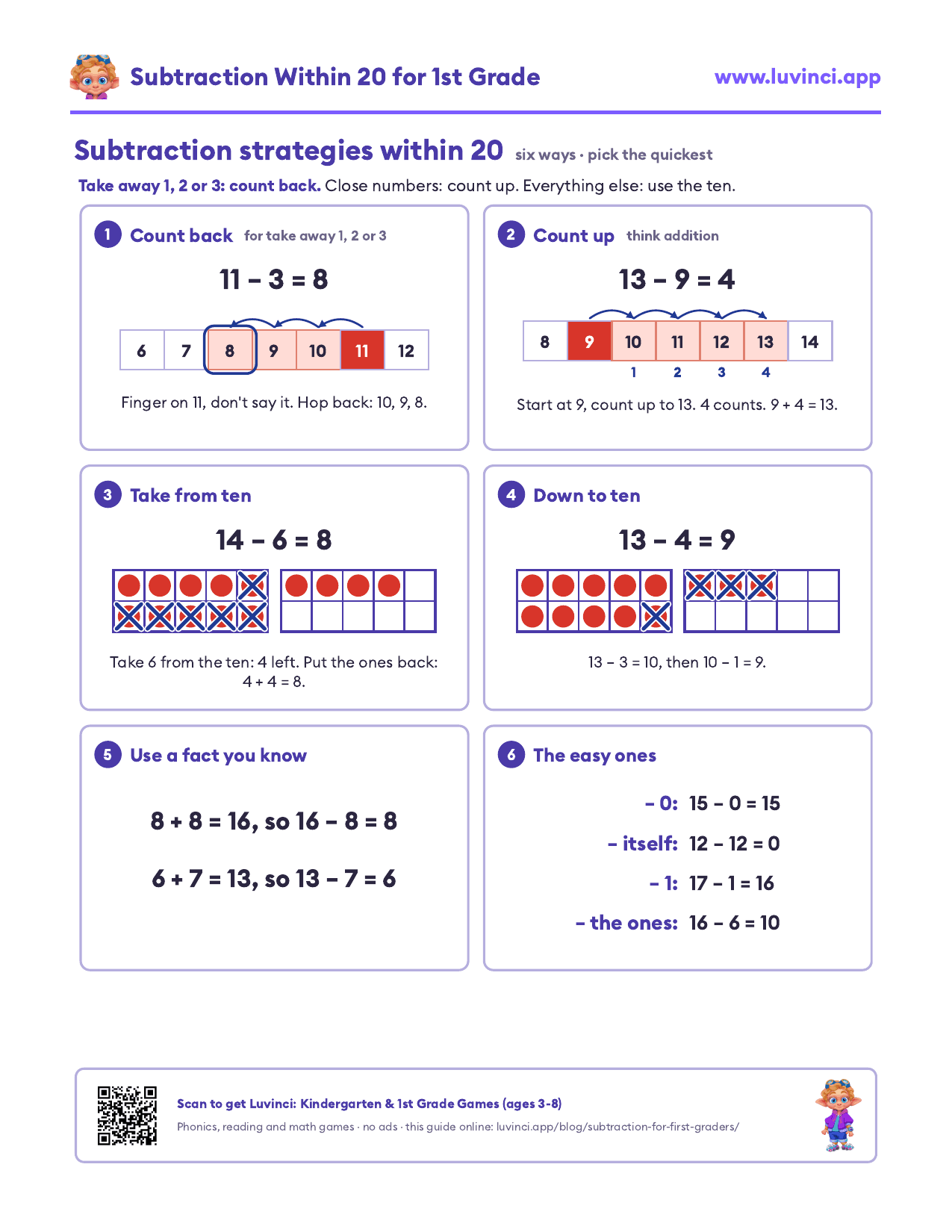
Page 2: a subtraction anchor chart with one worked example for each strategy.
Count back for 1, 2 or 3
For 11 - 3, put a finger on 11 and don’t say it. Then hop back: 10, 9, 8. The answer is 8. Counting back past 10 is where saying the numbers out loud pays off.
It’s the same hop back as our counting back section for kindergarten. Page 5 uses a number path, a row of boxes, and our number path or number line section explains why boxes come first.
Don’t count back for bigger take-aways. 1, 2 or 3 is the limit. That’s one less than for counting on in addition, which works for 1 to 4, because counting back is harder. Counting down is “difficult and error-prone” (Progressions, p. 36).
Count up: think addition
For 13 - 8, ask “8 plus what makes 13?” Start at 8 and count up: 9, 10, 11, 12, 13. That’s five counts, so 13 - 8 = 5. The counts are the answer.
This often works better than counting back. “Counting on for subtraction is easier than counting down,” say the Progressions (p. 15). Adding It Up, from the National Research Council (2001, p. 194), notes that “single-digit subtraction is usually more difficult than addition for U.S. children”, and that counting up “makes subtraction more accessible”.
Fingers are fine here. “The accumulated fingers or head bobs give the answer” (Progressions, p. 15). Each finger your child puts up is one count.
Subtraction as a missing part (1.OA.4) ties every take-away to the addition twin: knowing 8 + 5 = 13 gives 13 - 8 = 5. These pairs are also called related facts. Our fact families guide has a page of them.
Count up is best when the numbers are close: 13 - 9, 15 - 12, 20 - 17.
Take from ten
For 14 - 6, think of 14 as a ten and 4 (more in teen numbers). Take the 6 from the ten: 10 - 6 = 4. Then put the 4 ones back: 4 + 4 = 8.
On two ten frames, your child crosses out 6 from the full frame and counts what’s left in both. That’s page 3.
10 - 6 is one of the ways to make 10 read backwards, which is why those pairs matter so much.
Programs name it differently. Eureka Math Grade 1 calls it “taking from ten”, and Singapore’s Dimensions Math 1A teaches “Subtract from 10”.
Subtract down to ten
For 13 - 4, take 3 to get to 10, then 1 more, so 9. This is the 1.OA.6 example: 13 - 4 = 13 - 3 - 1 = 10 - 1 = 9. That’s page 4.
Some workbooks call this “make a 10 to subtract”. The number bonds your child knows tell them how to split the 4 into 3 and 1.
This one is harder for some kids. The Progressions say going down to ten “can be more difficult than the forward methods” (p. 15). If it feels hard, count up or take from ten instead.
Use a fact you already know
16 - 8 = 8, because 8 + 8 = 16. Doubles facts work backwards.
And then there are the easy ones:
- Take away 0 and nothing changes: 15 - 0 = 15.
- A number take away itself is 0: 12 - 12 = 0.
- Take away 1 and you get the number before: 17 - 1 = 16.
- Take away the ones and 10 is left: 16 - 6 = 10.
Which way is quickest?
- Taking away 1, 2 or 3: count back.
- Numbers close together: count up.
- A double you know: use it.
- Everything else past 10: use the ten, either take from ten or down to ten, whichever your child likes.
Page 6 mixes them up. Tick the quickest way, then solve. Any way that gets the right answer is fine.
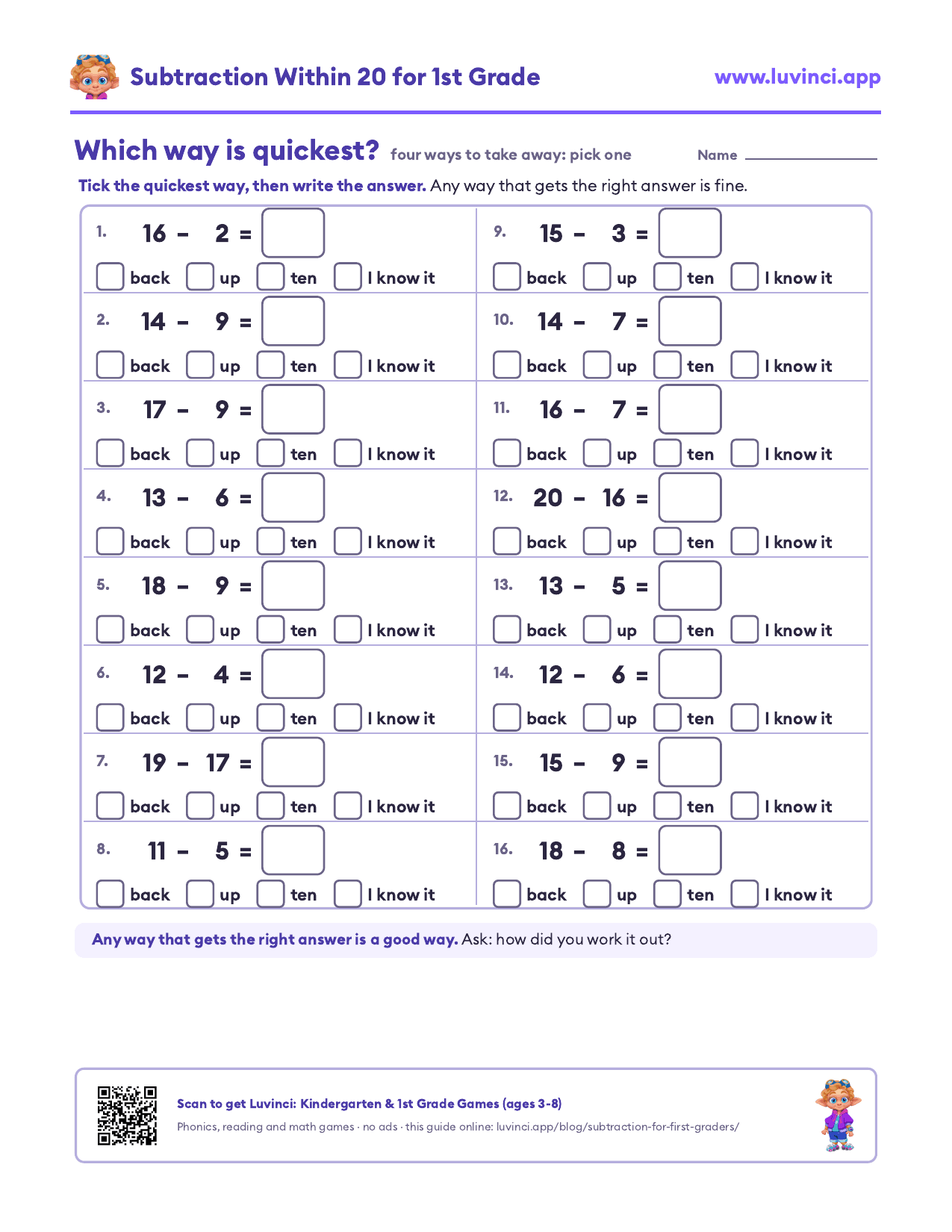
Page 6: tick a way, then solve. The answer key lists a quick way for each, but any way that works is fine.
Subtraction facts to 20
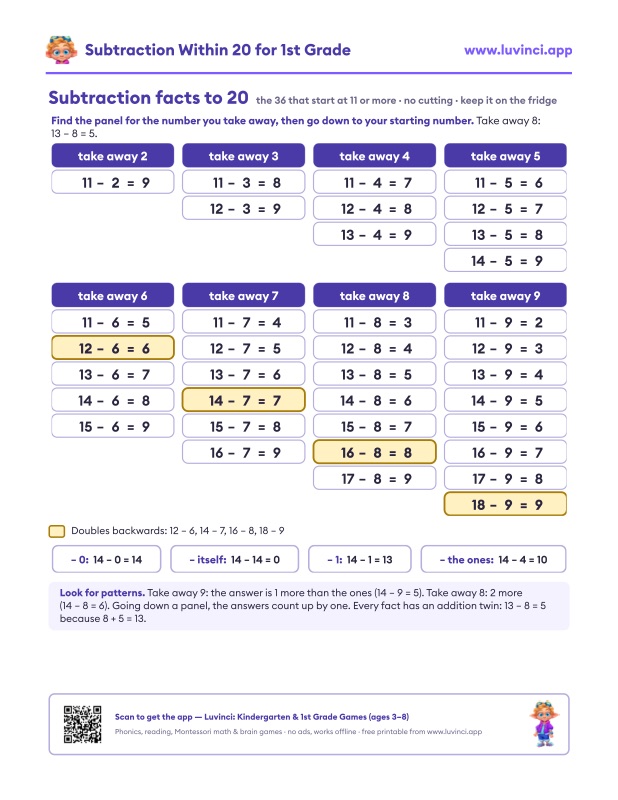
Subtraction facts are the take-aways that undo the addition facts. Start at 18 or less, take away 0 to 9, and the answer is 0 to 9. 13 - 8 = 5 undoes 8 + 5 = 13.
There are 100 of them, from 0 - 0 to 18 - 9. 36 of them start at 11 or more, and those 36 are on page 1 of the PDF.
To read page 1, find the panel for the number you take away, then go down to your starting number. In the take away 8 panel, 13 - 8 = 5.
Patterns to spot:
- Take away 9: one more than the ones (14 - 9 = 5).
- Take away 8: two more than the ones (14 - 8 = 6).
- Answers count up by one as you go down a panel.
- Doubles backwards (yellow): 12 - 6, 14 - 7, 16 - 8, 18 - 9.
- Every fact has an addition twin (13 - 8 = 5 because 8 + 5 = 13).
Quick within 10 is the 1st grade goal. These 36 get quick during 2nd grade (2.OA.2, “using mental strategies”). Hang the chart next to the within 10 chart from subtraction for kindergarten.
10 subtraction examples (and the quickest way for each)
Here are 10 examples, each with the quickest way to solve it.
- 7 - 0 = 7. Taking away 0 changes nothing.
- 9 - 9 = 0. A number take away itself is 0.
- 15 - 1 = 14. Take away 1: the number before.
- 11 - 3 = 8. Count back three: 10, 9, 8.
- 13 - 9 = 4. Count up from 9: 10, 11, 12, 13. Four counts.
- 11 - 8 = 3. Think addition: 8 + 3 = 11.
- 14 - 6 = 8. Take from ten: 10 - 6 = 4, then 4 + 4 = 8.
- 13 - 4 = 9. Down to ten: 13 - 3 = 10, then 10 - 1 = 9.
- 16 - 8 = 8. Use a double: 8 + 8 = 16.
- 12 - 8 = 4. How many more is 12 than 8? Line them up: 4 more.
Subtraction worksheets for first graders: the 11 pages
The PDF is free and prints in black and white, with every answer in the back. None of these pages need borrowing. Every problem is a single take-away within 20.
- Page 1. Facts to 20 chart (no cutting).
- Page 2. Strategies anchor chart (no cutting).
- Page 3. Take from ten: 8 problems on two ten frames.
- Page 4. Down to ten: 8 problems.
- Page 5. Count back and count up on a number path: 16 problems.
- Page 6. Which way is quickest?: 16 mixed problems; tick a way, then solve.
- Page 7. Practice: 30 facts past 10, kept in a row so kids see the whole number.
- Page 8. How many more?: 5 cube-train pairs.
- Page 9. 15 cut-out cards.
- Page 10. Their answer cards.
- Page 11. Answer key for pages 3 to 8.
Pages 3 to 8 are the subtraction within 20 worksheets. Do one a day. Don’t try all of them at once.
When those are done, our free Subtraction Facts to 20 Workbook has 20 more days of plain facts, one strategy at a time, with earlier facts mixed back in and the answers at the back.
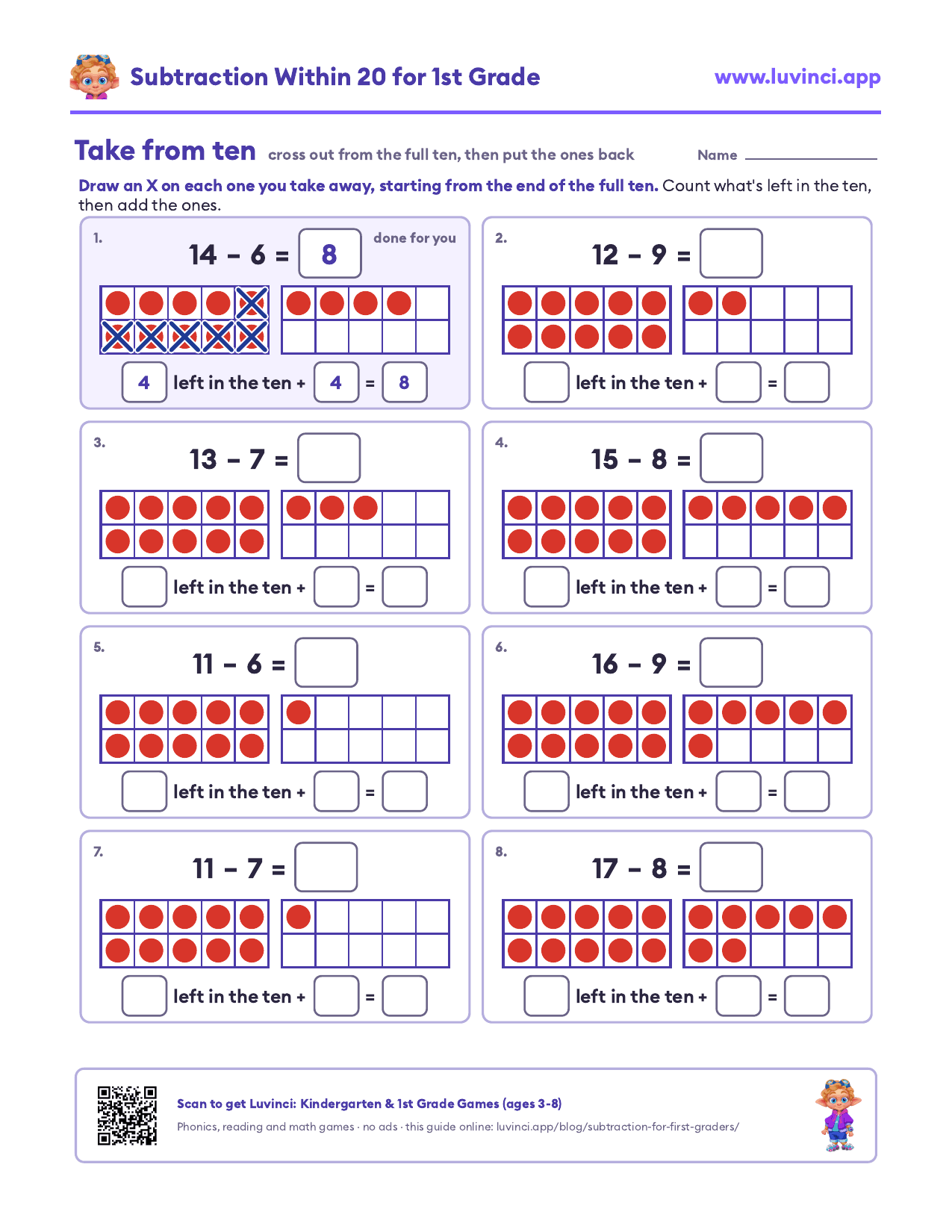
Page 3: cross out from the full ten, then put the ones back. Answers are on page 11.
More free subtraction pages:
- Within 10, with a chart and picture take-aways: subtraction for kindergarten.
- Blank two ten frames for building teens: ten frame printable.
- Hops back on a printed line: number line to 20.
- Jumps back and counting up, past 20 too: number line addition and subtraction.
- A dice game for “how many more?”: Difference Race.
The 15 cards: facts past 10
Pages 9 and 10 are the cards. Print page 10 on the back of page 9, flipping on the long edge. If you print the whole PDF two-sided, these two pages land on one sheet. Each answer card shows two small ten frames with the take-away crossed out from the end (the down-to-ten way).
Cards 1-2 count back, cards 3-6 count up, and cards 7-15 use the ten or a double. Each card front names its way in the small top-left label (“count back”, “count up”, “use the ten”, “a double”), so on a miss the way is right there.
Ways to use them:
- Quick look. Your child says the answer, then flips the card to check.
- Two piles. Quick ones go in a “know it” pile. The rest come back tomorrow.
- Say how you got it. For each card, your child says the way before the answer: “count up from 9”.
Practice comes after you teach the strategy. A guide for children who find math hard (Fuchs et al., IES, 2021, Recommendation 6) keeps timed practice to “between 1 and 5 minutes”, and when a child misses, it says to “remind them of the efficient strategy they have learned”. So keep it to 5 minutes, and on a miss, go back to the way, not just the answer.
Common subtraction mistakes in 1st grade
Subtraction for kindergarten covers the early slips, like saying the starting number or writing 2 - 5. These are the ones that show up past 10.
| What you see | Why | What helps |
|---|---|---|
| Counts back a long way (13 - 9, nine steps back) and lands wrong | Counting down is “difficult and error-prone” (Progressions, p. 36) | Count back only for 1, 2 or 3; otherwise count up from 9 to 13 |
| 13 - 9 = 5 | Counted the 9 too | Put a finger on 9 without saying it, then count 10, 11, 12, 13: four |
| 15 - 7 = 12 | Sees two digits and takes 5 from 7 | Build 15 on two ten frames; take from ten: 10 - 7 = 3, 3 + 5 = 8 |
| 14 - 6 = 4 | Took from the ten, forgot to put the ones back | Say both steps: “take from the ten, then put the ones back” |
| Adds on “how many more?” (12 and 8 gives 20) | “More” sounds like adding | Line the two towers up and count the extras |
Subtraction in the app
The app’s take-away boards practice subtraction within 10, the part first graders work to make quick. On its Singapore Math boards, each problem is one ten frame of pictures with the taken-away items crossed out, and your child picks the answer from three numbers. Subtraction Level 1 uses raindrop pictures, and Levels 2 to 4 are number sentences that start at 10 or less. None of the adding or take-away boards goes past 10, so subtraction from 11 to 20 lives on the PDF. These boards are in the full app. See our early math page for the rest of the math games.
FAQ
What is subtraction in 1st grade?
Taking away and finding how many more, mostly within 20. First graders get quick within 10 (1.OA.6), use strategies past 10, and learn subtraction as a missing part. 13 - 8 asks “8 and what make 13?” (1.OA.4).
What subtraction should a 1st grader know by the end of the year?
Quick and accurate take-aways within 10. Any take-away within 20 with a strategy. “How many more?” with objects or drawings. And that = means “the same as” (1.OA.7), which our addition for first graders post covers. Being quick within 20 is a 2nd grade goal.
Should 1st graders memorize subtraction facts?
Not all of them in 1st grade. The 1st grade goal is being quick within 10 (1.OA.6). Being quick within 20, with strategies in your head, is a 2nd grade goal, and its “know from memory” part is about adding, not subtracting (2.OA.2). Arthur Baroody (2006, Teaching Children Mathematics 13(1)) argues that the rote approach makes learning the basic combinations “unduly difficult and anxiety provoking”. Strategies first. Speed later.
Does 1st grade subtraction go past 20?
A little, late in the year, using tens:
- They find 10 less than a two-digit number in their head: 10 less than 57 is 47 (1.NBT.5).
- They take tens from tens: 70 - 30 = 40, or 7 tens take away 3 tens (1.NBT.6).
Taking away other two-digit numbers, like 42 - 17, isn’t in the 1st grade standards. It comes in 2nd grade (2.NBT.5). For a game, try 10 More, 10 Less.
How many subtraction facts are there to 20?
100, from 0 - 0 to 18 - 9. Each one undoes one of the 100 addition facts of two one-digit numbers. 36 of them start at 11 or more, and all 36 are on page 1 of the PDF.
The takeaways
- Subtraction for first graders is mostly within 20: quick within 10, a strategy for the rest.
- Count back only for 1, 2 or 3.
- Count up when the numbers are close: the counts are the answer.
- Use the ten: take from ten, or go down to ten.
- Every take-away has an addition twin: 13 - 8 = 5 because 8 + 5 = 13.
- Ask “how many more?” with two towers side by side.
- Quick within 20 is a 2nd grade goal, so go for strategies before speed.
- Print the free subtraction worksheets for first graders: a facts to 20 chart, a strategies chart, six practice pages, 15 flash cards and an answer key.
More free math worksheets: ten frames, number charts, addition and subtraction, daily practice workbooks and more, all in one place. See the math printables →
