 Luvinci
September 11, 2026
First Grade Math Games: 11 Dice Games (Free Printable PDF)
Free printable · PDF · 680 KB
First Grade Math Games: 11 Dice Games (Free Printable PDF)
No signup needed. Just print it.
Download PDFFirst grade math games take almost nothing to start. A die or two, a crayon and a printed board cover the three big jobs of 1st grade math: adding and subtracting within 10, sums to 20, and tens and ones.
These math games for first graders have 3 short rules each, and 11 of them run on ordinary dice (Addition Grab Bag uses two paper bags instead). They’re built for 1st graders. The within-10 games work for late kindergarten too.
The short version:
Within 10: Roll and Color to 10, Difference Race.
Sums to 20: Roll and Color to 12, Race to the Top, Shut the Box.
Tens and ones: Race to 100, 10 More, 10 Less.
Our free first grade math games printable has 8 pages: a two-dice sums chart, six pages of game boards and score sheets, and paper-clip spinners. You don’t cut anything, and there’s no signup or email.
Jump to: screen or table · the free PDF · which game · within 10 · sums to 20 · place value · FAQ
Screen or table?
Screen games give instant feedback without a grown-up sitting there. Table games give talk, turn-taking and a grown-up who can ask “How did you know?”
- PBS KIDS: free games from the public broadcaster, including Odd Squad’s dice game “Dicey Escape”.
- Khan Academy Kids: a free app with math and no ads.
- Math Playground: 1st grade browser games, free with ads.
- Starfall: some free, the rest with a paid membership.
- IXL and ABCmouse: paid, with a free sample or trial.
- Luvinci, our app: mostly a reading app with a math side. Its addition and subtraction boards stay within 10. The first counting board is free; the rest are in the full app.
Plenty of families mix the two.
Free printable math games for first graders (PDF)
You’ll find 8 pages in the free PDF:
| Page | What’s on it |
|---|---|
| 1 | Two-dice sums chart (keep it out for the sums-to-20 games) |
| 2 | Roll and Color to 10 board |
| 3 | Roll and Color to 12 board |
| 4 | Difference Race and Race to the Top graphs |
| 5 | Shut the Box score strips and a How Many Equations sheet |
| 6 | Two Race to 100 grids (landscape) |
| 7 | 10 More, 10 Less game board, 1 to 120 (landscape) |
| 8 | Paper-clip spinners, 1 to 6 and 0 to 5, for families with no dice |
What you need: ordinary dice (three for Going to Boston and How Many Equations), two crayons, a pencil, and a paper clip for page 8. Slide the boards into sheet protectors and they work with dry-erase markers. Dice and paper clips are a choking hazard for babies and toddlers, so put them away after the game.
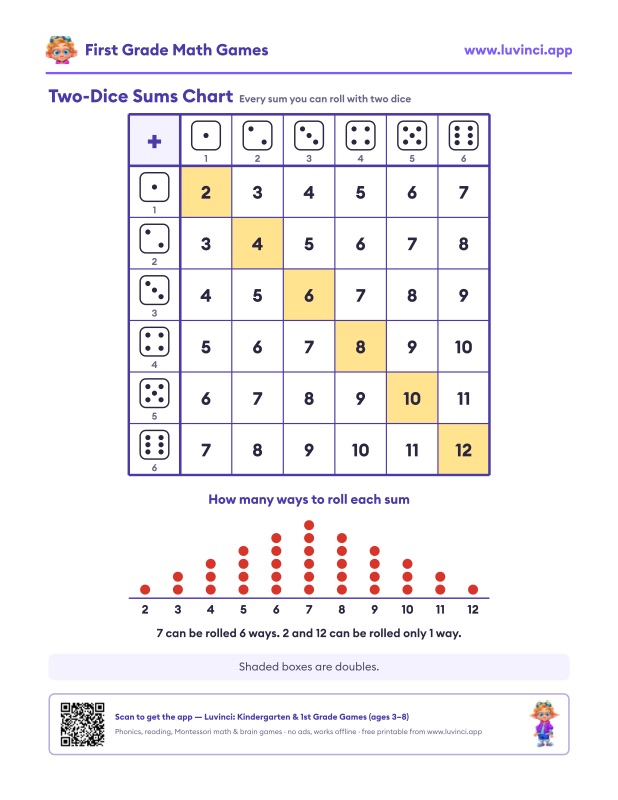
Page 1 lays out every two-dice sum, with the doubles shaded. The dots show why 7 comes up most: it can be rolled 6 ways, and 2 and 12 only one way each.
Page 1: the two-dice sums chart.
Math dice games for first graders: which one to play
Match the game to what your child is working on, one level below, so the first round is a win.
| Game | Level | What it practices | Dice | PDF page |
|---|---|---|---|---|
| Roll and Color to 10 | within 10 | adding within 10 (1.OA.6) | 2 (a 6 counts as 0) | 2 |
| Difference Race | within 10 | subtracting within 10 (1.OA.6) | 2 | 4 |
| Addition Grab Bag | within 10 | adding within 10 | none | none |
| Roll and Color to 12 | to 20 | adding to 12 (1.OA.6) | 2 | 3 |
| Race to the Top | to 20 | adding to 12, which sums come up most | 2 | 4 |
| Shut the Box | to 20 | breaking a number into parts (1.OA.6) | 2 | 5 |
| Going to Boston | to 20 | adding three numbers (1.OA.3) | 3 | none |
| How Many Equations | to 20 | + and − facts from three numbers (1.OA.6) | 3 | 5 |
| Race to 100 (or Race to 50) | tens and ones | counting on by rows of ten (1.NBT.2) | 2 | 6 |
| Biggest Number Wins | tens and ones | reading two-digit numbers (1.NBT.2) | 2 | none |
| 10 More, 10 Less | tens and ones | 10 more and 10 less (1.NBT.5) | 1 | 7 |
| Don’t Roll a One | tens and ones | adding to a two-digit total (1.NBT.4) | 1 | none |
Most games wrap up in 5 to 10 minutes, so one a day is plenty.
Addition and subtraction games within 10
Getting quick at sums within 10 is the big 1st grade goal (1.OA.6). These are also good subtraction games for first graders just starting to take away.
1. Roll and Color to 10
You need: 2 dice, 2 crayons, page 2 · Players: 2 · Skill: adding within 10 (1.OA.6)
- Roll both dice and add. A 6 counts as 0, so every sum stays within 10. (No-dice option: the 0 to 5 spinner on page 8.)
- Color one box with that sum in your color. No box left with your sum? Your turn is over.
- The first player to color 8 boxes wins.
Why it works: middle sums (4, 5, 6) come up most, so those boxes take up more of the board.
Easier: play to 5 boxes. Harder: say the matching subtraction fact before coloring (4 + 3 = 7, so 7 − 3 = 4).
2. Difference Race
You need: 2 dice, 2 crayons, page 4 · Players: 2 · Skill: subtracting within 10 (1.OA.6)
- Player 1 takes columns 1 and 5. Player 2 takes columns 0, 2, 3 and 4.
- Take turns rolling both dice and taking the smaller from the bigger (5 and 2: 5 − 2 = 3). Color a box in that column, whoever rolled.
- The first column to reach the top (6 boxes) wins for the player who owns it.
Why it works: column 1 fills fastest, because 10 of the 36 rolls give a difference of 1. The split looks uneven, but it isn’t: columns 1 and 5 win about half the time, the same as the other four together.
Harder: say the adding fact that checks it (3 + 2 = 5).
3. Addition Grab Bag
You need: 2 paper bags, small toys or blocks · Players: 1 or more · Skill: adding within 10, writing a number sentence
- Put 5 toys in each bag.
- Your child grabs a handful from each bag, eyes closed.
- Count each pile, then say and write the sentence (3 + 4 = 7).
Harder: grab from one bag of 10 and say how many are still inside (10 − 6 = 4). Use big blocks if your child still mouths toys.
Make-10 games are in our ways to make 10 post.
On a screen, the Luvinci app covers this within-10 part. Its Singapore Math boards put sums on ten frames of pictures and cross pictures out to take away. The Addition and Subtraction rows are number sentences. The first counting board is free, and those boards are in the full app. None of the adding or take-away boards goes past 10, and nothing in the app works on tens and ones, so the rest of this list is paper only. See how Luvinci’s math games work.
Addition games for first graders: sums to 20
1st graders add and subtract within 20 (1.OA.6). Two dice make sums to 12. Three dice go to 18.
4. Roll and Color to 12
You need: 2 dice, 2 crayons, page 3 · Players: 2 · Skill: adding to 12 (1.OA.6)
- Roll both dice and add.
- Color one box with that sum in your color. No box left with your sum? Your turn is over.
- The first player to color 8 boxes wins.
Easier: keep page 1 out to check sums. Harder: say the near double that helps (6 + 5 is 5 + 5 + 1).
5. Race to the Top
You need: 2 dice, a pencil, page 4 · Players: 2 · Skill: adding to 12, and seeing which sums come up most
- Player 1 takes the odd columns (3, 5, 7, 9, 11). Player 2 takes the even columns (2, 4, 6, 8, 10, 12).
- Take turns rolling both dice and adding. Color a box in that sum’s column, whoever rolled.
- The first column to reach the top (5 boxes) wins for the player who owns it.
Why it works: the middle columns (6, 7, 8) usually win, 7 most often. Page 1 shows why. It’s a first look at a bar graph. Odd columns have a tiny edge (about 54 games in 100), so swap sides each game.
6. Shut the Box
You need: 2 dice, a pencil, page 5 · Players: 2 · Skill: breaking a number into parts (1.OA.6, 1.OA.3)
- Roll both dice and add.
- Cross out one, two or three numbers on your strip that add up to that total (roll 8: cross out 8, or 5 and 3). Once 7, 8 and 9 are gone, roll one die.
- Stuck? Write the sum of the numbers left in the “left over” box and pass the dice. Lowest leftover wins; same leftover is a tie.
Each move is a number bond.
Harder: play all 3 strips on page 5. The lowest total leftover wins.
7. Going to Boston
You need: 3 dice, paper for scores · Players: 2 or more · Skill: adding three numbers in an easy order (1.OA.3)
- Roll all three dice and set aside the biggest.
- Roll the other two, set aside the bigger, then roll the last one.
- Add the three dice you kept. The biggest total wins the round (tie? nobody scores), and the first to win 5 rounds wins.
Harder: look for a pair that makes 10 or a double first (6 + 4 + 5: 10 and 5 is 15).
8. How Many Equations
You need: 3 dice, a pencil, page 5 · Players: 2 · Skill: + and − facts that belong together (1.OA.6, 1.OA.4)
- Roll 3 dice once. Both players write the same three numbers.
- Write true sentences with two or three of the numbers, using + and − (for 2, 3 and 5: 2 + 3 = 5, 5 − 2 = 3, 2 + 3 + 5 = 10).
- Stop after 1 minute (a grown-up counts slowly to 60, or set a timer). Check each other’s sentences: one point each, and a turnaround (3 + 2 after 2 + 3) counts once. Tie? You both win.
Easier: + only, and 90 seconds. Harder: 30 seconds.
More games: Race to 20 on a double ten frame (ten frame printable) and Roll a double (doubles facts).
Place value games for first graders
1st graders learn that a two-digit number is tens and ones (1.NBT.2). They add within 100 (1.NBT.4) and find 10 more or 10 less (1.NBT.5). In 2nd grade that adding grows into 2-digit addition with regrouping.
9. Race to 100 (or Race to 50)
Also known as Roll and Add to 100.
You need: 2 dice, 2 crayons or pencils, page 6 · Players: 2 · Skill: counting on, tens and ones (1.NBT.2, 1.NBT.1)
- Roll both dice and add.
- Mark that many squares on your grid, left to right, row by row. Each full row is one ten.
- Say your total as tens and ones (“3 tens and 4 ones is 34”). The first to reach the thick line (50) wins; no exact roll needed.
Easier: stop at the end of row 3 (30). Harder: keep going to 100 (about 15 turns each).
10. Biggest Number Wins
You need: 2 dice, paper · Players: 2 · Skill: reading and building two-digit numbers (1.NBT.2)
- Each player rolls 2 dice.
- Make the biggest two-digit number you can (a 3 and a 5 make 53, not 35) and read it as tens and ones.
- The bigger number scores a point; first to 5 points wins. On a tie, roll again.
Easier: smallest number wins. Harder: write the two numbers with > or < between them.
11. 10 More, 10 Less
You need: 1 die, 2 crayons, page 7 · Players: 2 · Skill: 10 more and 10 less (1.NBT.5), numbers to 120 (1.NBT.1)
-
Both players start on 1. Circle it in your color.
-
Roll the die:
- 1, 2 or 3: 10 more (straight down one row).
- 4 or 5: 1 more (the next square, wrapping to the next row).
- 6: 10 less (straight up one row; in the top row, stay put).
Circle your new number and say it.
-
After 10 turns each, the player on the bigger number wins. Tie? You both win.
Why it works: 10 more changes the tens and keeps the ones (24, 34, 44).
12. Don’t Roll a One
Also called Pig.
You need: 1 die, paper for scores · Players: 2 or more · Skill: adding a one-digit number to a two-digit total (1.NBT.4), counting on (1.OA.5)
- Everyone starts at 0. Add each roll to your score out loud (27, 31, 36).
- Stop when you like, write your new score and pass the die. Roll a 1 and you lose that turn’s points.
- The first to 50 wins.
Harder: play to 100.
More math activities for first graders
These math activities for first graders use things you already have: a die, a deck of cards, a snack, a car ride, a walk. Five minutes or less covers most of them.
- Family games that already sneak in math: if you have them, Mancala, Uno, Yahtzee and Shut the Box (the wooden one). Yahtzee and Shut the Box add dice, Uno matches numbers, and Mancala counts stones one by one.
- A deck of cards: take out the face cards (aces are 1) and play Addition War: flip two cards each, and the bigger sum wins. More in our math card games.
- Guess My Number in the car: “I’m thinking of a number between 1 and 50. Ask me ‘more or less?’” Then swap, so your child gives the clues.
- Snack math: “You have 8 crackers and eat 3. How many are left?” Your child lines up the crackers to check (8 − 3 = 5).
- Counting on while you walk: count 10 steps from 27 to land on 37, then 10 back to 27. It’s 10 More, 10 Less without the board.
- Reading night: the same die plays our sight word board game.
Right or wrong, follow any answer with “How do you know?”
FAQ
What are some fun math games for 1st grade?
Roll and Color to 10, Race to the Top, Shut the Box and Race to 50 are the ones kids pick up and finish fast. All four boards are in our free PDF. For games on a screen, PBS KIDS and Khan Academy Kids are free (see screen or table).
How do you play math dice games with first graders?
Roll, say the math out loud, then mark it. Color a box, cross out a number or circle a square. Start within 10 (“a 6 counts as 0” keeps sums small), then move to two full dice once those sums come fast.
What are good subtraction games for first graders?
Difference Race (take the smaller die from the bigger), How Many Equations (write the take-away facts), 10 More, 10 Less (the “10 less” rolls), and the harder Addition Grab Bag: how many are still in the bag?
How do you teach place value to 1st graders?
Show tens your child can see: a full row of 10 on a grid, a stick of 10 snap cubes, a full ten frame. Say numbers as tens and ones (“4 tens and 2 ones is 42”). Race to 50 and Biggest Number Wins give that practice.
How do you make first grade math fun?
Play games where anyone can win. Dice level the field, so a parent can lose to a 6-year-old fair and square. Let your child roll and keep score. Stop while it’s still fun.
The takeaways
- A die or two, a crayon and a printed board are enough, and you cut nothing from the PDF.
- Start within 10 (Roll and Color to 10, Difference Race), move to sums to 20, then tens and ones.
- Say the math out loud on every turn.
- Print the free first grade math games PDF: a sums chart, game boards and spinners.
More free math worksheets: ten frames, number charts, addition and subtraction, daily practice workbooks and more, all in one place. See the math printables →
