 Luvinci
September 19, 2026
Addition for Kindergarten: Picture Sums Within 10 (Free PDF)
Free printable · PDF · 769 KB
Addition for Kindergarten: Picture Sums Within 10 (Free PDF)
No signup needed. Just print it.
Download PDFAddition for kindergarten means putting two groups together and finding how many there are in all, with sums up to 10. Kids get there in three steps. They start with real things they can touch, then pictures, then numbers. When a child can push 3 toy cars next to 2 more and count 5, they’re already adding. The plus sign comes later, as a short way to write down what they did.
Our free picture addition PDF has six pages: an addition chart within 10, picture addition, adding on one ten frame, counting on, and 15 flash cards with answer cards. No signup, no email.
What kindergarten addition looks like
In the Common Core standards, kindergarten addition stays within 10. Most kids are expected to do this by the end of the year:
- Show a sum with objects, fingers or drawings (K.OA.1). 2 blocks and 3 blocks, pushed together, make 5.
- Solve simple story problems within 10 (K.OA.2). “You have 4 crackers. I give you 2 more. How many now?”
- Split a number into two parts (K.OA.3). 5 is 4 and 1, or 3 and 2. These are the number bonds.
- Find the partner that makes 10 (K.OA.4). 7 needs 3 more to make 10.
- Add within 5 quickly and easily (K.OA.5). Sums like 2 + 2 and 3 + 1 become facts they just know.
Adding within 10 quickly and easily is a 1st grade goal (1.OA.6). Counting is fine in kindergarten. Fingers are a tool, not a crutch.
How to teach addition in kindergarten
Most teachers follow this same order. People often call it concrete, pictorial, abstract. That means real things, then pictures, then numbers. Stay at each step until it’s easy, and go back a step whenever a sum feels hard.
- Real things. Tell a tiny story and act it out. “3 ducks are in the pond. 2 more swim in.” Your child moves 2 more toys next to the 3 and counts them all. Use snacks, socks, toy cars, anything.
- Pictures. Draw the story, or use a worksheet with pictures. Your child counts the first group, then the second, then counts them all.
- Numbers. Write the story as 3 + 2 = 5. Read it out loud: “3 and 2 more make 5.”
Two words do a lot of work at the start. Read + as “and” or “plus”. Read = as “makes” or “is the same as”. “Equals” is fine to say, but “makes” tells a five-year-old what it means.
Addition with pictures
Picture addition is the bridge from toys to numbers. Frozen on paper, the pictures stand in for the objects, so your child can count and recount without anything rolling away.
Page 2 of the PDF has eight picture sums, from 2 + 1 to 5 + 5, with stars, apples, fish and strawberries. For each one, your child:
- counts the first group and writes the number,
- counts the second group and writes the number,
- counts them all and writes the answer.
The whole number sentence is written from those pictures. The first one is already filled in as an example.
One tip for counting all is to have your child touch each picture once, left to right, and put a small dot under it as they count it. Skipping or double counting is the most common mistake at this age. If counting a group of 5 is still shaky, spend some time on one to one correspondence first.
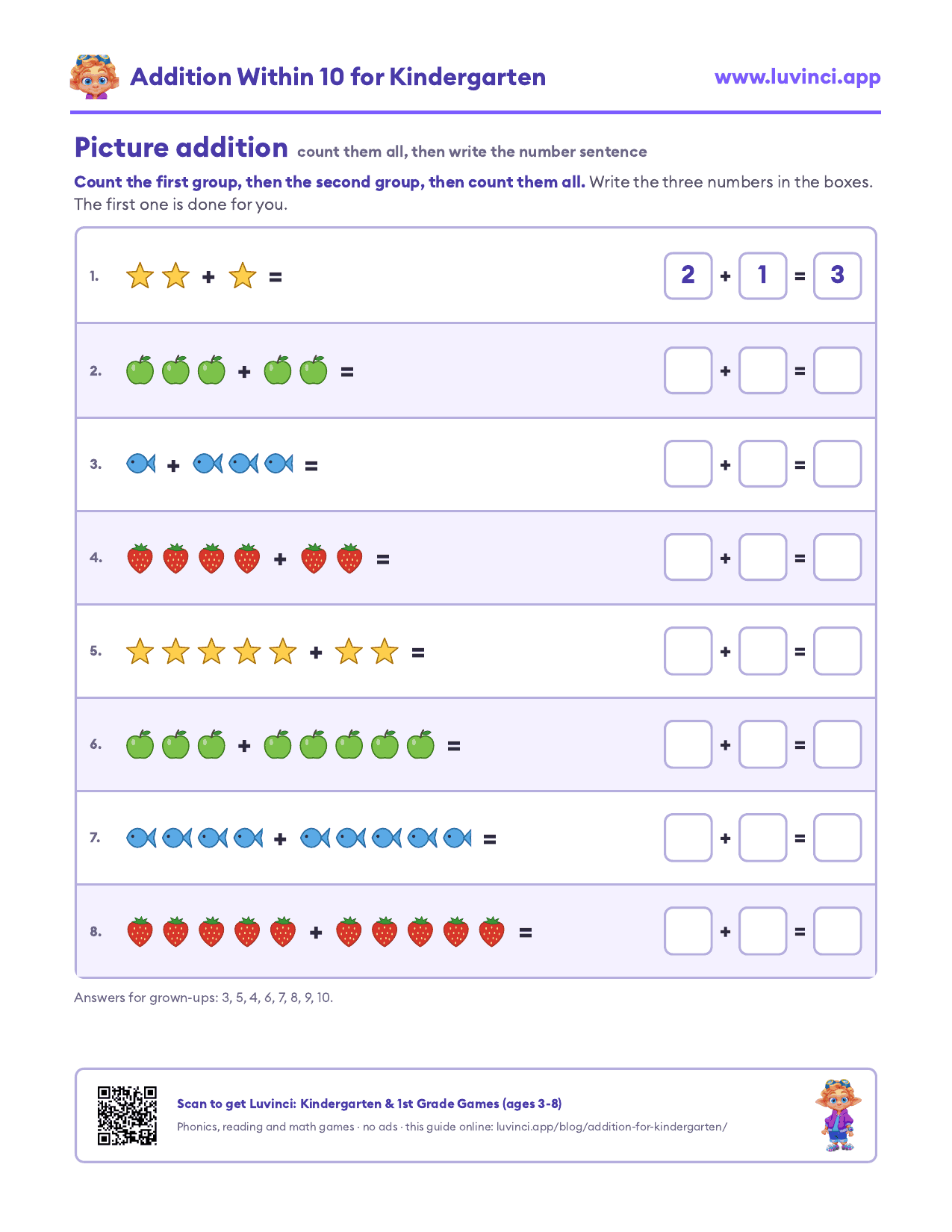
Page 2: count each group, count them all, and write the number sentence.
Adding on one ten frame
A ten frame is a box of 10 squares in two rows of five. Classrooms use it as the tool for addition within 10, because your child can see the total without counting every counter.
Classrooms do it this way. Put the first number in red counters, top row first. Put the second number in yellow counters, right after the red ones. For 3 + 4, that’s 3 red, then 4 yellow: one full row of 5 and 2 more below. That’s 7. The empty boxes show how far 7 is from 10.
Page 3 of the PDF uses crayons for the same move. Your child colors the first number red, then the second number yellow, and counts every colored box. You need one red and one yellow crayon. The boxes are blank, so it prints fine in black and white.
The frame also shows sums that make 10. When the frame is full, the two colors are a pair that makes 10, like 7 and 3. Our ways to make 10 post covers all 11 of those pairs.
Counting on
Counting all works. It just gets slow. For 6 + 3, a child who counts all says “1, 2, 3, 4, 5, 6”, then “7, 8, 9”. Counting on skips the first part. Start at 6, then say “7, 8, 9”.
Counting on is usually a late-kindergarten skill that settles in 1st grade (1.OA.5). Signs your child is ready:
- They count a group, and when you ask “how many?”, they say the last number without recounting.
- They can start counting from any number, like “5, 6, 7”, not only from 1.
Page 4 of the PDF has a number path from 0 to 10. Your child puts a finger on the bigger number, then steps one box for each dot in the smaller group. The last number they land on is the answer. Below those are eight more with just the numbers. Starting with the bigger number matters. 2 + 7 is easier as 7 + 2.
The usual mistake is counting the starting number again. For 6 + 3, a child who says “6, 7, 8” lands on 8, one short. Put a finger on 6, say nothing, then step “7, 8, 9”.
Addition within 10: the addition chart
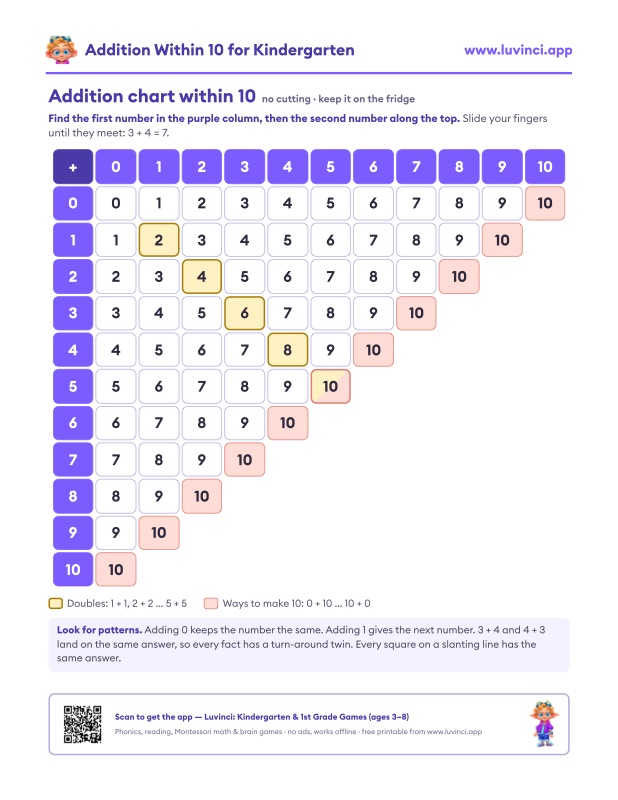
Page 1 of the PDF is an addition chart within 10. Hang this page on the fridge. There’s no cutting and no prep. Some sites call it an addition table. Find the first number down the purple column, find the second along the top, and slide your fingers until they meet. 3 down and 4 across meet at 7.
Kids can also spot patterns all over the chart:
- Adding 0 changes nothing. The whole 0 row is just the numbers again.
- Adding 1 gives the next number. 6 + 1 is the number after 6.
- Turn-arounds. 3 + 4 and 4 + 3 land on the same answer. Once your child sees this, there are nearly half as many facts to learn.
- Doubles. The yellow squares run down a diagonal: 1 + 1, 2 + 2, up to 5 + 5. Our doubles facts post has a chart and games for them.
- Ways to make 10. The pink squares on the long slanting edge all say 10. 5 + 5 is half yellow and half pink, because it’s both a double and a way to make 10.
Every slanting line on the chart has one answer. Number bonds use the same idea, laid out on a grid.
Want a page a day? Our free Addition Within 10 Workbook has 20 short pages of plain facts like 3 + 5, one idea at a time (plus 1, plus 2, doubles, making 10), with a number path on every page and the answers at the back. Start it once your child has added with objects and pictures, and skip the timer.
Addition flash cards within 10
Pages 5 and 6 are 15 cut-out addition flash cards with answer cards. Print page 6 on the back of page 5 (flip on the long edge), and each card has its answer on the back, with the sum drawn on a small ten frame.
The first six cards are sums within 5, the kindergarten fluency goal: 1 + 1 up to 4 + 1. The other nine go up to 10, from 5 + 1 to 8 + 2. Start with the within 5 cards. Add the others once those come quickly.
Ways to use them:
- Quick look. Hold up a card, your child says the answer, then flips it to check.
- Two piles. Answers that come right away go in a “know it” pile. The rest go back in for tomorrow.
- Match game. Print the answer page separately. On each answer card, cover everything except the big answer with a sticky note (the small sum, the ten frame and the card number). Lay all 30 cards face down and turn over two at a time. A sum and an answer that fits it make a pair. Some answers come up twice, so any answer card with the right big number counts.
Keep it to five minutes. Daily short sessions do more than one long one.
Addition games for kindergarten
Games pack in lots of practice without it feeling like practice.
- Roll and add. Roll two dice and add the dots. Cover the 6 on each die with a sticker so every sum stays within 10. Start with one die and “roll plus one”. Dice dots are great practice for seeing small amounts without counting.
- Snack sums. Put 3 crackers in one pile and 2 in another. Your child pushes them together and counts. If the count is right, they eat the answer.
- Domino sums. Each half of a domino is one number. Add the two halves. Take out every domino with a 6 on it, and every sum stays within 10.
- Finger stories. “4 fingers on this hand, 1 on that one. How many up?” Fingers are always with you, in the car or in line.
- Race to 10. Each player has a ten frame. Take turns rolling one die and adding that many counters to your frame. Whoever fills their frame first wins, and a roll bigger than the empty boxes still fills it.
For card games, see our math card games.
If your child still puts small things in their mouth, use big blocks instead of small counters and snacks, and stay close.
Addition in the app
The app’s Early Math boards teach addition with picture sums. On its Singapore Math addition boards, each sum sits on two ten frames of pictures, one frame for each number. Those boards are in the full app; the counting board is free. See our early math page for the rest of the math games.
FAQ
What addition should a kindergartner know?
By the end of kindergarten, most kids can add within 10 using objects, fingers or pictures, solve a simple “how many in all” story, and add within 5 quickly and easily. Adding within 10 quickly and easily comes in 1st grade.
How do you explain addition to a 5-year-old?
Begin with a story and real things. “You have 2 blocks. I give you 3 more. How many blocks now?” Let them push the groups together and count. Once that’s easy, draw it, then write it as 2 + 3 = 5 and read it as “2 and 3 make 5”.
Is it OK for kindergartners to count on their fingers?
Yes. Fingers are a great first tool for adding, and most kids drop them on their own as facts become familiar. Use them as the bridge to ten frames and counting on, not something to ban.
What is the difference between counting all and counting on?
Counting all means counting both groups from 1. Counting on means starting from the bigger number and counting up. For 6 + 2, counting all is “1, 2, 3, 4, 5, 6, 7, 8”. Counting on is “6… 7, 8”. Most kids count all first and move to counting on late in kindergarten or in 1st grade.
Should kindergartners do addition worksheets?
A few pages are fine after your child has added with real objects. Picture worksheets are the best fit at this age. Keep them short, and if a page is a struggle, go back to toys for a while.
The takeaways
- Addition for kindergarten is putting two groups together, with sums up to 10.
- Teach it in three steps: real things, then pictures, then numbers.
- Read + as “and” and = as “makes” at the start.
- One ten frame, two colors: red for the first number, yellow for the second.
- Counting on is the next step: start with the bigger number.
- Sums within 5 are the fluency goal for kindergarten; all the facts to 10 come in 1st grade.
- Taking away is next: see subtraction for kindergarten, part 2 of this series.
- Print the free picture addition PDF: an addition chart, picture sums, ten frames, counting on and 15 flash cards.
More free math worksheets: ten frames, number charts, addition and subtraction, daily practice workbooks and more, all in one place. See the math printables →
