Luvinci
September 26, 2026
Nonsense Words List by Grade: Screened + Free PDF
Free printable · PDF · 1047 KB
Nonsense Words List by Grade: Screened + Free PDF
No signup needed. Just print it.
Download PDFNonsense words are made-up words that follow phonics rules, like pab, wib and jom, so the only way to read one is to sound it out. This nonsense words list is sorted by grade and phonics stage, and every word was checked for real words, sound-alikes and slang. Teachers also call them pseudowords.
Use them for a quick check that your child is really decoding. Spend most of practice time on real words. Each set below comes with real words in the same pattern.
You’ll find the whole list on one page in our free nonsense words list and game PDF, plus Earth or Alien?, a rocket race where your child calls each word real or nonsense. 8 pages. You don’t need to sign up or leave an email.
Jump to: kindergarten · 1st grade · 2nd grade and up · the game
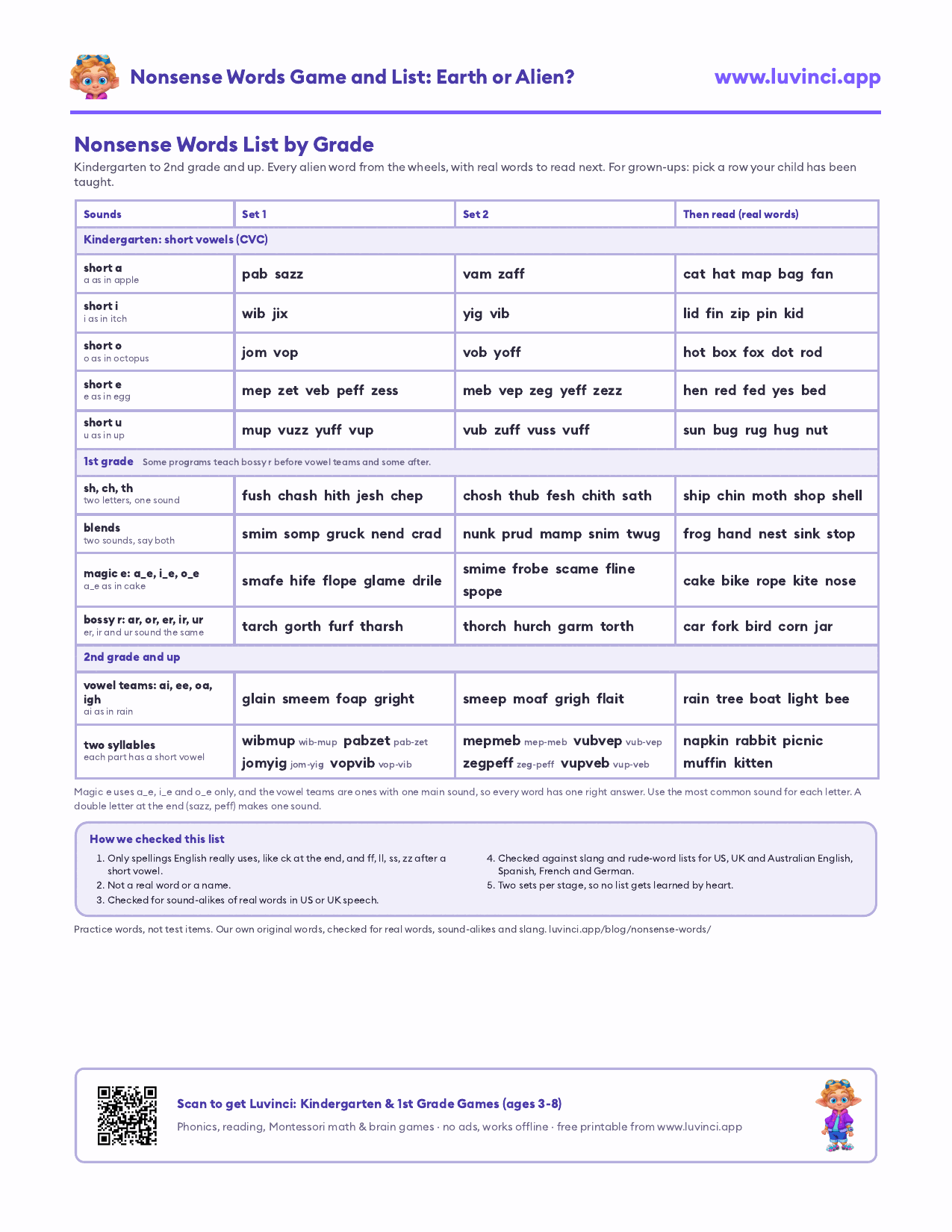
Nonsense words list by grade: page 8 of the free PDF.
What are nonsense words (and why schools use them)?
A nonsense word, or pseudoword, is a string of letters that follows English spelling patterns but has no meaning. Your child can’t have memorized it. There’s no picture or sentence to guess from. If they read it right, they decoded it. Each letter goes to its sound, then the sounds blend. England’s framework for its Year 1 phonics check calls pseudo-words “the purest assessment of phonic decoding.”
Long words need it too. In struggling (strug-gling), neither part is a word on its own, so a reader decodes chunks that are, in effect, nonsense.
A nonsense word separates decoding from guessing. It shows whether blending has really clicked.
How we checked this list
Check any list before you print it. Several popular lists online include real words and slang. Ours passed five checks:
- Only spellings English really uses: ck at the end after a short vowel; ff, ll, ss and zz where the floss rule puts them; k, not c, before e or i (soft c and soft g); no final j or v; q always with u; ai inside a word, ay at the end, no final oa, igh at the end or before t.
- Not a real word or a name in three dictionaries, US baby names or Wiktionary.
- Checked for sound-alikes of real words in US or UK speech, so “real or nonsense?” games still work.
- Checked against slang and rude-word lists for US, UK and Australian English, Spanish, French and German.
- Two sets per stage, so no child memorizes one list.
With only the first six letters (s, a, t, p, i, n), almost every three-letter word is real or a name. Our lists use later letters of the letter-sound order too.
Nonsense words for kindergarten
Many schools start checking nonsense words in kindergarten. Some do it at the start of the year and some in the middle. Start with nonsense CVC words (consonant, vowel, consonant), one short vowel at a time, and only vowels your child has been taught.
CVC nonsense words (short a, i, o, e, u)
After each row, read the real words. They are the main practice. More in our CVC word lists.
- Short a (a as in apple): pab, sazz. Then read: cat, hat, map, bag, fan
- Short i (i as in itch): wib, jix. Then read: lid, fin, zip, pin, kid
- Short o (o as in octopus): jom, vop. Then read: hot, box, fox, dot, rod
- Short e (e as in egg): mep, zet, veb, peff, zess. Then read: hen, red, fed, yes, bed
- Short u (u as in up): mup, vuzz, yuff, vup. Then read: sun, bug, rug, hug, nut
A double letter at the end (sazz, peff) makes one sound.
Why so few for short a, i and o? Almost every three-letter spelling is already a word, a name or slang. Four or five per vowel passed.
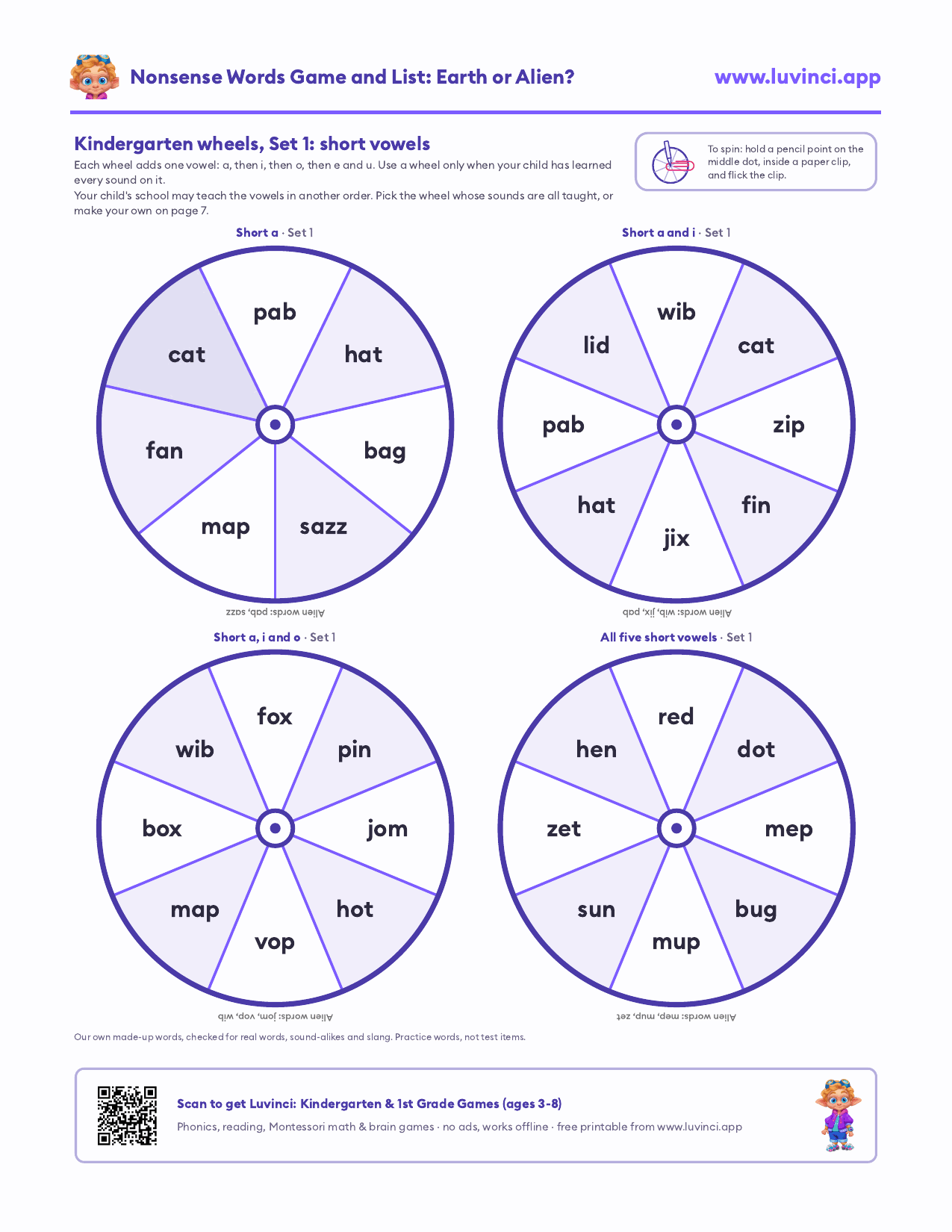
Page 2 of the free PDF: kindergarten wheels.
Nonsense words for 1st grade
Some first-grade checks mix in blends, digraphs, magic e and bossy r from early in the year. Practice each pattern only after it’s been taught, and first graders unsure of short vowels can stay with the kindergarten rows. Some programs teach bossy r before vowel teams and some after. See what comes after CVC words.
In parentheses you’ll find a real word that rhymes.
Nonsense words with sh, ch and th
That’s two letters, one sound. More on digraphs.
- Set 1: fush (hush), chash (dash), hith (smith), jesh (fresh), chep (step)
- Then read: ship, chin, moth, shop, shell
Nonsense words with blends
Two consonants sit side by side. Say both sounds. More on consonant blends.
- Set 1: smim (him), somp (stomp), gruck (luck), nend (lend), crad (had)
- Then read: frog, hand, nest, sink, stop
Nonsense words with magic e
Only a_e, i_e and o_e. We left out u_e, which has two common sounds (cube, rude), and e_e, so every word has one right answer. More on magic e.
- Set 1: smafe (safe), hife (life), flope (hope), glame (name), drile (file)
- Then read: cake, bike, rope, kite, nose
Nonsense words with bossy r (ar, or, er, ir, ur)
The spellings er, ir and ur sound the same, so one ur word covers all three. More on bossy r.
- Set 1: tarch (march), gorth (forth), furf (surf), tharsh (marsh)
- Then read: car, fork, bird, corn, jar
Nonsense words for 2nd grade and up
One common screener keeps nonsense words through 3rd grade, and schools may skip it for children who already read passages very well.
Vowel team nonsense words
Only teams with one main sound: ai, ee, oa and igh. We left out ea, ow, oo, ie and ou, which have two, and ay, because every short ay word we tried was real or sounded real (play, stay). More on vowel teams.
- Set 1: glain (gain), smeem (seem), foap (soap), gright (right)
- Then read: rain, tree, boat, light, bee
Two-syllable nonsense words
One common screener adds two-syllable nonsense words in 3rd grade. Cover half with a finger. Read wib, then mup, then the whole word.
- Set 1: wibmup, pabzet, jomyig, vopvib
- Then read: napkin, rabbit, picnic, muffin, kitten
How to use nonsense words at home (5 minutes, not 50)
The whole routine takes about 5 minutes. Only 1 of those minutes is nonsense words.
- Pick a row with patterns your child already knows.
- Read 6 to 10 made-up words, about a minute.
- Sounding out first is fine, with each letter’s most common sound: /p/ /a/ /b/, pab.
- Right after, read the “Then read” real words. Practice counts there.
- Next time, use Set 2 from the PDF, so no row gets learned by heart.
If your child reads jix as “six”, that isn’t a failure. Slow down and point at each letter.
Never practice the sheets from your child’s school test. Once a word is memorized, the test can no longer tell you what your child can decode.
Should kids practice nonsense words? What the research says
Most reading researchers agree nonsense words are a good check of decoding. Teaching with them is where they disagree.
- Against teaching with them: Timothy Shanahan (2016): “teaching with nonsense words adds no benefit over teaching with real words, and may be misleading to kids in terms of real pronunciations and spellings.” In 2023 he called nonsense-word tests a useful check of one part of reading. AIM Nexus (2025) agrees: no sign of harm, but practice time is better spent on real words.
- In between: Linda Diamond and Holly Lane (Collaborative Classroom, 2022) find the teaching evidence thin: real words first, made-up words at most a small extra.
- Further against: a few dyslexia specialists question them even in testing, because English spelling is tied to meaning, so a made-up word can have more than one fair reading (Kelli Sandman-Hurley, 2017).
- For: many teachers use a few minutes of them for blending practice.
Our take: check with them, and practice with real words.
What is nonsense word fluency (NWF)?
Nonsense word fluency (NWF) is a one-minute check where a child reads made-up words aloud, sound by sound or as whole words. Two common US screeners that include it are DIBELS® 8th Edition (kindergarten to 3rd grade) and Acadience® Reading (middle of kindergarten to the start of 2nd grade).
On both, each correct letter sound scores the same whether or not your child blends. The word score differs. See the scoring question.
Ask the teacher about goals for your child’s grade and time of year. We don’t print score tables. Practicing toward a number is what makes these checks stop working.
3 quick nonsense word games
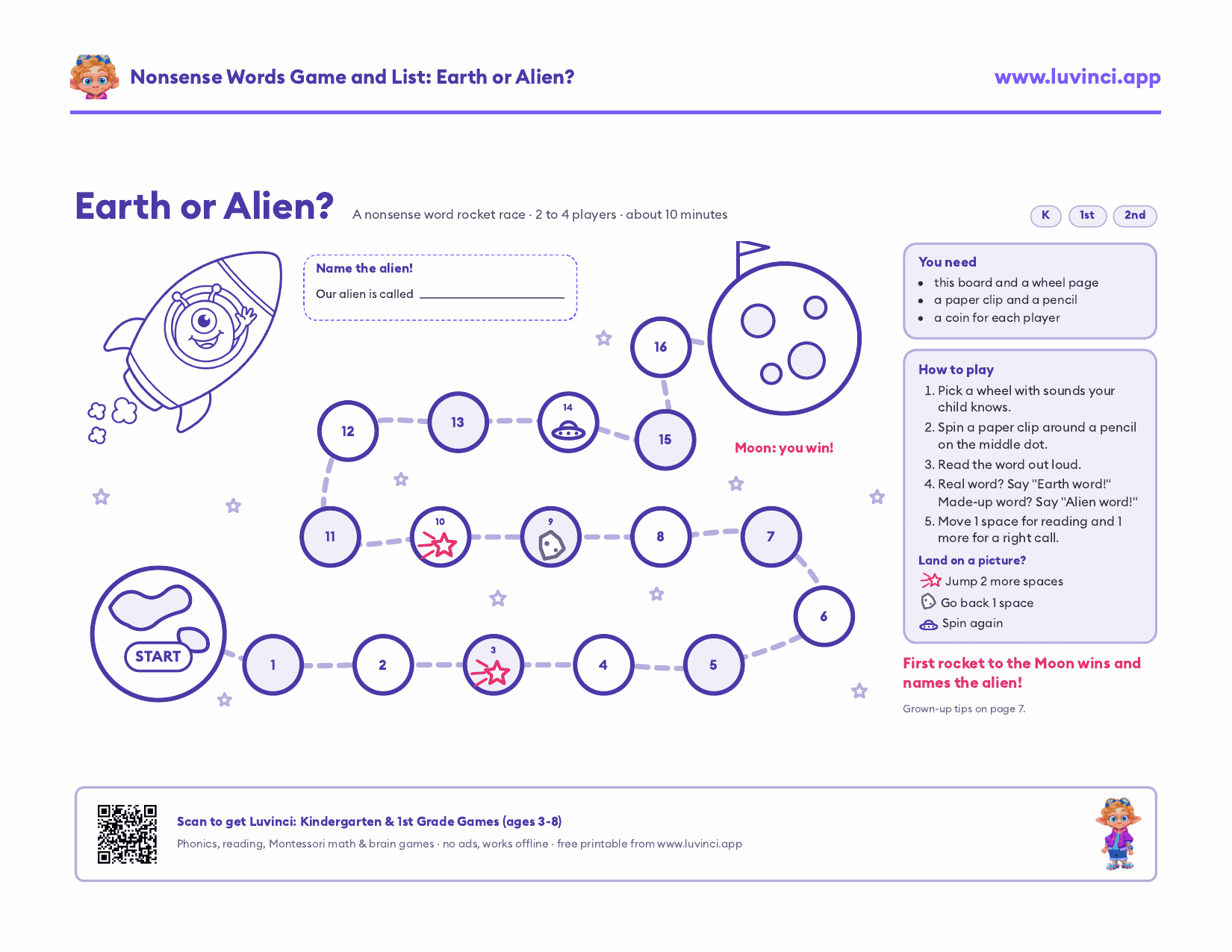
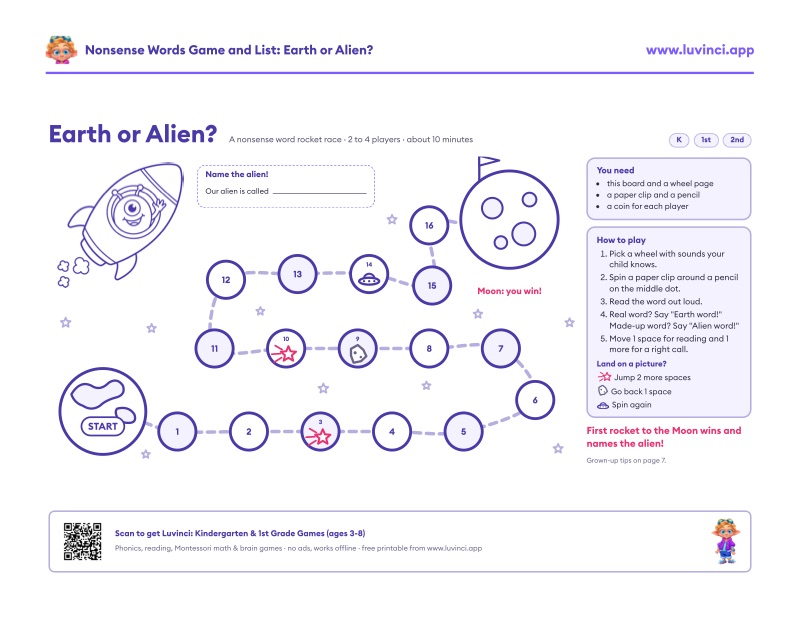
Page 1 of the free PDF: the board.
- Earth or Alien? (our free printable). A rocket race to the Moon: spin a paper clip on a word wheel, read the word and call it “Earth word!” (real) or “Alien word!” (made up). Move 1 space for reading and 1 more for a right call; first to the Moon wins and names the alien. Each wheel has 5 real words and 2 or 3 alien words. Nothing to cut out: you need a paper clip, a pencil and a coin per player.
- Build it. Make mup with letter tiles or the free Word Builder, then change one letter to make it real: cup.
- One-letter chain. Read cup, mup, mep, map. At each step, ask “Real or nonsense?” More word chains.
Free nonsense words list and game (PDF)
Page 1 is the Earth or Alien? board and rules. Pages 2 to 6 hold 20 word wheels in two sets, each with an upside-down answer key for grown-ups. Page 7 has blank wheels and grown-up notes. Page 8 is the whole list by grade on one sheet, if you want a printable nonsense words worksheet instead. Download the free nonsense words list and game. More in our printables library.
Questions parents ask
What is a nonsense word example? Sazz: it has the short a of cat and the zz of jazz, but means nothing. Hife follows magic e and rhymes with life.
Can you give me a list of nonsense words? Yes: the lists above, by grade, each checked for real words, sound-alikes and slang, plus a second set in the PDF.
What are nonsense words called? Pseudowords or nonwords in research, made-up words at home, and “alien words” in England, where the Year 1 phonics check shows each one next to a picture of a creature.
Why are kids taught nonsense words? Mostly to check decoding, since a child can’t have memorized them. Most practice should use real words.
How to practice nonsense word fluency? Not with more nonsense words: practice letter sounds and blending with real words, and use a minute of nonsense words only to check.
What is an example of nonsense word fluency? Your child reads a page of made-up words like mep and mup for one minute, sound by sound (/m/ /e/ /p/) or as whole words. The tester counts correct sounds and words.
How is nonsense word fluency scored? Each correct letter sound counts the same, blended or not. DIBELS 8 also counts words read correctly, sounded out first or not; Acadience counts only words read whole on the first try. Ask the teacher about goals.
Is there a connection between dyslexia and nonsense words? Trouble reading nonsense words is a well-known sign of a decoding difficulty (Rack, Snowling and Olson, 1992), so schools screen with them early. A low score means “look closer,” not a diagnosis. Talk to the school.
What does a low nonsense word score mean? Usually that some letter sounds or blending need work. It’s timed, so a slow, careful reader can score low too. Ask the teacher first; at home, go back one stage and use real words.
What grade are nonsense words for? Mostly kindergarten and 1st grade. One common screener keeps checking through 3rd grade, but schools may skip it for fluent readers.
Want the real-word side too? Our reading games sound out every letter and have your child pick the missing letter, ages 3 to 8, no ads, offline. Next: how kids learn to read.
Our own original word lists and game. Not affiliated with or endorsed by the University of Oregon (DIBELS) or Acadience Learning. DIBELS® is a registered trademark of the University of Oregon. Acadience® is a registered trademark of Acadience Learning.