Luvinci
November 12, 2026
Clock Worksheets: Telling Time to the Hour and More (Free PDFs)
8 free PDFs in this post
More PDFs (7)
Clock worksheets teach telling time in steps. O’clock comes first, then half past, then 5 minutes. Around 3rd grade, the exact minute comes last. Have your child start with the short hand. That hand tells the hour. The long hand tells the minutes.
The short hand points to 3. The long hand points to 12. It is 3 o’clock.
You’ll find 11 pages in our free Telling Time to the Hour PDF. Kids glue clocks onto a day of pictures and build a clock face. After that they read the short hand, match, draw the hands and color. The pack closes with a clock chart and an answer key. It’s free. Half past, 5 minutes and the exact minute each have their own free PDF in the list at the top. Blank clock faces, a paper clock, matching puzzles and a memory game sit there too.
Jump to: by age · the PDFs · o’clock · half past · 5 minutes · make a clock · mistakes · activities · FAQ
Clock worksheets by age
Most kids learn o’clock first, then half past, then 5 minutes, over about three school years. After that comes the exact minute.
| Skill | Usual age | |
|---|---|---|
| O’clock | Pre-K and kindergarten | Telling Time to the Hour |
| Half past | 1st grade | Telling Time to the Half Hour |
| 5 minutes, quarter past and quarter to, a.m. and p.m. | 2nd grade | Telling Time to 5 Minutes |
| To the minute | 3rd grade | Telling Time to the Minute |
Many kindergarten classes start with o’clock and the order of the day. Breakfast comes before school. Dinner comes before bed. A clock puts numbers on that order too.
It is normal for a 6 year old to read 3:30 and still be lost at 3:40. Minutes come later.
Free clock worksheets (PDF)
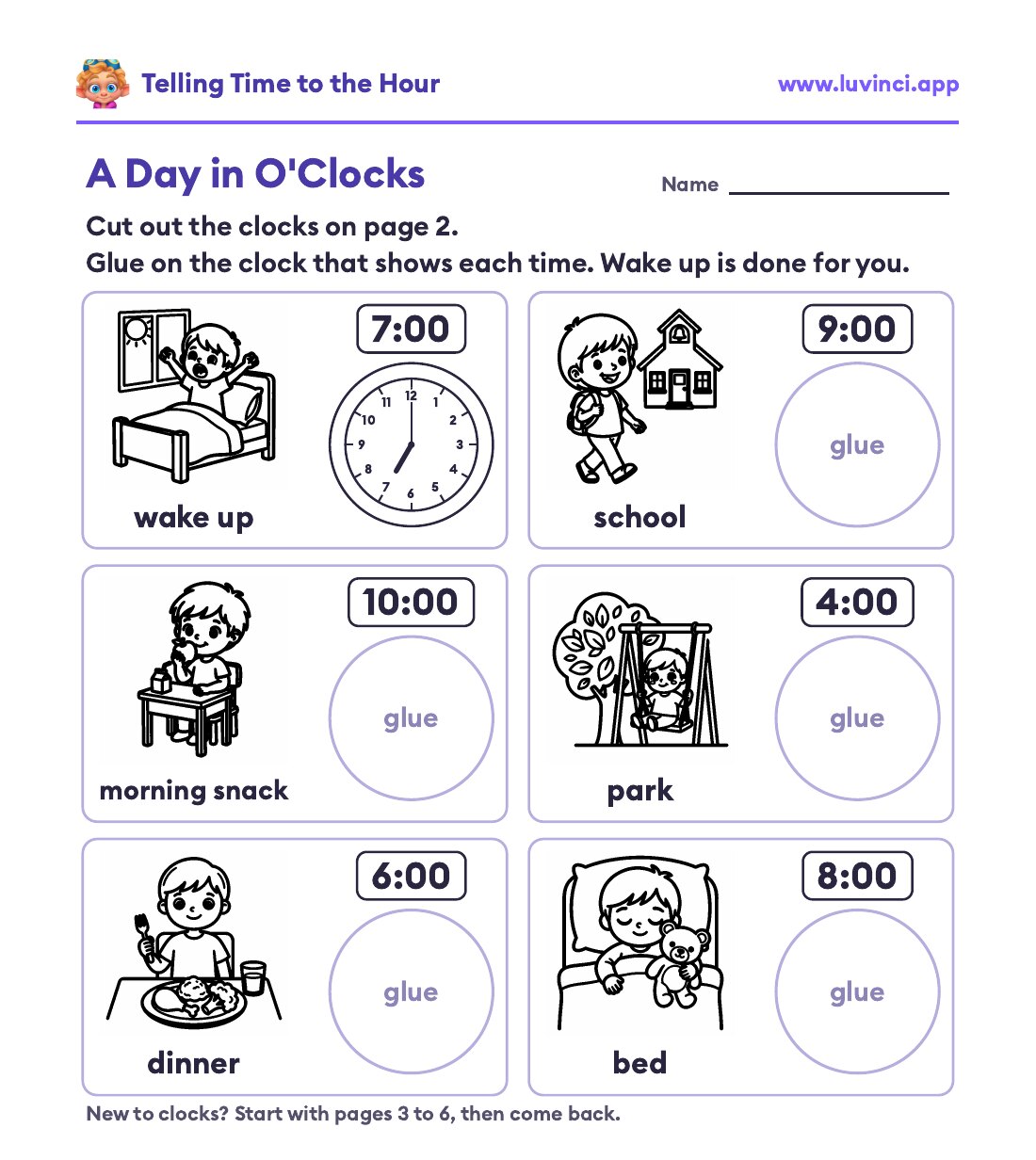
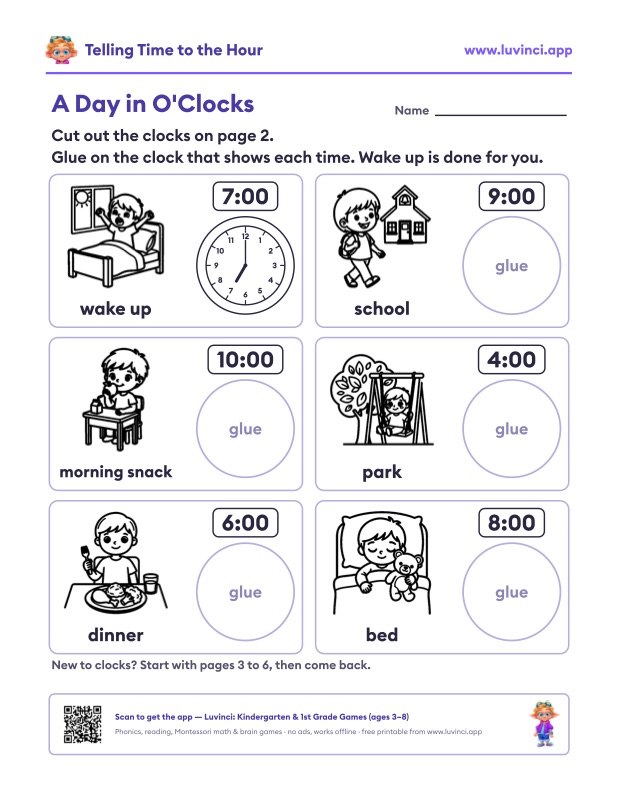
Page 1. A Day in O’Clocks.
Each page of the Telling Time to the Hour PDF looks like this.
| Page | What’s on it |
|---|---|
| 1 | A Day in O’Clocks. Glue the right clock next to each picture of the day |
| 2 | Clocks to cut out for page 1 |
| 3 | Clock Numbers. A big face with only the 12. Glue a number on each dot |
| 4 | The numbers 1 to 11 to cut out for page 3 |
| 5 | Write the Clock Numbers. A face with 12, 3, 6 and 9. Write the rest |
| 6 | Short Hand Only. Write the hour, then circle “about 3” or “about 4” |
| 7 | Match the Clocks. Draw a line from each clock to its time |
| 8 | Draw the Hands. The short hand first, then the long hand to 12 |
| 9 | Color the Clocks. 3 o’clock red, 8 o’clock blue |
| 10 | Parts of a Clock chart |
| 11 | Answer key |
The other PDFs sit in the list at the top.
| Ages | What’s on it | |
|---|---|---|
| Telling Time to the Half Hour | 1st grade | Color by the time, a cut and paste sort, match, draw and write |
| Telling Time to 5 Minutes | 2nd grade | a.m. or p.m., count by 5s, quarter past and quarter to, write and draw |
| Telling Time to the Minute | 3rd grade | Count by 5s then 1s, write, draw, match and how long it took |
| Blank Clock Faces | All ages | 1, 4 or 6 faces per page, with or without numbers |
| Make a Clock | Kindergarten to 2nd grade | A paper clock with hands that move |
| Match the Clock | Kindergarten to 2nd grade | Three-piece puzzles. Clock, digital time and words |
| Clock Memory Match | Kindergarten to 2nd grade | A memory game with two decks |
Printing tips:
- Print at 100% (“actual size”) so the cut-out clocks fit the glue spots.
- Use card stock for the clock, the puzzles and the memory cards. They last longer. The hands turn better too.
- Laminate the blank faces and the charts, or slide them into a sheet protector. Then use a dry-erase marker.
- Black and white is fine. The clocks are line art and use little ink.
- Answer keys are at the back of each worksheet pack.
Telling time to the hour
Look at the short hand first. It points to the hour. The long hand points straight up to 12. That’s o’clock.
Telling time for kindergarteners starts with the day, not the clock. Page 1 puts wake up at 7:00 and bed at 8:00. Your child cuts out a clock for each time and glues it on.
Then comes the clock face. Page 3 prints only the 12. Your child glues the numbers 1 to 11 on the dots, starting at 12 and going around. That job fits pre-K well. Page 5 is the kindergarten version. The 12, 3, 6 and 9 are there, and your child writes the rest.
Page 6 hides the long hand. Only the short hand is on each clock, so your child has to look at it. In the last row the short hand is a little past a number. Your child circles “about 3” or “about 4”. That step sets up half past, when the short hand sits between two numbers.
Use “short hand” and “long hand” every time. Those words tell your child which is which.
Telling time to the hour and half hour
At half past, the long hand points straight down to 6. It has gone halfway around. The short hand sits halfway between two numbers.
One rule covers every half past. The hour is the number the short hand has just passed. At 3:30 the short hand is between 3 and 4. It has passed 3, so it’s half past 3. Between 12 and 1, it’s 12:30.
Half past is half of the circle. You’ll see the same idea in the halves kids color in 1st grade.
Say “three thirty” and “half past three”. Kids hear both, and both are right.
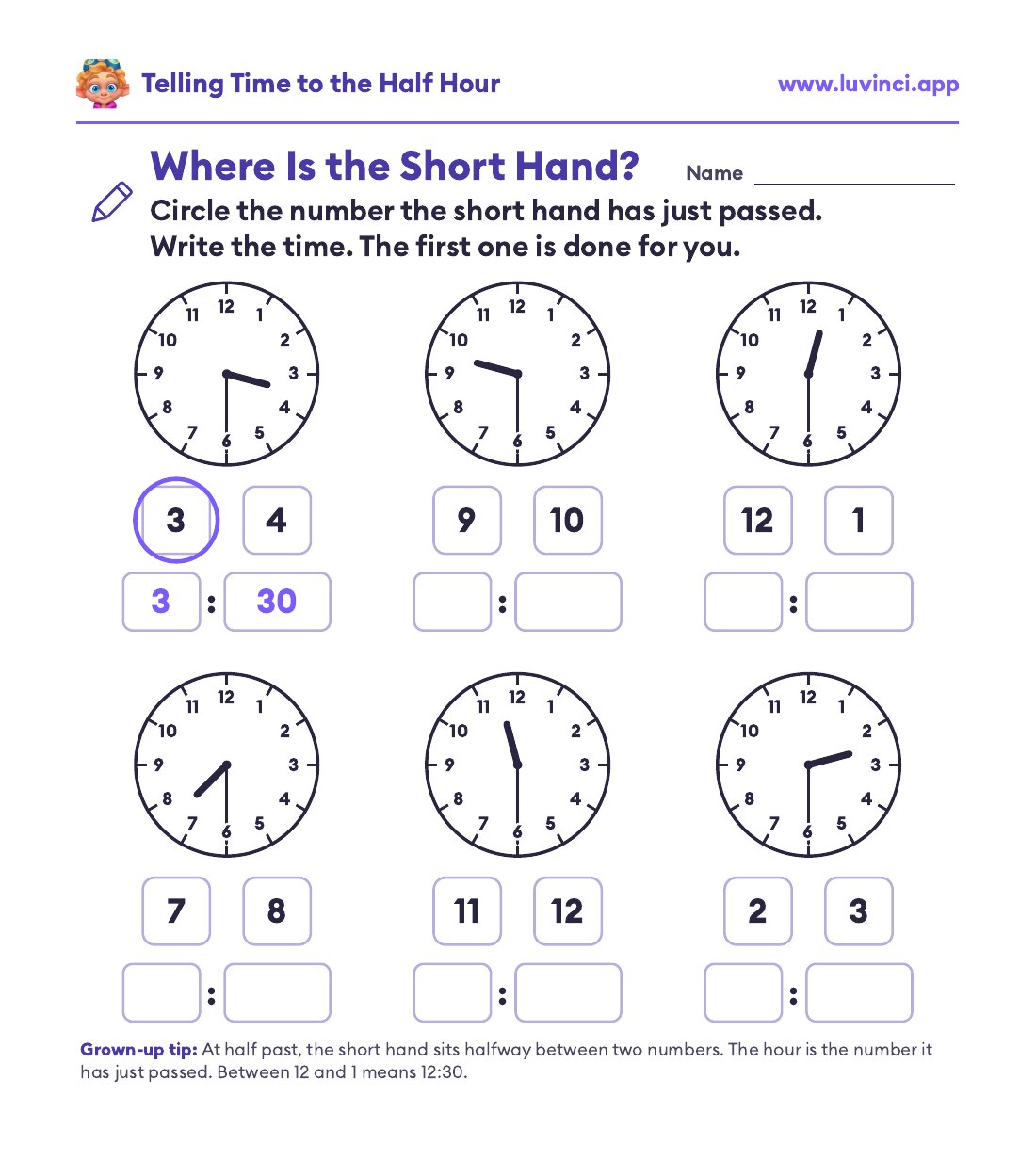
Page 2 of the half hour pack. Circle the number the short hand has just passed.
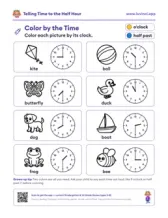
O’clock and half past mix across the 9 pages of our free Telling Time to the Half Hour PDF. Page 1 has 8 picture cards, like a kite, a dog and a boat, each with its own clock. Your child colors the o’clock pictures yellow and the half past pictures blue. Page 2 drills where the short hand sits. A cut and paste sort comes next, then a match from clock to digital time to words, and pages to draw and write the time. They include 11:30 and 12:30, the trickiest ones. A chart and an answer key close the pack.
Telling time to 5 minutes
Each number on the clock is 5 more minutes. Start at 12. At the 12, it’s 00 minutes. Then count by 5s around the face. Say 5, 10, 15 and on up to 55. When the long hand points to 4, it’s 20 minutes, not 4.
Quarter past means 15 minutes after the hour. The long hand points to 3. Quarter to means 15 minutes before the next hour. The long hand points to 9. So 4:15 is quarter past 4, and 4:45 is quarter to 5. Some people say “quarter after” too.
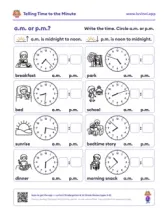
a.m. and p.m. come next. Any time from midnight to noon is a.m. Any time from noon to midnight is p.m. So 4:00 p.m. is a sunny afternoon at the park, not night. Breakfast is a.m. Dinner is p.m. For 12:00, say “noon” or “midnight”.
After 30, times get harder. At 9:45 the short hand is close to 10. It hasn’t passed it yet. It’s still 9.
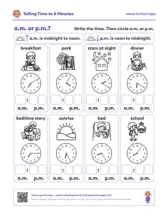
There are 9 pages in our free Telling Time to 5 Minutes PDF. Page 1 has 8 picture cards, like breakfast, the park and stars at night. Your child writes each time and circles a.m. or p.m. Next, your child glues the missing minutes around a big clock, counting by 5s, and matches quarter past, half past and quarter to. The first Write the Time page has the minute numbers around each clock. The second takes them away and uses mostly times after 30, with a 3:05 and 3:50 pair. Draw the Hands, a chart and the answer key finish the pack.
Length and money show up in 2nd grade too. Our word problems for 2nd graders cover both.
The exact minute often comes next, in 3rd grade. Kids count by 5s to the last number the long hand passed. Then they count on by 1s on the small marks. Our free Telling Time to the Minute PDF walks through it in 8 pages. It has a.m. and p.m. picture cards with times like 7:23, and one page on how long something took inside one hour. Your child counts up on a number line. That’s elapsed time, which stays hard for a few more years.
Make your own clock
With a paper clock with hands that move, your child can set any time. No geared clock needed.
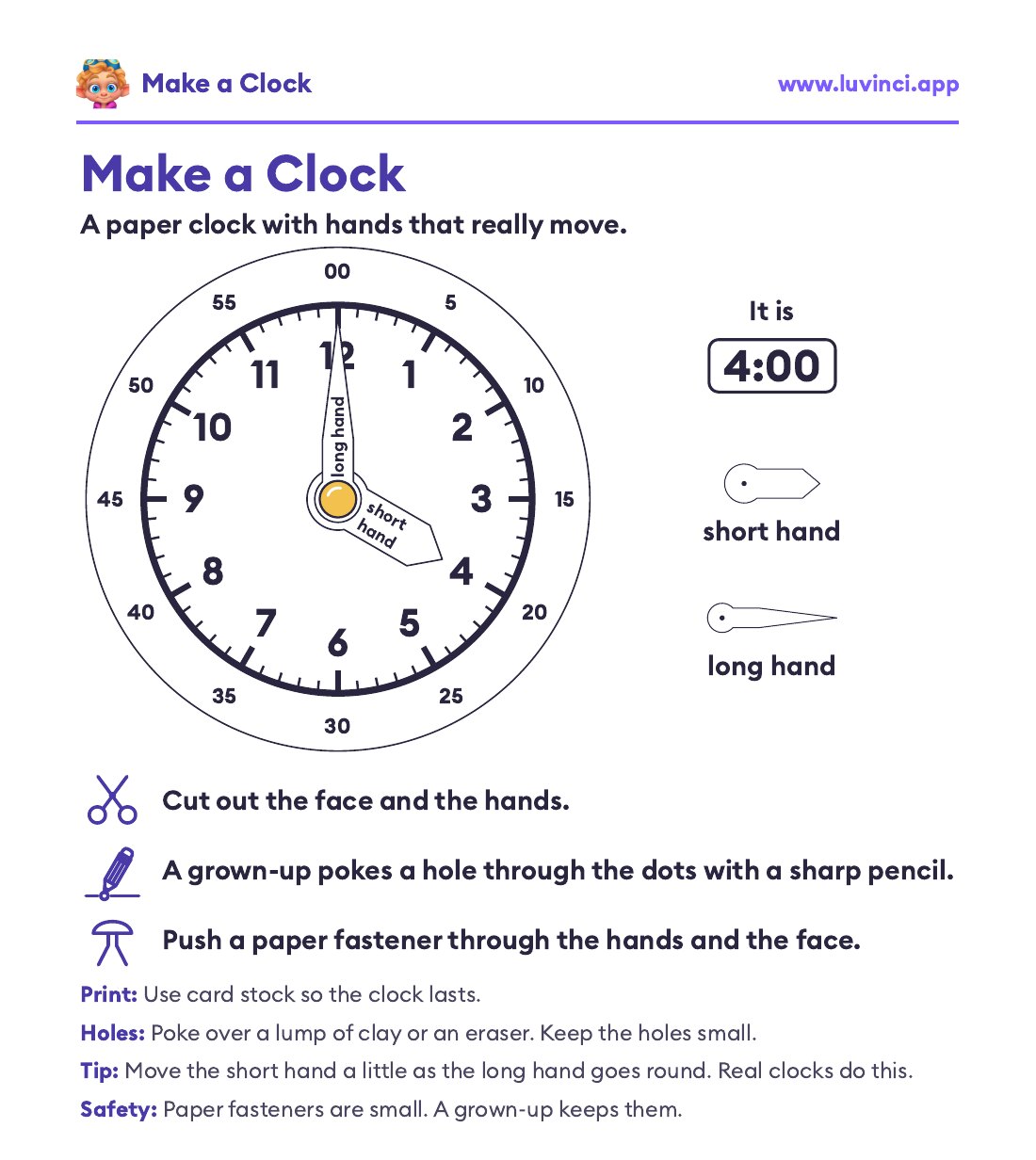
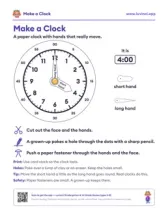
Our free Make a Clock PDF is 4 pages. After the how-to page comes a big face, 6.5 inches across, with the minutes by 5s around it. Then a face with numbers only, for younger kids, and three pairs of hands.
- Print on card stock. Cut out the face and the hands.
- A grown-up pokes a hole through the dots with a sharp pencil.
- Lay the short hand on the face and the long hand on top. Push a paper fastener through all three.
A grown-up keeps the paper fasteners, because they are small. Move the short hand a little as the long hand goes round. Real clocks do this.
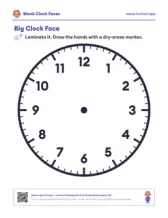
To practice with no cutting, use our free Blank Clock Faces PDF. It has 7 pages. Three have one big face. The rest have 4 or 6 clocks per page. Some have numbers, some have only the marks, some have the minutes by 5s, and some have time boxes. Write a time in the boxes and draw the hands to match. Laminate a page and it lasts all year.
Telling time mistakes to watch for
- Swapped hands. Your child reads the long hand as the hour. Say “short hand” and “long hand”, and read the short hand first.
- Half past read as the next hour. 3:30 comes out as 4:30. Ask which number the short hand has just passed.
- The long hand read as its number. On 4, it means 20 minutes, not 4 minutes. Count by 5s from 12.
- 9:45 read as 10:45. The short hand is close to 10. It hasn’t passed it, so it’s still 9.
- 3:5 for 3:05. Minutes always have two digits.
Fun telling time activities
Fun telling time activities use the clock all day, not only on paper.
- Say the time at routines. “It’s 7 o’clock. Time for breakfast.”
- Use “about” and “almost”. “It’s almost 8. The short hand is nearly on the 8.”
- Hang a clock with hands where your child can see it.
- Make a floor clock. Lay 12 numbered papers in a circle, with a short stick and a long stick for hands. Call out a time for your child to set.
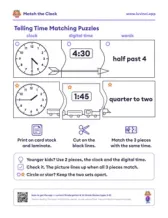
- Play a puzzle. Our free Match the Clock PDF has three-piece puzzles. Each strip has a clock, the digital time and the words. A small picture runs across all 3 pieces, so your child can check the match.
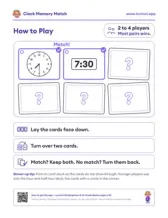
- Play a memory game. Our free Clock Memory Match PDF is for 2 to 4 players. Turn over two cards and keep a clock and its time. Younger players use only the hour and half hour deck.
For more games, see our math games for first graders.
FAQ
At what age should a child be able to tell the time?
Many kids read o’clock in kindergarten, around 5 or 6. Half past often comes in 1st grade, around 6 or 7. Five minutes often comes around 7 or 8. Around 8 or 9, the exact minute often shows up. Each child gets there at their own pace.
How to teach kids time on a clock?
Begin with the short hand alone. Add the long hand next, up at 12 for o’clock and down at 6 for half past. Count by 5s after that. Say the time out loud at routines every day, and let your child turn the hands on a paper clock.
Is it OK to learn digital time first?
Yes. Digital is easier to read, so lots of kids learn it first. Keep a clock with hands next to it. These worksheets pair the clocks with digital times, on the page or in the answer key.
The takeaways
- Read the short hand first. It tells the hour.
- O’clock, then half past, then 5 minutes. The exact minute comes last.
- The hour is the number the short hand has just passed.
- Count by 5s from 12 for the minutes.
- a.m. is midnight to noon. p.m. is noon to midnight.
- Say the time out loud at routines every day.
- Print the free Telling Time to the Hour PDF. 11 pages with an answer key.
Try the free counting board in the Luvinci app. The ten-frame, addition and subtraction boards are in the full app. See how Luvinci’s math games work.
More free math pages, each with its own free PDF:
- Skip counting chart
- Shapes for kindergarten: 2D and 3D shapes
- Hundreds chart
- More free math worksheets in the math printables library
Sources
- Common Core State Standards for Mathematics. Grade 1 Measurement and Data (1.MD.B.3).
- Common Core State Standards for Mathematics. Grade 2 Measurement and Data (2.MD.C.7).
- Common Core State Standards for Mathematics. Grade 3 Measurement and Data (3.MD.A.1).
- Friedman, W. J., and Laycock, F. (1989). Children’s analog and digital clock knowledge. Child Development, 60(2), 357-371.
- Burny, E., Valcke, M., and Desoete, A. (2012). Clock reading: An underestimated topic in children with mathematics difficulties. Journal of Learning Disabilities, 45(4), 351-360.
- Kamii, C., and Russell, K. A. (2012). Elapsed time: Why is it so difficult to teach? Journal for Research in Mathematics Education, 43(3), 296-315.
- Cambridge Mathematics (2020). Espresso 32: What does research suggest about developing concepts of time?
- NIST Time and Frequency Division. Times of Day FAQs.
More free math worksheets: ten frames, number charts, addition and subtraction, daily practice workbooks and more, all in one place. See the math printables →