 Luvinci
September 13, 2026
2nd Grade Word Problems with Tape Diagrams (Free PDF with Answers)
Free printable · PDF · 780 KB
2nd Grade Word Problems with Tape Diagrams (Free PDF with Answers)
No signup needed. Just print it.
Download PDFThese 2nd grade word problems cover what the grade asks for: math word problems for 2nd graders that add and subtract within 100, in one step or two. Many schools call them story problems or math story problems. Either way, the hard part is rarely the math. Working out what the story is asking is the real job, so this guide is mostly about that.
Everything is in one free word problems PDF of 10 pages: a chart of the 4 kinds with tape diagrams, a “key words can trick you” poster, 38 practice problems, a reusable work mat and an answer key. The stories use short sentences, so many second graders can read them alone; read the first one together. No signup, no email.
You’re in part 2 of our word problems series. Part 1 covers 1st grade, with pictures and numbers within 20.
Jump to: what 2nd grade expects · the 4 kinds · addition · subtraction · how to help · key words · the PDF · mistakes · FAQ
2nd grade word problems: what the standards expect
Second grade word problems mostly come from one Common Core standard, and the standard is short. Here it is in full (2.OA.1):
“Use addition and subtraction within 100 to solve one- and two-step word problems involving situations of adding to, taking from, putting together, taking apart, and comparing, with unknowns in all positions, e.g., by using drawings and equations with a symbol for the unknown number to represent the problem.”
In plain words:
- Within 100. Two-digit numbers, like 48 + 35. Some cross a ten and some don’t; on pages 3 and 4 of the PDF the ones that don’t cross a ten come first. Crossing a ten (regrouping) is its own skill in 2nd grade.
- One and two steps. A two-step problem needs one answer to find the next (more on that below).
- Four kinds of stories: add to, take from, put together (or take apart), and compare.
- “Unknowns in all positions.” The missing number can be at the end, in the middle (how many came or went) or at the start. Kids meet all of these in 1st grade too. What changes in 2nd grade is mastery: the start-missing problems and the two compare wordings that point the wrong way, practiced in 1st grade, are expected now (Progressions pp. 20-21).
- Drawings and equations. 2.OA.1 drops “objects” (the 1st grade standard, 1.OA.1, says “objects, drawings, and equations”). Kids move from counters to quick drawings like the tape diagram.
Also in 2nd grade:
- Length: “Use addition and subtraction within 100 to solve word problems involving lengths that are given in the same units, e.g., by using drawings (such as drawings of rulers)” (2.MD.5).
- Money: word problems with “dollar bills, quarters, dimes, nickels, and pennies, using $ and ¢ symbols” (2.MD.8).
- Bar graphs: “Solve simple put-together, take-apart, and compare problems using information presented in a bar graph” (2.MD.10).
Page 7 has length and money stories; bar graphs are not in this PDF.
The goal for the year, from the Progressions: “Students in Grade 2 master all of the problem situations and all of their subtypes and language variants” (Common Core Standards Writing Team, 2011, p. 21).
By the end of 2nd grade, kids also “know from memory all sums of two one-digit numbers” (2.OA.2), which is why quick facts make word problems easier. If those facts are still slow, go back to adding within 20.
Multiplication word problems come in 3rd grade (3.OA.3). In 2nd grade, equal groups show up only as adding the same number in rows (2.OA.4).
Where’s the missing number? The 4 kinds within 100
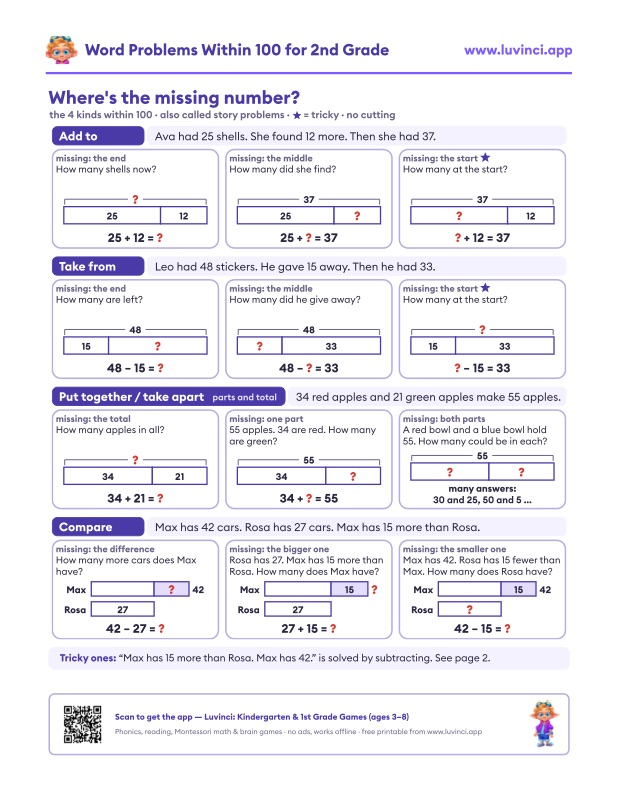
Every adding or subtracting story is one of 4 kinds, and the missing number can move in each kind. If the 4 kinds are new to your child, the table in 1st grade word problems shows each one with small numbers within 20.
| Kind | What happens | Example | The missing number can be |
|---|---|---|---|
| Add to | something joins | Ava had 25 shells. She found 12 more. | at the end (37), in the middle (12) or ★ at the start (25) |
| Take from | something leaves | Leo had 48 stickers. He gave 15 away. | at the end (33), in the middle (15) or ★ at the start (48) |
| Put together / take apart (parts and total) | two parts make a whole, nothing moves | 34 red apples and 21 green apples | the total (55), one part (21), or both parts |
| Compare | two amounts side by side | Max has 42 cars. Rosa has 27. | the difference (15), the bigger one or the smaller one (★ when the wording points the wrong way) |
★ marks the 4 tricky kinds: the two start-missing stories and the two compare wordings that point the wrong way. Kids practice them in 1st grade and master them in 2nd.
The start is the hardest spot. “Ava had some shells. She found 12 more. Now she has 37. How many did she have at the start?” There is nothing to count from. The fix is to turn it around: 12 + ? = 37, then count on from 12: by tens to 32, then 5 more, so 25 (Progressions p. 16). That’s the same move as finding a missing addend.
Compare word problems are the trickiest kind. In a compare story, the difference “is not present in the situation physically” (Progressions p. 12). Two compare wordings also point to the wrong operation; they get their own section below and page 5.
The tape diagram. A tape diagram, also called a bar model, is a long box that stands for an amount. Adding and taking away use one bar cut into two parts, with the total over the top. Comparing uses two bars, one under the other, and the extra piece at the end of the longer bar is the difference. Put the ? where the missing number goes. That’s the same idea as a part-part-whole picture, stretched out so the sizes show. If your child’s homework uses Eureka Math, its routine for this is called Read, Draw, Write.
Keep the drawings quick. The Institute of Education Sciences (IES) practice guide suggests “simpler sketches, such as stick figures for people or circles”, so the drawing leaves time for solving (IES 2021 practice guide, Recommendation 5, p. 50).
Addition word problems
Addition word problems are any story you solve by adding. Not all of them have an adding word in them.
- The end is missing (add to). “Milo had 46 stickers. He got 28 more. How many stickers does he have now?” 46 + 28 = 74 stickers. Bar: 46 and 28, with ? over the top.
- The start is missing (take from). “Some cars were in a lot. 18 drove away. 35 cars are still there. How many cars were there at first?” The story takes cars away, but you find the start by adding: 35 + 18 = 53 cars.
- “Fewer,” but you add (compare). “Jess has 13 fewer cards than Gabe. Jess has 48 cards. How many cards does Gabe have?” Gabe has more, so add: 48 + 13 = 61 cards.
Page 3 has 6 of these. Problems 1 to 3 don’t cross a ten; 4 to 6 do. The page title already says to add, so the tricky words (“fewer”, “left”) are safe practice there. Page 8 mixes the kinds, and that is where telling them apart really counts.
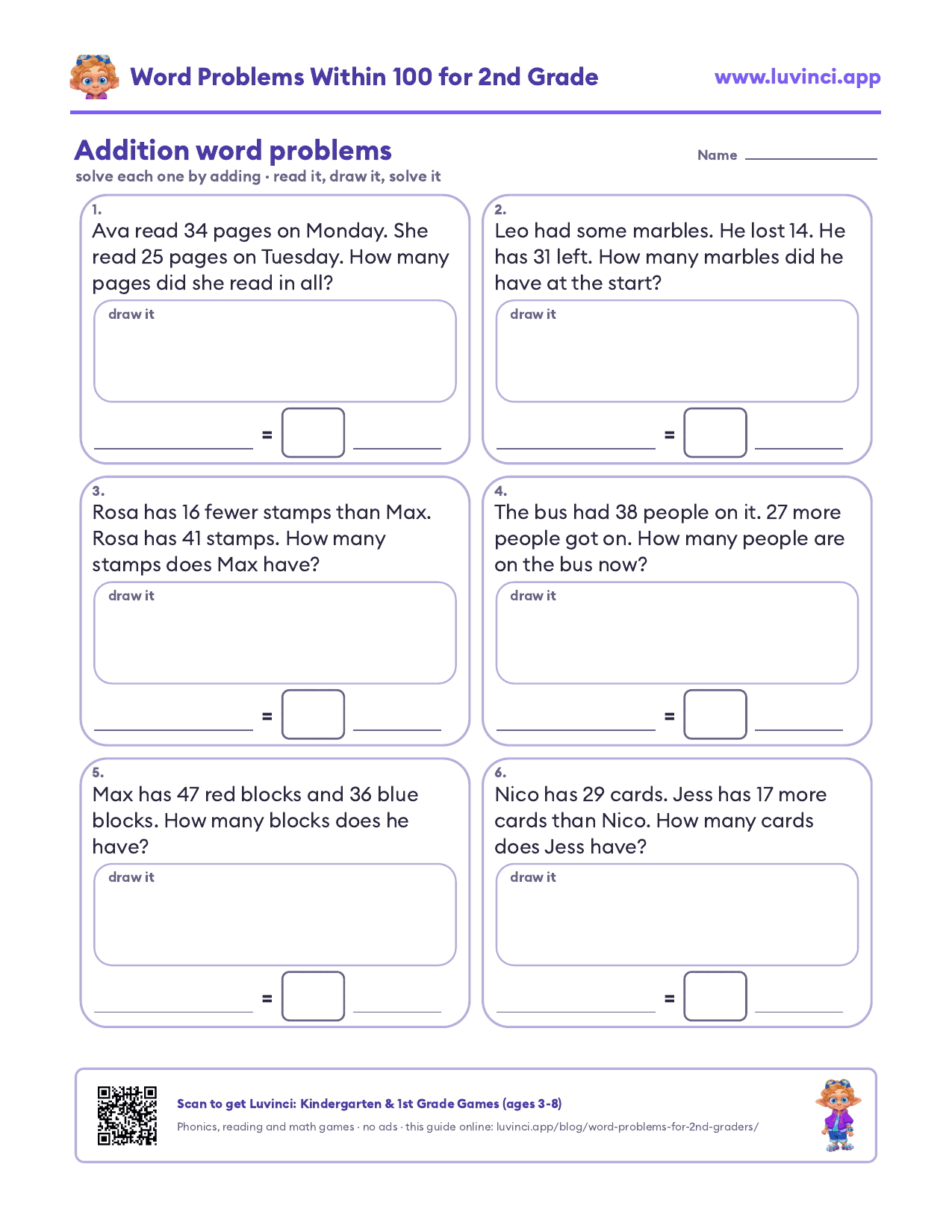
Page 3: every problem is solved by adding, even the ones that say “fewer” or “left”.
Subtraction word problems
Subtraction word problems are just as sneaky. Some say “more”, and some have no taking away in them at all.
- Taking away (the end is missing). “A tree had 93 apples. Kids picked 41 of them. How many apples are left?” 93 - 41 = 52 apples.
- How many more (compare). “Ava read 64 pages. Leo read 38 pages. How many more pages did Ava read?” 64 - 38 = 26 pages, or count up from 38 to 64.
- “More,” but you subtract (compare). “Rosa has 25 more beads than Lin. Rosa has 70 beads. How many beads does Lin have?” Lin has fewer, so subtract: 70 - 25 = 45 beads.
- A missing part (parts and total). “There are 48 kids on the field. 19 are playing soccer. The rest are running. How many kids are running?” 48 - 19 = 29 kids. Nothing leaves; it’s one part of a whole.
Any subtraction problem can be written as adding. 64 - 38 = ? asks the same thing as 38 + ? = 64: count up from 38 to 64. Counting up works the same way with bigger numbers. An open number line shows that count as jumps. Jump 2 to 40, then 20 to 60, then 4 to 64. That’s 26.
Page 4 has 6 subtraction problems, and page 5 has 6 compare word problems, one of each wording.
How to help your 2nd grader solve word problems
Five steps, used the same way every time (the page 9 work mat has them too):
- Read it three times. First: what happens? (No numbers yet.) Second: what is the question, in your own words? Third: which numbers matter? A classroom routine called Three Reads does this. The IES 2021 guide advises encouraging students to “reread the problem more than once and restate the problem in their own words” (Recommendation 5, p. 46).
- Name the kind. Add to, take from, parts and total, or compare. “Identifying a problem type is different from determining the operation” (IES 2021, p. 41). That is why page 8 asks for the kind before the answer.
- Draw it. A bar for each amount, a ? for the missing one. Boxes, not pictures.
- Write the story, then solve. The story equation can have the ? anywhere (? + 12 = 37). The solving equation can be different (37 - 12 = 25). Both are right: the Progressions call them a situation equation and a solution equation (p. 13).
- Answer with a label, then check. “25 shells”, not “25”. Does it make sense? Is that what the question asked?
Two-step word problems. These need one answer before you can find the next. “Ava had 7 shells. She found 5 more. Then she gave 4 to Leo. How many shells does she have now?” Step 1: 7 + 5 = 12. Step 2: 12 - 4 = 8. The Progressions advise that “most work with two-step problems should involve single-digit addends” (p. 18), meaning one-digit numbers. So start two-step problems with small numbers. On page 6, problems 1 to 4 do; the two marked “big numbers” are for when the small ones are easy. The most common slip is stopping after step 1. Ask: is that what the question asked?
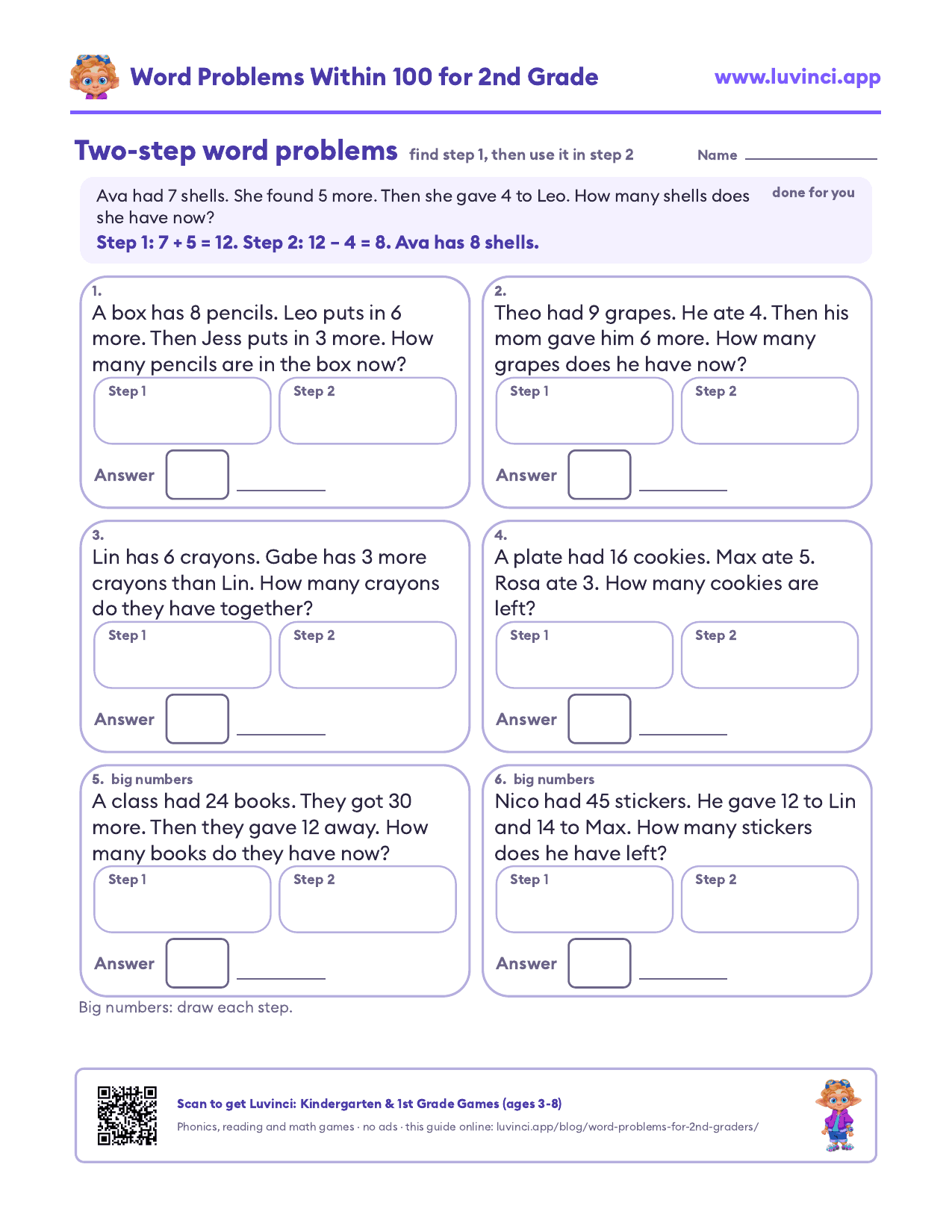
Page 6: two boxes, two steps. The last two use bigger numbers.
When reading is the hard part. Read the problem aloud together the first time, then your child reads it again. In 1st grade the question often needs a grown-up; in 2nd grade many children read the whole problem themselves, with help on the first read. If reading is slowing things down, start with the 2nd grade sight words list. And try the reading passages for 2nd graders: retelling a story builds the same habit as step 1, saying what happens.
Key words for word problems (and when they trick your child)
Posters of key words for math word problems list words like “in all”, “altogether” and “total” for adding, and “left”, “fewer” and “difference” for subtracting. Some posters call them keywords. They go wrong here:
- “More”, but subtract: “Ava has 9 more stickers than Leo. Ava has 15. How many stickers does Leo have?” 15 - 9 = 6.
- “Fewer”, but add: “Leo has 6 fewer shells than Ava. Leo has 8. How many shells does Ava have?” 8 + 6 = 14.
- “Left”, but add: “Some ducks were in a pond. 5 swam away. 7 are left. How many ducks were there at the start?” 7 + 5 = 12.
- “In all”, but subtract: “There are 14 cups in all. 9 are red. The rest are blue. How many cups are blue?” 14 - 9 = 5.
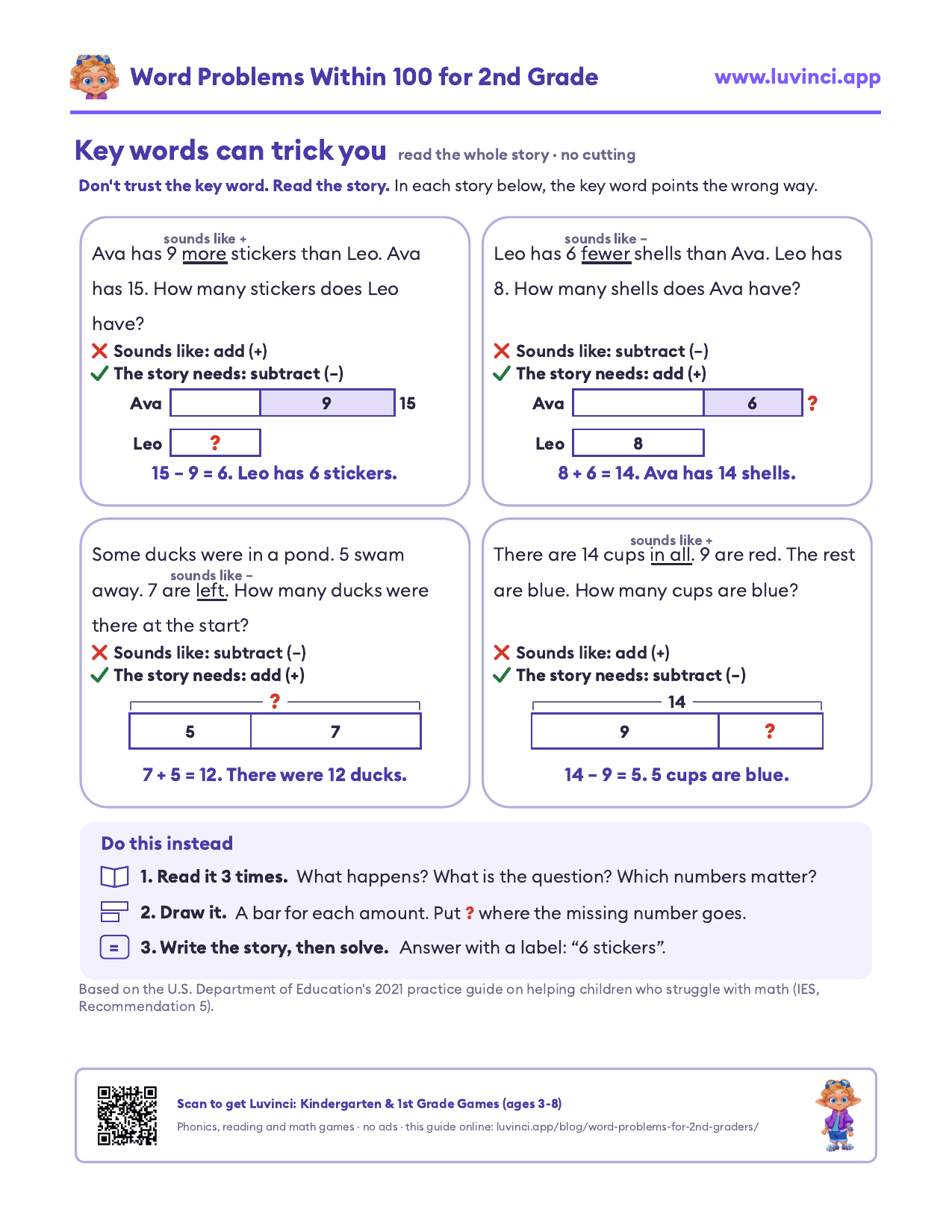
Page 2: print it for the fridge or the homework folder.
A 2021 U.S. Department of Education practice guide on helping children who struggle with math gives plain advice: “Avoid teaching key words that link specific words to operations.” Key words, it says, “remove the need to read and understand the entire problem” (Fuchs et al., 2021, IES, Recommendation 5, p. 49). Math educators Karp, Bush and Dougherty list “Use keywords to solve word problems” as one of 13 rules that expire (Teaching Children Mathematics, 2014). And the Common Core’s own problem-type table marks which compare wordings suggest the wrong operation (Progressions, Table 1, p. 7).
Do this instead:
- Read it three times: what happens, what is the question, which numbers matter.
- Draw a bar for each amount, and put the ? where the missing number goes.
- Write the story equation, then solve.
Read the story, not the key word.
If your child’s class uses the CUBES math strategy (Circle the numbers, Underline the question, Box the key words, Evaluate, Solve and check), keep most of it. Circling and underlining slow a child down in a good way, and some classes use the E for “Eliminate extra information”, which is the cross-out step on page 8. Just swap the B step: instead of boxing key words, say what happens in the story. (Letters vary a little by school.)
The free PDF: 2nd grade math word problems within 100
The PDF is free, prints in black and white, and every answer sits on the last page.
- Page 1: Where’s the missing number? A no-cut chart of the 4 kinds, with tape diagrams.
- Page 2: Key words can trick you: a poster with 4 stories.
- Page 3: Addition word problems: 6 problems.
- Page 4: Subtraction word problems: 6 problems.
- Page 5: Compare word problems: 6 problems, one of each wording.
- Page 6: Two-step word problems: 6 problems.
- Page 7: Inches, centimeters and cents: 3 length and 3 money problems.
- Page 8: Mixed word problems: 8 problems with room to work. Tick the kind, then solve.
- Page 9: A reusable work mat.
- Page 10: Answer key, with the equation for every problem.
Pages 3 to 8 hold the addition and subtraction word problems for 2nd graders; page 8 mixes them the way homework does. For a quick start on math word problems for 2nd graders, use pages 3 and 4. Page 7 has 3 money word problems for 2nd graders (a dime, a nickel, quarters and dollars) and 3 measurement word problems in inches and centimeters (2.MD.5, 2.MD.8). Pages 1 to 10 together make one full set of word problem worksheets for 2nd graders.
Two problems on page 8 carry a number the question doesn’t need (a farm’s 4 dogs, Nico’s age). Crossing it out is part of reading carefully; the IES guide recommends practice with extra information like this (IES 2021, pp. 44-46).
Page 9 is a word problem graphic organizer you can reuse: slide it into a sheet protector and use a dry-erase marker.
Pace: one page a day, about 10 to 15 minutes. The answer key on page 10 is for grown-ups.
Common word problem mistakes in 2nd grade
| What you see | Why | What helps |
|---|---|---|
| Adds the two numbers no matter what | number hunting; no picture of the story | read it three times; say what happens before touching a number (IES 2021, pp. 49-50) |
| Adds on “how many more?” | hears “more” | draw two bars, one under the other; the extra piece is the answer (Progressions p. 12) |
| Subtracts on “Jess has 13 fewer than Gabe. Jess has 48.” | follows the key word | ask “who has more?” first; Gabe does, so his bar is longer |
| Gives up when the start is missing | there’s nothing to count from | turn it around: ? - 18 = 35 becomes 35 + 18 = ? (Progressions p. 16) |
| Stops after step 1 | answers the first question | ask “Is that what the question asked?”; use the Step 1 and Step 2 boxes on page 6 |
| Uses every number, even the 4 dogs | didn’t reread the question | cross out what the question doesn’t need (IES 2021, pp. 44-46) |
| Writes “25”, not “25 shells” | habit | answer in a sentence with a label |
| Draws 53 cars one by one | detail, not amount | a bar with the number on it (IES 2021, p. 50: simpler sketches) |
| Gets 28 + 45 = 613 | adds tens and ones separately and writes both | line up tens and ones; a ten made from the ones goes with the tens |
| Gets 63 - 27 = 44 | takes the smaller ones digit from the bigger one, whichever number it is in | 3 ones can’t lose 7: break a ten first, or count up from 27 to 63 |
FAQ
What are word problems in 2nd grade?
Short stories with a question that you answer by adding or subtracting within 100, in one step or two (2.OA.1). There are 4 kinds: add to, take from, put together (or take apart) and compare, and the missing number can be anywhere. 2nd grade also adds length and money stories (2.MD.5, 2.MD.8) and simple bar graph questions (2.MD.10).
What are some examples of word problems?
One of each kind, with answers:
- Add to: “Gabe had 41 marbles. He won 25 more. How many marbles does he have now?” 41 + 25 = 66 marbles.
- Take from: “There were 76 leaves on a branch. 32 fell off. How many leaves are left?” 76 - 32 = 44 leaves.
- Parts and total: “A box has 60 crayons. 28 are broken. How many crayons are not broken?” 60 - 28 = 32 crayons.
- Compare: “Theo jumped 45 times. Milo jumped 61 times. How many more times did Milo jump?” 61 - 45 = 16 times.
Page 8 of the PDF mixes all four kinds.
What is a tape diagram in 2nd grade?
A drawing of long boxes that stand for the amounts in a word problem, with a ? where the missing number goes. Adding and taking away use one bar in two parts; comparing uses two bars, one under the other. Some books call it a strip diagram. Every cell on page 1 of the PDF has one.
How are 2nd grade word problems different from 1st grade?
Four differences, from the standards. 1st grade works within 20; 2nd grade works within 100. 1st grade solves one-step problems (plus adding three numbers); 2nd grade adds two-step problems. 1st grade uses “objects, drawings, and equations”; 2nd grade uses “drawings and equations”. And the 4 tricky kinds (start missing, and compare wordings that point the wrong way) are practiced in 1st grade and mastered in 2nd (Progressions pp. 20-21). Part 1 of this series has the picture version within 20.
The takeaways
- 2nd grade word problems stay within 100, in one or two steps, and every kind gets mastered this year.
- Four kinds: add to, take from, put together (or take apart), compare. The missing number can be at the end, in the middle or at the start.
- Read it three times before touching a number.
- Draw a bar for each amount and put a ? where the missing number goes.
- Read the story, not the key word: “more” can mean subtract and “left” can mean add.
- Two steps? Start small, and check the question before writing the answer.
- Print the free 2nd grade math word problems: 38 problems, a key words poster, a work mat and an answer key.
Word problems live on paper; Luvinci has none. What the app practices is the adding and take-away facts within 10, the first part of the facts within 20 that 2nd graders learn to do fluently (2.OA.2). Its Singapore Math boards show many of these facts as pictures: an adding fact on two ten frames, a take-away on one ten frame with the taken-away pictures crossed out. None of the adding or take-away boards goes past 10. These boards are in the full app; the counting board is free. See the math boards.
More free math worksheets: ten frames, number charts, addition and subtraction, daily practice workbooks and more, all in one place. See the math printables →
