Luvinci
October 18, 2026
Shapes for Kindergarten: 2D and 3D Shapes + Free Worksheets
5 free PDFs in this post
More PDFs (4)
Shapes for kindergarten are 5 flat shapes and 4 solid shapes. The flat shapes are circle, square, triangle, rectangle and hexagon. The solid shapes are cube, cone, cylinder and sphere. These are the shapes kindergarten standards name. Kids learn to name each one, and they count the sides and corners of the flat shapes. They tell flat from solid, even when a shape is turned, big or small.
A triangle has 3 straight sides and 3 corners. Skinny, wide or upside down, it’s still a triangle.
These shapes for kindergarten worksheets sit in one free Shapes for Kindergarten PDF of 10 pages. Kids count, sort, color and match the shapes, with answer keys at the end. It’s free, with no signup and no email. The pattern block templates and a shape bingo game each have their own free PDF, in the list at the top.
Jump to: the 9 shapes · the free PDF · 2D shapes · tricky shapes · 3D shapes · activities · 1st grade · FAQ
What shapes should a kindergartener learn?
Nine shapes, five flat and four solid. We call them the kindergarten list.
| Flat shape | Sides | Corners | Shaped like |
|---|---|---|---|
| Circle | 0 | 0 | A wall clock |
| Triangle | 3 | 3 | A yield sign |
| Square | 4 | 4 | A cracker |
| Rectangle | 4 | 4 | A door |
| Hexagon | 6 | 6 | A honeycomb cell |
| Solid shape | Flat faces | Rolls, stacks or slides | Shaped like |
|---|---|---|---|
| Sphere | None | Rolls any way | A ball |
| Cube | 6 square faces | Stacks and slides | Dice |
| Cylinder | 2 circle faces and a curved side | Rolls on its side. Stacks and slides on its flat ends | A can |
| Cone | 1 circle face and a point | Rolls in a circle. Slides on its flat face | A party hat |
A square is a special rectangle. All 4 of its sides match.
Hearts, stars and ovals are fine to name for fun. They aren’t on the kindergarten list. Rhombus and trapezoid are 1st grade names.
Readiness checklists ask for circle, square and triangle, the basic shapes goal before kindergarten. A lot of kids know a typical triangle and miss a skinny one.
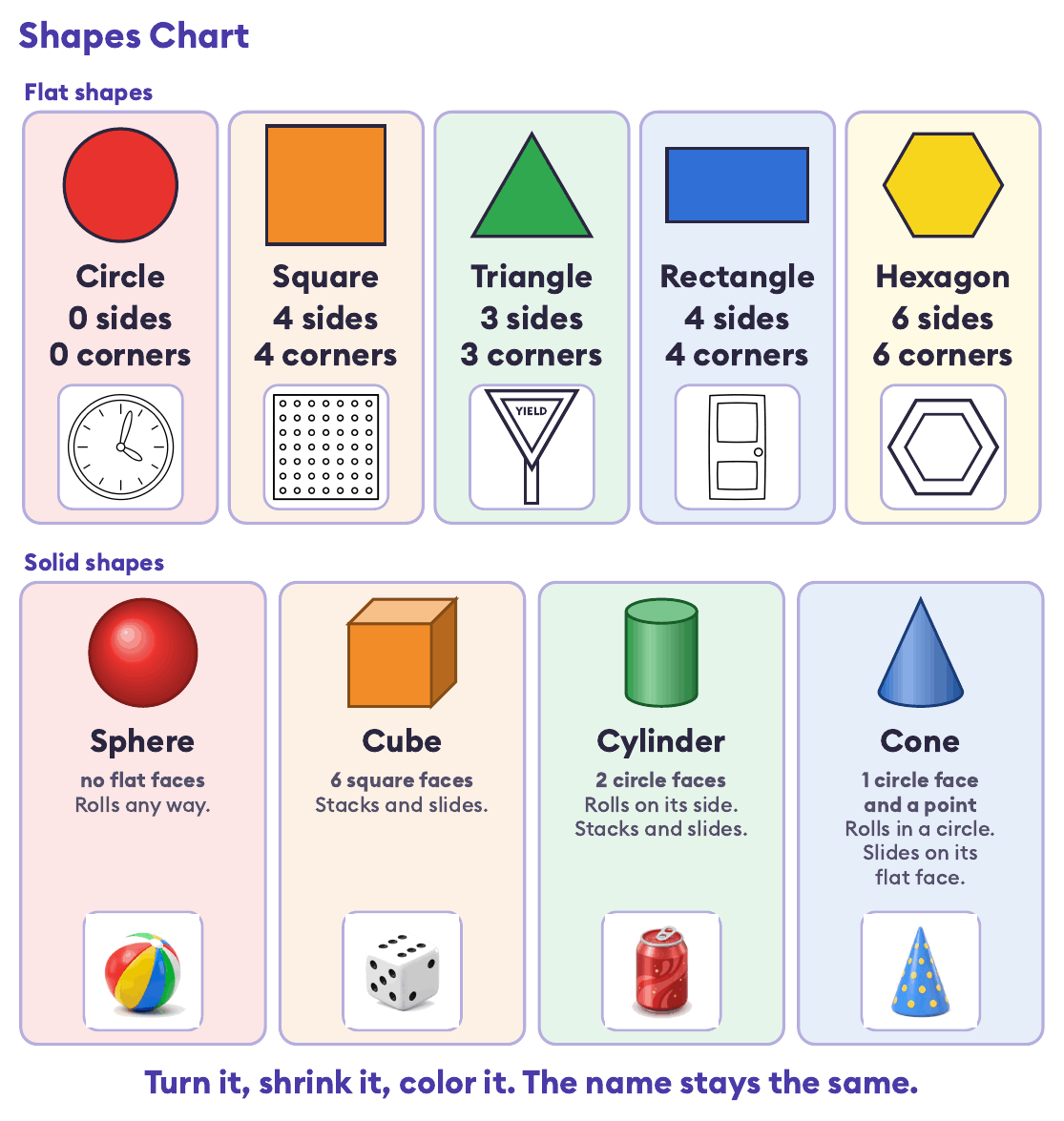
Page 8. All 9 printable shapes on one chart.
Free shapes for kindergarten worksheets (PDF)
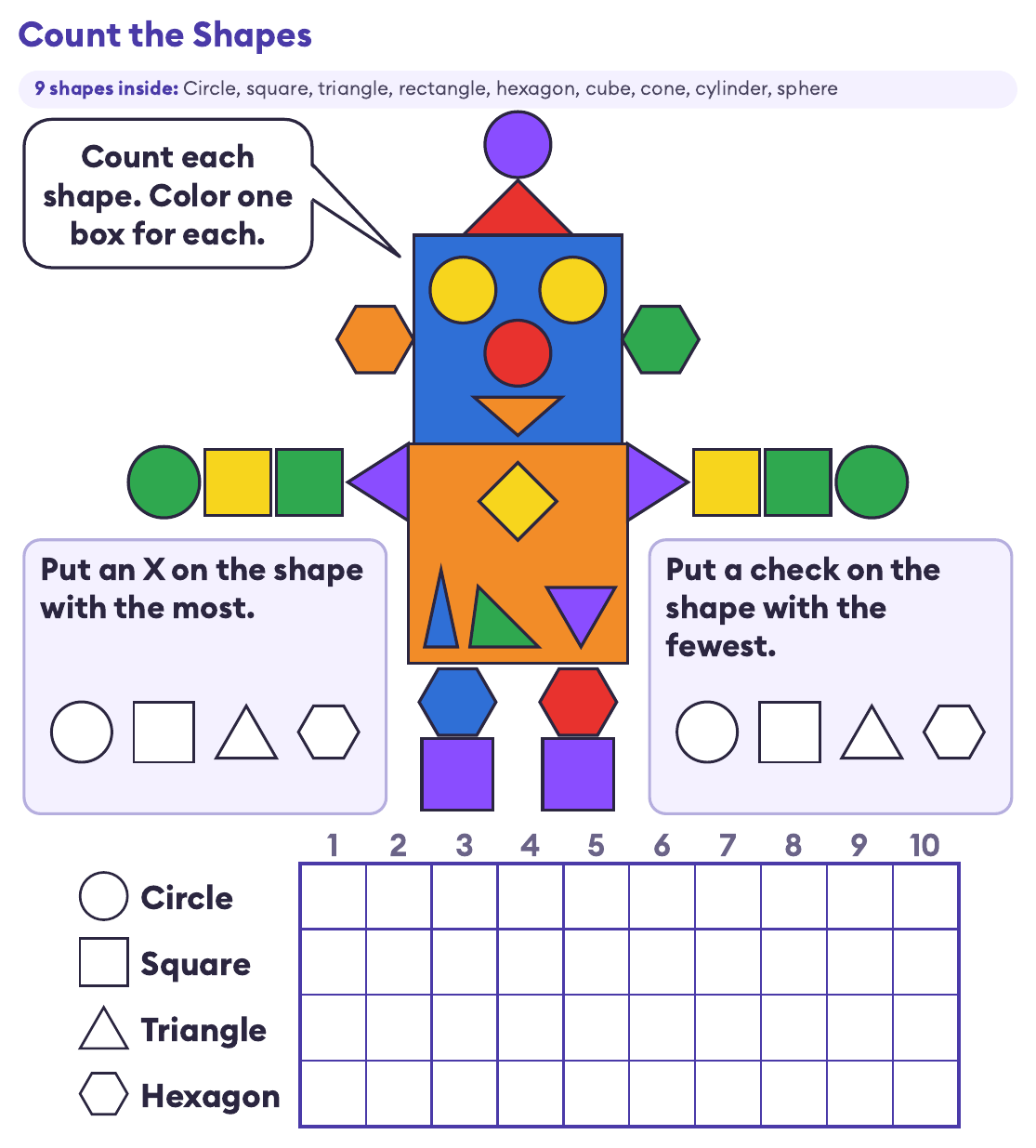
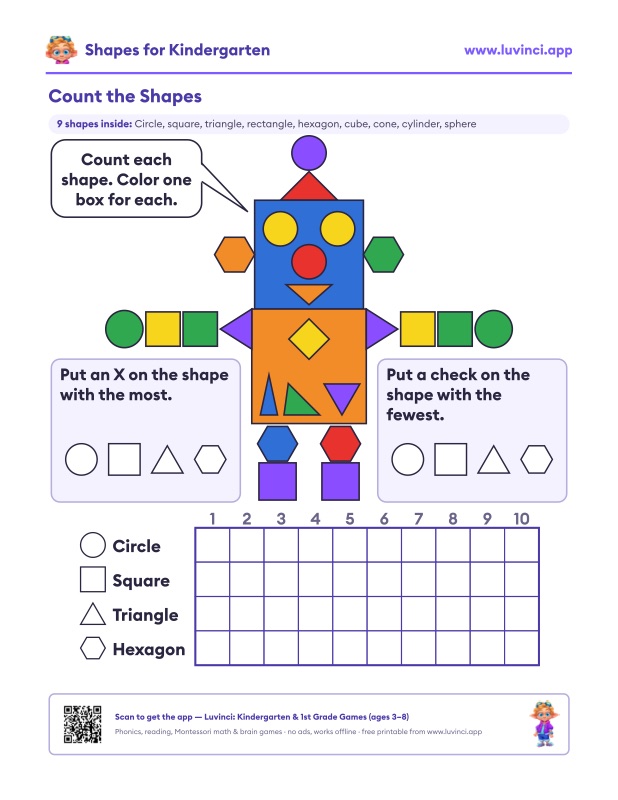
Page 1. Count the shapes, then color the graph.
Here’s what’s on each page of the Shapes for Kindergarten PDF.
| Page | What’s on it |
|---|---|
| 1 | Count the Shapes. Count the shapes in a robot and color a bar graph |
| 2 | Shapes All Around. Cut out 12 pictures and glue each under circle, square, triangle or rectangle |
| 3 | Color by Shape. Color a shape garden with a color for each shape |
| 4 | Solid Shapes All Around. Cut out 12 pictures and glue each under sphere, cube, cylinder or cone |
| 5 | Flat or Solid? Color the flat shapes and put an X on the solid ones |
| 6 | Sides and Corners. Write the sides and corners of 6 shapes |
| 7 | Shape Detectives. Color the real triangles and the real rectangles |
| 8 | Shapes Chart. 5 flat and 4 solid shapes with sides, corners, faces and a real object |
| 9 | Answer key for pages 1 to 4 |
| 10 | Answer key for pages 5 to 7 |
The robot on page 1 has 6 circles, 9 squares, 7 triangles and 4 hexagons, in mixed colors. Kids put an X on the shape with the most and a check on the shape with the fewest.
On page 2, squares go under the square, not the rectangle. The page says so, and it reminds kids that squares are rectangles too. Page 3 prints its color key above the picture.
Pages 2 and 4 are cut and paste shape sorting worksheets. Cutting on the lines gives kids scissor practice. Our fine motor skills guide has more.
Print at 100% (“actual size”) on US Letter, and print the keys for yourself.
2D shapes for kindergarten: sides and corners
Flat shapes lie on paper, and you can draw them. School calls these the 2D shapes, and kindergarten says “flat”.
A side is a straight line around the outside of a shape. A corner is the place two sides meet. (Math books call a corner a vertex. Your child can just say corner.)
When you count corners, touch each one once as you count. It’s the same skill as touch and count. Start at the top and go around one way.
A square corner looks like the corner of a sheet of paper. If the paper’s corner fits inside it, it’s a square corner.
- Rectangle. 4 straight sides and 4 square corners.
- Square. A special rectangle. All 4 sides match.
- Circle. Perfectly round. No sides and no corners.
Pages 1, 2, 3, 6 and 7 are the 2D shapes worksheets in the PDF. Page 6 has six shapes to count. One triangle is lopsided. The square sits turned on a corner, and the last triangle is skinny and upside down.
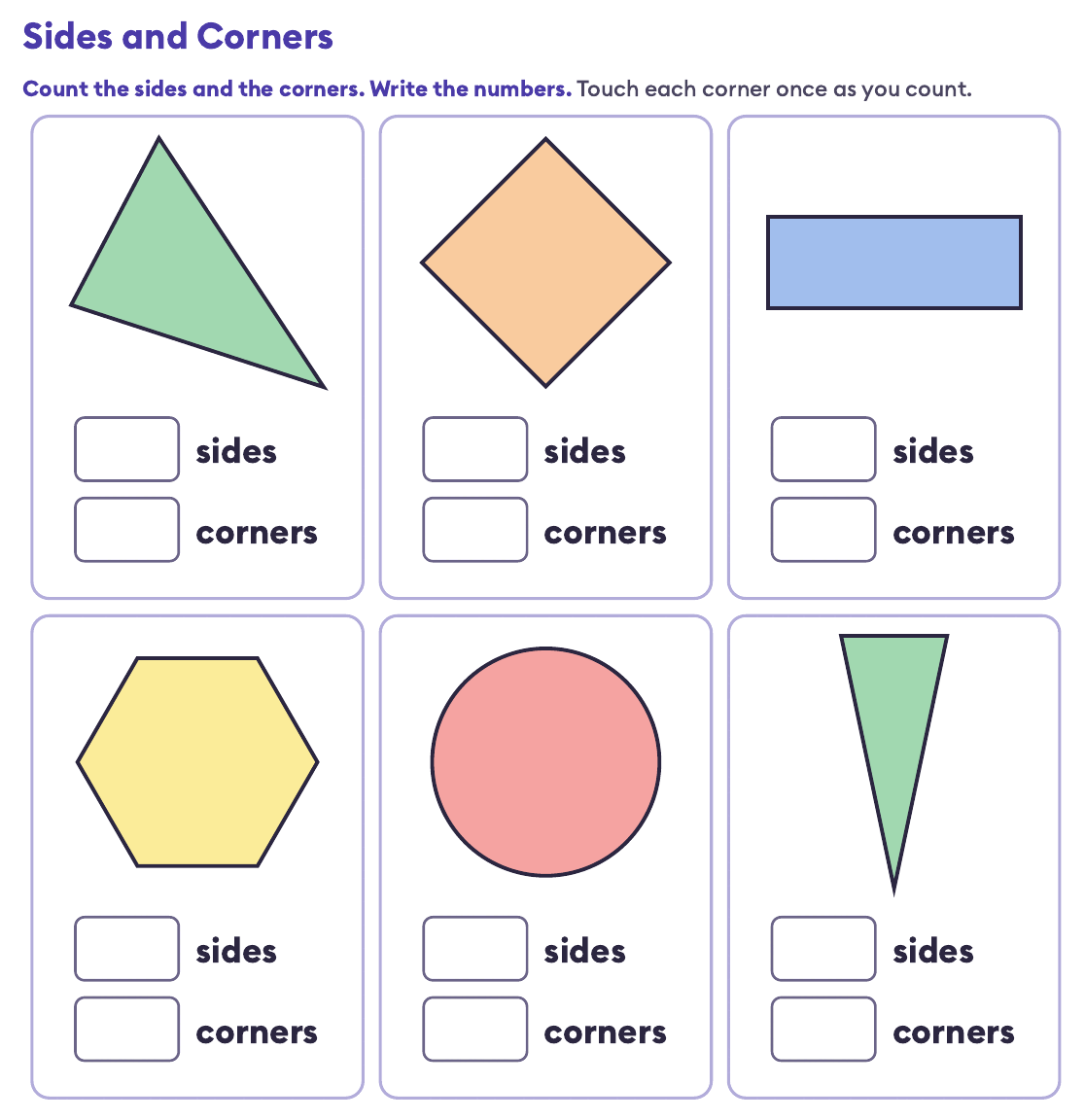
Page 6. Write the sides and the corners.
Tricky shapes: turned, skinny and upside down
Kids learn shapes from a few typical pictures, then they say no to the others. A quick fix for each mix-up sits below.
- A turned square is still a square. Turn the paper and it’s the same shape.
- “Diamond” is an everyday word, not a math name. If all 4 sides match and all 4 corners are square corners, it’s a turned square. If it’s squished, it’s a rhombus, a 1st grade word.
- Skinny, wide or upside down, 3 straight sides make a triangle.
- A square is a rectangle too. It has 4 straight sides and 4 square corners.
- An oval is stretched. A circle is not. A stretched circle gets a new name.
- A stop sign has 8 sides, so it isn’t a hexagon.
- A pizza slice has a curved crust, so it isn’t a triangle.
- A shape with rounded corners or a gap is not a triangle.
On page 7, kids color the real triangles and the real rectangles. Each one that isn’t real breaks one rule, like rounded corners, a gap or a curved side. A square sits in the rectangle rows, and it gets colored.
Ask why they picked it. “How do you know it’s a triangle?” is the best question you can ask.
3D shapes for kindergarten: flat or solid?
Solid shapes are shapes you can hold, and they take up space. School calls these the 3D shapes, and kindergarten says “solid”. A face is a flat side of a solid.
Try the roll, stack and slide test with things at home.
- A ball (sphere) rolls any way you push it.
- Dice (cubes) stack and slide.
- A can (cylinder) rolls on its side. Stand it up and it stacks and slides.
- A party hat (cone) rolls in a circle. On its flat face, it slides.
Mind the names. A ball is a sphere. A circle is flat. Dice are cubes, not squares.
The stamp test shows it. Dip a solid in paint and press it down. The print is a flat shape. A cube makes a square. A can makes a circle. A ball makes just a dot.
Pages 4 and 5 are the 3D shapes worksheets for kindergarten. Page 4 sorts 12 real things, like a beach ball, an ice cube and a drum. It is a shape matching worksheet too. Each picture goes under the solid it looks like. On page 5, kids color the flat shapes and put an X on the solid ones. The rule at the top helps. You can draw a flat shape, and you can hold a solid one.
Those are the 3D shapes for kindergarten. In 1st grade, kids add the rectangular prism, like a cereal box.
Shape activities for kindergarten
- Shape hunt. Find a circle, a square, a triangle and a rectangle at home. Then find a cone, a cube, a sphere and a cylinder.
- Build shapes. Straws make the sides. Playdough balls make the corners.
- Feely bag. Your child feels a block’s corners in a bag and guesses the shape.
- Two triangles make a square. Fold a square napkin corner to corner.
- Count and graph. Like page 1. Our Valentine’s Day math pages graph candy hearts the same way.
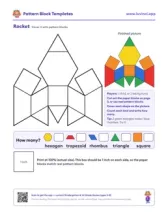
The free Pattern Block Templates have a rocket mat, a turtle mat and a page of paper blocks. Cover the picture, then count each block. Paper blocks come with it, so you don’t need a set. Print it at 100% (actual size), so the paper blocks match real ones. Trapezoid and rhombus are 1st grade names, so “the red block” is fine in kindergarten.
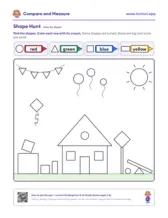
Our free Compare and Measure Worksheets start with a shape hunt. Your child colors each circle, triangle, square and rectangle in a picture, even the turned ones. Then the pages compare things. Kids color the longer one, color the heavier one on a balance and circle what holds more. The last page pairs up groups to find more or fewer. An answer key for grown-ups is at the end.
Shape games for kindergarten
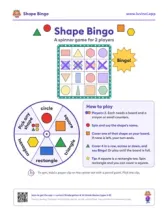
In the free Shape Bingo game, a paper-clip spinner calls the shapes, so no grown-up has to. It has two boards of 16 shapes.
- Players: 2. Each needs a board and a crayon or small counters.
- Spin and say the shape’s name.
- Cover one of that shape on your board. If none is left, your turn ends.
- Cover 4 in a row, across or down, and say Bingo! Or play until the board is full.
- Tip: A square is a rectangle too. Spin rectangle and you can cover a square.
To spin, hold a paper clip on the center dot with a pencil point. Flick the clip.
Two shape riddles for the car.
- “I have 3 sides and 3 corners. What am I?” (A triangle.)
- “I roll any way you push me. I have no flat faces. What am I?” (A sphere.)
Shapes in 1st grade: new names and halves
1st grade adds rhombus, trapezoid and rectangular prism. Kids learn what makes the name. The number of sides, the straight sides and a closed shape matter. Color, size and turn don’t.
1st grade also splits circles and rectangles into equal parts. Halves are 2 pieces the same size. Fourths are 4 pieces the same size. More parts make smaller parts. This is the first step into fractions.
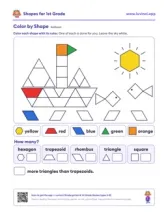
Our free Shapes for 1st Grade PDF is a separate 6-page pack for this step. Kids color a sailboat by shape, split big shapes into smaller ones and draw shapes from clues. Then they color halves and fourths and match real things to solids, like a cereal box to the rectangular prism. The answer key is on the last page.
FAQ
What are some examples of two-dimensional shapes?
Circle, square, triangle, rectangle and hexagon are the five on the kindergarten list. Hearts, stars and ovals are two-dimensional too.
What are the 2D shapes that are appropriate for kindergarteners?
Circle, square, triangle, rectangle and hexagon. Heart, star and oval are fine for fun. Rhombus and trapezoid come in 1st grade.
How do you explain 2D and 3D shapes to a child?
Say flat and solid. Flat shapes lie on paper, and solid shapes you can hold. Put a paper circle next to a ball. The circle is flat. The ball is a sphere.
Can you give me 10 examples of 3D shapes?
A ball, an orange and a globe are spheres. Dice and an ice cube are cubes. A can and a drum are cylinders. A party hat and an empty ice cream cone are cones. A cereal box is a rectangular prism, a 1st grade name.
What grade do kids learn about 3D shapes?
Kindergarten. Kids name the cube, cone, cylinder and sphere and tell flat from solid. 1st grade adds the rectangular prism and builds new shapes from solids.
Should a 5 year old know shapes?
Circle, square and triangle are a common readiness goal. The rest of the kindergarten list comes during the year. Keep naming shapes in everyday talk.
Do the pages come with answer keys?
Yes, on pages 9 and 10. The 1st grade PDF has its key on the last page. The pattern block mats show each finished picture. Shape Bingo needs no key.
The takeaways
- 9 shapes on the kindergarten list. 5 flat and 4 solid.
- Count sides and corners. Touch each corner once.
- Turned, skinny or upside down, it’s the same shape.
- A square is a special rectangle.
- Flat or solid? Roll, stack and slide to find out.
- Two cut and paste sorts with real things.
- Pattern block templates and Shape Bingo are in the list at the top.
- Print the free Shapes for Kindergarten PDF. 10 pages with answer keys, no signup.
Try the free counting board in the Luvinci app. The ten-frame, addition, subtraction and times-table boards are in the full app. See how Luvinci’s math games work.
More free math pages, each with its own free PDF:
- Counting mats and number sense activities for kindergarten
- Touch and count mats 1 to 10
- Ten frames to 10 and 20
- Math War and three more card games
Sources
- Common Core State Standards for Mathematics, Kindergarten. Geometry (K.G.1 to K.G.6), Measurement and Data (K.MD.3) and the Kindergarten introduction.
- Common Core State Standards for Mathematics, Grade 1. Geometry (1.G.1 to 1.G.3).
- Common Core Standards Writing Team (2012). Progressions for the Common Core State Standards in Mathematics: K-6 Geometry.
- Illustrative Mathematics K-5. Kindergarten Unit 3 family materials, “Flat Shapes All Around Us”, and Unit 7 family materials, “Solid Shapes All Around Us”.
- Great Minds, Eureka Math. Grade K Module 2, “Two-Dimensional and Three-Dimensional Shapes”, and Grade 1 Module 5, “Identifying, Composing, and Partitioning Shapes”.
- Clements, D. H., Sarama, J., Swaminathan, S., Weber, D., and Trawick-Smith, J. (2018). Teaching and learning Geometry: early foundations. Quadrante, 27(2), 7-31.
- Tsamir, P., Tirosh, D., and Levenson, E. (2008). Intuitive nonexamples: the case of triangles. Educational Studies in Mathematics, 69, 81-95.
- Verdine, B. N., Lucca, K. R., Golinkoff, R. M., Hirsh-Pasek, K., and Newcombe, N. S. (2016). The shape of things: The origin of young children’s knowledge of the names and properties of geometric forms. Journal of Cognition and Development, 17(1), 142-161.
More free math worksheets: ten frames, number charts, addition and subtraction, daily practice workbooks and more, all in one place. See the math printables →