 Luvinci
September 25, 2026
Skip Counting Chart 2s to 10s: Free Printable PDF
Free printable · PDF · 932 KB
Skip Counting Chart 2s to 10s: Free Printable PDF
No signup needed. Just print it.
Download PDFA skip counting chart puts each count-by in its own row: 2, 4, 6, 8 … 20 in one row, 5, 10, 15 … 50 in another, all the way to 10, 20, 30 … 100. Skip counting means counting by a number other than 1, so your child lands on every 2nd, 5th or 10th number and skips the ones in between. Once the rows feel easy, a big pile of things is quicker to count.
Our free skip counting chart PDF has 10 pages: a color chart for 2s to 10s, a black and white copy, counting socks and tally marks, the 2s, 5s, 3s and 4s shaded on a 1 to 100 grid, fill-in strips and a blank chart. These free skip counting charts print on US Letter. No signup, and no email to leave.
Kindergartners count by 10s first. 2s and 5s come next, often in 1st grade and by 2nd grade at the latest. 3s and 4s get kids ready for the times tables in 3rd grade. Start with the starred rows on page 1 (10s, 5s and 2s).
Jump to: the 10 pages · how to read it · what order · by 2s · by 5s · 3s and 4s · worksheets · games
Free skip counting chart printable PDF
Keep page 1 handy. You’ll check the groups page, the strips and the blank chart against it.
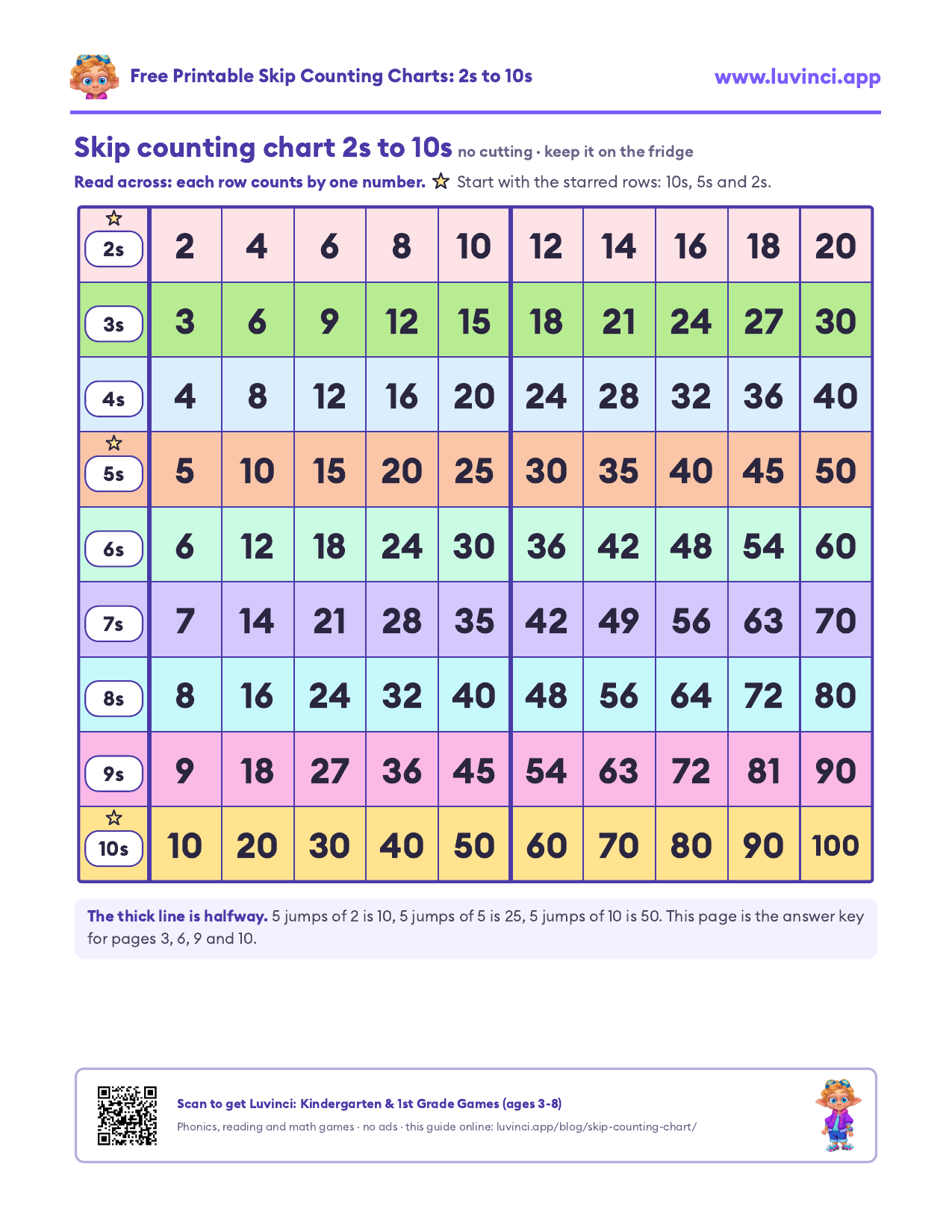
Page 1: 2s to 10s, 10 numbers in each row. It’s also the check for pages 3, 6, 9 and 10.
- Skip counting chart 2s to 10s (page 1). Nine rows, one for each count-by, 10 numbers in each. The 10s, 5s and 2s rows have a star. No cutting.
- Black and white skip counting chart (page 2). The same chart in ink only, for highlighting one row at a time.
- Count the groups (page 3). Pairs of socks by 2s and tally marks by 5s. Write how many so far.
- Count by 2s on the chart (page 4). Every 2nd number shaded on a 1 to 100 grid.
- Count by 5s on the chart (page 5). Every 5th number shaded.
- Skip counting strips (page 6). 2s and 5s to trace, then write. Then count back by 10s and by 5s, and count by 100s to 1,000.
- Count by 3s on the chart (page 7). Every 3rd number shaded.
- Count by 4s on the chart (page 8). Every 4th number shaded.
- Count by 3s and 4s (page 9). Rows of dots to count, then strips to trace and write.
- Blank skip counting chart (page 10). Only the first number of each row. Fill it in, then check with page 1.
A few print tips:
- Ink only? On page 1 the row colors print as gray stripes, and page 2 has no color at all.
- Reuse it. Pages 6, 9 and 10 go in a sheet protector, so a dry-erase marker wipes off for the next round.
- On the wall. Page 1 on cardstock works as a small skip counting poster or anchor chart.
- Want to shade a pattern yourself? Print page 2 of our hundreds chart PDF (the black and white chart). Color every 2nd or every 5th number, then check with pages 4 and 5 here.
What is skip counting?
The National Research Council’s report on early math describes skip counting as counting “every second, or third, or fourth, etc., number, such as 2, 4, 6” (NRC, 2009, p. 25).
The numbers you say are a running total. Each one is one more group. Count 4 pairs of socks by 2s: 2, 4, 6, 8. You get the same answer as counting 8 socks by ones, in half the words.
Write those running totals down, one row for each number, and you have a skip counting chart.
How to read a skip counting chart
A skip counting chart has one row for each count-by. Read across. The 2s row is 2, 4, 6 … 20.
- Every row has 10 numbers. So the last number is 10 of that number: 20, 30, 40 … 100. The 10s row is the one that reaches 100. That’s skip counting to 100.
- The thick line is halfway. It sits after the 5th box: 10 on the 2s row, 25 on the 5s row, 50 on the 10s row.
- Read down a column, too. The 3rd box of every row is 3 of that number: 6, 9, 12, 15 … 30.
If you’re counting along a row, stay on this chart. If you’re looking up 6 × 7, use our multiplication chart, which puts the same numbers in a grid.
Why 10 numbers in a row and not 12? The 10s row ends at 100, and 10 steps is plenty at this age. Rows of 12 belong to the multiplication chart.
What order to teach skip counting
Start with 10s, then 5s and 2s. 3s and 4s can wait.
| Grade | Count by | Ready to move on when |
|---|---|---|
| Kindergarten | 10s, to 100 (some states add 5s) | Your child counts by 10s to 100 and can show 3 tens with fingers or dimes |
| 1st grade | 2s and 5s | Your child counts by 5s to 50 and can tell you that’s 10 fives |
| 2nd grade | 5s and 10s past 100, and 100s | Your child counts by 100s to 1,000 (the last strip on page 6) |
| 3rd grade | 3s, 4s and the rest | These become the times tables |
The grades follow the Common Core: counting by 10s in kindergarten, and by 5s, 10s and 100s in 2nd grade (K.CC.1, 2.NBT.2). Many states and programs bring the 2s and 5s into 1st grade, and Tennessee starts the 5s in kindergarten.
Keep this in mind. In a national survey of kindergarten teachers, 44 percent said their class counted by 2s, 5s and 10s at least three times a week. The report’s authors suggested that time on skip counting, “especially if involving only verbal counting”, might be better spent on adding and taking away (NRC, 2009, p. 240). So keep the chanting short, and count real things.
To start with 10s tonight, use the bottom row of page 1. Count bundles of 10 straws, dimes or full egg-carton rows, and touch 10, 20, 30 as you go. Raise one finger for each ten. The hundreds chart guide has more on counting by 10s to 100.
Count real groups first
Before the chart, count real things in groups. Pairs show up everywhere: socks, shoes, mittens, eyes. A hand has 5 fingers. Dimes and full ten frames are 10s. These skip counting activities take a minute and cost nothing.
The Bridges in Mathematics Grade 1 family guide puts it simply: “Tally marks encourage grouping and counting by 5s, while sticks on a twin-pop encourage counting by 2s.”
Use fingers to keep track. The Common Core progressions note that “The count-bys give the running total”, while children keep track of how many groups with fingers or head bobs (Common Core Standards Writing Team, 2011, p. 25). Say “5” and raise one finger. Say “10” and raise a second. Two fingers up at 10 means you’ve counted 2 fives.
Coins. At this age the useful money ideas are the “groups of five pennies in nickels” and the “groups of ten pennies in dimes” (NRC, 2009, p. 147). Counting a mixed handful of dimes, nickels and pennies is “too complex for many children at this level”. Put 5 pennies next to a nickel so the 5 is easy to see. Then count only the nickels: 5, 10, 15. Coins are a choking hazard for young children, so a grown-up stays close.
Counting real things is its own skill: see our one to one correspondence guide.
Page 3 puts the socks and tally marks on paper.
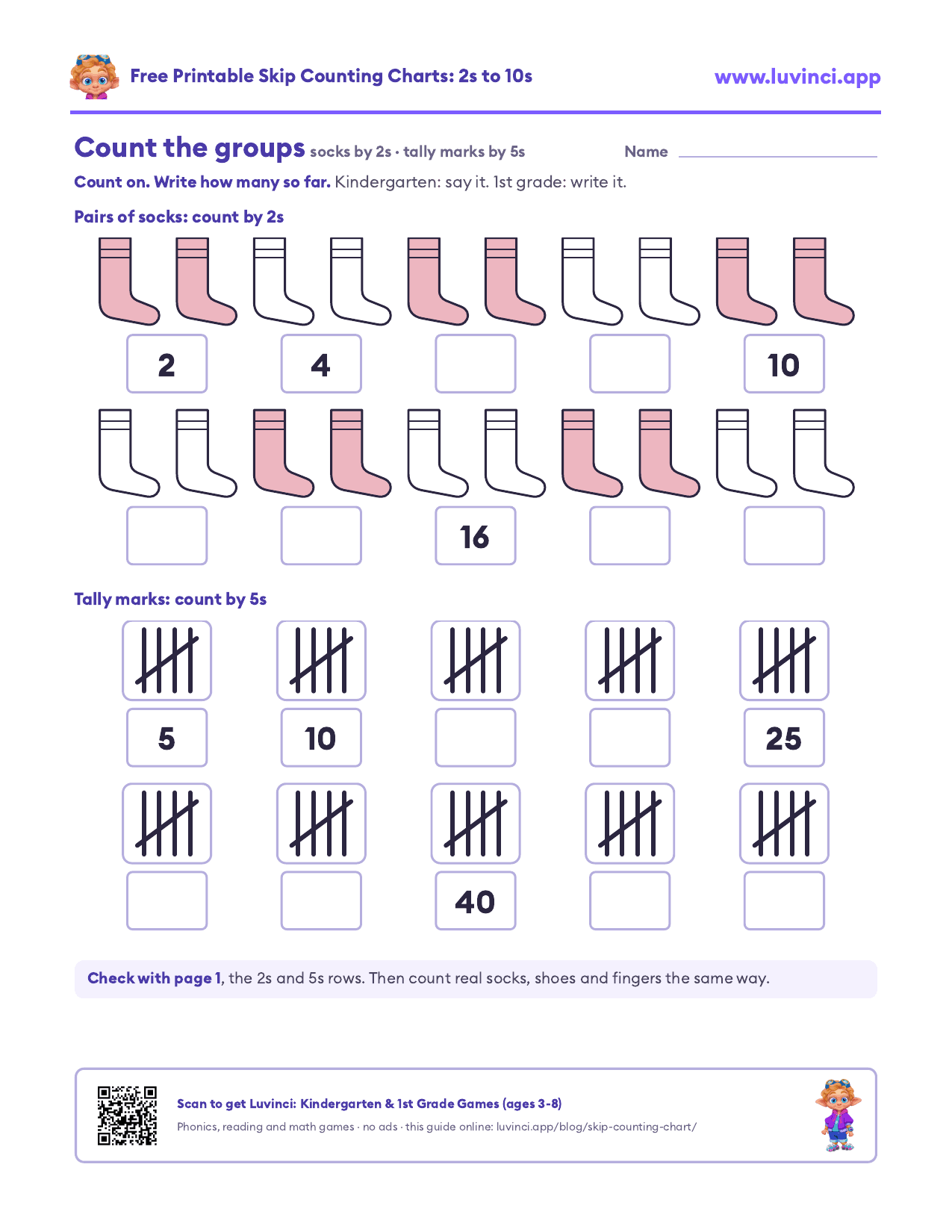
Page 3: count pairs by 2s and tally marks by 5s.
Skip counting by 2s
The 2s row is 2, 4, 6, 8, 10 … 20. On page 4, every 2nd number is shaded on a 1 to 100 grid, which makes 5 stripes down the grid.
Counting by 2s lands on the even numbers. Every shaded number ends in 2, 4, 6, 8 or 0.
The Common Core progressions call counting by 2s “the easiest count-by” (2011, p. 25). The 2s row is also the doubles answers: 1 + 1 is 2, 2 + 2 is 4, 3 + 3 is 6. Our doubles facts guide has more on those.
Skip counting on a number line works the same way. Each hop lands 2 further along.
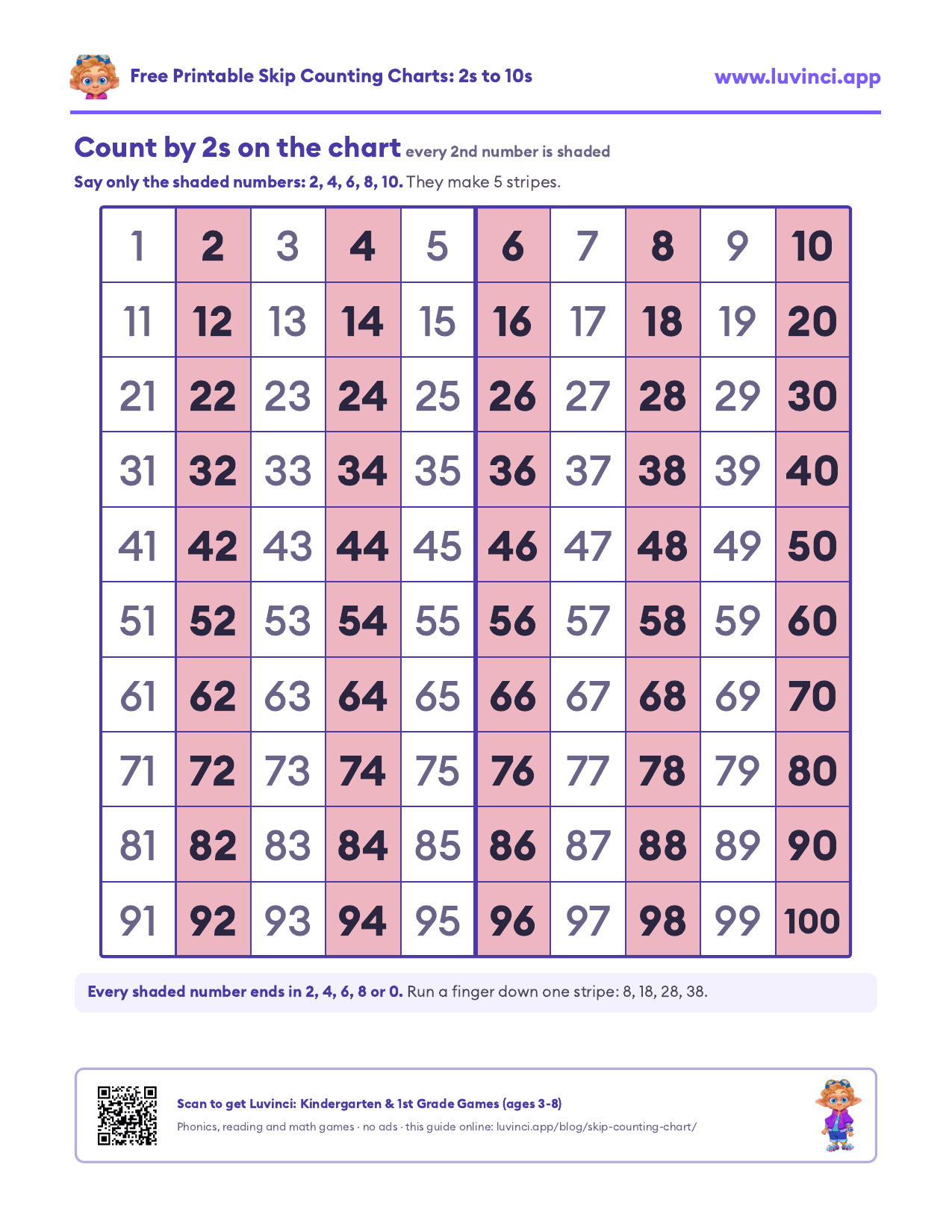
Page 4: counting by 2s makes 5 stripes.
Skip counting by 5s
The 5s row is 5, 10, 15, 20 … 50. Every number ends in 5 or 0. On page 5 the shading makes two stripes: the 5s column and the last column. Every row has 2 shaded boxes, because 2 fives make 10.
The NRC report describes counting by fives as “counting every fifth entry in a repeating pattern of 5” (NRC, 2009, p. 48). Hands, the tally marks on page 3 and nickels all count by 5s.
Counting by 5s is a 2nd grade goal in the Common Core (2.NBT.2). Tennessee starts it in kindergarten. Page 5 is the counting by 5s chart for either.
Our hundreds chart games include a skip-count coloring game.
Skip counting by 3s and 4s
Counting by 3s
3, 6, 9, 12 … 30. On page 7 the 3s make slanted lines that run down and to the left: 6, 15, 24, 33.
Past 10 is the hard part. The progressions note that counting by 5s is easy and counting by 7s is hard, because of how each one fits with 10. Their tip is to break the count at the ten (2011, p. 25). From 18, 2 more gets you to 20, then 1 more gets you to 21.
Counting by 4s
4, 8, 12, 16 … 40. Every 4s number is every other 2s number. On page 8 the shading lands 2 boxes in one row, then 3 in the next.
Fingers help here too. In a study of how 3rd graders worked out multiplication facts, one child “counted by 4’s to 32”, putting up a finger for each number to keep track (Sherin and Fuson, 2005, p. 369).
Counting by 3s and 4s is where skip counting turns into the times tables: the 4s row is 1 four, 2 fours, 3 fours and on up. Here’s what order to learn them in.
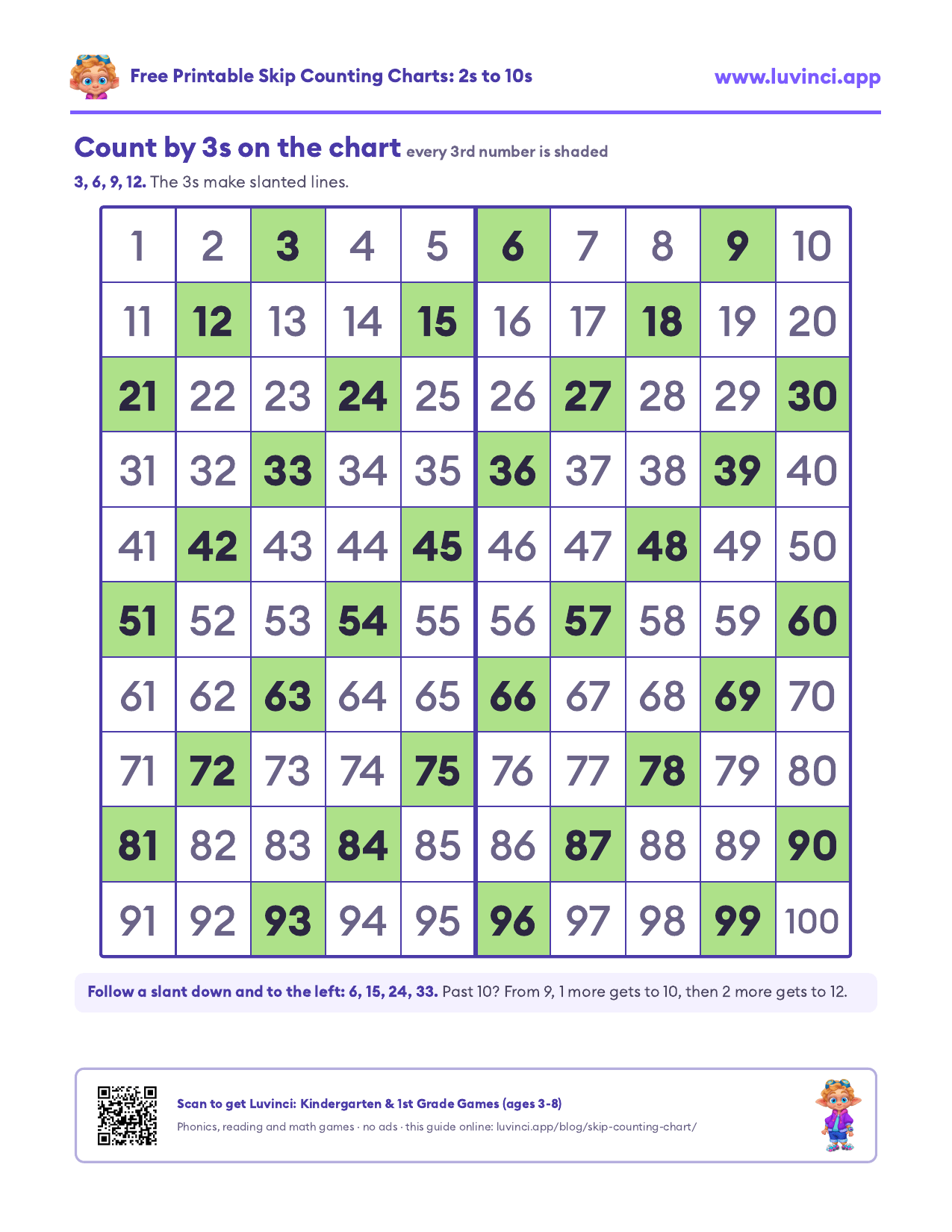
Page 7: the 3s run in slanted lines.
Skip counting by 6, 7, 8 and 9
These rows sit on pages 1, 2 and 10, and they’re 3rd grade work. Children “often learn to count rapidly by the integers 2 through 10” while they learn single-digit multiplication (Sherin and Fuson, 2005, p. 354).
Show your child this pattern: on the 9s row, the tens digit goes up 1 and the ones digit goes down 1. 9, 18, 27, 36.
Skip counting worksheets: fill-in strips and a blank chart
Page 6. A 2s strip and a 5s strip with light dotted numbers to trace, then a 2s and a 5s strip with only the first number. Then count back by 10s (100, 90, 80 …) and by 5s (50, 45, 40 …), and fill in a strip that counts by 100s to 1,000. These work as skip counting by 2 worksheets and by 5 worksheets on one page.
Page 9. Rows of dots, 3 in each row and 4 in each row. Your child writes how many dots so far at the end of each row. Then come 3s and 4s strips to trace and write.
Page 10. The blank chart. Only the first number of each row is there.
Pick the pages that match your child:
- Kindergarten. Kindergartners write numbers to 20 (K.CC.3), so they trace the 2s strip and say the numbers.
- 1st grade. 1st graders write the 2s and 5s strips. They read and write numbers to 120 this year (1.NBT.1).
- 2nd grade. The count-backs and the 100s strip on page 6, and the rows of dots on page 9.
- 3rd grade. The 3s and 4s strips on page 9, then the whole blank chart on page 10.
Check with page 1. Find the same row on page 1 and read along. The 100s are the 10s row with one more 0.
Tip: on page 10, fill the 10s row first, then the 5s, then the 2s.
Skip counting games at home
A minute or two at a time is enough.
- Clap and count. Whisper the numbers in between, then clap as you say each count-by number out loud: “one, TWO, three, FOUR”.
- Hop and count. Count by 2s with each jump. Count back on the way home.
- Ball toss. Toss a soft ball back and forth. Whoever catches it says the next number: 5, 10, 15, 20.
- Start somewhere else. “Start at 15 and count by 5s.” Then count back to 0.
- How many hands? Count fingers by 5s around the table, then say how many hands: 5, 10, 15 is 3 hands.
For dice and board games, see our first grade math games.
Common skip counting mistakes
| What you see | What to try |
|---|---|
| Says “5, 10, 15” fast but can’t tell you how many 5s | Raise a finger for each number. 3 fingers up at 15 means 3 fives |
| Gets lost after 20 on the 3s or 4s | Stop at the ten: on the 4s, from 28, 2 more gets to 30, then 2 more gets to 32 |
| Starts at 1 when you say “count by 2s” (1, 3, 5) | That’s a real pattern too, just a different one. Start at 2 and check the 2s row on page 1 |
| Goes back to the start every time | “Start at 20 and count by 5s.” Point to 20 on the 5s row first |
| Skips a number in the chant (2, 4, 6, 10) | Slow down and touch each box on page 1 |
| Mixes nickels and pennies in one count | Put 5 pennies next to a nickel, then count only the nickels |
FAQ
What age should kids start skip counting?
Counting by 10s comes first, in kindergarten (about age 5 to 6). Counting by 2s and 5s comes in 1st grade or by 2nd, and 3s and 4s come in 3rd grade. The 5s row on page 1 ends at 50, so it helps if your child can count to 50 by ones first: our number chart 1-50 is for that.
What is the best way to teach skip counting?
Count real groups first, then use the chart, then say the numbers without the chart. Start with 10s, 5s and 2s, and keep each round to a few minutes.
How do you explain skip counting to a child?
Use socks. “We’re counting pairs, so we say every 2nd number: 2, 4, 6.” Then count the same socks by ones, so they can see it’s the same total.
Is there a skip counting chart to 100?
Yes. The 10s row on page 1 goes to 100, and pages 4, 5, 7 and 8 shade the 2s, 5s, 3s and 4s on a grid that goes all the way to 100.
How do you skip count by 100s?
Say the 10s row and add a 0: 100, 200, 300 … 1,000. It’s a 2nd grade goal (2.NBT.2), and it’s the last strip on page 6. You can count by 25s too: 25, 50, 75, 100, like quarters in a dollar.
The takeaways
- A skip counting chart puts each count-by in its own row. Page 1 has 2s to 10s, 10 numbers each.
- Start with 10s, then 5s and 2s. 3s and 4s come with the times tables in 3rd grade.
- Count real groups first. Socks by 2s, hands and tally marks by 5s, dimes by 10s.
- Use fingers to keep track of how many groups you’ve counted.
- Print the free skip counting chart PDF: the chart, the 2s, 5s, 3s and 4s on a 1 to 100 grid, strips and a blank chart.
The app doesn’t drill skip counting. Its times tables (×2 to ×9, in the full app) are where counting by 2s, 3s and 5s ends up: each board goes in order from × 1 to × 10, so the answers on the ×2 board run 2, 4, 6, all the way to 20. Each fact appears as groups of the same size, so 3 × 4 is three plates with 4 on each. See how Luvinci’s math games work.
More free math worksheets: ten frames, number charts, addition and subtraction, daily practice workbooks and more, all in one place. See the math printables →
