 Luvinci
October 11, 2026
Compound Words Worksheets and List for Kids (Free PDF)
Free printable · PDF · 1341 KB
Compound Words Worksheets and List for Kids (Free PDF)
No signup needed. Just print it.
Download PDFFree worksheets (5)
Printable PDFs, no signup.
A compound word is two small words joined to make a new one. Sun + set = sunset. Cup + cake = cupcake. These free compound words worksheets start with pictures, so a child who can’t read yet can still put star and fish together. Below is a compound words list for kids, sorted by what your child can sound out, from sunset to watermelon. We checked every word. Each one is two real words, joined, and fine for kids.
Our free compound words worksheets PDF is 7 pages. The pack includes picture sums to cut and paste, matching, coloring, finish-the-word, a read-and-split page, the list by stage and an answer key. Two small PDFs have 12 compound word puzzles and the list on its own. No signup, no email.
Parents and teachers of kindergarten and 1st grade children can use it, and it starts out loud for pre-K.
Say it. Build it. Read it, one half at a time.
Jump to: the worksheets · what it is · the list · not compound words · starfish · at home · when · FAQ
Page 1 of the free PDF.
Free compound words worksheets (PDF)
Pictures and activities come first. The word list and an answer key sit at the back, so the first page your child sees is a fun one.
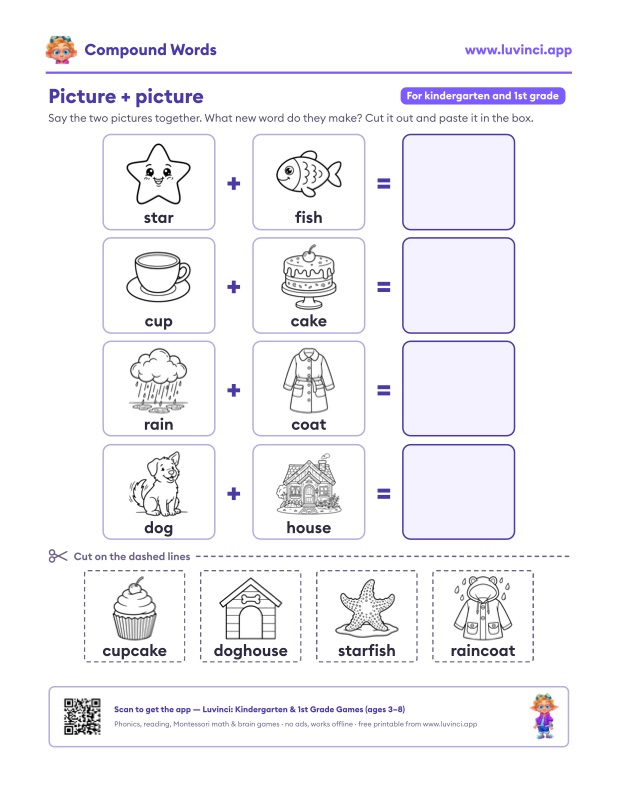
- Page 1: picture + picture, cut and paste.
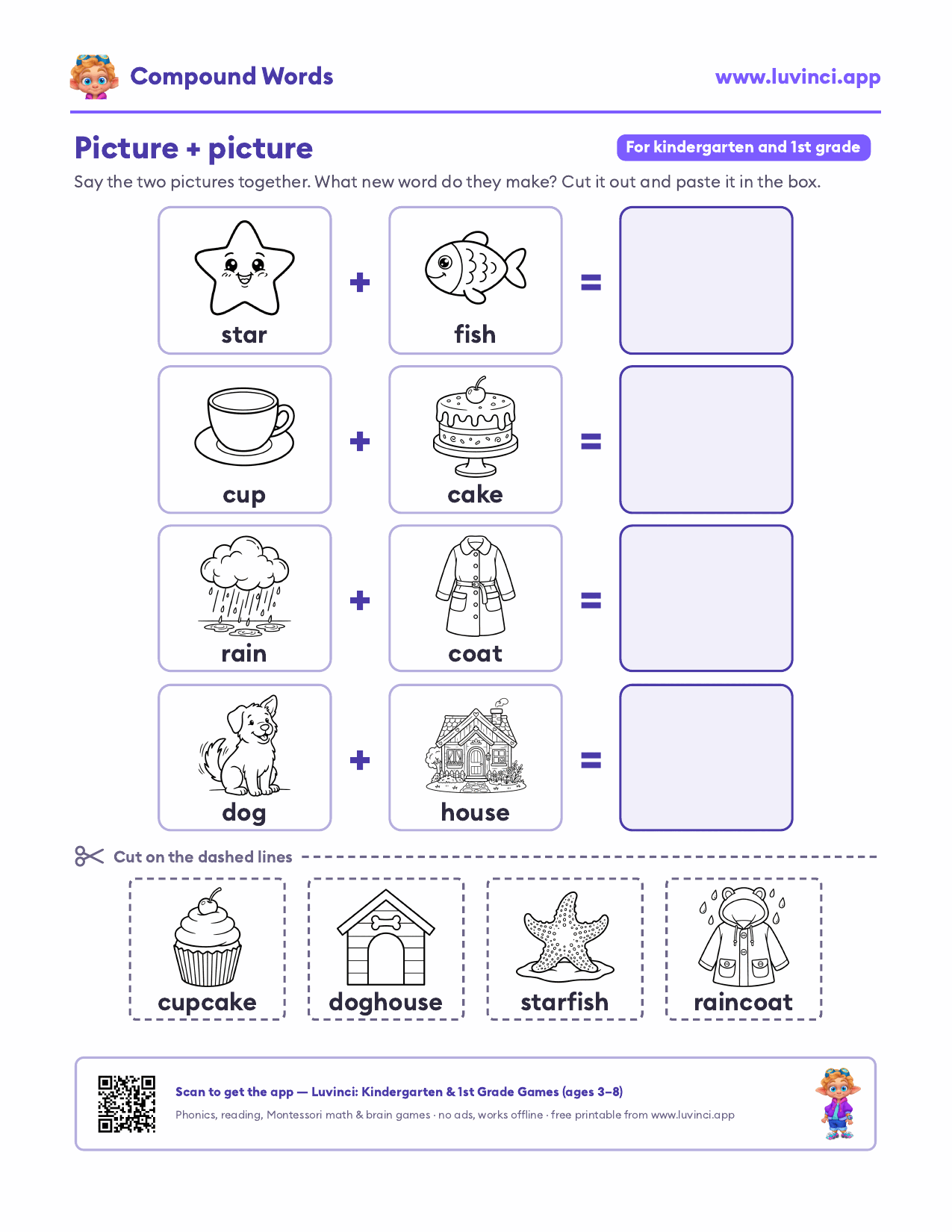
- Page 2: break it in two, a matching page.
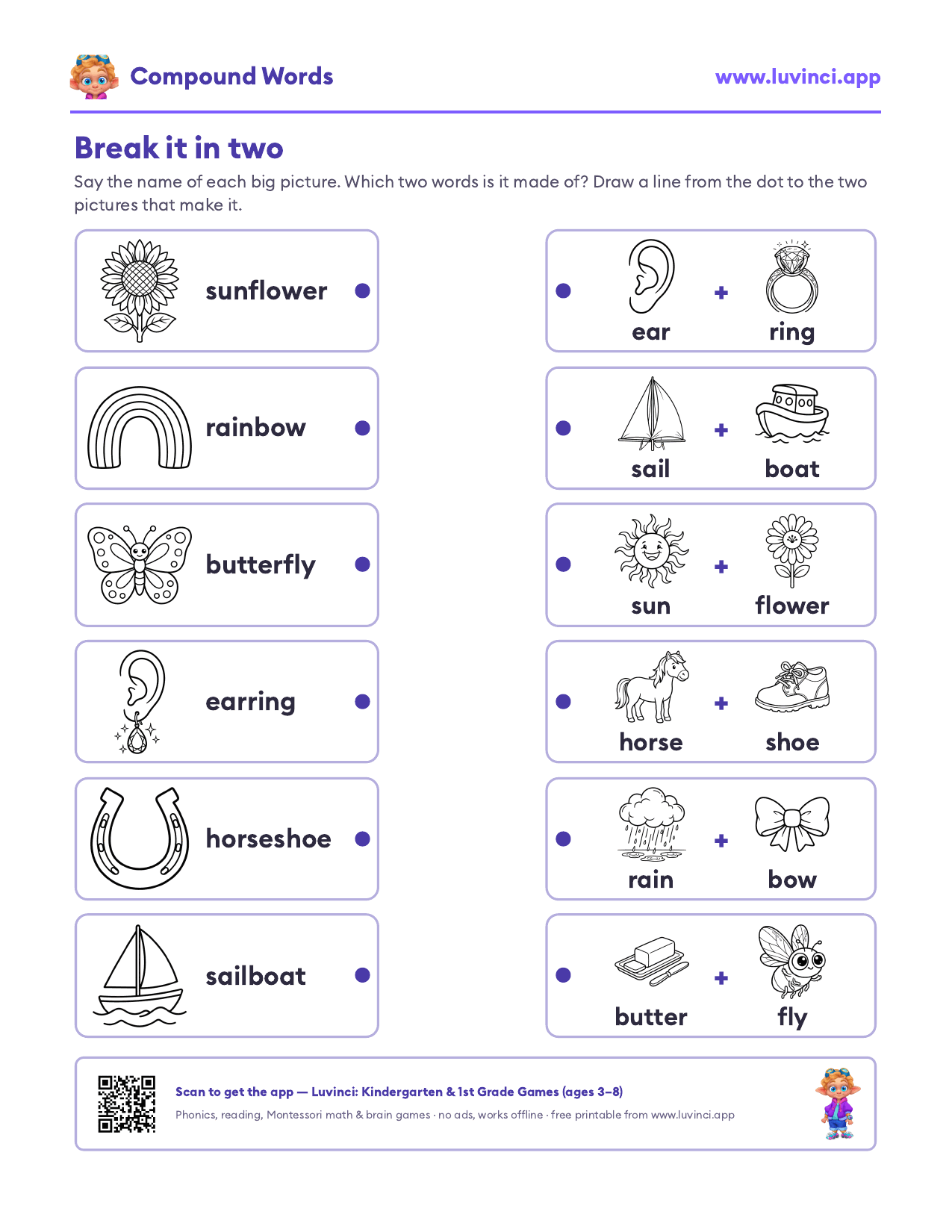
- Page 3: color the compound words.
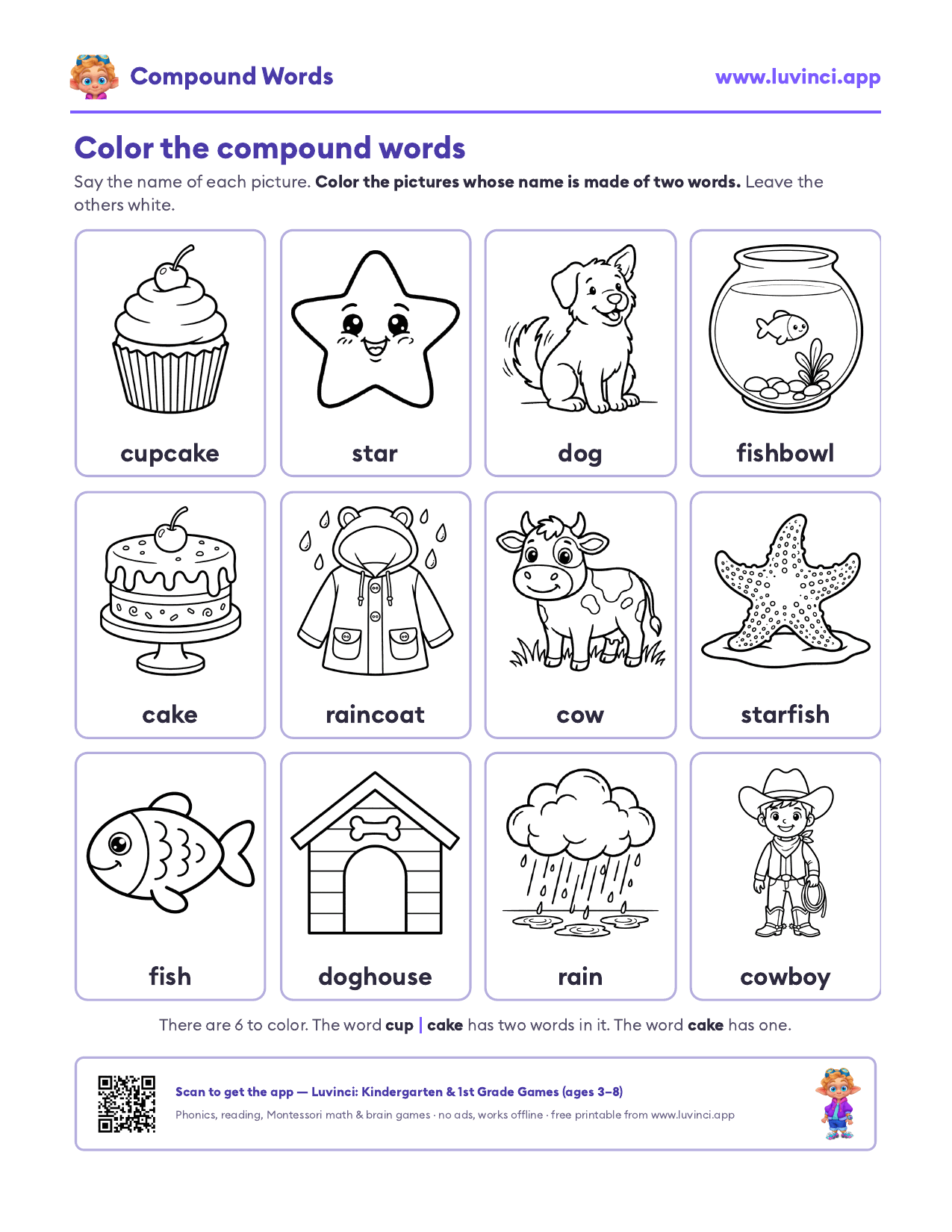
- Page 4: finish the word, with a picture word bank.
- Page 5: read it, split it, write it.
- Page 6: the compound words list by stage.
- Page 7: the answer key.
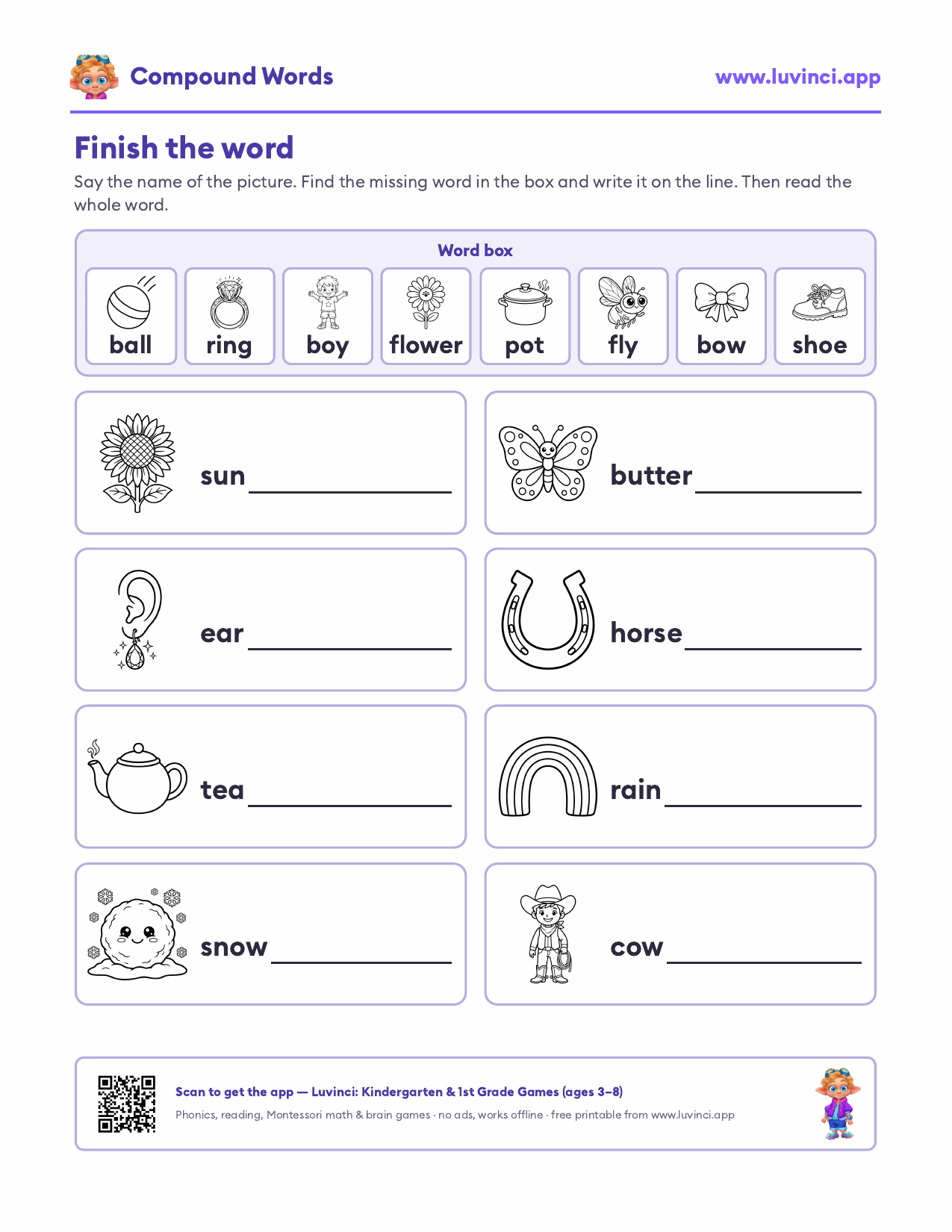
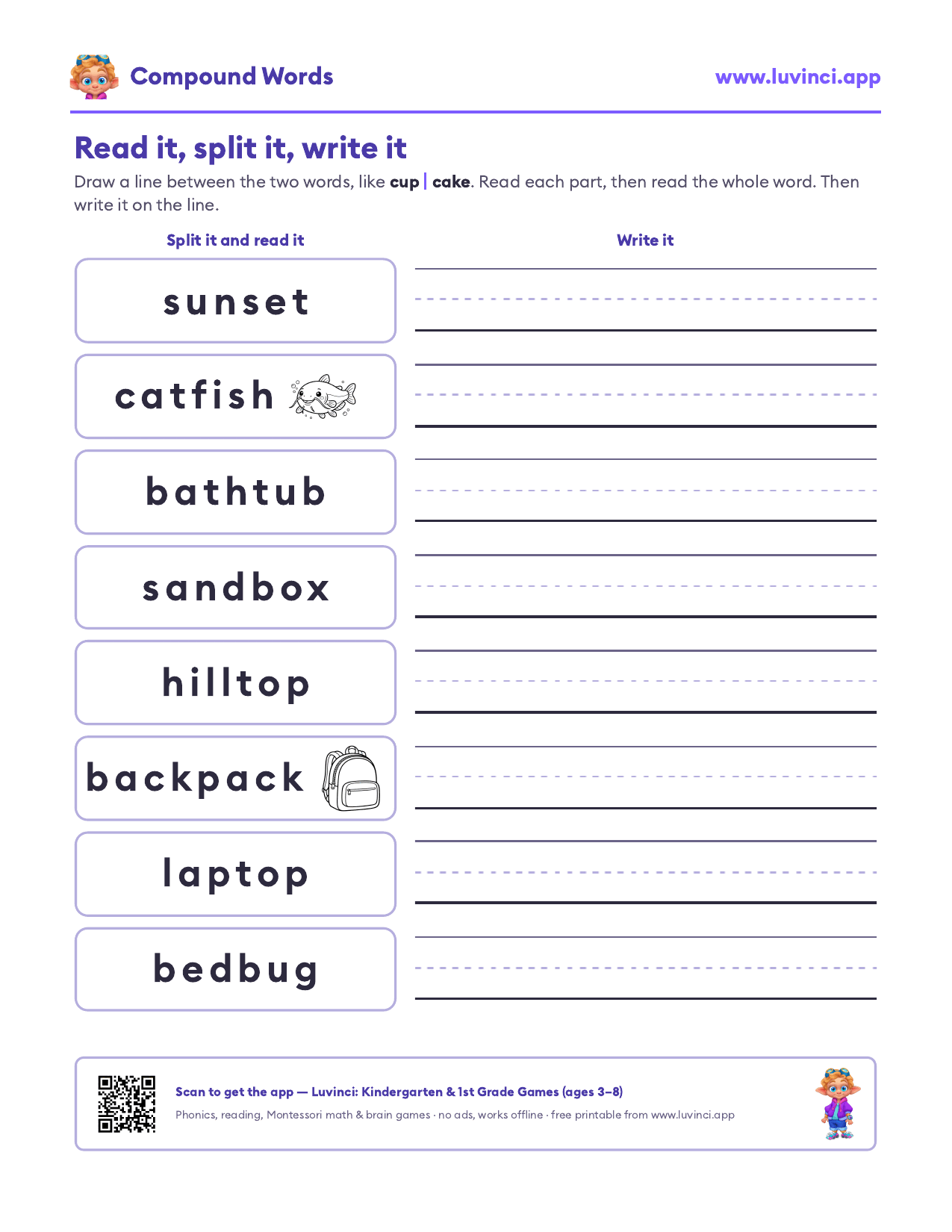
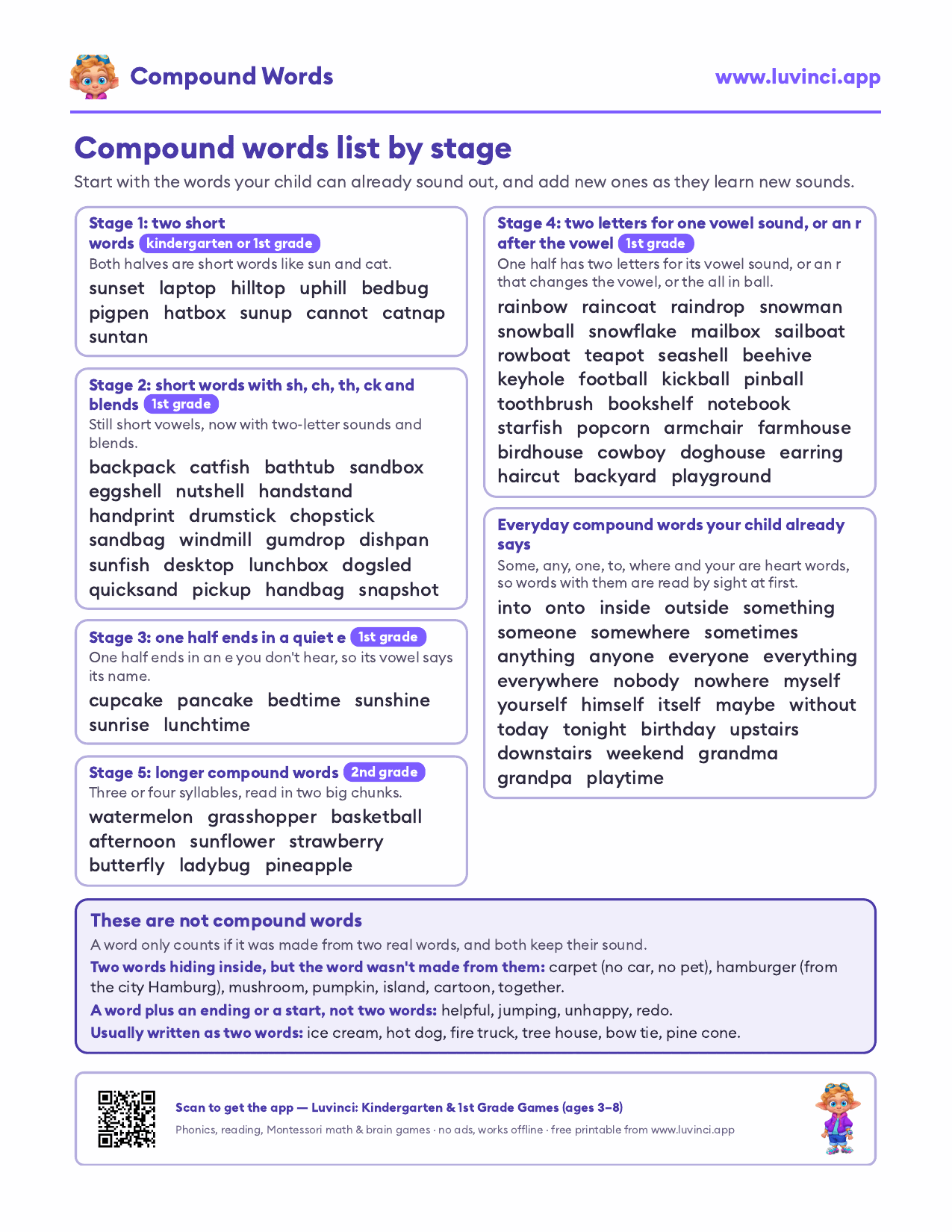
Page 7 is the answer key.
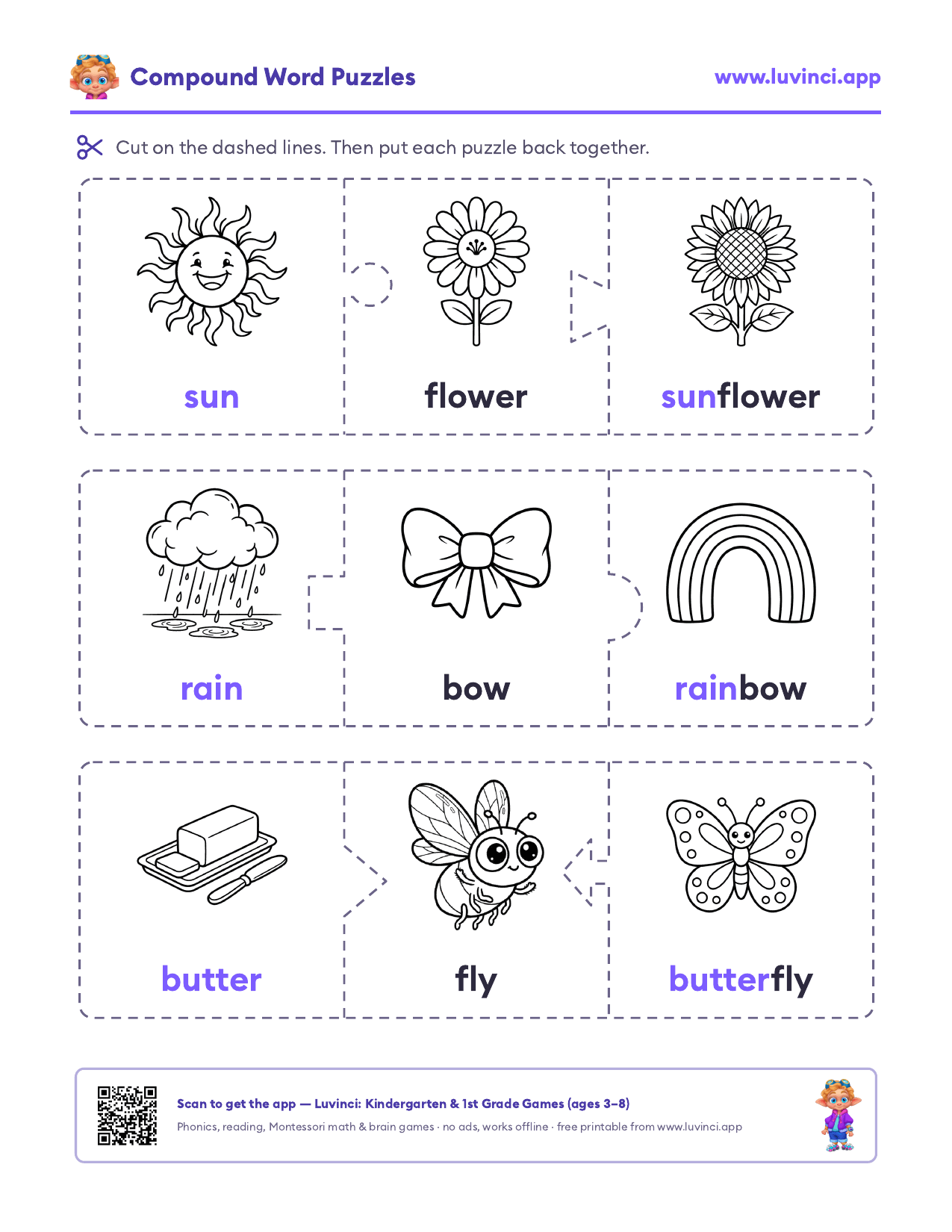
Compound word puzzles are 12 three-piece picture puzzles, a separate free PDF. Cut every piece apart and they turn into a memory game. Six of the puzzles use page 2’s words on purpose, so the same words show up in new ways.
Compound words list for kids is the list below, on 2 printable pages.
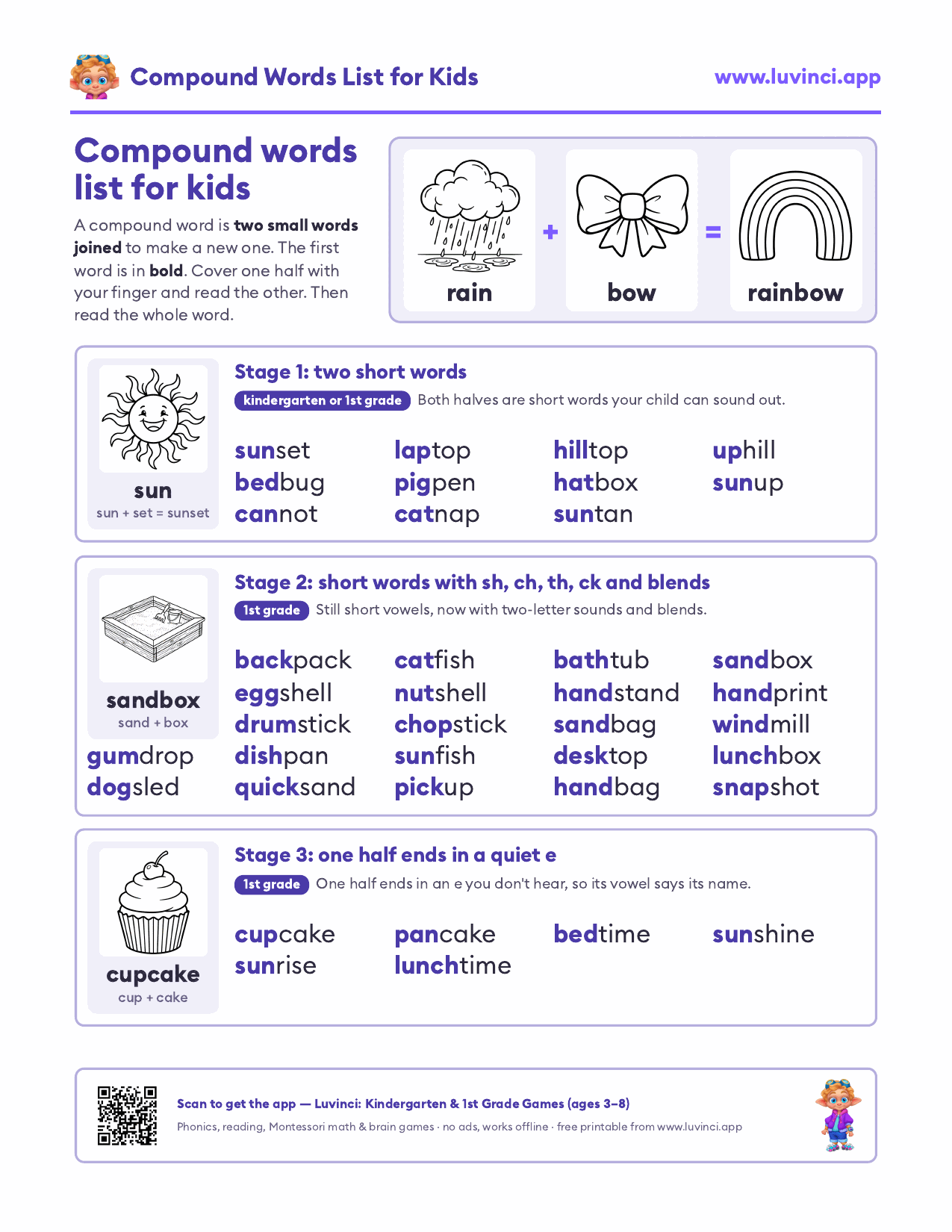
Three more one-page compound words worksheets, a red sunset, a big backpack and hotdog in a bun, are in the box at the top of this post.
For a silly-sentence cut-out game, try our compound words Sentence Builder (more in our sentence building worksheets).
Printing tips:
- Black and white is fine.
- Slide pages 2 and 4 into a sheet protector and use a dry-erase marker.
- Print the puzzles on cardstock.
What is a compound word?
A compound word is made of two words that can each stand alone. Together they name something new.
Try the cover test. Cover one half with your finger. Is what’s left a real word? Now cover the other half. If both halves are words and the word was made from them, it’s a compound word. Sun and set make sunset. The parts usually tell you the meaning. Sometimes they surprise you, like butterfly.
Most compound words for kids are written as one word (sunset). Some are written as two words (ice cream, fire truck) or with a dash (great-grandma). In kindergarten and 1st grade, children read the one-word kind.
Say the whole thing as one word, a little louder on the first part. SUN-set, CUP-cake.
Compound words list for kids, by reading stage
Begin with the words your child can already sound out, then add new ones as they learn new sounds.
Stage 1: two short words (kindergarten or 1st grade)
Both halves are short words like sun and cat, so your child can read each part sound by sound.
sunset, laptop, hilltop, uphill, bedbug, pigpen, hatbox, sunup, cannot, catnap, suntan
See why sunset splits after the n in our two-syllable words.
Stage 2: short words with sh, ch, th, ck and blends (1st grade)
The vowels stay short, and now you add two-letter sounds and blends. Try back·pack, bath·tub and lunch·box.
backpack, catfish, bathtub, sandbox, eggshell, nutshell, handstand, handprint, drumstick, chopstick, sandbag, windmill, gumdrop, dishpan, sunfish, desktop, lunchbox, dogsled, quicksand, pickup, handbag, snapshot
Stage 3: one half ends in a quiet e (1st grade)
One half ends in an e you don’t hear, which makes its vowel say its name. Try cup·cake and bed·time.
cupcake, pancake, bedtime, sunshine, sunrise, lunchtime
You’ll find more in our two-syllable magic e words, like milkshake and bathrobe.
Stage 4: two letters for one vowel sound, or an r after the vowel (1st grade)
In this stage, one half has two letters for its vowel sound, like rain·bow. An r can change the vowel too, like star·fish. Some end in the all of ball, like kick·ball.
rainbow, raincoat, raindrop, snowman, snowball, snowflake, mailbox, sailboat, rowboat, teapot, seashell, beehive, keyhole, football, kickball, pinball, toothbrush, bookshelf, notebook, starfish, popcorn, armchair, farmhouse, birdhouse, cowboy, doghouse, earring, haircut, backyard, playground
You’ll meet these sounds after the short-vowel stages. Our vowel teams explained and bossy r words guides cover them.
Stage 5: longer compound words (2nd grade)
These run three or four syllables, and you read them in two big chunks. Try water·melon and grass·hopper.
watermelon, grasshopper, basketball, afternoon, sunflower, strawberry, butterfly, ladybug, pineapple
Each first half is a word your child may already read. Cover the second half, read the first, then swap.
Everyday compound words your child already says
A lot of the first compound words children read are little words they already say every day, like into, inside and something.
into, onto, inside, outside, something, someone, somewhere, sometimes, anything, anyone, everyone, everything, everywhere, nobody, nowhere, myself, yourself, himself, itself, maybe, without, today, tonight, birthday, upstairs, downstairs, weekend, grandma, grandpa, playtime
Some, any, one, to, where and your are heart words, so words with them are read by sight at first. Every splits ev-er-y. In today and tonight, the to says “tuh”. About a third of these, like inside, today and without, are said a little louder on the second part.
Five of the 1st-grade spelling words for week 20 are compound words, and so is that week’s tricky word into.
Words that look like compound words but aren’t
A word only counts if it was made from two real words, and both keep their sound. Plenty of lists online slip in a few of these.
- Two words hiding inside, but the word wasn’t made from them: carpet (no car, no pet), hamburger (from the city Hamburg), mushroom, pumpkin, island, cartoon, together.
- A word plus an ending or a start, not two words: helpful, jumping, unhappy, redo.
- Usually written as two words: ice cream, hot dog, fire truck, tree house, bow tie, pine cone.
Some school programs and worksheets write the food as hotdog, and so does one of ours. Most dictionaries write hot dog. Either way, it’s two words your child knows.
Is a starfish a fish? Compound words with a twist
Some compound words mean exactly what their parts say. Some don’t, and that is half the fun.
A catfish, a goldfish, a sunfish and a seahorse are fish. A starfish and a jellyfish are not.
A butterfly has no butter, a ladybug isn’t a lady, and a pineapple is neither a pine cone nor an apple. Those are all compound words. So are strawberry and rainbow.
Ask your child which ones are fish before you give it away. Guessing wrong is part of the game.
How to teach compound words at home: say it, build it, read it
Start out loud, well before your child reads a compound word.
- Say it. “What word do sun and flower make?” Then take one away. “Say cupcake without cup.” This part is for pre-K and kindergarten.
- Build it. Put two puzzle pieces side by side, like sun and flower. Or build sun, then sunset, with letter tiles.
- Read it. Cover one half with a finger and read it. Then read the other half, then the whole word.
- Write it. Page 4 has finish-the-word rows.
Each of these games takes five minutes:
- Memory. Lay the puzzle pieces face down. Find two halves that go together. Any real word counts, like sun + fish = sunfish.
- Silly compounds. What would a froghat look like? Draw it.
- Compound hunt. Look for them in a book. Our decodable stories for lessons 63-68 have uphill and sunrise.
When do kids learn compound words?
Children usually put compound words together out loud in pre-K and kindergarten. They read them in kindergarten or 1st grade, and they use the two parts to work out meanings in 2nd grade.
In 1st grade, children read compound words one part at a time, as soon as they can read short words like sun and bath. In UFLI Foundations, compound words are lesson 67a, right after syllables (see our worksheets in UFLI order).
In 2nd grade they use the parts for meaning. A birdhouse is a house for birds. A notebook is a book for notes.
FAQ
What is a compound word in first grade?
It is two short words your child can read, joined into one, like sunset, bathtub and backpack. First graders read each part, then the whole word.
What grade teaches compound words?
Pre-K and kindergarten put them together out loud. Kindergarten and 1st grade read them, and 2nd grade uses the parts to work out what a new word means.
How do you know if it’s a compound word?
Cover each half. If both halves are real words and the word was made from them, it is one. Sunset (the sun sets) is a compound word. Carpet is not. Nobody made it from car + pet.
What are the rules for compound words?
Two whole words, joined without changing their spelling. Most are written as one word. A few stay two words, like ice cream.
Can you give me 20 examples of compound words?
sunset, cupcake, rainbow, snowman, backpack, bathtub, sandbox, catfish, starfish, sunflower, football, popcorn, toothbrush, doghouse, cowboy, raincoat, mailbox, birthday, inside, something.
What are some fun activities for learning compound words?
You’ll find picture sums to cut and paste, three-piece puzzles and a memory game with the puzzle pieces in our free PDFs. You can also make up silly compounds, like a froghat, and draw them.
Is “rainbow” a compound word?
Yes. Rain + bow = rainbow. Strawberry is too, even though there’s no straw in it.
Where can I find free compound words worksheets?
Our free compound words worksheets PDF has 7 pages, picture-led, with an answer key. A puzzle PDF and a list PDF sit next to it. No signup, no email.
Our reading games practice the sounds behind these words, and they have no ads. From here, try closed syllable words for napkin and rabbit.
The takeaways
- Two words make one new word. Sun + set = sunset.
- Say it before you read it. Out loud comes first.
- Read one half at a time, then the whole word.
- Start with two short words like sunset and laptop.
- Print the free compound words worksheets PDF: 7 pages, with an answer key.
Created to align with UFLI Foundations’ scope and sequence; lesson numbers are cited for alignment only. This post and its PDF are our own original work, not created by nor endorsed by UFLI or the University of Florida.
Sources
- UFLI Foundations. Toolbox, lessons 63-68, and lesson 67a materials: Home Practice, Roll and Read and the decodable Mo and the Sandbox.
- Foorman, B. et al. (2016). Foundational Skills to Support Reading for Understanding in Kindergarten Through 3rd Grade (NCEE 2016-4008). Institute of Education Sciences, Recommendation 2, Example 2.1, “Building and dividing compound words”.
- Reading Universe. Deleting syllables in a word, lesson plan, Phonological awareness continuum and An overview of syllable awareness.
- Heggerty. Pre-K parent newsletter, weeks 1-6: compound words.
- Reading Rockets. Phonological and phonemic awareness.
- Merriam-Webster. hot dog, tree house and pine cone.
- Carnegie Mellon University. The CMU Pronouncing Dictionary.
