Luvinci
August 20, 2026
Free Phonics Worksheets by UFLI Lesson Number (Created to Align With the Scope and Sequence)
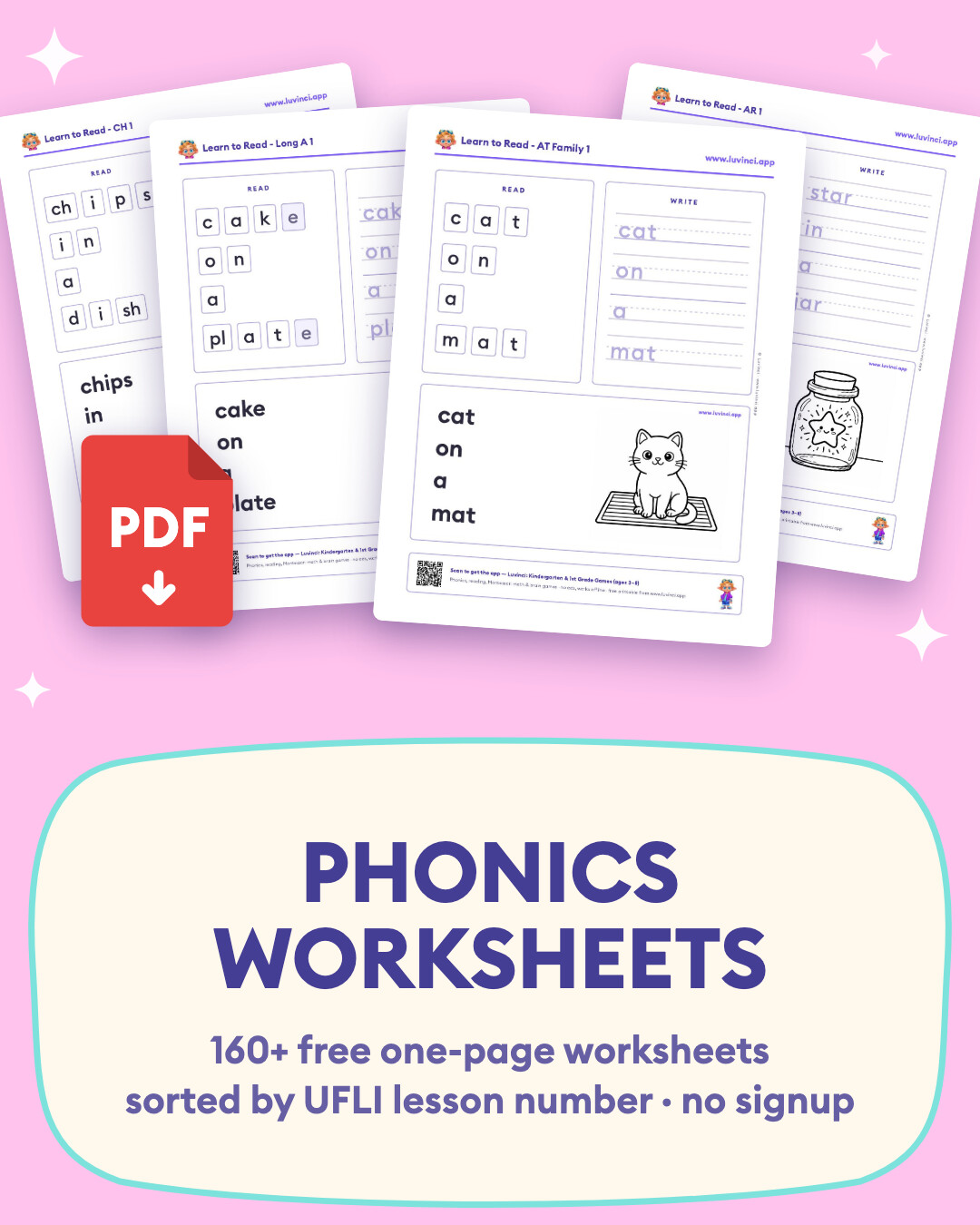
If you searched for UFLI worksheets, you probably want one thing: a printable that matches the lesson your child or class is on this week, without paying for a bundle first. Our printables library is 200+ free phonics printables created to align with UFLI Foundations’ scope and sequence, and you can filter it by lesson band: pick “54–62” and you get every silent-e sheet, pick “77–83” and you get every r-controlled one. Every sheet is our own original work, not UFLI’s.
What UFLI Foundations is (and what it isn’t)
UFLI Foundations is an explicit and systematic phonics program from the University of Florida Literacy Institute. Its 128 concept lessons run from letter sounds through to silent letters in a fixed order. The teacher manual is a paid book (about $70), but the online Toolbox that goes with it is free: slide decks, decodable passages, homework sheets and practice games for every lesson. The manual came out in 2022.
What the Toolbox is built for is the classroom lesson itself. A child who needs a third and fourth go at one pattern needs more practice than a lesson’s own materials are meant to carry, which is why the “UFLI worksheets” search is mostly Teachers Pay Teachers category pages, and why parents hit the same gap when a child comes home with “we’re on lesson 48” and nothing to practise with.
How the library maps to the lesson bands
UFLI groups its 128 lessons into bands, each teaching one family of patterns. Every worksheet in the library is tagged with the band where UFLI teaches its pattern, checked sheet by sheet against UFLI’s published at-a-glance sequence, so each band has a matching shelf. Lesson numbers below are UFLI’s; the mapping is ours.
| UFLI lessons | What’s taught | Our worksheets | Guide to read first |
|---|---|---|---|
| 1–34 | Alphabet: letter sounds, first CVC words, qu | 11 (sound mats, word families) | Order to teach letter sounds |
| 35–41 | Short vowel review and longer words: CCVC, CVCC, am/an | 41 | Short vs. long vowels, consonant blends |
| 42–53 | Digraphs: ck, sh, th, ch, wh, ph, ng, nk, plus FLSZ (floss rule) and -all/-oll/-ull | 20 | Digraphs for beginning readers, sh words, th words, ch and tch words |
| 54–62 | VCe (silent e), plus soft c and soft g | 18 | Magic e words, long vowel words, soft c and soft g words |
| 63–68 | Reading longer words: -es, -ed, -ing, two-syllable words | 7 | Closed syllable words, open syllable words |
| 69–76 | Ending spelling patterns: -tch, -dge, long VCC, -y, -le | 6 | tch words, soft c and soft g words (dge) |
| 77–83 | R-controlled vowels: ar, or, er, ir, ur, w+or | 11 | Bossy r words |
| 84–88 | Long vowel teams: ai, ay, ee, ea, ey, oa, ow, oe, ie, igh | 15 | Vowel teams explained |
| 89–94 | Other vowel teams: oo, ew, ui, ue, au, aw, augh, ea as in bread | 9 | |
| 95–97 | Diphthongs: oi, oy, ou, ow | 7 | |
| 98 | Silent letters: kn, wr, mb | 3 |
Two honest notes on the mapping. A few sheets sit in a different band from their topic shelf because that’s where UFLI teaches the pattern: soft c and g (mice on ice, gem in a cage) are VCe lessons 60–61, worm in the dirt is w+or at lesson 82, and the oo sheets are lessons 89–90. UFLI has no separate “blends” band; blends are folded into the 35–41 longer-words lessons and the digraph review at 53, which is why our blends sheets sit under 35–41. And UFLI teaches irregular words (heart words) as step 7 of every lesson rather than as a block, so our six heart-words sheets (I love you, go to the zoo, she is my friend…) aren’t pinned to one band. Search “heart words” in the library to find them.
What’s on each sheet
Every worksheet is a single page built the same way, so a child who has done one knows how to do all of them:
- Read. A short decodable phrase or sentence, using only patterns from earlier bands plus a handful of heart words. Nothing to guess at.
- Write. The same words traced, then copied on a handwriting line.
- Colour. A line-art scene of the sentence to colour in: the reward, and a picture that only makes sense once the words have been read.
That decodability rule is the whole point of following a scope and sequence. A sheet labelled “digraphs” that sneaks in light or boat forces a child who hasn’t met vowel teams yet to guess, and guessing is exactly the habit systematic phonics exists to prevent. Ours are checked against the earlier bands before they’re published.
How to use them at home or in class
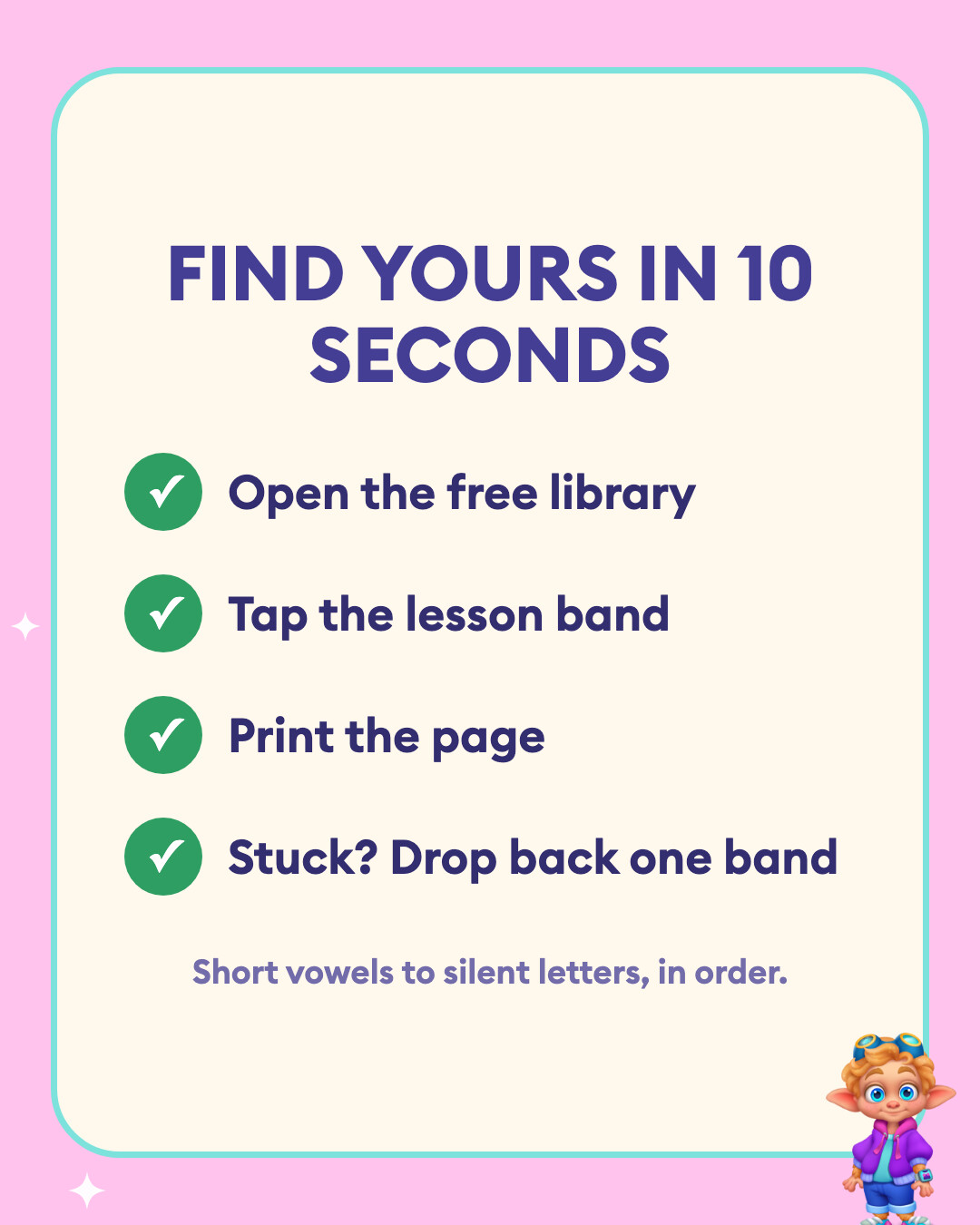
At home, after school. Ask which lesson the class is on (it’s usually on the weekly newsletter), open the library, tap that band, and print one sheet. One page, five to ten minutes, done. Pulling from a lower band is never wasted: fluency on short vowels is what makes the later bands stick. Spelling lists in the same lesson order: first grade and second grade.
For independent practice. Teachers use them as the “word work” slot in centres or as homework, because the read-trace-colour format needs no explanation. Print a band at a time and keep the stack in lesson order. For a scissors-and-cards version of the same practice, the library also has 20 cut-out sentence building worksheets, one or two per phonics stage: children pick WHO, DID WHAT and WHERE picture cards, build a silly decodable sentence, and write it.
For a child who’s stuck. Drop back one band and do three sheets there before returning. If a child can’t blend the words on a 35–41 sheet by ear, the gap is earlier than worksheets; start with oral blending first.
“As a reading teacher, I really like how simply this app breaks down reading topics. My students especially enjoy using the games on CVC words, short - long vowels, and vowel teams. It is highly engaging and useful!” (Acb201300, App Store review, US)
The same stages run through the app’s ABC and reading games, so a child can practise the pattern on paper and then hear it sounded out on screen; our reading overview explains how the stages fit together.
Quick takeaways
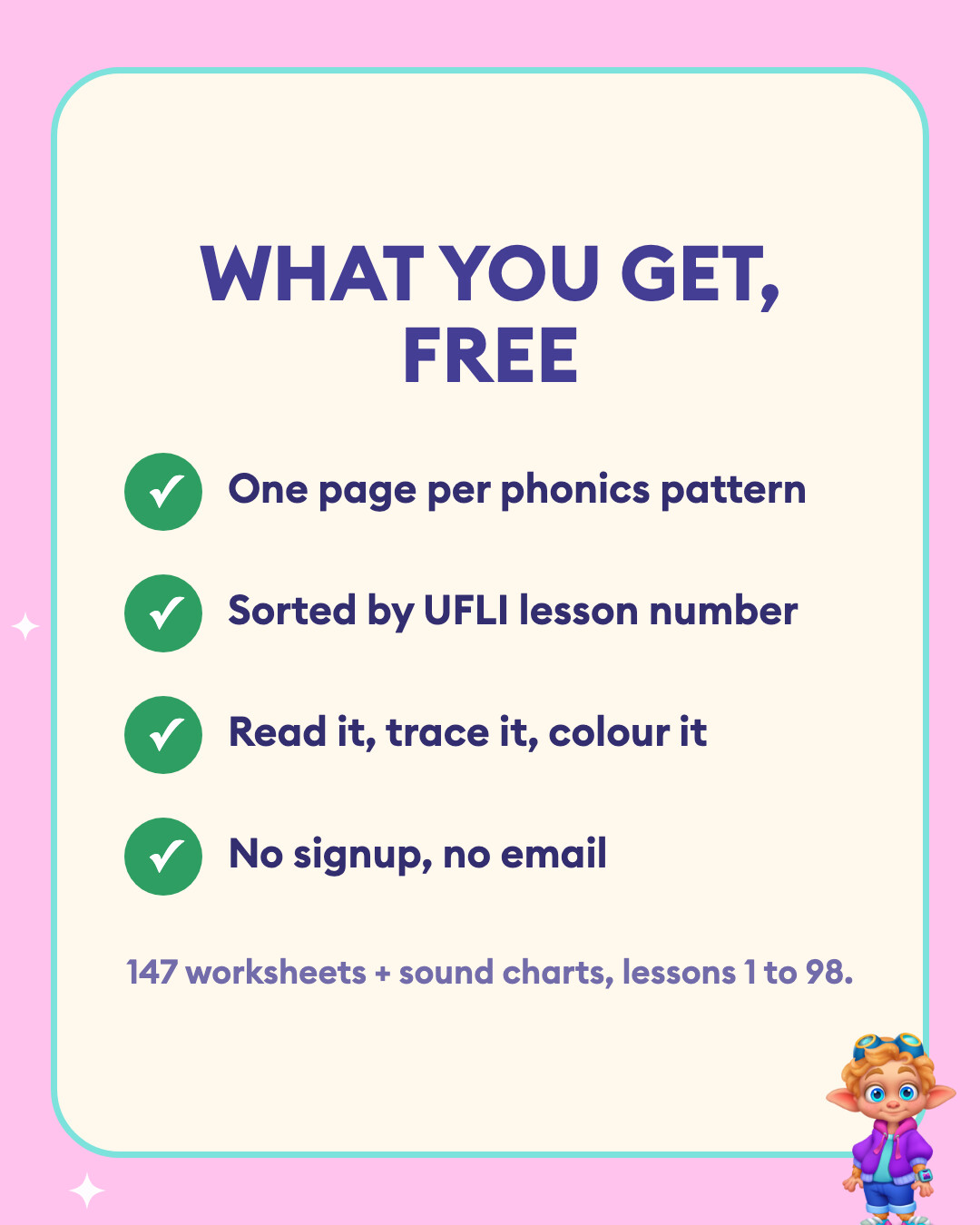
- The whole library is free and needs no signup: luvinci.app/printables.
- Filter by UFLI lesson band first, then by type (worksheet or sound chart) if you want fewer results.
- Each sheet is one page: read, trace, colour, all with decodable words from earlier bands only.
- Heart words are spread across the sequence, as UFLI does it; search “heart words” to find them, or see what heart words are, with the full list by grade.
- Stuck? Drop back one band rather than pushing ahead.
These printables were created to align with UFLI Foundations’ scope and sequence. They are our own original work, not created by nor endorsed by UFLI or the University of Florida. Lesson numbers are cited for alignment only.