Luvinci
August 24, 2026
Sentence Building Worksheets: Free Cut-Out PDFs for Every Phonics Stage
Free worksheets (20)
Printable PDFs, no signup.
Show all 20Show fewer
- Sentence Builder - Digraphs II
- Sentence Builder - Long Vowels I
- Sentence Builder - Long Vowels II
- Sentence Builder - Suffixes I
- Sentence Builder - Compound Words I
- Sentence Builder - Ending Patterns I
- Sentence Builder - Advanced I
- Sentence Builder - Bossy R I
- Sentence Builder - Vowel Teams I
- Sentence Builder - Vowel Teams II
- Sentence Builder - Vowel Patterns I
- Sentence Builder - Tricky Spellings I
- Sentence Builder - Diphthongs I
- Sentence Builder - Heart Words I
If your child can sound out “pig” but a whole sentence still feels like a wall, print this free short vowels sheet and find the scissors. Sentence building worksheets hand a child a small set of word cards to compose a real sentence with, read aloud, and write down. This sheet is the first of our new sentence building worksheets for kindergarten and 1st grade: free cut-out PDFs, one or two for every phonics stage, no signup, no email. Yours will pick a card from each colour, lay a sentence out on the mat, read it aloud, and usually start giggling.
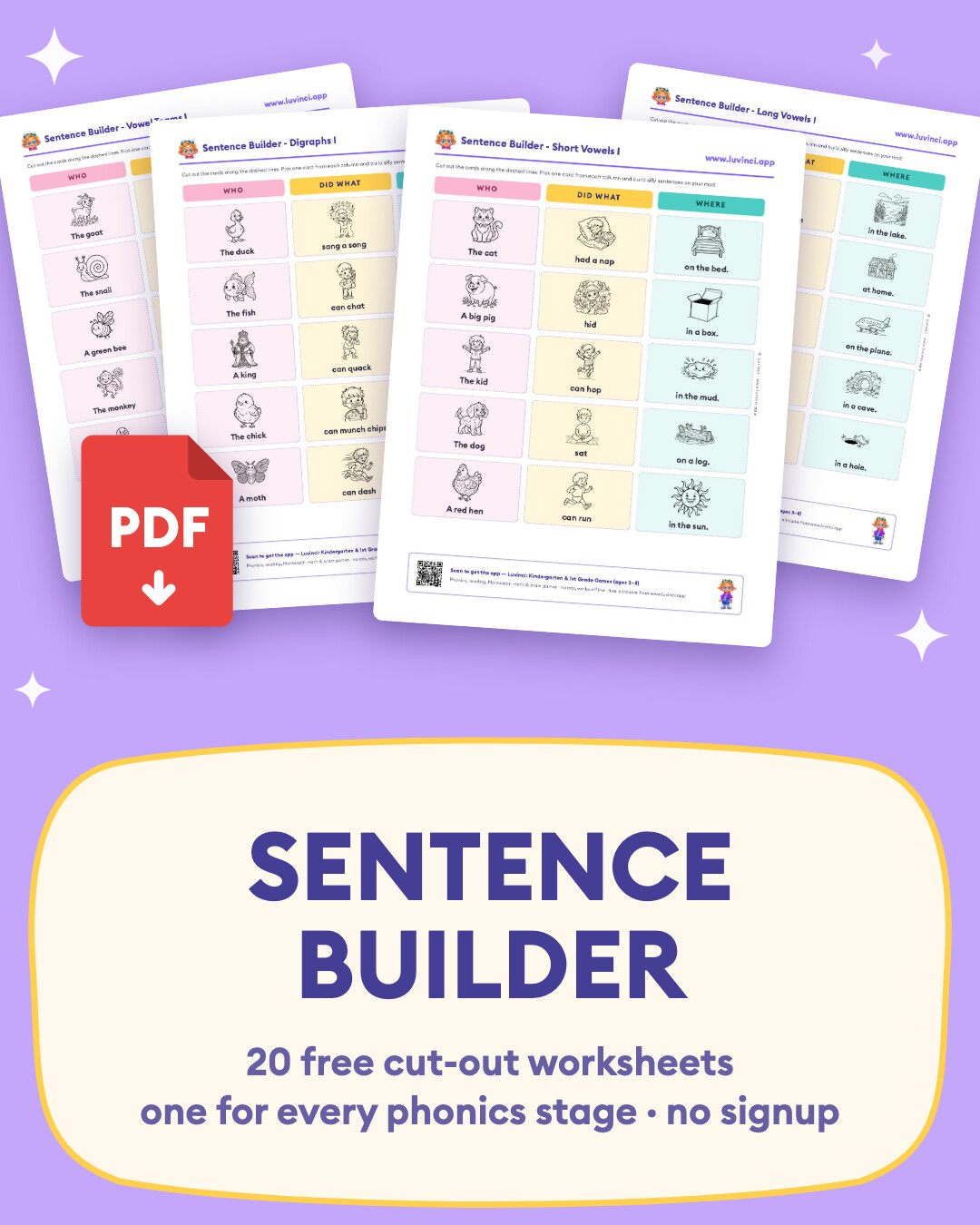
How the cut-out pages work
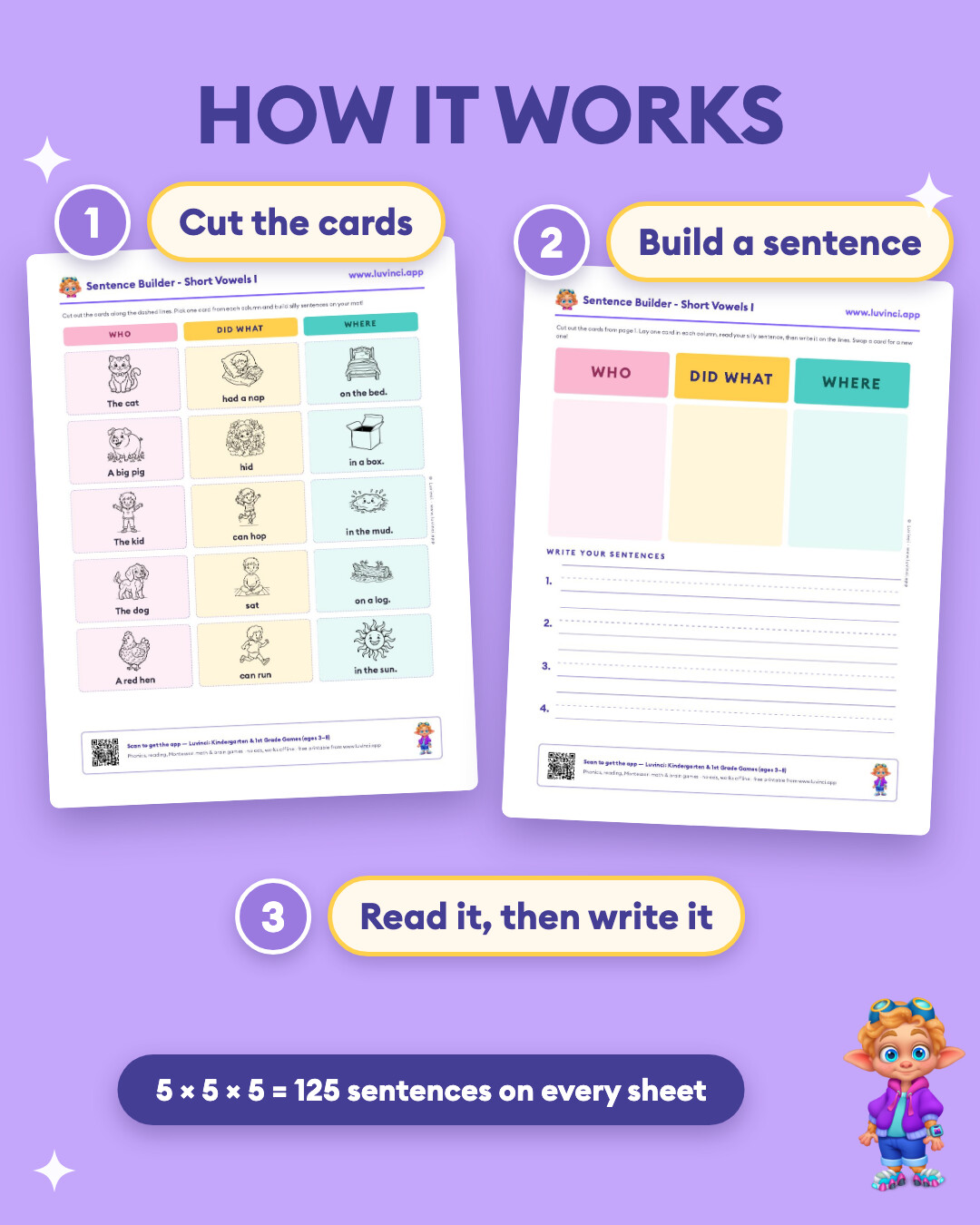
Each of these cut-out sentence worksheets is two pages. Page one holds 15 picture cards in three colour-coded columns: WHO in pink, DID WHAT in yellow, WHERE in turquoise. Five cards per column, each with a small picture and a short phrase like “The pig”, “can jog”, “in the mud.”
Page two is the sentence mat: three boxes plus writing lines. Your child cuts out the cards, picks one from each column, lays them in the boxes, reads the sentence aloud, then copies it onto the lines. The cards stay loose: swap one and a brand-new sentence is ready to read.
Because the columns follow a who did what where pattern, any combination works grammatically. Five cards per column means 5 x 5 x 5 = 125 possible sentences on every sheet, and most of them are ridiculous.
Why silly sentences work
The silliness is the engine. An ox mopping in a hut, say, is grammatically fine and completely absurd, and a five-year-old will build another sentence just to get another laugh. Every laugh costs three more phrases decoded and read aloud. That’s repeated reading practice that doesn’t feel like practice.
The other half is that every word is decodable. A decodable sentence is one your child can read using only the letter-sound patterns they’ve already been taught, plus a few taught heart words like “the”. The Short Vowels sheets use simple CVC-type words; the Digraphs sheets add sh, ch, th, ng and ck words; and so on up the ladder. No guessing from the picture, no words they haven’t met yet.
Most decodable sentence building worksheets online sit behind a paywall or an email gate. Ours are free, no signup, and matched to the exact stage your child is on.
Pick your child’s phonics stage
Start at the stage your child is working on now (when in doubt, start easy); every free sentence building worksheets PDF in the series is linked below.
| Stage | Free PDFs | UFLI lessons | Our guide |
|---|---|---|---|
| Short vowels | I · II | 35-41 | Short vs long vowels |
| Blends | I · II | 35-41 | Consonant blends |
| Glued sounds (all, ull, am, an) | I | 42-53 | |
| Digraphs | I · II | 42-53 | Digraphs |
| Long vowels (magic e) | I · II | 54-62 | Magic e words |
| Suffixes (-ed, -es, -ing) | I | 63-68 | |
| Compound words | I | 63-68 | |
| Ending patterns (-le, -y) | I | 69-76 | |
| Advanced (tch, dge, kn, soft c and g) | I | 69-76 | |
| Bossy r | I | 77-83 | Bossy r words |
| Vowel teams | I · II | 84-88 | Vowel teams |
| Vowel patterns (oo, igh, ie) | I | 84-88 | |
| Tricky spellings (oo as in book, ea as in bread) | I | 89-94 | |
| Diphthongs (ou, ow, oi, oy) | I | 95-97 | |
| Heart words | I | any |
Sentence building or sentence scramble?
They sound alike but they’re different tasks. In a sentence scramble, one fixed sentence is chopped up and your child reorders it: a single right answer. In sentence building, your child composes a new sentence from word cards, so there are many right answers. For beginners, composing is the better workout. A scramble can be solved from memory of word order; with cards, the only way through is to decode each phrase and decide what it means. And a child reads a sentence more willingly when they made it themselves; there’s no wrong order to fail at. These sheets are the building kind.
Five ways to reuse one sheet
- Laminate the cards and they last all term.
- Oral-only round: a pre-writer builds and reads the sentence, no copying.
- Draw your sentence: build it, read it, then illustrate the silly result.
- Sentence chains: go around the table, each person adds one card, the youngest reads the result.
- Beat the clock: how many different sentences can they build and read in five minutes?
Quick takeaways
- Free cut-out sentence building worksheets for every phonics stage, in the box at the top of this post.
- Three colour-coded columns (who, did what, where) make 125 grammatical sentences per sheet.
- Every word is decodable at that sheet’s stage, so it’s reading, not guessing.
- Print at home: no signup, no email.
The whole series lives in our free printables library, organised by the same stages as our UFLI-aligned scope and sequence. And when the scissors go back in the drawer, our reading games practise the same phonics stages on screen.
Created to align with UFLI Foundations’ scope and sequence; these worksheets are our own original work and are not endorsed by UFLI or the University of Florida.