Luvinci
September 27, 2026
Closed Syllable Words List With Examples + Free PDF
Free printable · PDF · 771 KB
Closed Syllable Words List With Examples + Free PDF
No signup needed. Just print it.
Download PDFA closed syllable has one vowel with a consonant right after it, like a door shut behind the vowel, so the vowel says its short sound. Closed syllable words are built from them: cat, fish, sun·set. Children read this syllable type first, and it is the most common one in English. About 43% of syllables are closed, in one count of more than 17,000 words (Stanback, 1992).
This closed syllable words list starts with one-syllable words a kindergartner can read and builds to two- and three-syllable words. We checked every word, and we mark any word where a vowel goes lazy. Words like bread and storm show up on some lists online, and those aren’t closed.
cat, fish, duck, frog, jump, hot·dog, pic·nic, sun·set, lunch·box, plas·tic, wom·bat, nut·meg, zig·zag, fan·tas·tic, go → got
Parents, tutors and teachers can print the lists, picture cards and a sort. You’ll find them in our free closed syllable words PDF: 3 pages, free, no signup, no email.
Jump to: one syllable · two syllables · open and closed · exceptions
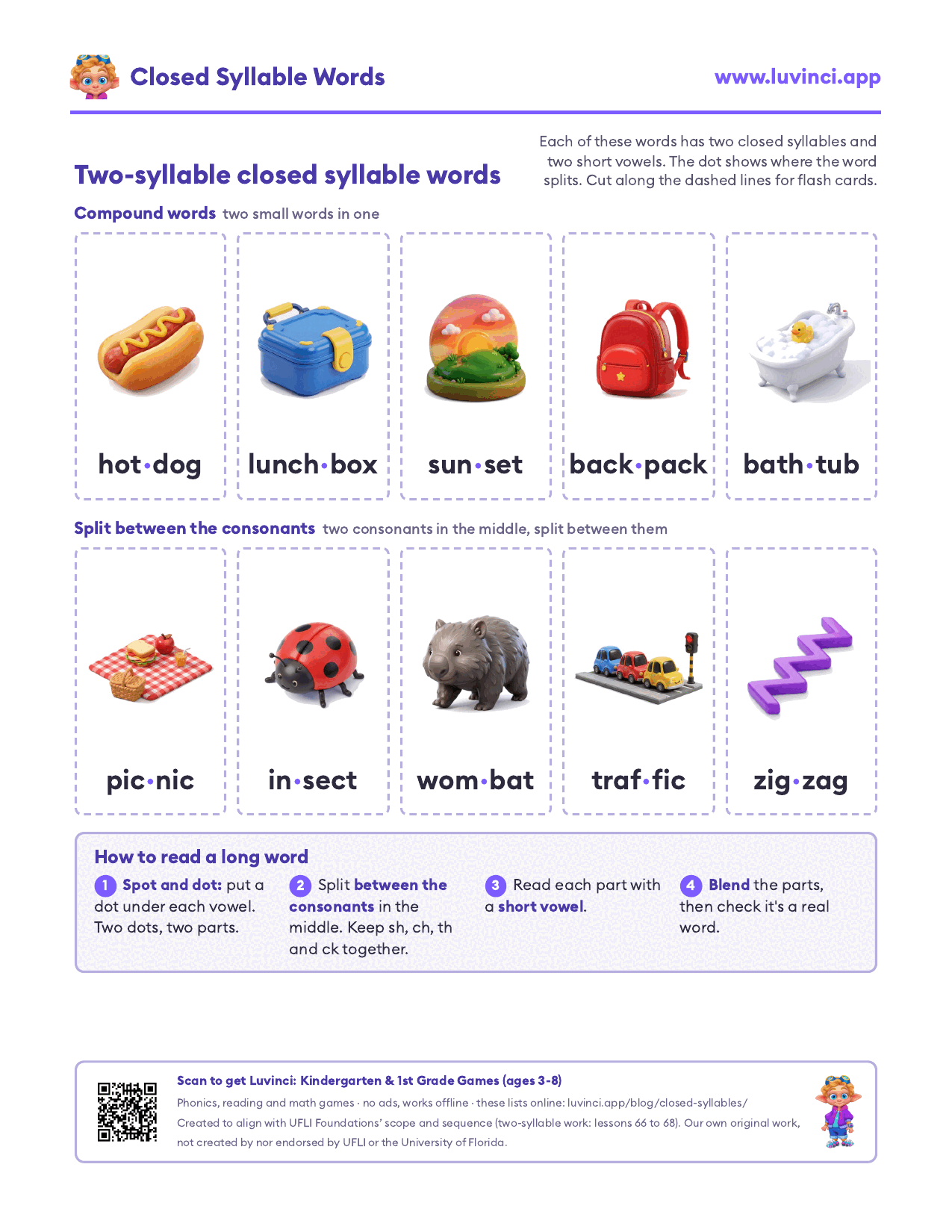
Page 2 of the free PDF: ten two-syllable picture cards.
What is a closed syllable? (with examples)
A closed syllable is a syllable with one vowel followed by at least one consonant. Close the door with that consonant and the vowel usually says its short sound: got, fish, stamp.
Run through four checks. You want a yes on every one:
- One vowel letter?
- A consonant right after it? Not w or y, which team up with the vowel (saw, cow, day, boy).
- No magic e? cake and bike aren’t closed.
- No r right after the vowel? car isn’t closed.
At the table: Write go. Your child reads it. Add a t and say, “The t shut the door. Now the o is short.” Read got. Then try the other door pairs:
- no → not, hi → hit, me → met, we → wet, be → bed, she → shed
More than one consonant still counts: stamp, splash and strict are each one closed syllable. Two letters that make one sound still count: fish, duck, bath.
That’s the closed syllable rule. It’s a pattern, not a law. The vowel is short about 95% of the time, and closed and open syllables together make up nearly 75% of all syllables (Reading Universe).
Most programs teach six syllable types: closed, open (short vs long vowels), magic e (magic e words), vowel team (vowel teams explained), bossy r (bossy r words) and consonant-le.
Closed syllable words list: one syllable (kindergarten)
Your child will read closed syllables long before they hear the name. Every CVC word is one, so our CVC word lists are closed syllable practice too.
One vowel, one closed door: a, i, o, e, u
- Vowel first: at, in, up, on, it, if, ox, us
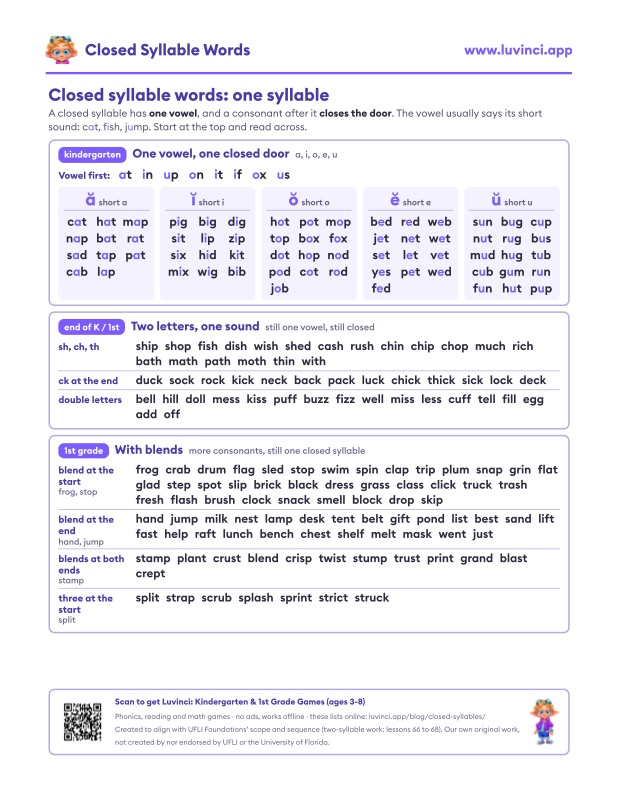
- Short a: cat, hat, map, nap, rat, sad, tap, cab, lap
- Short i: pig, big, dig, sit, lip, zip, six, hid, kit, mix
- Short o: hot, pot, mop, top, box, fox, dot, hop, job, nod
- Short e: bed, red, web, jet, net, wet, leg, vet, yes, pet
- Short u: sun, bug, cup, nut, rug, bus, mud, hug, tub, pup
If your family says egg or leg like “ayg”, use bed or wet as the anchor. In fan, jam and man the a sounds a little nasal. They’re still closed. Say them the way you talk.
Read one row in order, then point to words mixed up. Keep that row until reading it feels easy.
With sh, ch, th, ck and double letters (end of kindergarten into 1st grade)
- sh, ch, th: ship, fish, shop, chin, chop, much, bath, thin
- ck: duck, back, kick, sock, neck, rock, pack, deck
- Double letters: bell, hill, doll, kiss, puff, buzz, fizz, egg, add
Two letters make one sound, and the door is still shut. More on digraphs. The floss rule (ff, ll, ss, zz) is a closed syllable spelling rule.
With blends (1st grade)
- CCVC: crab, flag, snap, swim, spin, frog, stop, sled, trip, step, drum, plum
- CVCC: hand, lamp, milk, gift, list, pond, nest, desk, belt, help, jump, lunch
- CCVCC: stamp, crust, blend, crisp, twist, print
- CCCVC: split, strap, scrub, splash
In a consonant blend, every sound is heard, and the vowel is still short. The letter codes are explained in what comes after CVC words.
Two-syllable closed syllable words (1st grade)
Two closed syllables, each read with a short vowel first. Teachers sometimes call these CVC-CVC words. Most children learn the name in 1st grade, but many read words like sunset in kindergarten. UFLI Foundations covers syllables in lesson 66, compound words and closed/closed words in 67, and open and closed syllables in 68 (see our worksheets in UFLI order).
Cover one half with your finger, read it, then the other half, then put them together.
Start with compound words
Say, “There are two little words hiding in this one.”
- hot·dog, lunch·box, chop·stick, drum·stick, nut·shell, egg·shell, hand·stand, bob·sled, kick·stand, hand·print, cat·fish, up·hill
You’ll find practice on paper in our compound words worksheets.
Rabbit words: split between two consonants
Split between the two consonants that sit between the vowels. Read each part with a short vowel, blend, then fix it to the word you know.
- plas·tic, traf·fic, at·tic, fab·ric, tid·bit, nut·meg, wom·bat, in·vent, in·sist, pub·lish, suf·fix
When the second vowel goes lazy
By spelling, these are closed syllables. The second vowel often relaxes to a quick “uh” when we talk.
- rab·bit, nap·kin, bas·ket, kit·ten, but·ton, mag·net, gob·lin, den·tist, muf·fin, hel·met, pen·cil, cac·tus
Read each part with a short vowel, blend, then ask, “Does that sound like a word you know?” Rabbit names the pattern even though its second i is quick. In pencil, the c says /s/ (soft c and soft g). It’s fine if your child reads “bas-KET”. Say the word back the normal way and move on.
How to split a long word
- Spot and dot. Put a dot under each vowel. Count the dots. In words like these, that’s how many syllables, because every syllable has a vowel sound. (Two vowels side by side, like the ea in bread, get one dot.)
- Look between the dots. Two consonants? Split between them: rab·bit, nap·kin. Teachers call these rabbit words (VC/CV). Keep two letters that make one sound together: jack·et and dol·phin, never jac·ket. Only one consonant? Try the split before it first (ti·ger), then after it (cam·el). More on these camel words below.
- Read, blend, check. Read each part, put them together, and ask if it’s a real word.
Treat the split as a first try, not a law. In two-syllable rabbit words, the first vowel is short about 79% of the time (Kearns, 2020).
Longer closed syllable words (1st or 2nd grade)
Camel words: try it long, then short
One consonant sits between the vowels. Split before it first, so the first part is open and long: ro·bot (long o), ti·ger (long i). Not a word? Move the split after the consonant and read the vowel short: cam·el. Say, “Try it long. Not a word? Try it short.”
- Closed first part: com·ic, fin·ish, rad·ish, pan·ic, van·ish, rel·ish
- Closed first part, lazy second vowel: rob·in, vis·it (the s says /z/), cab·in, lem·on, wag·on, sev·en, plan·et, mel·on, drag·on
The second try matters. The long try works only about 47% of the time in two-syllable words (Kearns, 2020).
Three consonants in the middle
- sand·wich, con·trast, dis·trict
- Lazy second vowel: pump·kin
When there are three consonants, keep a blend or digraph together on one side: the tr in contrast and district. Many people drop the d in sandwich when they talk.
Three closed syllables
- fan·tas·tic, mag·net·ic, ath·let·ic, vol·can·ic
- With an ending: in·vent·ing, fin·ish·ing, van·ish·ing, up·lift·ing
Fantastic is the one to show off. It has three closed syllables and three short vowels.
Open and closed syllables
An open syllable ends with its vowel. Nothing closes the door, so the vowel usually says its name: go, me, hi, she, and the first part of ro·bot, ti·ger and o·pen. Our short vs long vowels post explains both sounds.
How to tell open and closed syllables apart: look at the letter right after the vowel in that syllable. If it’s a consonant, the syllable is closed and the vowel is usually short (got). If there’s no letter after it, the syllable is open and the vowel usually says its name (go).
At the table: Write go, got, no, not, hi, hit, me, met, she and shed on ten cards. Make two piles, “open door” and “closed door”. Your child reads each card and picks a pile. Then ask about these three:
- no: open
- nap: closed
- ap·ple: ap is closed; ple is a consonant-le syllable
UFLI Foundations covers open and closed syllables in lesson 68.
Closed syllable exceptions
A closed syllable exception is a word that looks closed, but its vowel doesn’t say the short sound. Most children meet these in 1st or 2nd grade. UFLI Foundations teaches -ild, -old, -ind, -olt and -ost in lesson 72.
- Long vowel before -ind, -ild, -old, -olt, -ost: kind, find, wild, child, old, cold, colt, bolt, most, post
- Exceptions to the exception (not long): wind (the air), lost, cost, frost
- -oll says long o: roll, troll
- -all says “aw”: ball, tall, small
- w + a says “ah”: want, wash, swan
- u sounds like the u in put: push, pull, full
- o says “uh”: from, of
The best pair to show your child: the i is long in child and short in chil·dren. Say, “Some words break the rule. We learn them as chunks.” Our long i words and long o words posts list more. The floss rule explains why -all, -oll and -ull break the pattern, and from and of are heart words.
Closed, but the vowel shifts: ng and nk
- king, sing, song, sang, bank, pink, trunk, think
The vowel changes a little before ng and nk. Some programs call these glued or welded sounds. They’re still closed syllables, taught as chunks.
Looks closed, but isn’t
A consonant sits after the vowel in these words, but the four checks rule them out:
- Two vowel letters (vowel teams): rain, boat, bread
- An e on the end (magic e): cake
- An r after the vowel (bossy r): car, storm, her
Bread has a short e, but it has two vowel letters, so it’s a vowel team. Some closed syllable lists online include words like these.
Closed syllable activities at home (5-10 minutes)
Choose one or two. Stop while it’s still fun.
- Door card. Write go and put a t on a paper flap. Fold it down: got.
- Spot and scoop. Dot the vowels, then draw a scoop under each syllable.
- Build it. Make sun, then sunset, with letter tiles.
- Compound match. Cut sunset and bathtub in half and match them.
- Open or closed? Sort the door cards.
- Dictation. Clap napkin. Your child writes nap, then kin.
- Book hunt. Find three closed words in tonight’s book.
A little cup (˘) over the short vowel can help. It’s optional. Once real words are easy, two-syllable nonsense words make a good check.
Sentences to read aloud
Every word is closed except the, a and we.
- The bobcat hid in the sandbox.
- Dad got a hotdog in a bun.
- We had a picnic on the hilltop.
- Six insects sat on the backpack.
- Tom did a handstand in the sand.
- The wombat had a fantastic lunchbox.
After each one, ask your child to find a two-part word and split it with a finger.
Free closed syllable words PDF
- Page 1: one-syllable words by vowel, digraphs, double letters and blends.
- Page 2: ten two-syllable picture cards and four steps for reading a long word.
- Page 3: an open or closed sort, split-it practice, lazy vowels, rule breakers and the sentences, with an answer key.
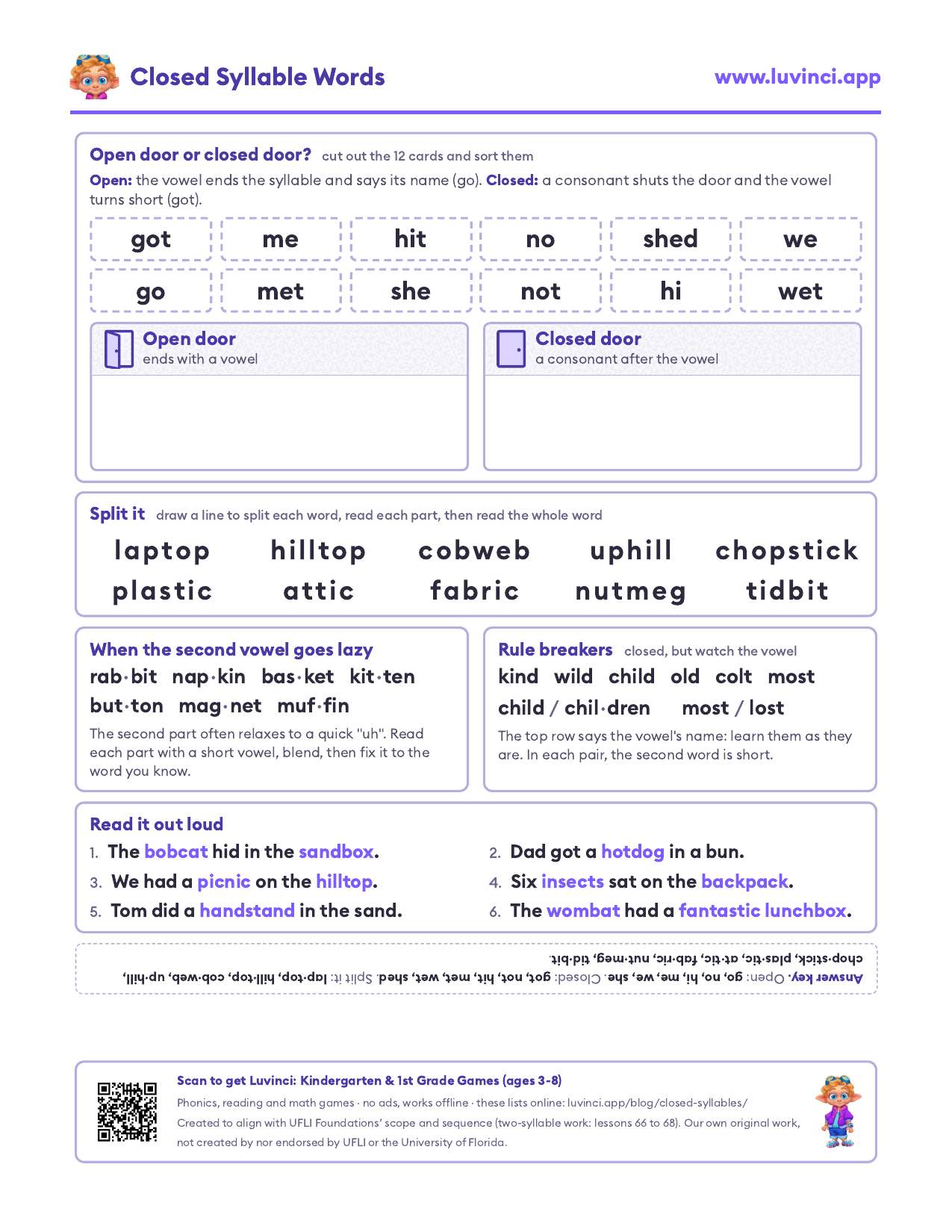
Page 3 of the free PDF.
Page 3 works as a free printable closed syllable worksheet: cut out the cards, draw the splits, read the sentences. Download the free closed syllable words PDF. No signup, no email. More in our printables library.
Questions parents ask
How do you tell if a syllable is open or closed? If a consonant comes after the vowel in that syllable, it’s closed and the vowel is usually short (got). If the syllable ends with the vowel, it’s open and the vowel says its name (go).
What are closed syllable words? Words made of closed syllables, where a consonant follows the vowel and the vowel is usually short: cat, fish, jump, sun·set, plas·tic, fan·tas·tic.
Can you give me a list of closed syllables? Yes: the lists above go from one syllable to three. The PDF has the one-syllable lists and ten two-syllable picture cards.
Is “no” a closed syllable word? No. The o ends the syllable, so it’s open and says its name. Add a t and the door shuts: not.
Is apple a closed syllable? Its first syllable is: ap has one vowel with a p after it. The second part, ple, is a consonant-le syllable.
Is “dentist” a closed syllable? Both parts are closed by spelling: den and tist. The second part often goes lazy when we talk. Read each part short, blend, then fix it to the word you know.
How to explain closed syllables to a child? Use the door: “When a consonant closes the door behind the vowel, the vowel is short.” Then show go and got.
What are the 7 types of syllables? Most programs teach six: closed, open, magic e, vowel team, bossy r and consonant-le. Some count seven by splitting oi, oy, ou and ow off vowel teams as their own type.
What are the five exceptions to the closed syllable rule? -ind, -ild, -old, -olt and -ost, where the vowel is long: kind, wild, old, colt, most. Children and lost are the tricky ones: their vowels aren’t long.
What grade do you learn open and closed syllables? Usually 1st grade for the name, though many kindergartners already read words like sunset. Camel words and exceptions come in 1st or 2nd grade.
Our reading games sound out every letter and have your child pick the missing letter, ages 3 to 8, no ads, offline. Next: how kids learn to read, or CVC word lists if short words need more practice.
Created to align with UFLI Foundations’ scope and sequence; lesson numbers are cited for alignment only. This post and its PDF are our own original work, not created by nor endorsed by UFLI or the University of Florida.