 Luvinci
September 18, 2026
Subtraction for Kindergarten: Picture Take-Away (Free PDF)
Free printable · PDF · 776 KB
Subtraction for Kindergarten: Picture Take-Away (Free PDF)
No signup needed. Just print it.
Download PDFSubtraction for kindergarten starts with taking some away from a group and finding how many are left, within 10. Kids learn it in three steps. Real things come first, then pictures, then numbers. When a child watches 2 of their 5 toy cars drive away and counts the 3 still there, they’re already subtracting. The minus sign comes later, as a short way to write down what happened.
Our free subtraction PDF has six pages: a subtraction chart within 10, picture take-away, taking away on one ten frame, counting back, and 15 flash cards with answer cards. No signup, no email.
This is part 2 of our adding and taking away series. If adding still feels shaky, start with addition for kindergarten.
What kindergarten subtraction looks like
In the Common Core standards, kindergarten subtraction stays within 10. Most kids are expected to do this by the end of the year:
- Take away with objects, fingers or drawings (K.OA.1). 6 blocks, push 2 away, 4 are left.
- Solve simple take-away story problems within 10 (K.OA.2). “You have 6 crackers. You eat 2. How many are left?”
- Split a number into two parts (K.OA.3). 8 is 5 and 3. Those are the number bonds, and every split hides a take-away: 8 take away 3 leaves 5.
- Subtract within 5 quickly and easily (K.OA.5).
Subtracting within 10 quickly and easily is a 1st grade goal (1.OA.6). Counting is fine in kindergarten. Fingers are a tool, not a crutch.
How to teach subtraction in kindergarten
Teachers follow the same order they use for adding, often called concrete, pictorial, abstract. Stay at each step until it’s easy, and go back a step whenever a fact feels hard.
- Real things. “5 ducks are in the pond. 2 swim away.” Your child moves 2 toys away and counts what’s left.
- Pictures. Draw the 5 ducks and cross out the 2 that left.
- Numbers. Write 5 - 2 = 3.
Read - as “take away” and = as “is” or “is the same as”. “5 take away 2 is 3”. Say “take away” first and “minus” later.
Subtraction isn’t only take away. In kindergarten your child also splits a group into two parts (8 is 5 and 3). Comparing two groups (“how many more?”) and missing-part story problems (“I had 5, now I have 8. How many did I get?”) come in 1st grade (1.OA.1). The one missing part kindergartners find is the partner that makes 10 (K.OA.4). Start with take away. It’s the easiest one to see.
Subtraction with pictures
Subtraction within 10 starts with pictures your child can cross out.
Page 2 of the PDF has eight picture take-aways, from 4 - 1 to 10 - 3, with strawberries, stars, apples and fish. The pictures come in groups of 5. Your child counts all the pictures, crosses out the number shown from the end, counts what’s left, and writes the three numbers. The first one is done.
An X means “taken away”, so don’t cross pictures off while counting. Touch each one instead. Count all by touching, cross out only the ones that go away, then touch-count the ones without an X. If counting a group of 5 is still shaky, spend some time on one to one correspondence first.
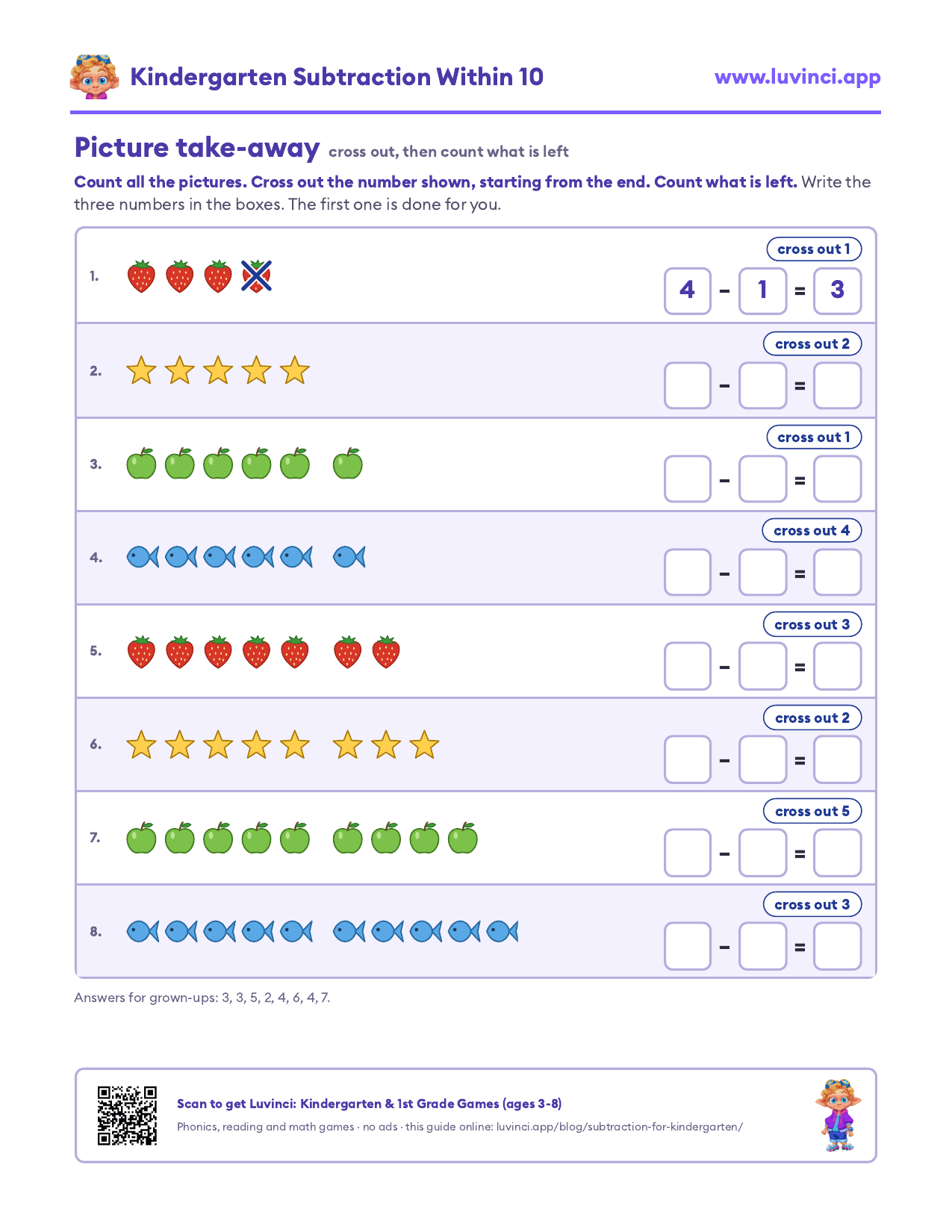
Page 2: count, cross out from the end, and write what is left.
Taking away on one ten frame
Classrooms take away on one ten frame: two rows of five boxes. Put the whole number in red counters, top row first. Then take away from the end: the last counter you filled goes first.
For 7 take away 4, cross out the 2 on the bottom row, then 2 more from the right of the top row. 3 are left. That’s all ten frame subtraction is. You fill, cross out from the end, and look at what’s left.
The frame is the same one as adding on one ten frame, turned around. 3 + 4 = 7, so 7 - 4 = 3. The 4 you cross out sit in the same boxes as the 4 yellow counters in the addition post.
On page 3 of the PDF, the counters are printed, and your child draws a big X across each one they take away. There are eight, from 8 - 3 to 10 - 7. It only needs a pencil and prints fine in black and white.
A full frame is 10, so the “10 take away” facts are the ways to make 10 pairs, read backwards. 7 and 3 make 10, so 10 take away 3 is 7.
Counting back to subtract
Counting back is a late-kindergarten skill that settles in 1st grade (1.OA.5).
Page 4 of the PDF has a number path from 0 to 10. Your child puts a finger on the starting number, hops back one box for each one taken away and lands on the answer. Below the eight path problems are eight chart patterns, like 8 - 1 and 5 - 5.
The usual mistake is saying the starting number. For 7 - 3, a child who says “7, 6, 5” lands on 5, one too many. Put a finger on 7, say nothing, then hop back “6, 5, 4”.
Counting back works best for taking away 1, 2 or 3. The ten frame is easier for bigger ones.
The subtraction chart within 10 (a subtraction table)
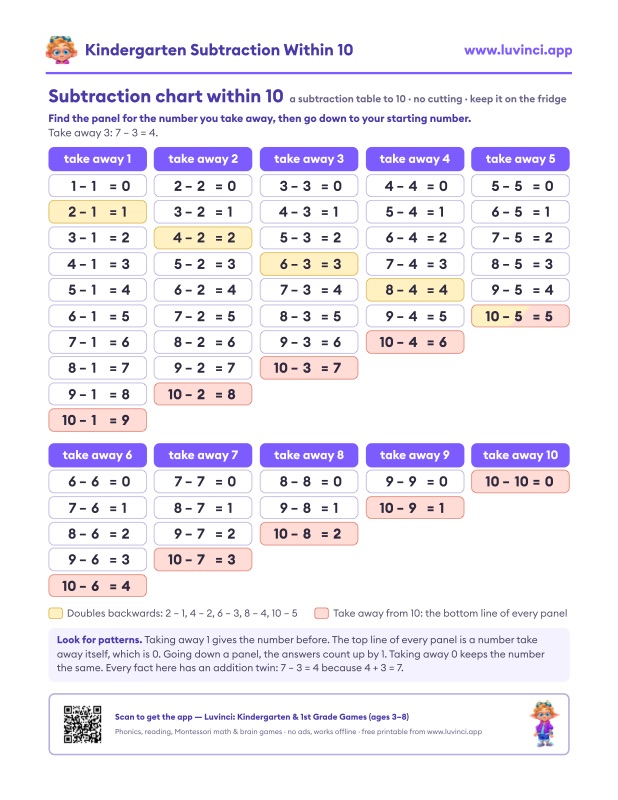
Page 1 of the PDF is a subtraction chart within 10, the page for the fridge. There’s no cutting and no prep. Some sites call it a subtraction table. It has every take-away from 1 to 10, 55 facts, in 10 panels: take away 1 to 5 on top, 6 to 10 below.
Each panel is one take-away number. Find the panel for the number you take away, then go down to your starting number: in the take away 3 panel, 7 - 3 = 4.
Patterns to spot:
- Taking away 1 gives the number before (the take away 1 panel).
- A number take away itself is 0: the top line of every panel.
- Answers count up by one as you go down a panel.
- Doubles backwards (yellow): 2 - 1, 4 - 2, 6 - 3, 8 - 4 and 10 - 5. If 4 + 4 = 8, then 8 take away 4 is 4. More in doubles facts.
- Take away from 10 (pink): the bottom line of every panel. 10 - 5 is both, so it’s half yellow and half pink.
- Taking away 0 changes nothing, so the chart skips it.
Every fact here is an addition fact turned around (7 - 3 = 4 because 4 + 3 = 7), which is why addition and subtraction within 10 are taught side by side. Hang it next to the addition chart from our addition post.
Want a page a day? Our free Subtraction Within 10 Workbook has 20 short pages of plain take-aways like 7 - 2, one idea at a time (take away 1, counting back, doubles backwards, take away from 10), with a number path on every page and the answers at the back. Start it once taking away with objects feels easy, and skip the timer.
Subtraction flash cards within 10
Pages 5 and 6 are 15 cut-out subtraction flash cards. Print page 6 on the back (flip on the long edge). Each answer card shows a small ten frame with the take-away crossed out.
The first six cards are within 5, the kindergarten goal (K.OA.5): 2 - 1 up to 4 - 3. The other nine go up to 10, from 6 - 2 to 9 - 6. Start with the within 5 cards.
Ways to use them:
- Quick look. Your child says the answer, then flips the card to check.
- Two piles. Quick answers go in a “know it” pile; the rest go back in for tomorrow.
- Match game. Print the answer page separately. On each answer card, cover everything except the big answer with a sticky note (the small sentence, the ten frame and the card number). Lay all 30 face down and turn over two at a time. A card and an answer that fits it make a pair. Some answers come up more than once, so any answer card with the right big number counts.
Keep it to five minutes a day.
Common subtraction mistakes
- Saying the starting number when counting back. “7, 6, 5” for 7 - 3 lands one too many (see counting back, above).
- Counting the crossed-out ones. Count only the ones without an X.
- Mixing up “how many are left” with “how many went away”. Point at the ones still there.
- Writing the numbers backwards (2 - 5). Adding works in either order, but taking away doesn’t. The number you start with, the whole group, always comes first.
After kindergarten: subtraction to 20
In 1st grade, kids get quick with subtraction within 10 (1.OA.6) and start taking away from numbers up to 20 with strategies, like counting back for 1, 2 or 3 and “Think addition”: for 13 - 8, ask “8 plus what makes 13?” (1.OA.4).
The number bonds they already know make this faster. For games, see our first grade math games.
Subtraction games and activities for kindergarten
The most fun subtraction activities for kindergarten are ones where things really go away. They get knocked down, eaten, or hopped off a bus.
- Bottle bowling. Stand up 6 plastic bottles and roll a ball. How many are still standing?
- Five little ducks. The finger rhyme: one finger goes away each verse. Ask how many are left before singing it.
- Bus stop. 6 toy passengers ride a “bus” (a shoebox). At each stop some get off. How many are still on?
- Snack take-away. 6 crackers, eat 2, how many are left? If they count right, they eat the rest.
- Empty the frame. Start with a full ten frame. Take turns rolling one die and taking off that many counters. Whoever empties their frame first wins, and a roll bigger than what’s left still empties it.
If your child still puts small things in their mouth, use big blocks instead of small counters and snacks, and stay close.
Subtraction in the app
The app’s Early Math boards teach subtraction with picture equations. On its Singapore Math subtraction boards, each problem is one ten frame of pictures with the last items crossed out, just like page 3 of the PDF, and your child picks the answer from three numbers. Its Subtraction levels practice the same facts, with raindrop pictures on Level 1 and number sentences after that. Every subtraction board stays within 10. Those boards are in the full app; the counting board is free. See our early math page for the rest of the math games.
FAQ
Is subtraction taught in kindergarten?
Yes. In the Common Core standards used by most US states, kindergartners take away within 10 with objects, fingers or drawings, and get quick within 5. Addition and subtraction for kindergarten go together, and both stay within 10.
At what age should a child be able to subtract?
By the end of kindergarten, the standards expect a 5- or 6-year-old to take away within 10 with objects or drawings and to be quick within 5. Getting quick within 10 is a 1st grade goal, around age 7.
How do you explain subtraction to a 5-year-old?
Tell a story with real things. “You have 5 blocks. 2 fall off. How many are left?” Let them move 2 away and count the rest. Then write 5 - 2 = 3 and read it as “5 take away 2 is 3”.
Is it OK to count back on fingers?
Yes, fingers are a tool, and most kids drop them on their own as facts become familiar. Watch for saying the starting number: for 7 - 3, it’s “6, 5, 4”.
What is the easiest way to teach subtraction?
Act it out with toys, then cross out pictures, then write the number sentence. Stay within 5 until it comes easily.
Should kindergartners subtract within 20?
It isn’t the goal. Within 10 is the kindergarten standard and 20 comes in 1st grade. A curious child can explore, no need to push.
The takeaways
- Subtraction for kindergarten is taking some away and finding how many are left, within 10.
- Real things, then pictures, then numbers.
- Read - as “take away” and = as “is”.
- One ten frame: cross out from the end.
- Count back without saying the first number.
- Quick within 5 is the kindergarten goal; quick within 10 comes in 1st grade.
- Print the free subtraction PDF: a subtraction chart, picture take-away, ten frames, counting back and 15 flash cards.
More free math worksheets: ten frames, number charts, addition and subtraction, daily practice workbooks and more, all in one place. See the math printables →
