Luvinci
September 22, 2026
Long E Words: Lists by Spelling (ee, ea, y), With Sentences
Free printable · PDF · 892 KB
Long E Words: Lists by Spelling (ee, ea, y), With Sentences
No signup needed. Just print it.
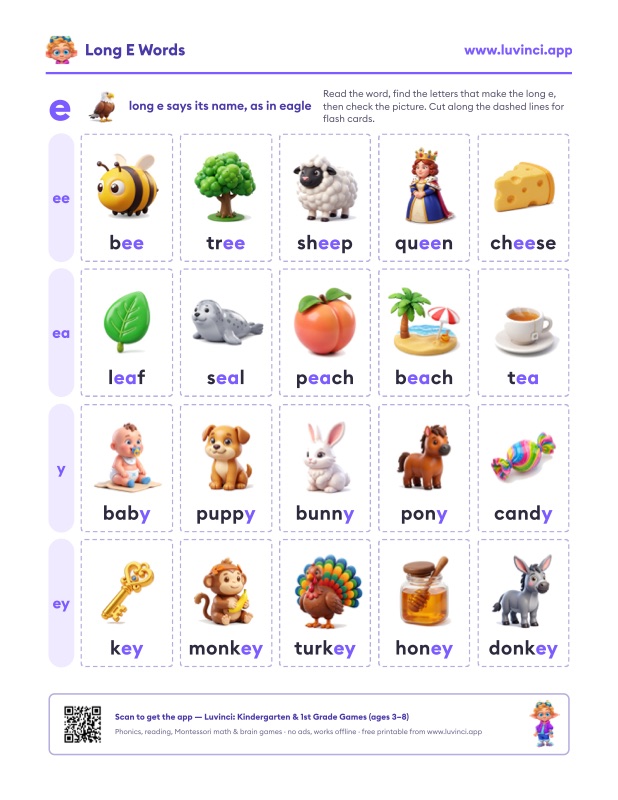
Download PDFLong e words are words where you hear the letter e say its name, “ee”, as in bee, leaf, me and happy. You’ll hear the sound easily. Several common spellings are the hard part, so your child will see it written different ways. You’ll find 20 picture cards sorted by spelling (ee, ea, y, ey) on our free long e words flash cards, plus the full word list and sentences on page 2. There’s no signup and no email.
You’ll find the long e words list on this page, sorted by spelling, with sentences to read aloud and the words that look like long e but aren’t. Start with our long vowel words overview for all five long vowels side by side.
The long e sound
Long e is the “ee” in see. Smile wide. The lips spread and the teeth come close together. You can hold the sound as long as you like, “eeeee”, which is one way to tell it from short e.
Short e, as in bed, is the opposite. The mouth is relaxed and the jaw drops a little. Have your child say bed, then bead, and feel the smile arrive on the second word.
Once three-letter short vowel words read smoothly, long vowels usually come in late kindergarten into 1st grade. A few long e words turn up much earlier, though: he, me, we, be and she are in the first books most kids read.
Long e words list by spelling
Long e has four spellings on our Sound Mat: e at the end of a short word, ee, ea, and ey at the end of a word like key. A fifth, y at the end of a longer word (happy), is just as common in books. Two more, ie and e_e, are rare. Stay on one spelling at a time. Read the words aloud together before your child sorts them.
You’ll find the rules behind these spellings in our vowel teams and magic e guides.
e on its own (me, he, we, be, she)
When you see it: a single e at the end of a short word, with nothing after it to cut it short, says its name.
- Short words: me, he, we, be, she
- Longer words (the e ends the first syllable): zebra, even, emu, fever
Most kids meet these five short words first among long e words. They’re often taught as sight words in kindergarten, before long vowels come in. That’s fine. Once your child knows that a vowel at the end says its name, they can sound them out too.
ee (tree)
When you see it, two e’s together almost always say “ee”. It’s the most reliable long e spelling, so start here once me, he and we are known.
- One syllable: bee, see, feet, meet, seed, need, feed, weed, deep, keep, jeep, peek, week, seek, beef, heel, feel, peel
- With blends and digraphs: tree, free, three, teeth, green, queen, sheep, sleep, sweep, sweet, street, cheek, wheel, speed, bleed, freeze, sneeze, cheese, geese
- Longer words: beehive, treetop, sixteen, fifteen, between, asleep
ea (leaf)
When you see it: ea usually says “ee” too. Try long e first. If the word doesn’t make sense, try short e (more on that in the traps).
- One syllable: eat, sea, tea, pea, each, leaf, seal, meat, heat, seat, neat, bead, read, bean, mean, team, beam, leap, heap, east, beak, weak, leak
- With blends and digraphs: clean, dream, cream, stream, beach, peach, reach, teach, cheap, feast, speak, sneak, squeak, wheat
- Longer words: eagle, easy, peanut, teacher, seaweed, season, reason
y at the end (happy, baby)
When you see it: a y at the end of a word with two or more syllables usually says “ee”.
- Two syllables: happy, puppy, baby, candy, bunny, funny, silly, sunny, windy, penny, kitty, jelly, lady, pony, tiny, city, lucky, messy, muddy, sleepy, twenty, teddy
- Three syllables: strawberry, blueberry, raspberry, library
In a short word with no other vowel, y says long i instead: my, by, fly, sky, cry, dry, try, why, shy, spy. Give your child this rule. Y at the end of a short word says “eye”. Y at the end of a longer word usually says “ee”. A few longer words break it: July and butterfly end in “eye”.
ey (key, monkey)
When you see it: ey at the end of a word often says “ee”. It shows up in some very useful picture words.
- Words: key, monkey, donkey, honey, money, turkey, valley, hockey, chimney, alley
A few ey words say long a instead: they, hey, prey. They is a word your child will read constantly, so it’s worth knowing early.
Rare spellings: ie and e_e
- ie: field, chief, piece, shield, thief, brief, niece. At the end of a longer word, ie also says “ee”: cookie, movie, brownie. But at the end of a one-syllable word, ie says long i: pie, tie, lie.
- e_e: these, Pete, eve, theme, Steve, complete. This is magic e with an e, and it’s rare. Point it out when it turns up. Don’t drill it.
Long e words that start with e
These all begin with the long e sound, so they work well for “what’s the first sound?” games.
eat, each, east, easy, eagle, eel, even, emu, Easter, easel, evening
Plenty of words start with e and don’t say long e: egg, elf, end (short e), eight (says “ay”), ear (e with r) and eye (says “eye”). Keep those out of a long e sort.
Long e words with pictures
Some long e words are easy to draw, which makes them good for picture cards, a matching game or a word wall:
bee, tree, sheep, feet, jeep, cheese, queen, seed, wheel, teeth, leaf, seal, peach, beach, bean, eagle, key, monkey, honey, baby, puppy, bunny, zebra, three
Many of these are drawn for you on our free printable long e picture flash cards: 20 cards to cut out, sorted by spelling.
You’ll find a long e row on our free Long Vowels Sound Mat, with a picture word for each main spelling (e, ee, ea, ey), next to the other four long vowels on one page.
Short e vs long e words
A pair is the easiest way to see the difference. Add one letter, and the short e turns long.
| Short e | Long e |
|---|---|
| bed | bead |
| met | meat |
| net | neat |
| men | mean |
| fed | feed |
| bet | beet |
| set | seat |
| wed | weed |
| ten | teen |
| step | steep |
| stem | steam |
| sped | speed |
Start with the short word, then read the long one. Ask your child what changed. It’s the sound, and the letter that made it.
Long e sentences to read aloud
These use long e words plus a few common words (the, a, is, in, at, to, and, has, can). The little word a says “uh” in a sentence. The and to are heart words. Read them for your child if they aren’t known yet.
Starting out (e and ee):
- We see a bee.
- He can see me.
- She has a green jeep.
- The sheep sleep.
- We need three seeds.
- Be sweet to the bee.
Adding ea:
- A seal is in the sea.
- We eat peas and beans.
- Clean the seat.
- The team can eat at the beach.
- Read to me.
Adding y and ey (1st grade):
- The puppy is happy.
- A monkey has a key.
- The baby is sleepy.
- The bunny can eat a leaf.
Your child can read, trace and write long e phrases on free one-page worksheets: bee in a tree and a green jeep for ee, a seal can read and eat a peach for ea, key for the monkey for ey, and a happy puppy for y. We ride home mixes we with long i and long o. There’s no signup.
Traps: words that look like long e but aren’t
- bread, head, dead, ready, heavy. Here ea says short e, the sound in bed. Try long e first. If the word doesn’t make sense, switch. There’s more on this in our short e words post, and a free fresh bread worksheet to practice it.
- read. Same letters, two words. I read every day is long e. I read it yesterday sounds like red. Only the sentence tells you which one it is.
- great, break, steak. Here ea says long a. There are only a handful. Teach them as a small group.
- ear, hear, near, year, deer, cheer. An r after ee or ea changes the sound. Bear, pear and wear change it even more. That’s bossy r, and it comes later.
- been. In most American speech, been sounds like bin. Teach it as a heart word. Heart the ee, because it says short i.
- they, hey, prey. The ey says long a.
- my, fly, sky. The y says long i in a short word.
- the. In a sentence, the usually says “thuh”. It’s a heart word, not a long e word.
How to practice long e
Five minutes a day is enough.
- The smile check. In front of a mirror, say “ee”, then short e. The lips spread into a smile for “ee”, and relax for short e. If your child’s mouth drops open on bead, it’s coming out as bed.
- Build the pair. With our letter tiles, build bed. Add an a after the e: bead. Take it out again. Then try met/meat and step/steep.
- Sort by spelling. Make three columns: ee, ea, y. Read a word card together and put it in its column. The sound is the same in all three. Only the spelling changes.
- The same-sound pairs. For spelling, pairs that sound the same show why the spelling matters: meet/meat, see/sea, week/weak, bee/be, peek/peak. Draw a picture for each word.
- Build silly sentences. Our long vowel sentence builder has picture cards to cut out, build into a silly sentence and write.
Bed and bead differ by one sound, so hearing them said the same clear way every time helps. Luvinci’s reading games do that. They build from single sounds up to whole words. It’s our kindergarten & 1st grade learning app for ages 3 to 8, ad-free and playable offline.
Questions parents ask
How will my child know whether to write ee or ea? A child can’t use a rule here. Feet and heat sound the same at the end, and nothing tells you which spelling each one takes. It’s spelling memory, built by reading the words many times. Say that out loud to your child. Hunting for a rule that doesn’t exist is more frustrating than knowing there isn’t one. For reading, it doesn’t matter. Both say long e.
Why does y say “ee” in happy but “eye” in my? Word length is why. In a short word where y is the only vowel (my, fly, sky), it says long i. At the end of a longer word (happy, baby, candy), it usually says long e. A few longer words, like July, break it.
Are he, me and we sight words? They’re on most kindergarten sight word lists, because they’re in almost every early book. But they aren’t irregular. The e is at the end, so it says its name. Our kindergarten sight words list groups them that way.
My child reads “bread” as “breed”. What do I do? That’s a good mistake. It means your child knows ea usually says long e. Tell them ea has a second sound, then have them try it: br-e-d. Most kids meet the short e ea in late 1st or 2nd grade, so until then, read those words for them.
When do long e words usually start? He, me, we, be and she come early in kindergarten. The ee and ea words usually come in late kindergarten into 1st grade, once short vowels are solid. The y endings and ey words tend to come later in 1st grade.
The takeaways
- Long e says its name, “ee”, as in bee, leaf, me and happy. Smile wide to make it.
- The main spellings: e at the end of a short word (me), ee (tree), ea (leaf), ey (key), and y at the end of a longer word (happy). ie and e_e are rare.
- ee or ea is spelling memory, not a rule. Both read the same.
- y usually says “ee” at the end of a longer word, but “eye” in a short word like my or fly.
- Watch the traps: bread and head (short e), great (long a), ear and bear (bossy r), been, they.
- Short vs long e: bed/bead, met/meat, step/steep.
- Print the free long e flash cards: 20 picture cards, plus the full list and sentences. For all five long vowels on one page, add the free Long Vowels Sound Mat, and see every long vowel worksheet.