Luvinci
September 22, 2026
Short E Words: Word Lists and Sentences for Kindergarten
Free printable · PDF · 954 KB
Short E Words: Word Lists and Sentences for Kindergarten
No signup needed. Just print it.
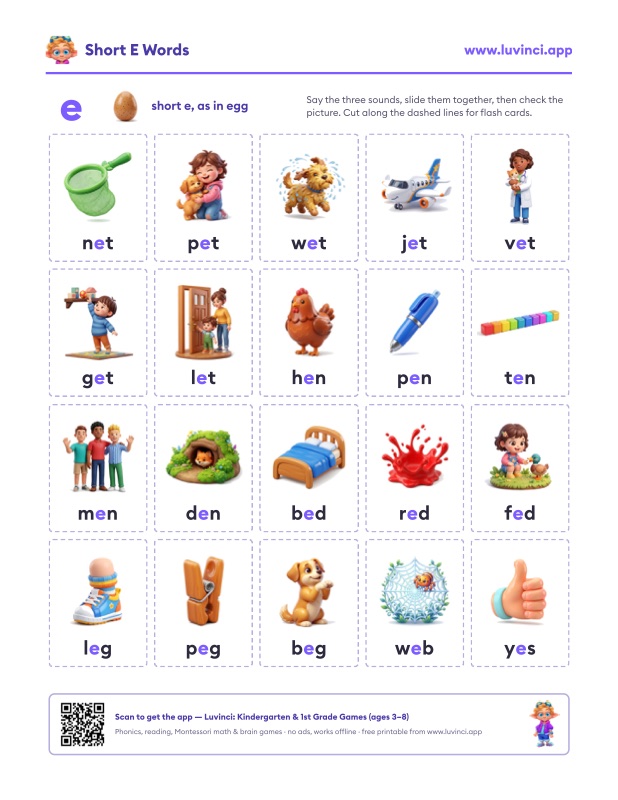
Download PDFShort e words have the /e/ sound in egg: bed, hen, net, red, ten. That /e/ is the short sound of the letter e, the one in egg, and you usually hear it in a short word with a consonant after it. You’ll find the short e words your kindergartner meets first grouped by word family, then the harder 1st grade words, sentences to read aloud and the traps. The free short e words flash cards come with 20 picture cards, plus the full word list and sentences on page 2. You don’t need to sign up or leave an email.
Short e is one of the hardest short vowels to hear, and many phonics programs teach it late (more on that below). You’ll find all five short vowels side by side, and how long vowels differ, in our short vowel words guide.
The short e sound
Say /e/ short and clean, as in egg. Don’t turn it into “eh-uh”, and don’t use the letter name “ee”.
Your child’s jaw drops a little lower than for /i/ in itch, and the mouth sits half open with relaxed lips. If the jaw stays too high, /e/ slides into /i/.
A mirror helps. Say egg and itch while your child watches your face, then have them try it on their own.
Short e words list by word family
These are all CVC words. That’s consonant, vowel, consonant. Swap the first sound and leave the ending the same. For the short a, i, o and u families in the same format, see our CVC word list.
- -et: net, pet, wet, jet, vet, get, let, met, set, bet, yet
- -en: hen, pen, ten, men, den
- -ed: bed, red, fed, led, wed
- -eg: leg, peg, beg
- -ell: bell, well, tell, sell, fell, yell
- -ess: less, mess
Start with -et, -en and -ed. They’re three sounds each and easy to picture. The -ell and -ess families have a doubled last letter that makes one sound. Families that end in two consonant sounds (-est, -end, -ent) come later, in the 1st grade section below.
Short e words that start with e
There aren’t many, and some of them are the best anchor words for the sound.
egg, Ed, elf, end, edge, exit
Most programs use egg as the short e picture, so it’s worth using at home too. Use bed or Ed as the anchor instead if your family says egg like “ayg”. Edge has -dge on the end, a 1st grade spelling. Exit uses x for two sounds. Read both to your child rather than asking them to sound them out.
Plenty of words start with e and don’t have short e: eat, eagle, even (long e), eight (says “ay”), ear (e with r). Leave those out of a short e sort.
More short e words for kindergarten
Here’s a mixed list you can use for reading practice or a quick sound hunt around the house:
bed, hen, pen, net, red, leg, ten, web, jet, wet, yes, vet, men, pet, get, let, peg, beg, fed, den, bell, well, mess, yell
Short e words with blends and digraphs (late K and 1st grade)
Wait to bring these in until your child can read consonant blends and digraphs like sh, ch and th. That’s late kindergarten into 1st grade for most kids.
- Blends at the start: sled, sped, fled, step, stem, spell, smell, dress, press, bless, fresh, Fred
- Blend families: nest, best, rest, test, vest, west (-est); end, bend, lend, mend, send (-end); tent, went, bent, dent, rent, sent (-ent)
- Other blends at the end: desk, belt, felt, melt, help, held, left, kept, self, pelt
- Both ends: slept, swept, spent, crept
- Digraphs: shed, shell, chest, chess, check, neck, deck, peck, then, them, when, bench
Longer short e words
Once CVC words are easy, your child can read these one chunk at a time. Every syllable is short:
bedbug, sunset, insect, upset, pigpen, desktop, contest
Cover half the word with a finger, read sun, then set, then put them together. Many two-syllable words have a lazy “uh” in one syllable (seven, lemon, kitten), so those stay off a short vowel list for now.
Sentences to read aloud
These use only short vowels and sounds your child already knows. Read each one twice. Go once slowly, then once smoothly.
Kindergarten (CVC words):
- Ted fed a red hen.
- Get in bed, Meg.
- Ben met a vet.
- Yes, Jen can get wet.
- Let Ken pet a hen.
- Ten men get wet.
- A red hen sat in a den.
Late kindergarten into 1st grade (blends and digraphs):
- Fred slept in a tent.
- Ned held a shell.
- Glen fell on a sled.
- Jess sent Meg a red dress.
- Check the desk, then help Ted.
A and the are heart words, words with a part to learn by heart. Most children know a early, so it’s fine inside these sentences.
You’ll find one decodable sentence and a picture on each of our free short e read-and-write worksheets: a red hen, ten red pens, a pet vet and ten in a bed. They’re one page each, and there’s no signup.
Short e and short i: the pairs drill
Lots of children mix up e and i. Bed comes out as “bid”, pen as “pin”. The two sounds sit right next to each other in the mouth. This isn’t carelessness.
On purpose, practice them together in pairs that differ by the vowel alone:
- bed / bid
- pet / pit
- set / sit
- bet / bit
- led / lid
- peg / pig
- beg / big
- bell / bill
- well / will
- fell / fill
- mess / miss
- desk / disk
- check / chick
- pen / pin (skip this one and the next if they sound the same in your family’s accent, see below)
- ten / tin
You say one word from a pair. Your child points to the matching card, or holds up an e or an i. Then swap. Your child says a word and you point. Five pairs a day is plenty.
Space e and i a few weeks apart first if both are still new. Once each sound is steady alone, drill the pairs.
Traps: words that break the short e pattern
he, me, we, be, she. The e is at the end of the word, with nothing after it to cut it short. So it says its name. That’s long e. These are the first long vowel words most kids read, and they sound out once that pattern is taught.
her, fern, term. An r after the e changes the sound to /er/. That’s bossy r, a 1st grade pattern. Keep these off short e lists.
pet and Pete. A magic e on the end makes a vowel say its name. That pair is rare with e (pet, Pete), so it’s not worth drilling. Magic e matters much more for cap/cape, kit/kite and hop/hope.
bread, head. ea spells short e here. It’s the same sound as bed, spelled another way. Other examples are thread, spread, breath and heavy. Most kids meet it in late 1st or 2nd grade, after vowel teams like the ea in eat. Until then, read these words to your child.
said, any, friend. These have a short e sound with an odd spelling. They’re heart words.
pretty, English. They’re spelled with e, but said with the short i in pig. Teach them as heart words.
How to practice short e
- Mirror check. Say egg and itch, then bed and bid, in front of a mirror. Your child watches the jaw drop for /e/.
- Family flip. Write -et on a card. Put letters in front one at a time: n, p, w, j, v. Your child reads each new word. Do the same with -en and -ed.
- e or i sort. Put an egg picture on one side of the table and an igloo on the other. Say a word from the pairs list. Your child puts a counter on the right side.
- Read, then write. Work through one of the four short e worksheets above a day. Read the sentence, then copy it.
- Build a silly sentence. The free short vowel sentence builder has picture cards to cut out, arrange into a sentence and write.
Short e words work well for blending practice because /e/ is a sound you can hold. Hold the middle sound, “b… ehhh… d” (the /e/ in egg, not “ee”), and keep your voice going instead of saying three separate sounds. Shorten the hold each time until it’s bed.
Hearing it said the same clean way every time helps, because /e/ blurs so easily. In Luvinci’s reading games, every word is sounded out one sound at a time before it’s read whole.
Questions parents ask
Is “the” a short e word? No. Before most words, the e in the says “uh”. Before a vowel it says “ee”. It never says /e/ as in egg. Teach the as a heart word, and use bed or hen as your short e examples.
We say pen and pin the same way. Is that a problem? In much of the southern US, e and i sound the same before m and n, so pen and pin, ten and tin, hem and him are said alike. That’s a normal accent, not a mistake. Drill pairs that end in a stop sound instead: bed/bid, pet/pit, set/sit, peg/pig, check/chick. From how the words are spelled, your child will learn which is which, the same way they learn to, two and too.
Why is short e often taught late? It’s one of the hardest vowels to hear, and the one most easily confused with i. Most programs start with a and i, as in the SATPIN order to teach letter sounds, and space e a few weeks away from i. Some, like UFLI, teach e as the last short vowel. Others teach it before o or u. Either works.
How many short e words should my kindergartner know? There’s no set number. A good goal is that your child can read the -et, -en and -ed families without stopping to sound out every letter, then tell bed from bid when you say them.
The takeaways
- Short e is /e/ as in egg: bed, hen, net, red, ten. The jaw drops a little, and the lips stay relaxed.
- Start with -et, -en and -ed, then -ell and -ess. Save -est, -end and -ent for 1st grade.
- Words that start with short e: egg, Ed, elf, end, edge, exit.
- Drill e and i as pairs: bed/bid, pet/pit, set/sit, five a day.
- Not short e: he, me, we (long e), her (bossy r), the (heart word).
- Short e can be spelled ea in bread and head. Most kids meet it in late 1st or 2nd grade.
- Print the free short e flash cards: 20 picture cards, plus the full list and sentences. Add the four short e worksheets linked above, the rest of the short vowel worksheets and the free Short Vowels Sound Mat.