Luvinci
September 22, 2026
Long I Words: Lists by Spelling (i_e, y, igh, ie), With Sentences
Free printable · PDF · 994 KB
Long I Words: Lists by Spelling (i_e, y, igh, ie), With Sentences
No signup needed. Just print it.
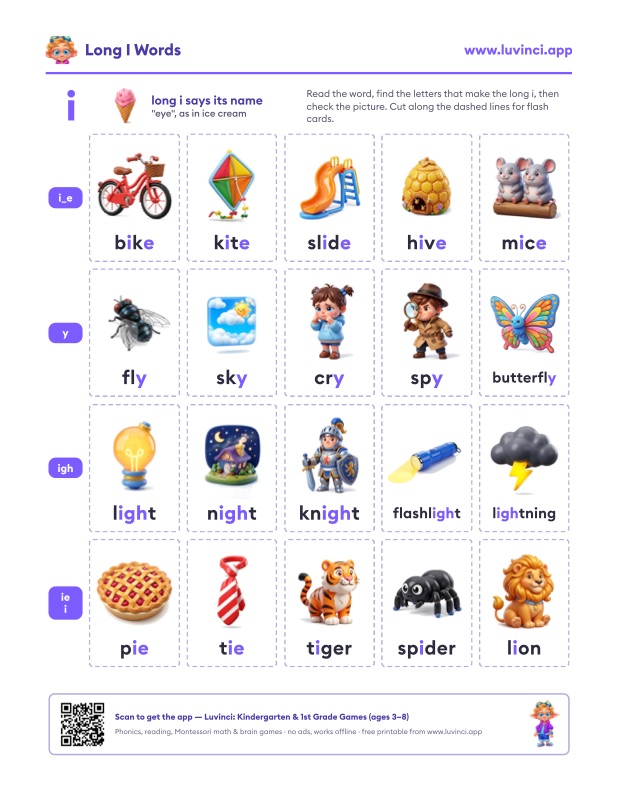
Download PDFLong i words are words where you hear the letter i say its name, “eye”, as in bike, my, light and pie. Hearing that sound is the easy part. The five common spellings are what get tricky, and one of them (the y in my) doesn’t even use the letter i. Our free long i words flash cards have 20 picture cards, one row per spelling, plus the full word list and sentences on page 2. You don’t need to sign up or leave an email.
You’ll find the long i words list on this page, sorted by spelling, with short and long i pairs, sentences to read aloud, and the words that look like long i but aren’t. For all five long vowels side by side, start with our long vowel words overview.
The long i sound
Long i is the “eye” in bike. It’s really two sounds glued together. An “ah” slides into an “ee”. Say it slowly, “ahh-ee”, and feel the jaw start open and close up as the lips spread a little. That slide is what makes it long.
Short i, as in kit, doesn’t slide. The lips stay relaxed, the jaw opens only a little, and the sound is over fast. Have your child say kit, then kite, and feel the mouth move on the second word.
In parts of the American South, long i often loses its slide, so ride sounds more like “rahd”. That’s the accent, not a mistake. Model words the way you normally say them.
Most kids start long i in late kindergarten into 1st grade, once short i words like kit and pin are easy. I, my and by come much sooner, in the first books most kids read.
Long i words list by spelling
Long i has five common spellings: i_e (bike), y at the end of a short word (my), igh (light), ie (pie), and i on its own, which covers words like tiger, I and hi plus the kind and wild group. Teach one spelling at a time. Say each word aloud with your child before they sort by spelling.
For the rules themselves, see our magic e and vowel teams guides. The word lists are below.
i_e (bike)
When you see it: i, then one consonant, then an e at the end. The e is silent and makes the i say its name. This is the most common long i spelling.
- One syllable: bike, like, hike, kite, bite, site, ride, hide, side, wide, time, dime, lime, pine, fine, line, mine, nine, vine, ripe, pipe, wipe, hive, five, dive, mice, nice, rice, dice, mile, pile, tile, size, life, wife
- With blends and digraphs: slide, bride, pride, white, write, quite, smile, while, slime, shine, spine, swipe, stripe, drive, slice, twice, price, prize, knife
- Longer words: inside, beside, sunshine, bedtime, hillside, sunrise, pinecone, invite, alive
Write and knife have a silent letter at the front (w, k). Pinecone has long o too, so it’s a good word for spotting two magic e’s.
y at the end of a short word (my, fly)
When you see it: a y at the end of a one-syllable word, with no other vowel, says long i.
- Words: my, by, fly, sky, cry, dry, try, why, shy, spy, fry
- Longer words that keep it: July, reply, butterfly
In a longer word, a y at the end usually says long e instead: happy, baby, candy. Give your child this rule. Y at the end of a short word says “eye”. Y at the end of a longer word usually says “ee”. Butterfly keeps “eye” because it ends in fly. July and reply keep “eye” because you say the last part loudest.
igh (light)
When you see it: three letters, one sound. The g and h are silent. Together with the i they say “eye”. It’s almost always followed by a t (light) or sits at the end of the word (high).
- -ight: light, night, right, might, sight, tight, fight, bright, flight, fright, knight
- At the end: high, sigh, thigh
- Longer words: tonight, midnight, sunlight, flashlight, highway, delight, lightning
Start with the -ight family. Treat it like a word family. Keep “ight” and change the first sound. l-ight, n-ight, r-ight, t-ight.
ie (pie)
When you see it: ie at the end of a short word says long i. There are only a few, but they’re easy picture words.
- Short words: pie, tie, lie, die
- When a y word grows: cry becomes cries and cried, fly becomes flies, try becomes tries and tried, dry becomes dried, spy becomes spies. The y turns into an i, and the sound stays long i.
In longer words, ie often says long e instead (cookie, movie, field). Those are in the traps below.
i on its own: tiger, I, and kind and wild
When you see it: an i with nothing after it in its syllable usually says its name. So does an i before nd or ld.
- Short words: I, hi
- Longer words (the i ends the first syllable): tiger, pilot, spider, silent, tiny, lion, item, ivy, Friday, idea
- -ind: kind, find, mind, blind, behind, remind
- -ild: wild, mild, child
The kind and wild words look like short i words with a blend at the end, like hint and milk, and a child sounding out letter by letter will read “kinned”. Our short i list calls them traps for that reason. Here they are simply their own group. Before nd and ld, try long i first. Teach them together, as a set of about ten words. (A few don’t follow it: wind, the breeze, is short, and so is children, even though child is long.)
Rare spellings: ye, uy, eye
- ye: bye, dye, goodbye
- uy: buy, guy
- eye: eye
These come up in books, but there are too few to drill. Treat them as heart words. Sound out the letters that play fair, and learn the part that says “eye” (uy, ye) by heart.
Long i words that start with i
Use these for “what’s the first sound?” games. Each one opens with long i.
I, ice, icy, ice cream, icicle, idea, item, ivy, island
Island has a silent s, so use it for the first sound only. Eye starts with the same sound but not the same letter. And plenty of words start with i and don’t say long i: igloo, in, itch, insect are short i. Leave those out of a long i sort.
Long i words with pictures
These long i words are easy to draw. Use them for picture cards, a matching game or a word wall:
bike, kite, slide, hive, five, nine, mice, dice, pine, vine, lime, smile, knife, bride, tie, pie, light, knight, fly, sky, spider, tiger, lion, pilot, child
Many of these are drawn for you on our free printable long i picture flash cards: 20 cards to cut out, sorted by spelling.
Our free Long Vowels Sound Mat has a long i row with a picture word for each main spelling (i, i_e, ie, igh), next to the other four long vowels on one page.
Short i vs long i words
A pair is the easiest way to see the difference. Add an e at the end, and the short i turns long.
| Short i | Long i |
|---|---|
| kit | kite |
| pin | pine |
| bit | bite |
| rid | ride |
| fin | fine |
| slid | slide |
| hid | hide |
| dim | dime |
| rip | ripe |
| twin | twine |
| spin | spine |
| slim | slime |
| strip | stripe |
| quit | quite |
Have your child read kit, then kite, and tell you what changed. Two things did. The sound changed, and the e at the end made it.
The same trick works with igh: fit / fight, lit / light, sit / sight, mitt / might. Here the letters change more, but the sound jump from short i to long i is the same.
Sentences to read aloud
These use long i words plus a few common words (the, a, is, to, has, can). The little word a says “uh” in a sentence. Start with whichever set matches your child’s program.
Starting out (i_e, plus I and my):
- I like my bike.
- Mike has a white kite.
- Nine mice hide.
- The dime is mine.
- Ride to the pine.
- Five limes in a line.
Adding igh:
- The light is bright.
- It is night.
- The kite is high.
- Shine the light at night.
Adding y, ie and kind or wild (1st grade):
- I can fly.
- The sky is bright.
- Why did the child cry?
- Tie it tight.
- A fly is on the pie.
- The kind pilot smiles.
- Find the wild mice.
Free one-page long i worksheets give your child phrases to read, trace and write: ride a bike, a wide smile and kite in the wind (the wind here is the short i one) for i_e, a light at night for igh, and eat a pie for ie. You don’t need to sign up.
Traps: words that look like long i but aren’t
- give, live (as in “we live here”). These end in i, consonant, e, but the i stays short. English words don’t end in v, so the e is there for the v, not the i. (A live show has a long i.) Teach them as heart words.
- fire, tire, wire, hire. An r after the vowel changes the sound (the bossy r family), and many kids hear two syllables, “fy-er”. Leave these out of a long i sort for now.
- wind. Same letters, two words. The wind that blows is short i. You wind a clock with a long i. Only the sentence tells you which.
- children. Child is long i, but children is short. Teach them side by side.
- happy, baby, candy. A y at the end of a longer word usually says long e, not long i.
- cookie, movie, field, chief. Here ie says long e. And in friend, it says short e. Save these for later.
- pizza, ski, police, machine. In some borrowed words, i says “ee”. Pizza is worth knowing early, because every kid wants to read it.
- bird, girl, first. An r right after a single i makes a new sound. That’s bossy r too.
How to practice long i
Five minutes a day is enough.
- The slide check. In front of a mirror, say long i slowly: “ahh-ee”. Watch the jaw close as the sound slides. Then say short i, as in kit. The mouth barely moves. If your child’s mouth doesn’t move on kite, it’s probably coming out as kit.
- Add the e. With our letter tiles, build kit. Add an e to the end: kite. Take it off again. Then try pin/pine and rid/ride.
- Sort by spelling. Make three columns: i_e, y, igh. Read a word card together and put it in its column. The sound is the same in all three. Only the spelling changes.
- Sound-alike pairs. Words that sound the same but are spelled differently show your child why spelling matters: night/knight, right/write, sight/site, I/eye, by/buy/bye, die/dye. Draw a picture for each word.
- Build silly sentences. Our long vowel sentence builder has picture cards to cut out, build into a silly sentence and write.
Go back to short i first if it isn’t solid yet. Long i only makes sense next to the short sound, and our short i words list has the families to practice.
Once someone says it slowly for you, the slide in long i is easy to hear. Our reading games sound out each word, so kit and kite come out clearly different. Luvinci is our phonics app for kindergarten and 1st grade (ages 3 to 8), with no ads, and it works without internet.
Questions parents ask
Which long i spelling should I teach first? Programs differ. Many US programs start with i_e, because it’s the most common spelling and it builds straight from short i words your child already reads: kit becomes kite. Then igh, which is mostly one family (-ight). Our own order teaches igh first and i_e later. Either works. Just don’t start both in the same week. Your child probably knows I and my already as sight words, and that’s fine.
How will my child know whether to write i_e or igh? There’s no rule that settles it. Bite and fight sound the same at the end, and nothing tells you which spelling each takes. One helpful hint: igh is almost always -ight or at the very end (high, sigh). Beyond that, seeing each word again and again is how your child learns its spelling. Reading is the easy direction. Both spellings say long i.
Why does “kind” have a long i with no e? Before nd and ld, the i usually says its name: kind, find, mind, wild, child. It’s a pattern, not a random exception. Teach the group together, and tell your child to try long i first when they see -ind or -ild.
Why does y say “eye” in my but “ee” in happy? Mostly because of word length. In a short word where y is the only vowel (my, fly, sky), it says long i. At the end of a longer word (happy, baby, candy), it usually says long e. July and reply keep “eye” because you say the last part loudest.
When do long i words usually start? I, my and by come early in kindergarten as sight words. In many US programs, i_e comes in late kindergarten and igh in 1st grade. Programs that start with vowel teams flip that. The ie and kind/wild words tend to come in 1st grade.
The takeaways
- Long i says its name, “eye”, as in bike, my, light and pie. It slides: “ahh-ee”.
- Five common spellings: i_e (bike), y at the end of a short word (my), igh (light), ie (pie), and i on its own (tiger, I, hi).
- kind, find, wild, child are their own group: before nd and ld, try long i first.
- y says “eye” in a short word, but usually “ee” at the end of a longer word like happy.
- Watch the traps: give and live (short i), fire and tire (bossy r), wind, children, cookie, pizza.
- Short i and long i: kit/kite, pin/pine, bit/bite, rid/ride, slid/slide.
- Print the free long i flash cards: 20 picture cards sorted by spelling, plus the full list and sentences. For all five long vowels on one page, add the free Long Vowels Sound Mat, and see every long vowel worksheet.