Luvinci
September 22, 2026
Long A Words: Lists by Spelling for Kindergarten and 1st Grade
Free printable · PDF · 982 KB
Long A Words: Lists by Spelling for Kindergarten and 1st Grade
No signup needed. Just print it.
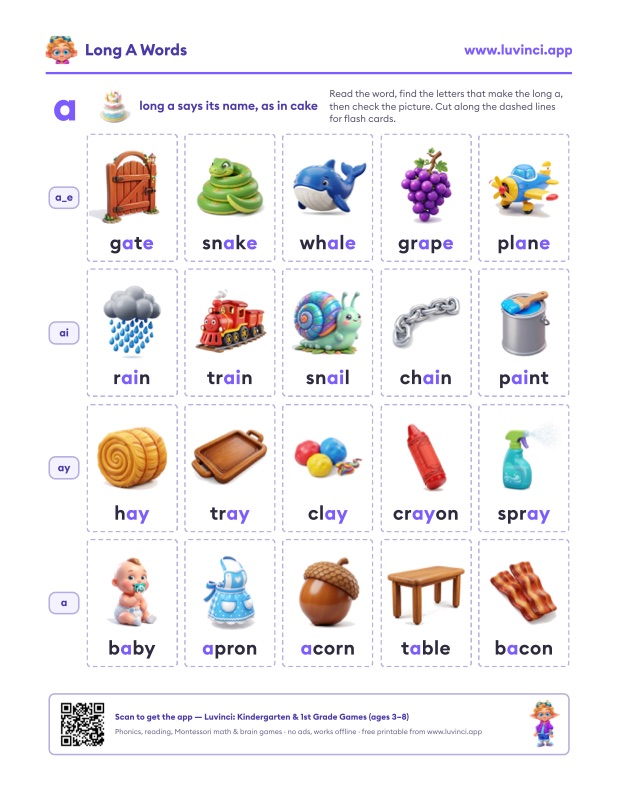
Download PDFLong a words are words where the a says its own name, “ay”, as in cake. You’ll hear it in rain, play and baby too. All four share the sound. What changes is the spelling, and that’s the part your child needs help with. Long a is usually taught late kindergarten into 1st grade, once short a words like cap and man are easy. Our free long a words flash cards have 20 picture cards, one row for each spelling, plus the full word list and sentences on page 2. There’s no signup and no email.
Grouped by spelling, this is the long a words list, with sentences to read aloud and the words that look like long a but aren’t. For all five long vowels side by side, start with our long vowel words overview.
The long a sound
Long a says “ay”, the name of the letter. Listen closely. It’s really two sounds sliding together. It starts close to the e in bed and glides toward “ee”. Watch the jaw in a mirror as you say cake slowly. It rises a little at the end. That glide is why long a sounds longer than short a.
Compare it with short a. In cap the jaw drops and the sound stays short. In cape the sound slides. If your child can hear that difference, they’re ready for long a.
Here’s one thing about American speech. Before an l, as in tail, whale and sale, most people slip a small “uh” in. You’ll hear “tay-ul”. That’s still long a. Say each word the way you normally do.
Long a words list by spelling
Long a has three main spellings: a_e (cake), ai (rain) and ay (play). A fourth, open a (baby), shows up in longer words, and a few rare spellings round out the list.
Long a words with silent e: a_e (cake)
You’ll see a, one consonant, then an e on the end. The e is silent and makes the a say its name. This is the most common long a spelling in short words. The rule itself is in our magic e words guide.
- -ake: cake, bake, lake, make, rake, take, wake, snake, shake, flake
- -ate: gate, late, date, plate, skate, state, crate
- -ame: name, game, same, came, tame, frame, flame, blame
- -ave: cave, gave, save, wave, brave
- -ade: made, fade, grade, shade, trade, blade
- -ane: cane, lane, mane, plane, crane
- -ape: tape, cape, grape, shape, scrape
- -ale: whale, sale, pale, tale, male, scale
- -ase / -aze: case, base, vase, maze, gaze, blaze
Save one group for later: face, race, space, place, page, cage, stage. They’re long a, but they’re also soft c and soft g words: the c says /s/ and the g says /j/. That’s a second new thing in the same word.
ai and ay (rain, play)
You’ll see two letters teaming up for one sound. ai usually sits inside a word (rain, tail). ay usually comes at the end (play, day). That position rule holds up well, and our vowel teams guide explains how it works.
ai (inside the word):
- -ain: rain, main, pain, gain, brain, train, drain, chain, grain, stain, plain
- -ail: tail, mail, nail, pail, sail, rail, jail, snail, trail
- -ait / -aint: wait, bait, paint, saint
- More: aim, maid, paid, laid, raid, afraid, waist, claim
ay (at the end):
- -ay: day, play, say, way, may, pay, hay, lay, ray, bay, stay, gray, clay, tray, pray, spray
- Two syllables: away, today, okay, subway, crayon
The ay stays inside a word when that word is built on an ay word: play becomes player and playground, stay becomes stayed. The base word still ends in ay.
Open a (baby)
You’ll see it in a longer word where the a ends a syllable, with nothing after it to cut it short. Split the word and the a is left on its own: ba-by, pa-per, ta-ble.
- Two syllables: baby, lady, paper, apron, acorn, bacon, navy, gravy, label, April
- -le endings: table, cable, able, maple, stable, fable, cradle
- Longer words: radio, potato, tomato, alien
Not every a at the end of a syllable does this. The a at the start of about and away says “uh”, and so does the little word a in a sentence. Teach open a after a_e, ai and ay are steady.
Rare spellings: eigh, ey, ea
A few long a words use spellings your child won’t see often. When they turn up in a book, point them out. Don’t drill them in kindergarten.
- eigh: eight, weigh, sleigh, weight, neighbor
- ey: they, hey, obey. Most ey words say long e (key, monkey, honey), so these few are the odd ones.
- ea: great, break, steak. These three are nearly the whole list. Most ea words say long e, so expect great read as “greet” the first time. That’s a sensible guess. Just give them the word.
Our sleigh in the snow worksheet is a gentle first look at eigh.
Long a words that start with a
These begin with the long a sound, the letter’s name. They’re good for “what’s the first sound?” games.
ape, ate, age, ache, aim, able, acorn, apron, April, alien
Eight sounds like it belongs here, but it starts with the letter e. That’s a good talking point, because the first sound matches and the first letter doesn’t. Ache and age are also odd. The ch says /k/, and the soft g says /j/. Use them for hearing, not for sounding out.
Long a words with pictures
They’re easy to draw and easy to recognize, so they work well as picture cards, on a word wall, or in a matching game:
cake, snake, whale, grape, plane, skate, gate, cave, rain, train, snail, nail, tail, chain, paint, hay, tray, baby, acorn, apron, table, paper
Many of these are drawn for you on our free printable long a picture flash cards: 20 cards to cut out, sorted by spelling.
Our free Long Vowels Sound Mat has long a picture words in four spellings, next to the other four long vowels, on one page.
Short a vs long a words
A pair is the clearest way to show long a. Use a word your child already reads, then its long a partner.
| Short a | Long a (a_e) |
|---|---|
| cap | cape |
| tap | tape |
| man | mane |
| can | cane |
| mad | made |
| hat | hate |
| rat | rate |
| Sam | same |
| pal | pale |
| plan | plane |
| Short a | Long a (ai) |
|---|---|
| pan | pain |
| ran | rain |
| man | main |
| bat | bait |
| mad | maid |
| pad | paid |
Before n or m, short a sounds a little nasal (man, can), so those pairs are the hardest to hear apart. Start with pairs like cap/cape and mad/made.
Spend a week back on short a first if the short word in each pair is still slow. Long a only makes sense as a contrast.
Sentences to read aloud
These use long a words plus a few common words (the, a, is, in, on, and, I). Short vowel words are fine too, since your child already reads them. Start with whichever set matches your child’s program.
Silent e (a_e):
- Jake made a cake.
- The snake is in the cave.
- Wave at the whale.
- Dave and Kate skate on the lake.
- Name the game.
- A grape is on the plate.
ai and ay:
- The snail is on the trail.
- The train is on the rail.
- Stay and play in the rain.
- Ray can paint the pail gray.
- The hay is on the tray.
- May I play in the clay?
Once those are easy, mix in open a: The baby naps on the table. Tape the paper on the table.
Traps: words that look like long a but aren’t
Almost every child gets caught by these. The spelling looks right, but the a doesn’t say its name.
- have, are. There’s an e on the end, but it isn’t a magic e. Have is a plain short a. In are, the r takes over. Both are heart words. Sound out what you can and put a heart on the tricky part.
- said, says, again. The ai and ay say /e/, as in bed. In most American speech again rhymes with ten. Teach said and says as heart words early, because they’re in almost every book.
- care, share, hair, chair, air, stairs. An r after the a changes the sound. These are bossy r words. Leave them out of long a lists.
- mountain, captain. In a longer word, ai at the end can shrink to a quick “uh”. Point it out if it comes up.
How to practice long a
Five minutes a day is enough.
- Add the e. Write cap. Your child reads it. Add a paper e on the end: cape. Read it again. Do five pairs from the table above. They should feel that change happen in their hand.
- Short or long? Say a word from a pair: cap or cape, bat or bait, mad or made. Your child holds up one finger for short, two for long. This is listening only, with no letters.
- Spell it by position. Say a word with the long a sound at the end (day, stay, tray). Your child writes it with ay. Then say a word from the ai list (rain, tail, paint) and ask: is the sound at the end? No, so it can’t be ay. A middle sound can be ai or a_e, and nothing tells you cake isn’t spelled “caik”, so give your child those words to copy. They are learned word by word.
- Read and write. Our one-page long a worksheets have a decodable sentence to read, trace and write. For a_e: cake on a plate, a whale can wave, snake in a cave and snake bakes a cake. For ai and ay: snail on a trail, rain on the train and play all day.
- Build silly sentences. Our long vowel sentence builder has WHO, DID WHAT and WHERE picture cards to cut out, build into a silly sentence, and write.
If your child hears long a but reads rain as “ran”, they’re skipping the second letter. Before they say it, have them put a finger under both letters of the team. Hearing short and long a side by side is where our reading games help. Luvinci sounds out each word cleanly, so cap and cape never blur. Luvinci is our kindergarten & 1st grade app for ages 3 to 8. There are no ads, and it plays offline.
Questions parents ask
When do kids learn long a words? It’s usually late kindergarten into 1st grade. It should follow solid short a reading, not a birthday. A child still sounding out cap letter by letter isn’t ready for cape.
Should I teach a_e or ai and ay first? Programs differ. Many US programs start with a_e, others with ai and ay. Our own teaching order does a_e first, then ai and ay. Either works. Just don’t start both in the same week. Teach ai and ay together, as two spellings of one sound.
How does my child know whether to write ai, ay or a_e? Position settles ai versus ay. At the very end of a word it is almost always ay. Between a_e and ai there is no rule. Tale and tail sound the same. Those are learned one word at a time, by reading them often. Saying so honestly saves a lot of frustration.
Is “said” a long a word? No. The ai in said says /e/, as in bed. It’s one of the most common heart words, so teach it early and put it next to paid to show the difference.
The takeaways
- Long a says its name, “ay”, as in cake, rain, play and baby. Same sound, written several ways.
- Start with a_e, ai and ay, in whichever order your program uses. ay goes at the end of a word. a_e is the most common spelling in short words.
- Open a comes next (baby, paper, table), then the rare ones: eigh, ey, ea.
- Use pairs: cap/cape, mad/made, bat/bait. The short word first, every time.
- Watch the traps: have, are, said, again, and bossy r words like care and hair.
- Print the free long a flash cards: 20 picture cards, one row per spelling, plus the full list and sentences. For all five long vowels on one page, add the free Long Vowels Sound Mat, and see every long vowel worksheet.