Luvinci
August 8, 2026
Long Vowel Words: All Five Sounds and How to Spell Them
Free printable · PDF · 818 KB
Long Vowel Words: All Five Sounds and How to Spell Them
No signup needed. Just print it.
Download PDFA long vowel is a vowel that says its own name: the a in cake, the e in bee, the i in bike, the o in boat, the u in cube. Five sounds — but each one can be spelled several different ways, and that’s the part that trips children up.
This is the question most parents actually have: my child can hear the long a, so why does it look different in cake, rain and play? Here is each sound with its spellings side by side.
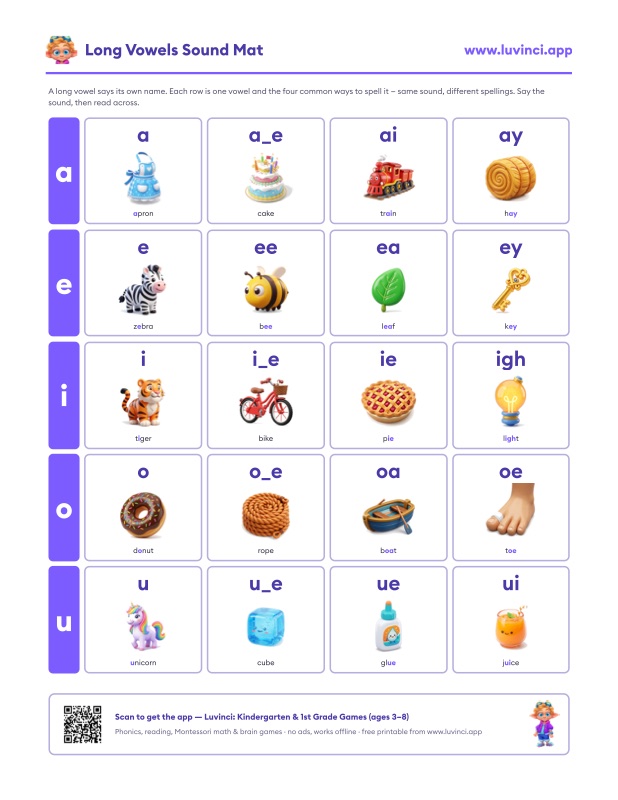
All five are on our free Long Vowels Sound Mat — one row per vowel, four spellings each, one page, no signup.
Long a — a, a_e, ai, ay
apron, able, baby, lady · cake, gate, plane, snake · rain, train, paint, tail · play, day, hay, gray (all long a words)
Long e — e, ee, ea, ey
me, we, he, zebra · bee, tree, feet, green · leaf, seat, beach, team · key, money, honey, valley (all long e words)
Long i — i, i_e, ie, igh
tiger, pilot, silent, spider · bike, kite, slide, time · pie, tie, lie, die · light, night, high, right (all long i words)
Long o — o, o_e, oa, oe
go, no, donut, open · rope, home, bone, stone · boat, coat, road, soap · toe, hoe, doe, goes (all long o words)
Long u — u, u_e, ue, ui
unicorn, uniform, music, human · cube, tube, flute, mule · glue, blue, true, rescue · juice, fruit, suit (all long u words)
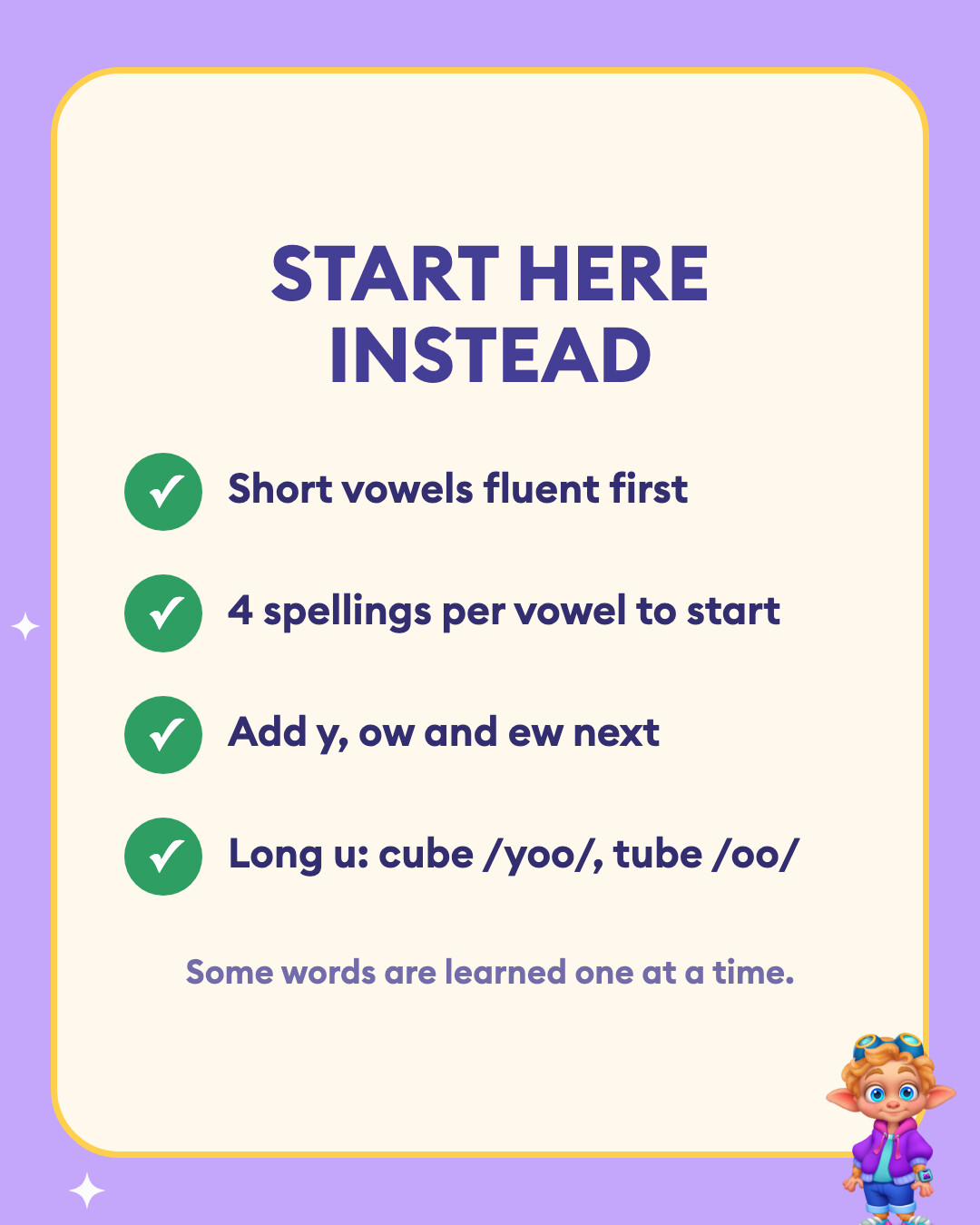
Long u is really two sounds, and it helps to say so out loud: unicorn, cube, mule and rescue say the letter’s name, /yoo/, while tube, flute, glue and juice say plain /oo/. Same spellings, same row on the mat — your child just needs to hear both.
Which spelling goes where
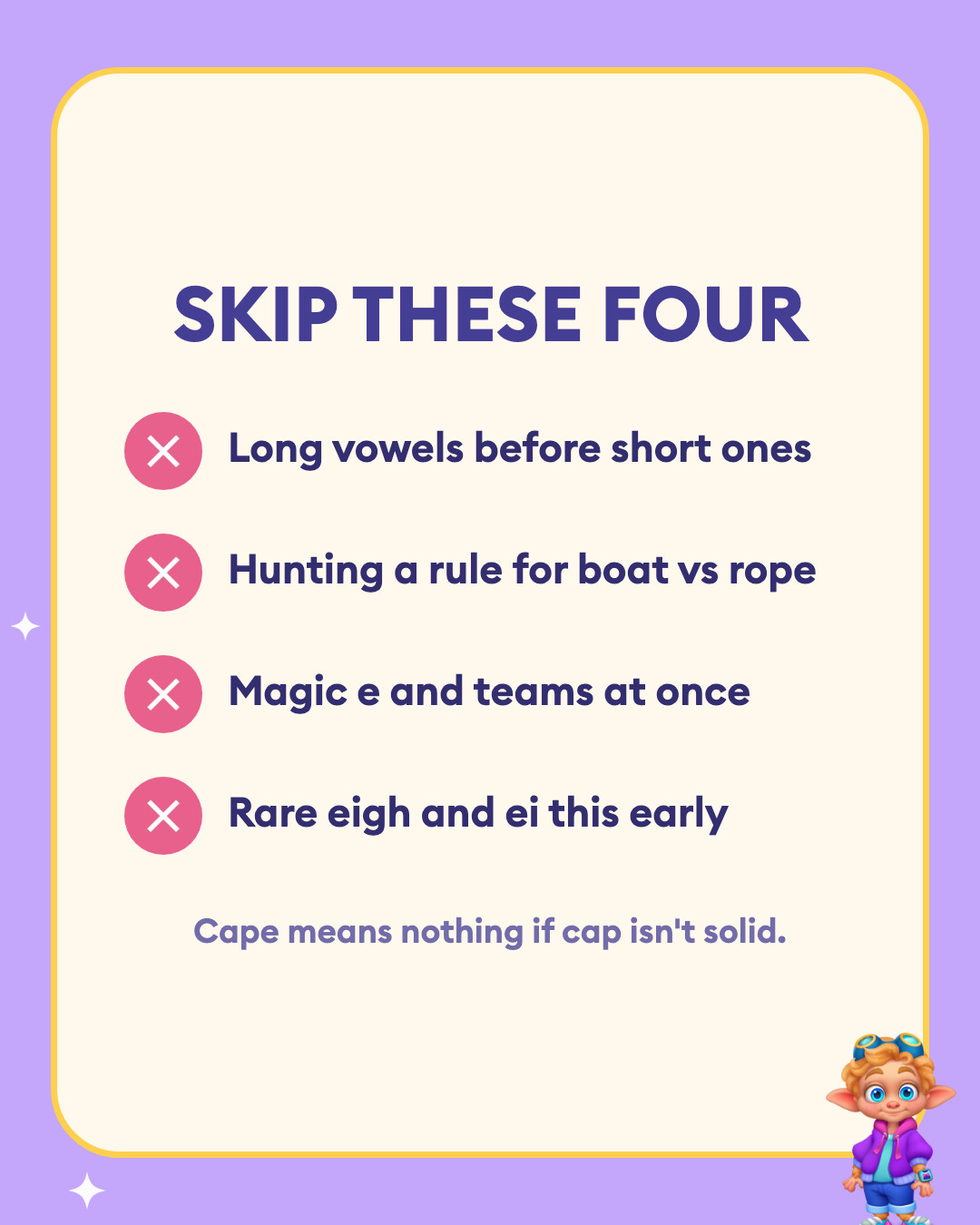
There are more spellings than these four. y does a lot of work — my, fly, sky for long i, and the end of happy and candy for long e — and so do ow (snow, grow) and ew (new, few). Those are the ones to add next, once the four on the mat are steady — though ow has a second sound, the one in cow and now, so introduce it expecting your child to try both. Genuinely rare spellings like eigh (eight, weigh) and ei (protein) can wait — don’t teach those early.
For a few of them, position decides: ai sits inside a word and ay goes at the end of a base word, which is why plai is never right — the vowel teams guide covers that rule and the others like it.
The rest come down to the word itself. Nothing tells you boat uses oa while rope uses o_e; those are learned one word at a time, by reading and writing them. Tell your child that honestly. Hunting for a rule that doesn’t exist is more frustrating than accepting there isn’t one.
Two of these patterns have their own pages, because they carry most of the load: the magic e pattern that turns cap into cape, and the vowel teams where two letters pair up. Start there if you want word lists and practice for either. For practice that uses the words instead of just listing them, our free decodable sentence building worksheet for this stage has picture cards your child cuts out, builds into a silly long-vowel sentence, and writes out.
Teach short vowels first
Long vowels only make sense as a contrast. Cape means nothing to a child who isn’t solid on cap. Get the short vowels fluent in three-letter words first, then long vowels land in weeks rather than months.
Hearing the difference cleanly is where a screen genuinely helps — our reading games sound out each vowel and build from single sounds to whole words for ages 3–8, with no ads and offline play.
Questions parents ask
Which long vowel spelling should I teach first? Magic e (a_e, i_e, o_e, u_e) is where many US programs start: it’s the most common spelling for four of the five vowels — long e is the exception, where ee and ea do that work — and it’s a visible pattern rather than a memory job, so it pairs directly with the short-vowel words your child already reads. Our own teaching order does the same: magic e first, then the vowel teams. Some programs, and UK phonics, teach the teams first. Either way round works. Just don’t run both at once.
Why does English have so many spellings for one sound? Because the words arrived from different languages at different times, and the spellings came with them. There’s no tidy reason. Naming that out loud helps — it stops your child assuming they’re the problem.
When do long vowels usually start? Once three-letter short-vowel words are comfortable, typically late kindergarten or early first grade. In UK schools the first vowel teams land in Phase 3 and magic e in Phase 5. Readiness matters more than age.
The takeaways
- A long vowel says its name — a, e, i, o, u in cake, bee, bike, boat, cube.
- Each sound has several spellings. The four per vowel on the mat are enough to start; add y, ow and ew next.
- Most are learned word by word. No rule tells you boat is oa and rope is o_e — saying so saves frustration.
- Print the free Long Vowels Sound Mat — one row per vowel, 20 picture words, one page.
- All 16 long vowel printables — this chart, the magic e chart, and 14 read-and-write worksheets.