Luvinci
August 8, 2026
Short Vowel Words: All Five Sounds, and How Long Vowels Differ
Free printable · PDF · 837 KB
Short Vowel Words: All Five Sounds, and How Long Vowels Differ
No signup needed. Just print it.
Download PDFA short vowel is the sound a vowel makes when it doesn’t say its own name: the /a/ in cat, the /e/ in bed, the /i/ in pig, the /o/ in dog, the /u/ in sun. Five sounds, and they carry almost every word your child will read first.
Long vowels are the opposite — the vowel says its name, like the a in cake or the i in bike. That single distinction is the one that unlocks reading, and it’s the one most children wobble on for months.
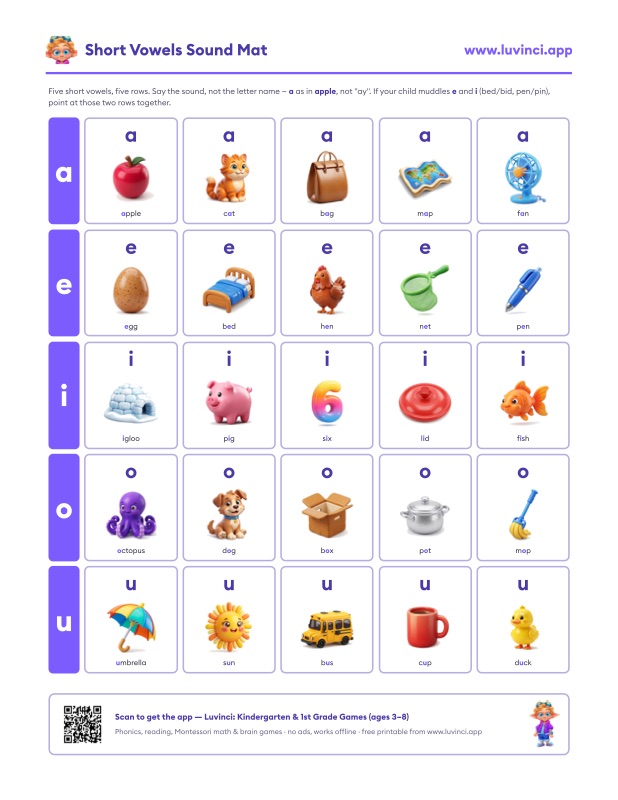
All five short vowels, with picture cues, are on our free Short Vowels Sound Mat — one page, no signup. Stick it where your child reads.
The five short vowels, with word lists
Say each sound clean and short. No “ah-uh,” no letter names.
Short a — /a/ as in apple cat, hat, bag, map, fan, cap, ham, jam, van, tap, sad, bat (all short a words)
Short e — /e/ as in egg bed, hen, net, pen, red, leg, ten, wet, jet, web, get, well (all short e words)
Short i — /i/ as in igloo pig, six, lid, fish, big, hit, lip, tin, win, zip, kid, dig (all short i words)
Short o — /o/ as in octopus dog, box, pot, mop, hot, top, log, fox, hop, rock, sock, job (all short o words)
Short u — /u/ as in umbrella sun, bus, cup, duck, bug, mug, rug, hut, nut, run, tub, jump (all short u words)
Notice what those words have in common: nearly all are three letters, consonant–vowel–consonant. That’s not a coincidence. Short vowels and simple three-letter words arrive together, which is why they come first in the letter-sound teaching order.
Once a handful of these words are readable, let your child do something with them: our free short vowel sentence building worksheet has WHO, DID WHAT and WHERE picture cards to cut out, build into a silly sentence, and write. Two pages, no signup.
How to tell a short vowel from a long one
The test a child can actually use: does the vowel say its name?
- cap — the a says /a/. Short.
- cape — the a says “ay,” its own name. Long.
A useful pattern, though not a law: a single vowel squeezed between two consonants is usually short — cat, bed, pig, hop, cub. Something has to be added to stretch it out.
There are three main ways English makes a vowel long:
- A magic e on the end — cap becomes cape, kit becomes kite. That’s the magic e rule.
- Two or three letters teaming up for one vowel sound — rain, boat, tree, pie, light. Those are vowel teams.
- A vowel at the end of a syllable — go, he, me, and the opening bit of baby, tiger, open. Nothing to cut it short, so it says its name.
All five long sounds with their spellings side by side are in long vowel words.
Teach short first, completely. Long vowels only make sense as a contrast, and a child who isn’t solid on /a/ has nothing to contrast cake against.
The one pair that causes real trouble
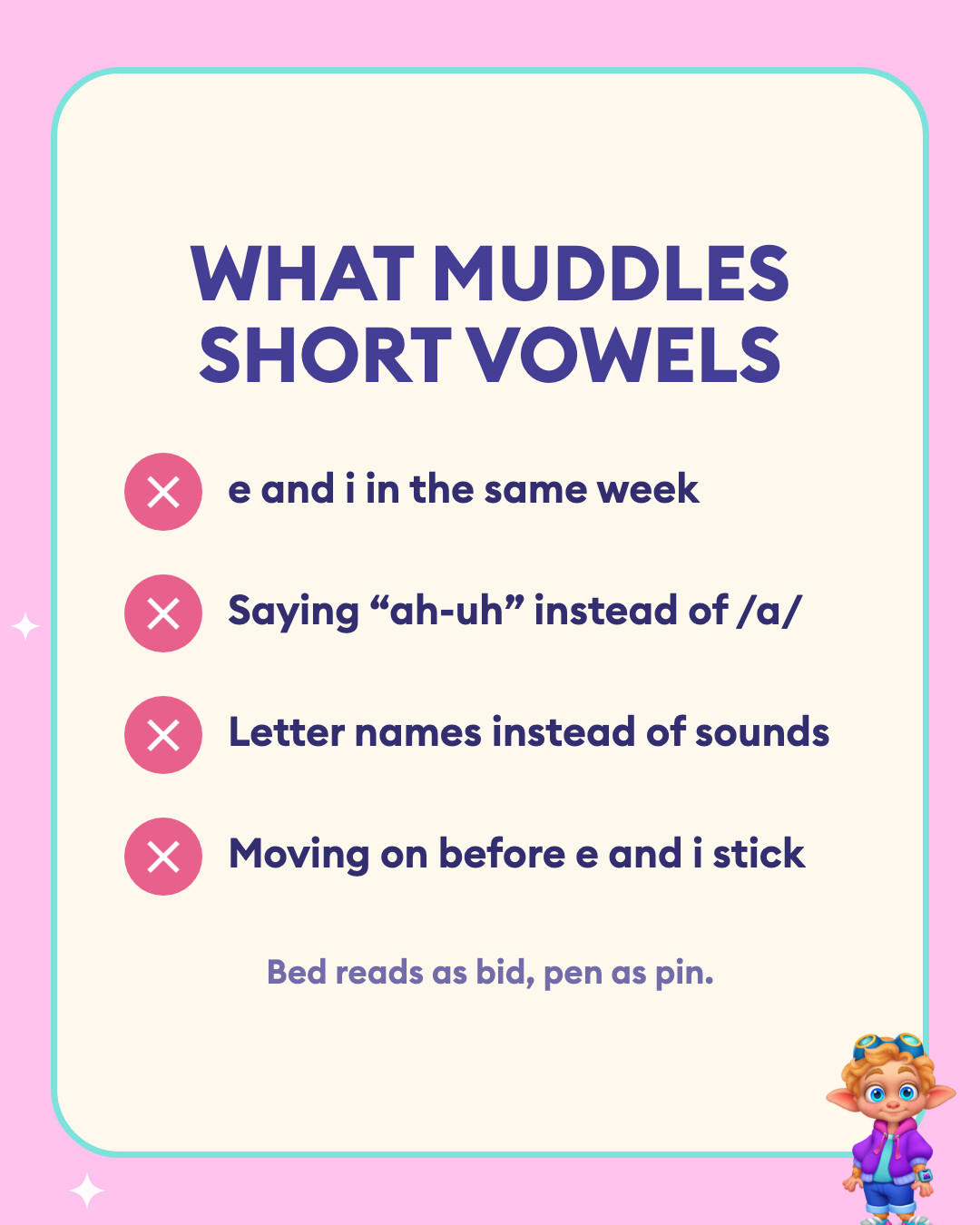
e and i. Almost every child mixes them: bed read as “bid,” pen as “pin,” ten as “tin.” It isn’t carelessness — the two sounds are genuinely close in the mouth.
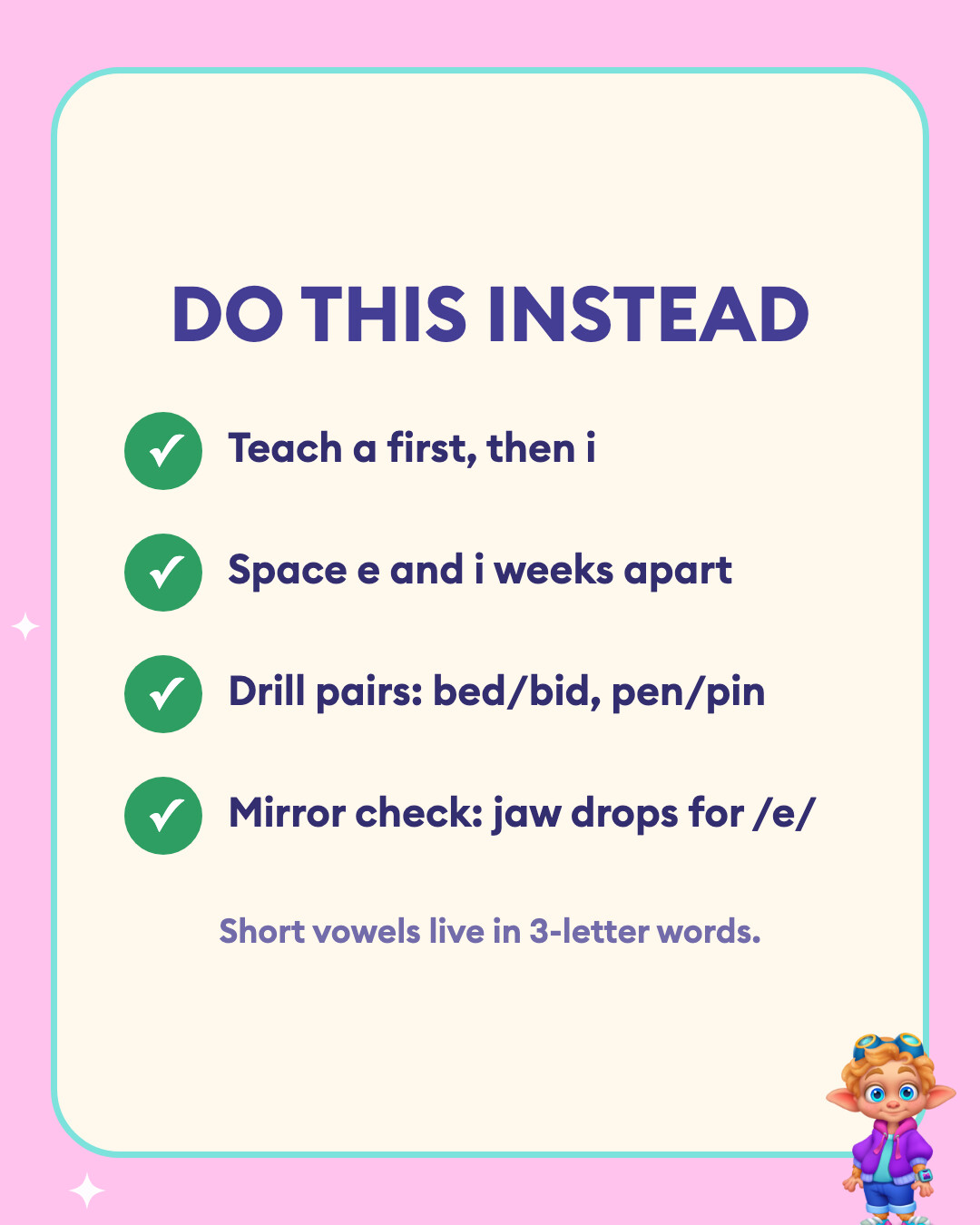
Two things help. First, don’t introduce them in the same week; space them apart, the same way you’d keep b and d apart. Second, make it physical: for /e/ the jaw drops open a little; for /i/ it closes back up, with the lips relaxed and only slightly spread. Have your child watch your face, then their own in a mirror.
Then practice them deliberately together, in pairs: bed/bid, pen/pin, peg/pig, bet/bit, met/mitt. Confusion beaten head-on beats confusion avoided.
Hearing the difference is exactly where a screen pulls its weight — our reading games sound out each vowel cleanly and build from single sounds to whole words for ages 3–8, with no ads and offline play.
Questions parents ask
Which short vowel should I teach first? a, then i. They’re the two vowels in the SATPIN opening group, and between them they unlock sat, pin, tap, nip and dozens more real words in the first weeks.
Are short vowel words the same as CVC words? Nearly. Almost every CVC word (consonant–vowel–consonant) has a short vowel, which is why the two terms get used interchangeably. A few CVC words break it — put, and anything with r after the vowel like car or her — but not enough to worry about early on. For the words grouped by family (-at, -an, -ig, -op) in teaching order, with picture cards, see our CVC word list.
My child knows the sound alone but not inside a word. That’s a blending problem, not a vowel problem. Stretch the word out — “mmm-aaa-p” — and squeeze it closer together each time until it snaps into “map.”
When do long vowels start? Once three-letter words are comfortable and not before. In UK schools that’s Phase 3 for the vowel teams and Phase 5 for magic e; in the US it’s usually partway through kindergarten or early first grade. Readiness matters more than the calendar.
The takeaways
- Five short vowels: a, e, i, o, u — the sound the vowel makes when it doesn’t say its name.
- Short vowels live in three-letter words — cat, bed, pig, dog, sun. Teach them together.
- Long = the vowel says its name, made by magic e, a vowel team, or a vowel ending a small word.
- e and i will get muddled. Space them out, then drill the pairs: bed/bid, pen/pin.
- Print the free Short Vowels Sound Mat — all five sounds, 25 picture words, one page.
- All 22 short vowel printables — this chart plus 21 read-and-write worksheets, short a through short u.