Luvinci
August 22, 2026
Phonics vs. Whole Language: What Parents Should Know (and How to Tell Which One Your School Uses)
Phonics vs whole language is the oldest argument in reading instruction, and it is shaping your child’s kindergarten or first-grade classroom right now. The short version: phonics teaches children to read a word by turning its letters into sounds. Whole language teaches them to recognize words as wholes and to use pictures, context and guessing when they get stuck. The research, summarized in the National Reading Panel’s 2000 report, found that systematic phonics produces better readers, and the gap is widest for the children who find reading hardest. The decoding part of reading has a right answer, and you can check whether your child is getting it.
What each method actually does
Phonics starts small. A child learns that s says /s/, a says /a/, t says /t/, then blends them into sat. New patterns follow in a planned order. The child reads words they have never seen by working them out; only a few truly irregular words are memorized.
Whole language starts big. The theory, popular from the 1970s to the 1990s, was that children learn to read the way they learn to talk: surrounded by real books, figuring words out from meaning. Children are taught to look at the first letter, look at the picture, think about what makes sense, and keep going. Phonics is taught “as needed”, which often means not at all.
If you learned to read when phones still had cords, there is a good chance this is how you were taught. So if your child’s phonics homework looks nothing like anything you remember, that is not a sign the school has lost the plot. It is a sign they updated it.
Most schools today say “balanced literacy”, meant as the peace treaty: real books and phonics. In many classrooms the phonics half is thin, unsystematic, or reserved for children already struggling.
What the research found
The 2000 National Reading Panel, convened by Congress and the NIH to review the experimental evidence, concluded that systematic, explicit phonics (a planned sequence, taught to every child) produced stronger word reading, spelling and comprehension than approaches with little or no phonics, most of all for children at risk of reading difficulty. Twenty years of “science of reading” research has reinforced it. The three-cueing strategy at the heart of whole language (use meaning, sentence structure and the first letter to guess) turns out to be what poor readers do and good readers do not. Skilled readers look at every letter, just too fast to notice.
Reading aloud, vocabulary and a love of books still matter enormously; whole language was right about that. They are just not a substitute for the code. How kids learn to read covers how the two halves fit.
How to tell which one your child’s school uses
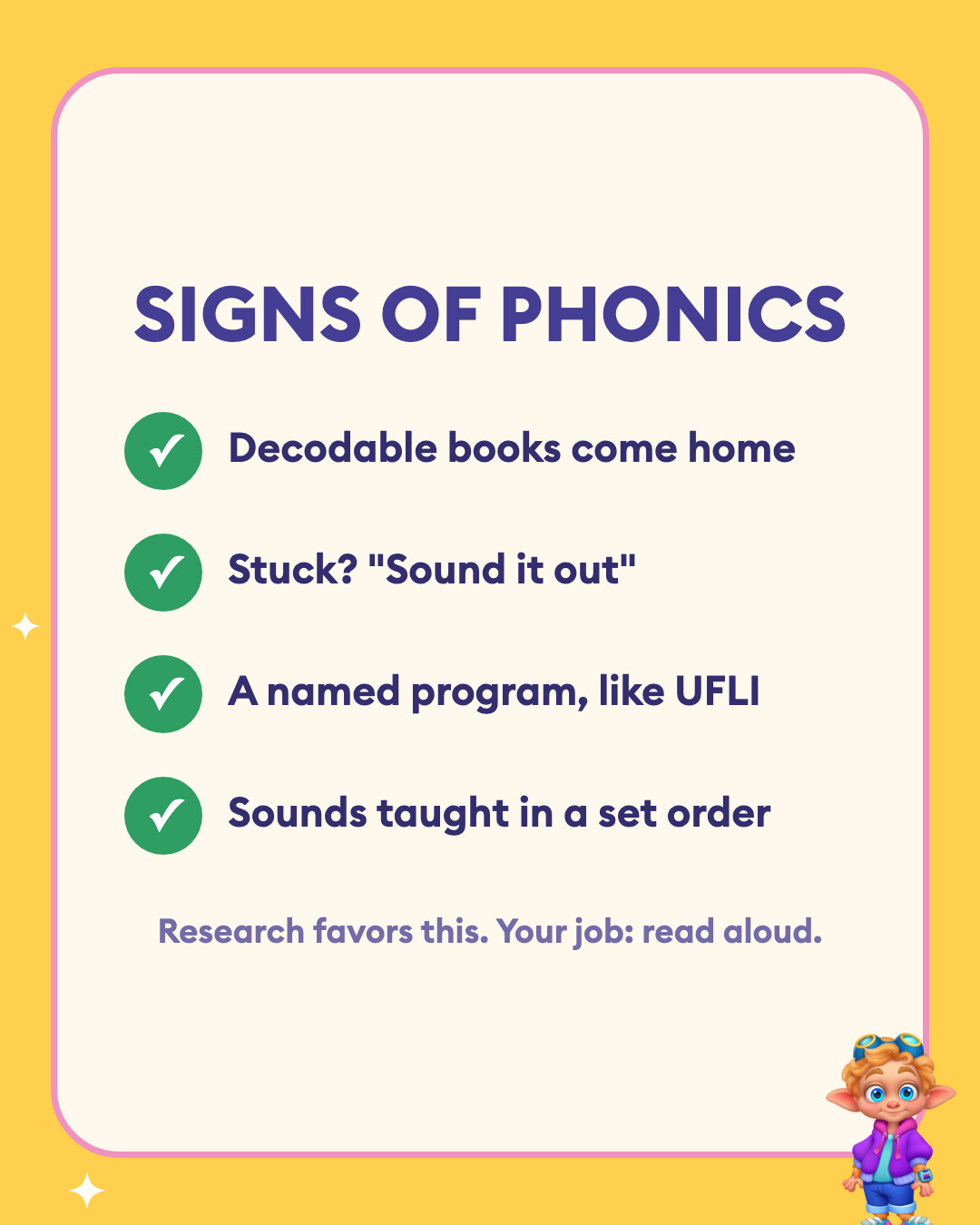
Signs of phonics
- A named scope and sequence: the teacher can say which sounds come in which weeks, usually from a named program such as UFLI Foundations or Fundations.
- Decodable books: slightly odd stories (“Sam sat on the mat”) built only from sounds already taught.
- The stuck-word prompt is “sound it out”, and the teacher waits.
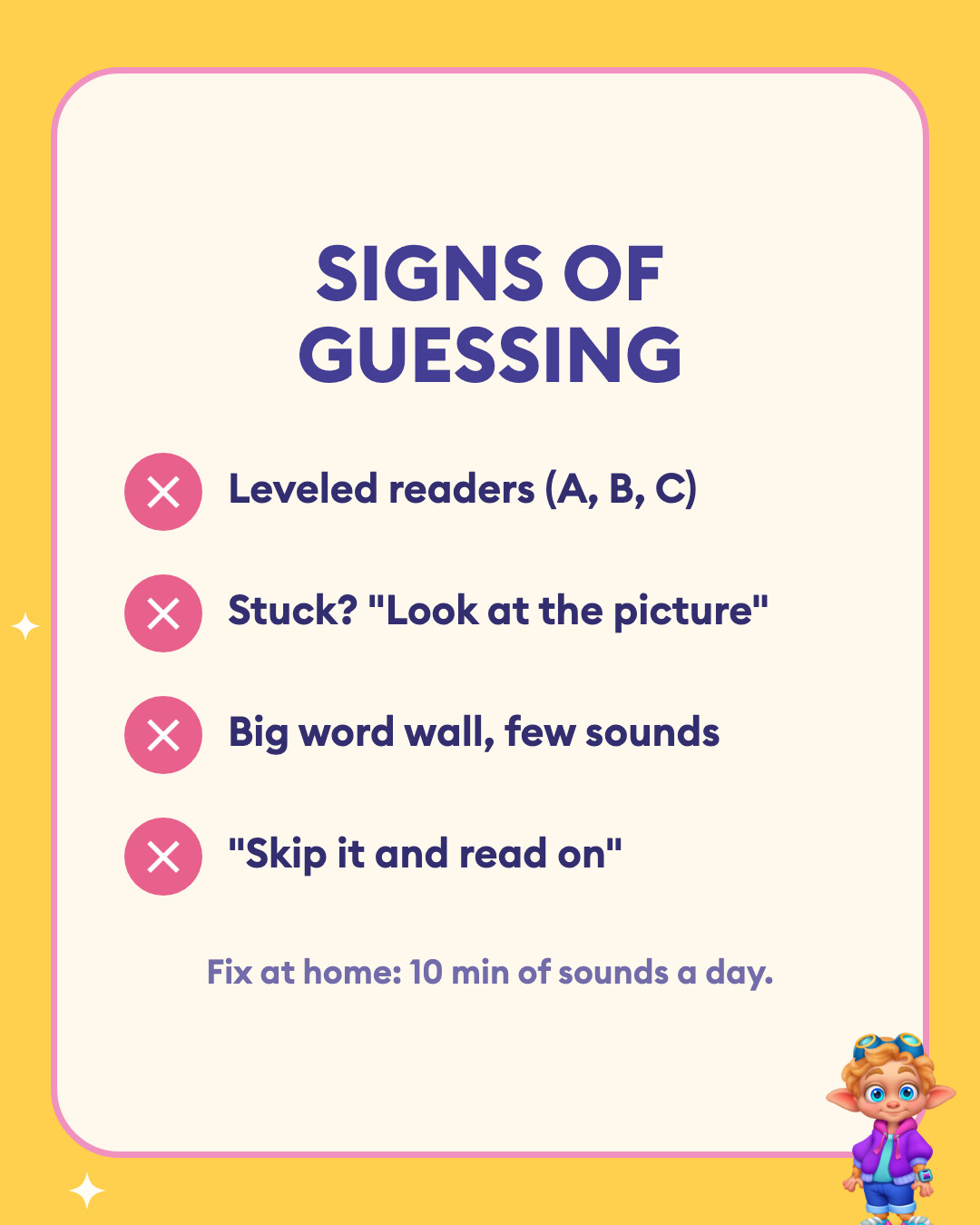
Signs of whole language or three-cueing
- Leveled readers (Level A, B, C…) with repeating sentences and a picture that gives the word away: I see a dog. I see a cat.
- The stuck-word prompts are “look at the picture”, “what would make sense?”, or “skip it and read on”.
- A big word wall and sight-word memorizing before most letter sounds are taught.
Two questions for the next conference: “Which phonics program do you use?” and “When my child gets stuck on a word, what should they do first?” The answer you want to the second is sound it out.
“The games are challenging and really teach kids a lot about math and reading, especially how to sound out vowels and consonants.” — GM’s review, App Store review (US)
What to do at home, whichever method the school uses
If the school is solidly phonics-based, read aloud daily and let the school do the decoding. If not, ten minutes a day at home covers the gap for most children.
- Teach letter sounds, not names, in a sensible order: the best order to teach letter sounds starts with s, a, t, p, i, n.
- Practice blending out loud. The skill whole language skips; how to teach blending sounds walks through it.
- Change the stuck-word prompt. When your child guesses from the picture, cover it and say “look at the letters”. The habit fades.
- Keep the good half of whole language. Real books aloud, every day. Phonics is for the ten minutes; stories are for the rest of the day.
- Add patterns as they come up: digraphs, then magic e and vowel teams.
How to teach phonics at home is the step-by-step version, and our reading games sound out every letter and highlight each word as it is read aloud.
Questions parents ask
Is “balanced literacy” the same as whole language? Not by design, but often in practice. The two conference questions tell you which kind you have.
My child reads fine with leveled readers. Should I worry? Try a word with no picture clue. Guessers often do well through first grade, then stall in second or third when words get longer and pictures disappear. A child who can sound out a nonsense word like vop, a made-up word they have never seen, is decoding.
Are sight words whole language? Only when they are taught by shape. A short list of truly irregular words (the, said, of) taught by pointing out the tricky part is phonics.
The takeaways
- Phonics teaches the code; whole language teaches guessing from context. The research favors phonics, most clearly for children who struggle.
- Decodable books and “sound it out” signal phonics. Leveled readers, picture prompts and early word walls signal whole language.
- Ten minutes of home phonics covers the gap, and keep reading aloud.
- 200+ free printables, organized by skill and UFLI lesson, if you want a sequence to follow. No signup.