 Luvinci
October 4, 2026
Open Syllable Words List: Examples by Vowel + Free PDF
Free printable · PDF · 765 KB
Open Syllable Words List: Examples by Vowel + Free PDF
No signup needed. Just print it.
Download PDFAn open syllable is a word part that ends with one vowel, so the vowel usually says its name. Open syllable words are built from them: so, we, my, and the first part of mu·sic and ba·by. About 29% of syllables are open, second only to closed syllables, in one count of more than 17,000 words (Stanback, 1992).
This open syllable words list starts with little words a kindergartner can read, then goes vowel by vowel through words like ro·bot and mu·sic. We checked every word, and we mark the ones where the vowel doesn’t say its name. Many lists online mix in words like ago, video and piano, where the first vowel isn’t long.
so, we, be, my, fly, ba·by, ti·ger, ro·bot, pi·lot, mu·sic, pa·per, ha·lo, e·mu, spi·der, so → sob
A chart, a picture sort and the full lists are ready for parents, tutors and teachers to print. They’re in our free open syllable words PDF. 3 pages, free, no signup, no email.
Jump to: one syllable · two syllables · not long · PDF
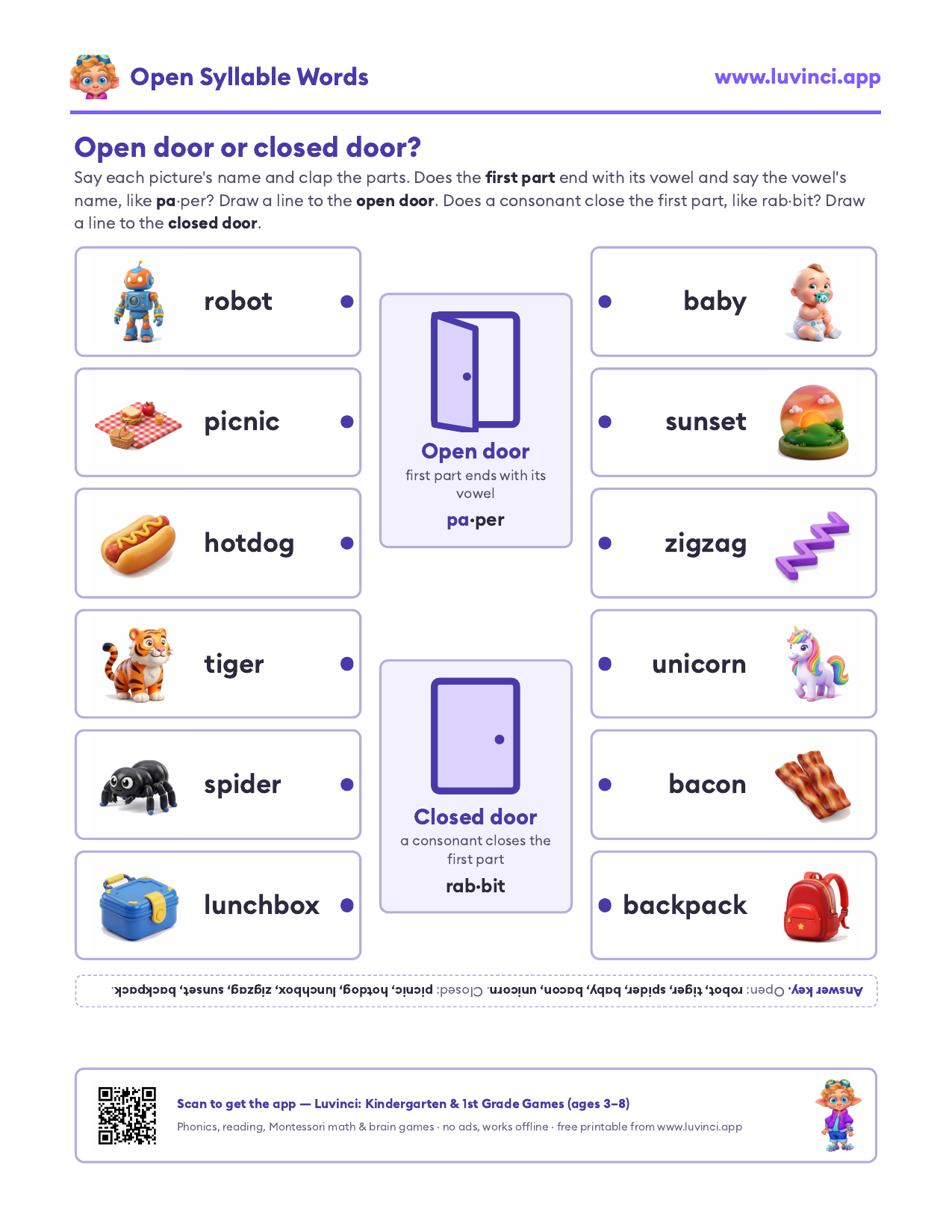
Page 2 of the free PDF. Twelve pictures to sort by their first part, open door or closed door.
What is an open syllable?
Look at the vowel, then look right after it in the same part of the word. If nothing is there, the syllable is open. Try the vowel’s name. If a consonant is there, it’s closed. Try the short sound. Picture a door sitting after the vowel. In an open syllable that door stays open. A consonant shuts it.
At the table: Put so on the page and have your child read it. Add a b after the o, then ask, “What happened to the o?” The b shut the door, and now the o is short: sob. Try two more:
- we → web, hi → hid
It’s a pattern, not a law. In open syllables, e, o and u say their names about 90% of the time. A, i and y are much less regular (Reading Universe, citing Stanback).
Long u has two sounds. Mu·sic says “yoo”, tu·lip says “oo”. Start with short vs long vowels if the long and short sounds are still new to your child.
Our open vs closed guide has a side-by-side with closed syllables and a card sort. Open is one of the syllable types children learn to spot. The first one they meet is the closed syllable.
Little open words: go, so, hi (kindergarten)
Your child will read these long before they hear the word “open”. A vowel at the end of a short word says its name.
The little word a ends with its vowel too, but it usually says “uh”. I is open too. Children meet it in their first books, before this pattern, so our sheets keep it as a heart word.
At first, some programs treat go, me and she as heart words. Once your child knows a vowel at the end says its name, those three can be sounded out. Our kindergarten sight words list treats them as sound-it-out words, with no heart mark.
When y is the vowel: my, fly, sky (1st grade)
In a short word with no other vowel, a y at the end says long i.
- my, by, why, fly, cry, try, dry, sky
When the word is longer, the y at the end usually says “ee”: ba·by, po·ny. More of both in our long i and long e lists.
Two-syllable open syllable words (1st or 2nd grade)
The first part in these words ends with its vowel, so try the long sound first: ro·bot, ti·ger. Put a finger over the second part, read the first part with the vowel’s name, then add the rest.
If that doesn’t make a word, move the split and try it short, as in cam·el. The long try works about 47% of the time in two-syllable words (Kearns, 2020). Our camel words show the closed side.
Only the first part is open. The second part can be closed (ba·sic), lazy, where the vowel goes quick and says “uh” (ba·con), or bossy r (ga·tor). Each row saves words that end with er, or or ar for last. If those endings are still new, read that last part for your child: er and or at the end of a word usually sound like “er” (see bossy r words).
By vowel: a, e, i, o, u
The open part is in bold.
- Long a, like ba·by: ba·sin, ra·ven, ba·sic, ha·zy, ba·ker, wa·fer, cra·ter, ga·tor, ra·dar
- Long e, like e·mu: se·cret, re·fill, re·run, re·play, pre·school, me·ter, ce·dar, fe·ver
- Long i, like ti·ger: li·lac, bi·son, si·ren, spi·ral, ti·dy, i·cy, di·ver, dri·ver, vi·per; y as the vowel: py·thon, hy·drant
- Long o, like ro·bot and o·pen: to·ken, bro·ken, ro·dent, o·pal, co·zy, clo·ver, ro·ver
- Long u, like mu·sic: hu·man, pu·pa (“yoo”); pu·ma, tu·na, du·et (“oo”, some say “yoo”); tu·tor, lu·nar
The e in re- and pre- often says its name. Sometimes it goes quick (see below).
Both parts open
A few words stay open from start to finish.
- ha·lo, so·lo, po·lo, lo·go, si·lo, rhi·no (the h is silent), ju·do, su·mo, to·fu
- ze·ro, he·ro: the e before r can sound like “ear”
The open part comes last
The first part here is closed and short. The open part sits at the end.
- hip·po, ban·jo, man·go, jum·bo, bin·go, tan·go, men·u
Words like ti·tle, sta·ple, la·dle and ta·ble start open and end in a consonant-le part.
Longer words with open parts (2nd grade and up)
You’ll often find more than one open part in bigger, multisyllabic words.
- la·dy·bug, po·ny·tail, ro·de·o (three open parts), ba·by·sit, tor·na·do, vol·ca·no, hy·e·na
The last part of hyena goes quick. Read each open part long, take the rest as they come, then say the word the way you talk.
When an open vowel doesn’t say its name
Treat an open syllable as a first guess. These are the words where that guess needs a fix.
- Lazy at the start: a·wake, a·like, a·live, to·day
- A quick “ih” in be- and re-: be·gin, be·low, be·side, re·peat (“ih” or “ee”, both are fine)
- o says “oo”: do, to, who
- “uh”: the, a
- a says “ah”: ma, pa, spa, ta·co, ko·a·la
- i says “ee”: ski, tax·i, ki·wi, and before another vowel: ra·di·o, pi·an·o, stu·di·o
An a at the end of a word often goes quick too. See our schwa list. The, to, do and who are on our heart words list.
Show your child the i that comes before another vowel. In radio, piano and studio it says “ee”, not its name. If the long i doesn’t make a word, try “ee”.
Looks open, but isn’t
- These end in a vowel sound spelled with two letters: see, tree, key, day, pie, toe, high, they. More in vowel teams explained.
- These end in an e you can’t hear: make, like. See magic e words.
Five-minute open syllable games
Grab paper and a pencil. Pick one or two, and stop while it’s still fun.
- Door card. Put so on a card. Tape a small paper flap just after the o and write a b on it. Fold the flap over: sob. Fold it back: so. Then try we/web, no/nod and hi/hid.
- Robot talk. Say “ti… ger” like a robot. Your child says the word and claps the parts.
- Y sort. Write eight words on scraps of paper: my, fly, sky, cry, ba·by, po·ny, ti·dy, co·zy. Your child reads each one and puts it under “says eye” or “says ee”.
- Picture sort. Page 2 of the PDF: draw a line from each picture to the open door or the closed door. No cutting.
- Mark it. Your child draws a short line over each vowel that says its name: sō, mū·sic, rō·bot.
- Build it. Make ti·ger with letter tiles, push the two parts apart, then read ti long and add ger.
- Book hunt. Find three open words in tonight’s book.
Sentences to read aloud
Open words sit in every line. After you read one, ask your child to find the words with a vowel that says its name.
- Hi! I am a robot.
- The tiny pony is so cozy.
- We hid the tuna in the silo.
- Why is the sky so dry?
- A bison and a rhino go to the rodeo.
- My spider can be a diver.
Free PDF: open syllable chart, picture sort and word lists
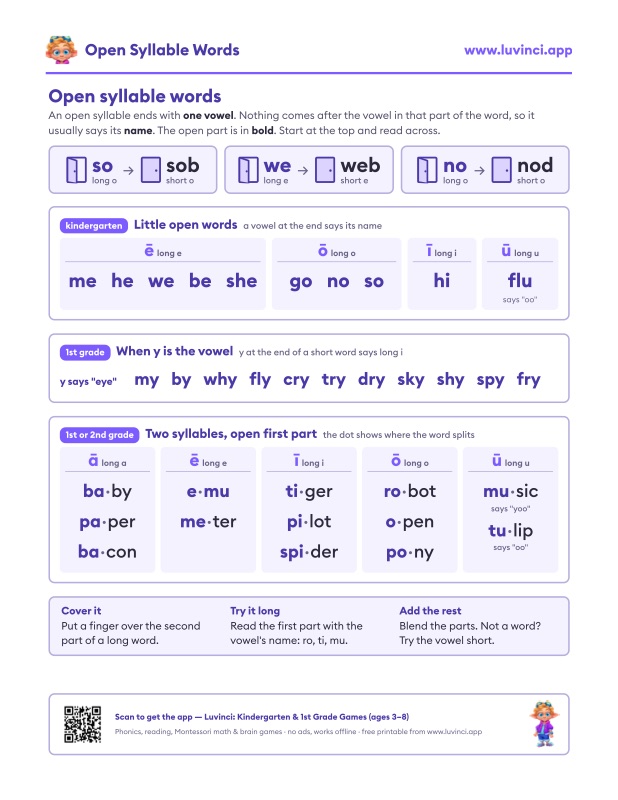
- Page 1: three door pairs, then one-syllable words, y words and two-syllable words by vowel, with the open part in bold.
- Page 2: a picture sort. Twelve pictures, open door or closed door. Draw a line, no cutting, no glue. The answer key is upside down at the bottom.
- Page 3: the full two-syllable lists by vowel, a consonant-le row, both-parts-open and open-part-last rows, a try-it-long strip, a strip of words where the vowel doesn’t say its name, and the six sentences.
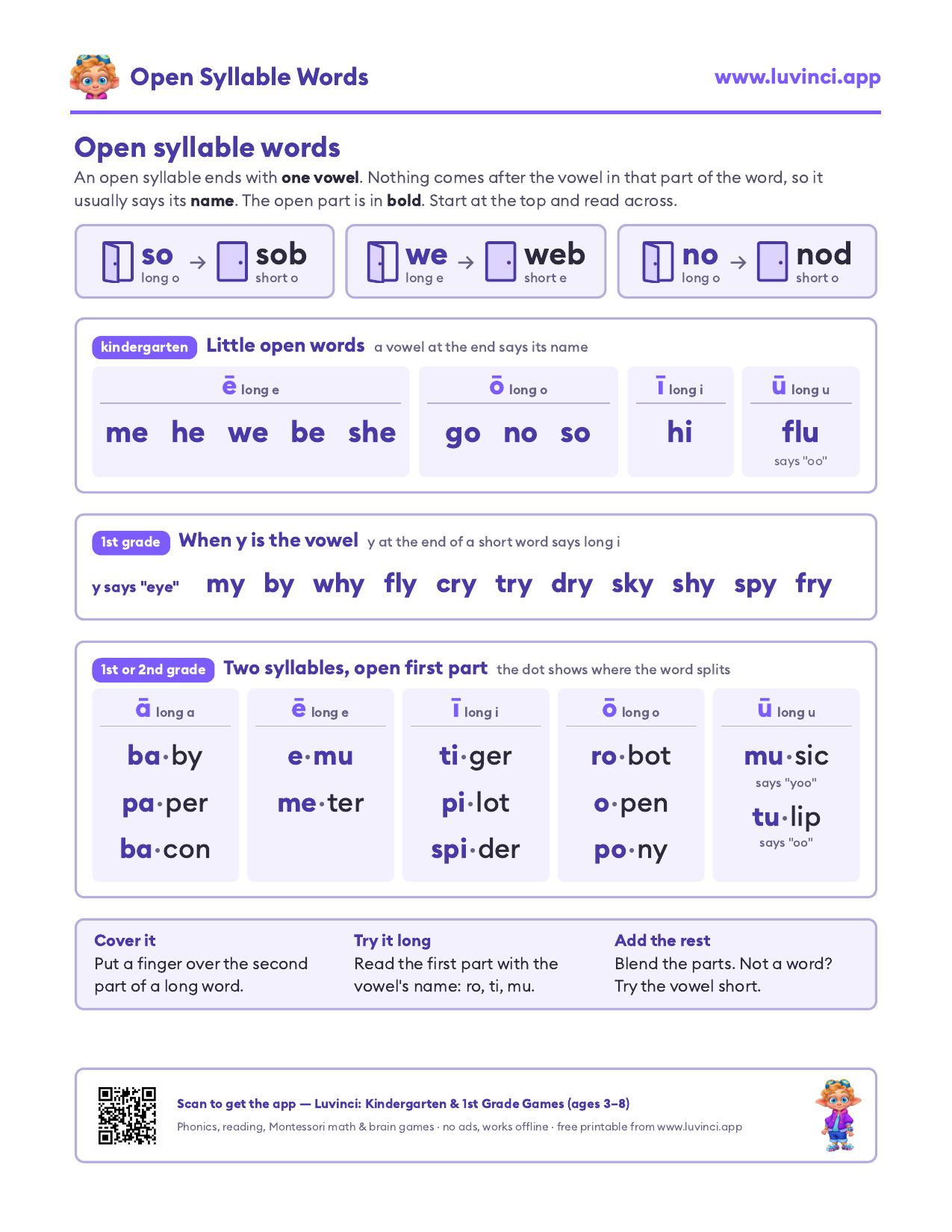
Page 1 of the free PDF.
Keep page 1 as a chart on the fridge. Page 2 works as a free printable open syllable worksheet. Download the free open syllable words PDF. No signup, no email. For more at this stage, see our printables for UFLI lessons 63-68 and the decodable stories for the same lessons: in “Milo and the Frog”, Mi·lo starts open.
Questions parents ask
Is open 1 or 2 syllables? Two: o·pen. The o ends the first part, so it says its name. The second part, pen, is closed, and its e goes quick when we talk.
Is she an open syllable? Yes. So are so, no, hi, we and be, and the first part of ba·by. Pi·lot starts with one too: pi says its name, and lot is closed.
Is the word “my” an open or closed syllable? Open. Y is the only vowel and it ends the word, so it says long i, like fly and cry.
Is the word “the” an open syllable? By spelling, yes: it ends with e. But the e usually says “uh”, so children learn the as a heart word. To and do end open too and say “oo”.
Is see an open syllable? No. See ends with ee and they with ey, both vowel teams. An open syllable ends with one vowel letter.
What are some open syllable long A words? ba·by, pa·per, ba·con, ba·sic, ra·ven, a·corn, ta·ble.
Can a kindergartner read open syllable words? Yes, short ones like go, so and me. Two-part words like ti·ger usually come in 1st or 2nd grade, depending on the program, and longer words like la·dy·bug after that.
UFLI Foundations teaches open syllables next to closed ones in lesson 68, y as long i in lesson 73 and y as long e in lesson 74 (see our worksheets in UFLI order).
Our reading games sound out every letter and have your child pick the missing letter, ages 3 to 8, no ads, offline. From here: long vowel words, or closed syllable words if short vowels need more practice.
Created to align with UFLI Foundations’ scope and sequence; lesson numbers are cited for alignment only. This post and its PDF are our own original work, not created by nor endorsed by UFLI or the University of Florida.
