Luvinci
September 22, 2026
Short I Words: Word Lists and Sentences for Kindergarten
Free printable · PDF · 931 KB
Short I Words: Word Lists and Sentences for Kindergarten
No signup needed. Just print it.
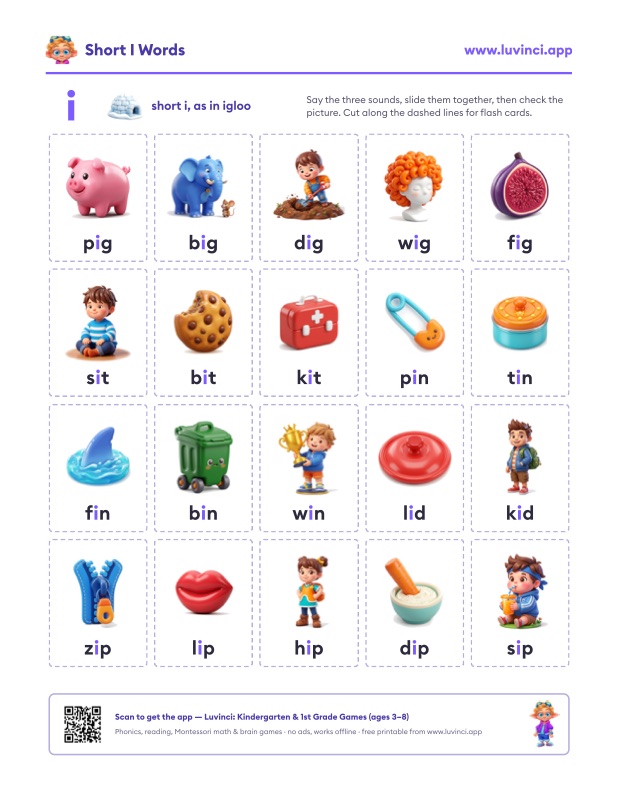
Download PDFShort i words are words where the letter i says /i/, as in igloo, itch and pig. It’s the second vowel most children learn, right after short a. It’s also the vowel in many of the first words they read: sit, pin, tip, pit, nip. You’ll find 20 picture cards on our free short i words flash cards, plus the full word list and sentences on page 2. You don’t need to sign up or leave an email.
The short i word list lives on this page, grouped the way you’d practice it, with sentences to read aloud and the words that look like short i but aren’t. For all five short vowels and how long vowels differ, start with our short vowel words overview.
The short i sound
Short i is a quick /i/. That’s not “eye”, which is the letter’s name. And it’s not “ih-uh” either. Clip it short.
To make it, the lips are relaxed, just slightly spread, and the jaw opens only a little. (A big smile makes long e, as in see.) Ask your child to say itch so they can feel how little the mouth opens.
That matters because of short e. For /e/ the jaw drops a little lower. The two sounds are only a jaw-drop apart, which is why bed and bid get mixed up. We’ll come back to that mix-up below.
SATPIN puts i in the first group of six letters, if that’s the order your child is following. See our order to teach letter sounds.
Short i words list by word family
These are CVC words. That’s consonant, vowel, consonant. Hold the ending still while you swap the first sound. That’s the fastest way to read a lot of words in one sitting.
- -it: sit, bit, fit, hit, kit, lit, pit
- -in: pin, tin, fin, win, bin
- -ig: pig, big, dig, wig, fig
- -ip: zip, lip, hip, dip, rip, sip, tip, nip
- -id: lid, kid, hid, rid, did
- -ix: six, fix, mix
- -im / -ib: him, dim, rim, bib, rib, fib
Next come families with two letters at the end. The ll, ck and sh are one sound each, so these still blend like three sounds.
- -ill: hill, fill, will, pill, bill
- -ick: kick, pick, sick, lick, tick
- -ish: fish, dish, wish
Our CVC word list has every CVC family across all five vowels, in teaching order.
Words that start with the short i sound
There aren’t many, and most are small words your child will read every day.
in, it, is, if, its, ill, inch, itch, insect
igloo is the classic picture for short i, and its first sound is a clean /i/. The rest of the word isn’t short i (the “loo” is a long oo), so hear the first sound with igloo. Don’t use it as a word to sound out.
One of these needs a note. is has an s that says /z/. And don’t confuse any of them with the word I, which says its name. Both are covered in the traps below.
Short i words for kindergarten: a starter set of 20
This is the list to use if you pick only one. Every word sounds out with a letter-by-letter blend, and most are easy to draw.
pig, big, dig, wig, sit, hit, pin, tin, win, lid, kid, hid, zip, lip, tip, six, fix, him, bib, did
Words that make good picture cards (for a matching game or a word wall): pig, fish, lid, pin, six, wig, bib, lips, hill, zip, dish, ship, chick, milk, gift, crib, mitt, kid. Short i picture words sit next to the other four vowels on one page of our free Short Vowels Sound Mat.
For a bigger set, print our free short i picture flash cards: 20 CVC picture cards like pig, zip and lid, ready to cut out.
Short i words with blends and digraphs (late K and 1st grade)
Add a second consonant after your child is reading CVC words smoothly. The short i doesn’t change. Only the edges get busier.
Blends at the start (consonant blends): flip, slip, drip, trip, grip, skip, clip, snip, spin, skin, grin, twin, swim, slim, crib, brick, stick, trick, still, split, sprint
Blends at the end: gift, lift, milk, list, fist, mist, mint, hint, limp, silk
Digraphs (sh, ch, th, wh): ship, shin, chip, chin, chick, rich, this, thin, with, whip, which
-tch (the t is silent here; more in our tch words list): itch, pitch, ditch, witch
Longer words where every syllable is short: picnic, windmill, lipstick, zigzag, hilltop, pigpen. The first three are short i all the way through. In the last three, the second syllable uses another short vowel. Read them in two chunks: pic / nic, zig / zag.
Sentences to read aloud
These use only short vowel words, mostly short i, plus two heart words. Those two are the and a. is and swims are fine too, once your child knows the s can say /z/. An -s on the end (pigs, sits) is fine once your child has met plural s.
Kindergarten (CVC words):
- Sit, pig, sit.
- A pig is in a pit.
- Tim did a big dig.
- The kid hid the lid.
- Is it a fig? It is!
- A pig can sit on a mat.
- Kim can fix the rip.
Late kindergarten into 1st grade (blends and digraphs):
- The fish swims with a fin.
- Jill will skip up the hill.
- A chick sits on a big stick.
- The ship tips and dips.
- Six chicks sit still.
Four free one-page worksheets give your child short i sentences to read, trace and write: a big pig, the pig sits, a kid digs and pig in a wig. You don’t need to sign up.
Short i and long i words: what happens when you add an e
Put an e on the end of a short i word and the i says its name, “eye”: kit / kite, pin / pine, rid / ride, Tim / time. That’s magic e. Wait until short i is solid before you teach it. Long i only makes sense as a contrast. Our magic e words guide has the full rule.
Traps: words that look like short i but aren’t
- kind, find, mind, wild, child. Before nd and ld, the i often says its name. These look like CVC words with a blend and they break the rule. Treat them as one small group when you teach them. (Not every word follows it. wind, the breeze, is short. wind a clock is long.)
- I. On its own, the word I says its name. It’s a heart word.
- is, his. The i is a normal short i. The s says /z/.
- bird, girl, first, dirt. An r after the i changes the sound. That’s bossy r, and it comes later.
- king, ring, pink, sink. Before ng and nk, the i sounds a little different in most American accents. Many programs teach -ing and -ink as chunks rather than as i + ng.
- give, live (as in “we live here”). These end in e but the i stays short. (A live show has a long i.) The e is there because English words don’t end in v. It’s not a magic e.
How to practice short i
- The mirror check. Say /i/ together in a mirror. Keep the lips relaxed and the jaw only a little open. Then say /e/ and watch the jaw drop a bit lower. Spend ten seconds on this every session.
- Pig to wig swap. Lay out the tiles i and g. Put p in front: pig. Swap the p for b, d, w, f. Have your child read each new word. Then do the same with -it and -ip.
- The e/i pair sort. Write e and i on two cards. Say a word from a pair: bed/bid, peg/pig, bet/bit, set/sit, led/lid, pet/pit. Your child points to the vowel they hear. Do this once short e has been taught, and keep it short. The pairs work better in practice than keeping the two vowels apart forever. (Pairs like pen/pin are left out on purpose. In some Southern accents pen and pin sound the same. That’s the accent, not a mistake.)
- Cover and write. Cover one of the sentences above after you read it, then have your child write it from memory. Or use a worksheet, or the cut-out short vowel sentence builder.
- Hunt the house. Find real short i things: a lid, a pin, a dish, a bib, milk, a gift. Say each one slowly: “lll-iii-d”. Have your child say the middle sound.
Short i is the quickest vowel to say, so in normal speech it almost disappears. If your child can say /i/ alone but can’t pick it out of a word, stretch the middle: “piiiig”. The next step, once they hear it, is blending the sounds back together.
Hearing /i/ and /e/ side by side is where a game helps. Our reading games say each sound cleanly, so your child hears pig and peg as different words. (Luvinci is our phonics app for ages 3-8, ad-free and playable offline.)
Questions parents ask
Should I teach short i before short e? Yes. i comes with the first six SATPIN letters. Short e comes later, and many children find it the hardest to hear. Keep e and i a few weeks apart, then practice them together in pairs.
My child reads “bid” as “bed”. What do I do? That’s one of the most common mix-ups, and it usually means the i sound isn’t solid yet. Go back to the mirror. For i the jaw barely moves. Then do the pair sort above with words like pig/peg and sit/set, a few minutes a day. (If your family says pen and pin the same way, that’s your accent, and it’s fine. Just skip pairs that end in n or m.)
Why is “find” not a short i word? Before nd and ld, the i usually says its name: find, kind, mind, wild, child. Teach those words as a group. It’s a pattern, not a random exception.
Is “igloo” a short i word? Its first sound is short i, which is why it’s on every sound chart. The rest of the word isn’t, so don’t ask your child to sound it out yet.
The takeaways
- Short i is /i/ as in igloo and itch. Keep the lips relaxed and the jaw only a little open.
- Start with the families: -it, -in, -ig, -ip, -id. Then -ill, -ick, -ish.
- Add blends and digraphs (flip, gift, ship, chick) once CVC words are smooth.
- Watch the traps: kind/find/wild, I, is, bossy r words like bird, and -ing/-ink.
- e and i get mixed up. Keep them apart at first, then drill pairs: bed/bid, peg/pig.
- Add an e and the i turns long: kit/kite, pin/pine. Save that for once short i is solid.
- Print the free short i flash cards: 20 picture cards, plus the full list and sentences. For all five vowels on one page, add the free Short Vowels Sound Mat, and see every short vowel worksheet.