Luvinci
November 11, 2026
Patterns for Kindergarten: AB to ABCD + Free Worksheets
3 free PDFs in this post
More PDFs (2)
Patterns for kindergarten are rows where a part repeats, like apple, banana, apple, banana. Kids start with AB, then move on to AAB, ABB and ABC. ABCD comes last. Copying a pattern and keeping it going comes first. After that they fix one, make their own and find the part that repeats.
Red, blue, red, blue. What comes next? Red.
Our free Picture Patterns PDF has 7 pages. Kids color, cut and glue, then fix and match picture rows from AB to ABCD. A pattern chart and an answer key sit at the back. You can download it for free. You’ll find a free PDF for Pattern Cards and for Patterns and Pairs in the list at the top.
Jump to: what a pattern is · the free PDF · AB to ABCD · how to teach it · what to say · activities · bigger patterns · FAQ
What are patterns for kindergarten?
A pattern is a row where a part repeats. The part that repeats is called the core. In red, blue, red, blue, the core is red, blue.
When you make a pattern, show the part that repeats at least two times, so your child can see it. “Red, blue, red” is too short to tell. “Red, blue, red, blue, red” is plenty.
Patterns are all around your child. Stripes on a shirt go red, white, red, white. Floor tiles take turns, light and dark. The days of the week start over every week. On a walk, point them out. Your child starts looking for them too.
No Common Core kindergarten standard is about patterns. Head Start’s preschool goals include them. Patterns also show up on early math readiness lists, and many kindergarten classes still teach them.
In one study that followed 517 children, pattern skills at 4 and 5 went with stronger math in 5th grade. The authors call the result tentative.
Kids find the core by noticing what is the same and what is different. Sorting by color or size uses that skill too. Our counting activities for kindergarten build the same early math in play.
Free patterns PDF: color, cut, fix and match
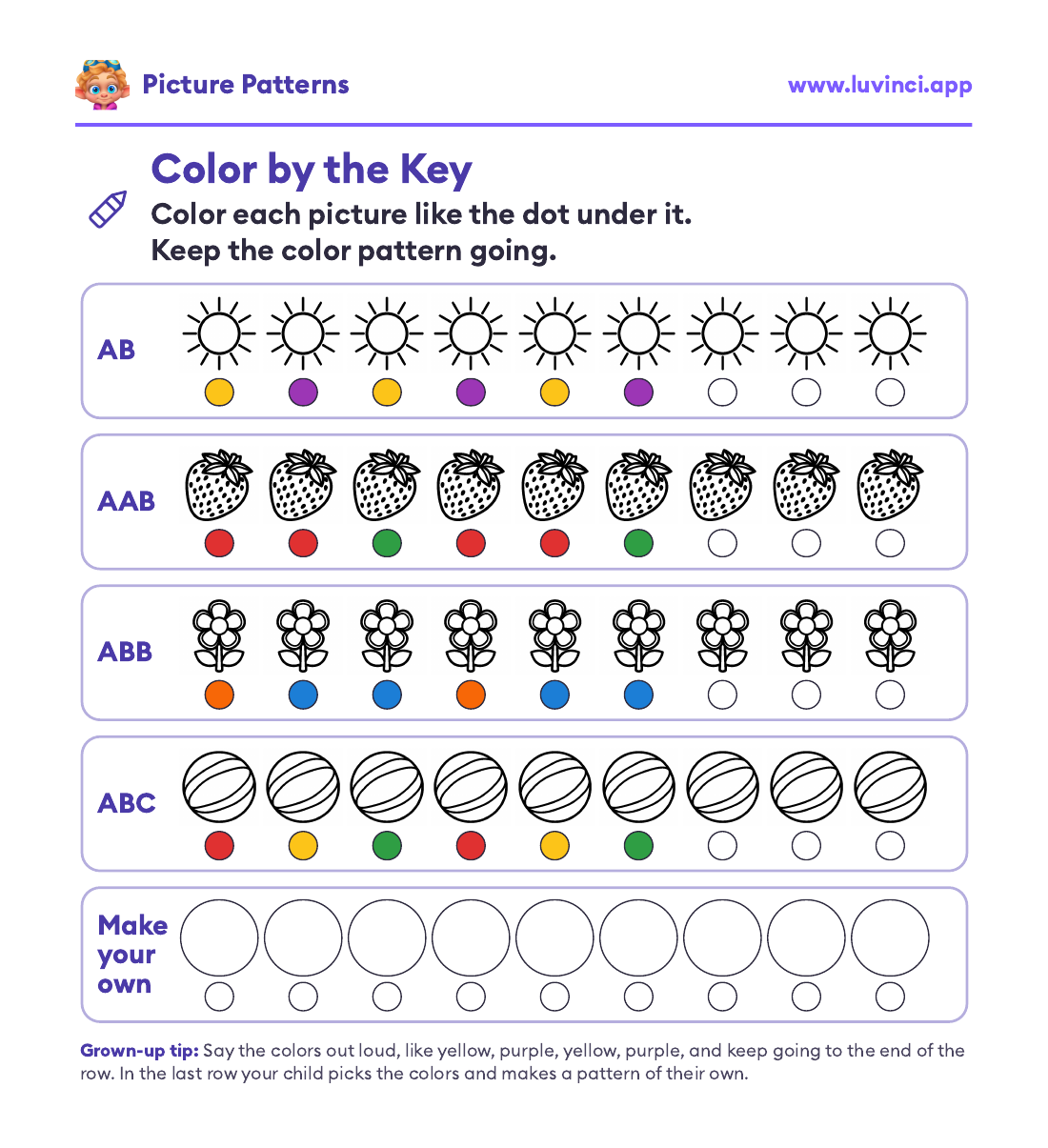
Each page of the Picture Patterns PDF covers this.
| Page | What’s on it |
|---|---|
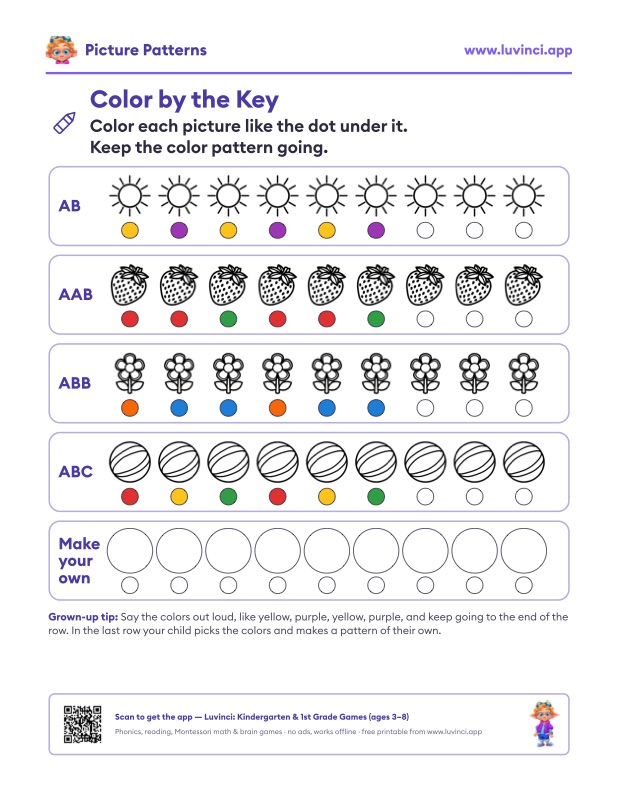
| 1 | Color by the Key. Each row starts with a color pattern. Keep the colors going, then make your own row |
| 2 | What Is Missing? Cut out the missing pictures and glue them into the gaps |
| 3 | Cut sheet. Round picture pieces for page 2, plus a few extras that don’t fit |
| 4 | Fix the Pattern. The first row is done for you. Put an X on the picture that doesn’t belong, then circle the right one |
| 5 | Name the Pattern. Match each picture row to the shape row with the same pattern, like AB or AAB. Then circle the part that repeats |
| 6 | Pattern Chart. AB, AAB, ABB, ABC, AABB and ABCD, with one picture row each |
| 7 | Answer key |
| What’s on it | |
|---|---|
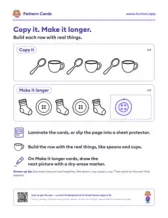
| Pattern Cards | A how-to cover, then 24 strip cards with rows of spoons, cups, bowls, forks, socks, crayons, buttons and blocks. Half say “Copy it” and half say “Make it longer” |
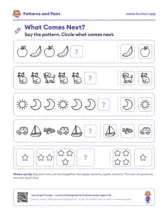
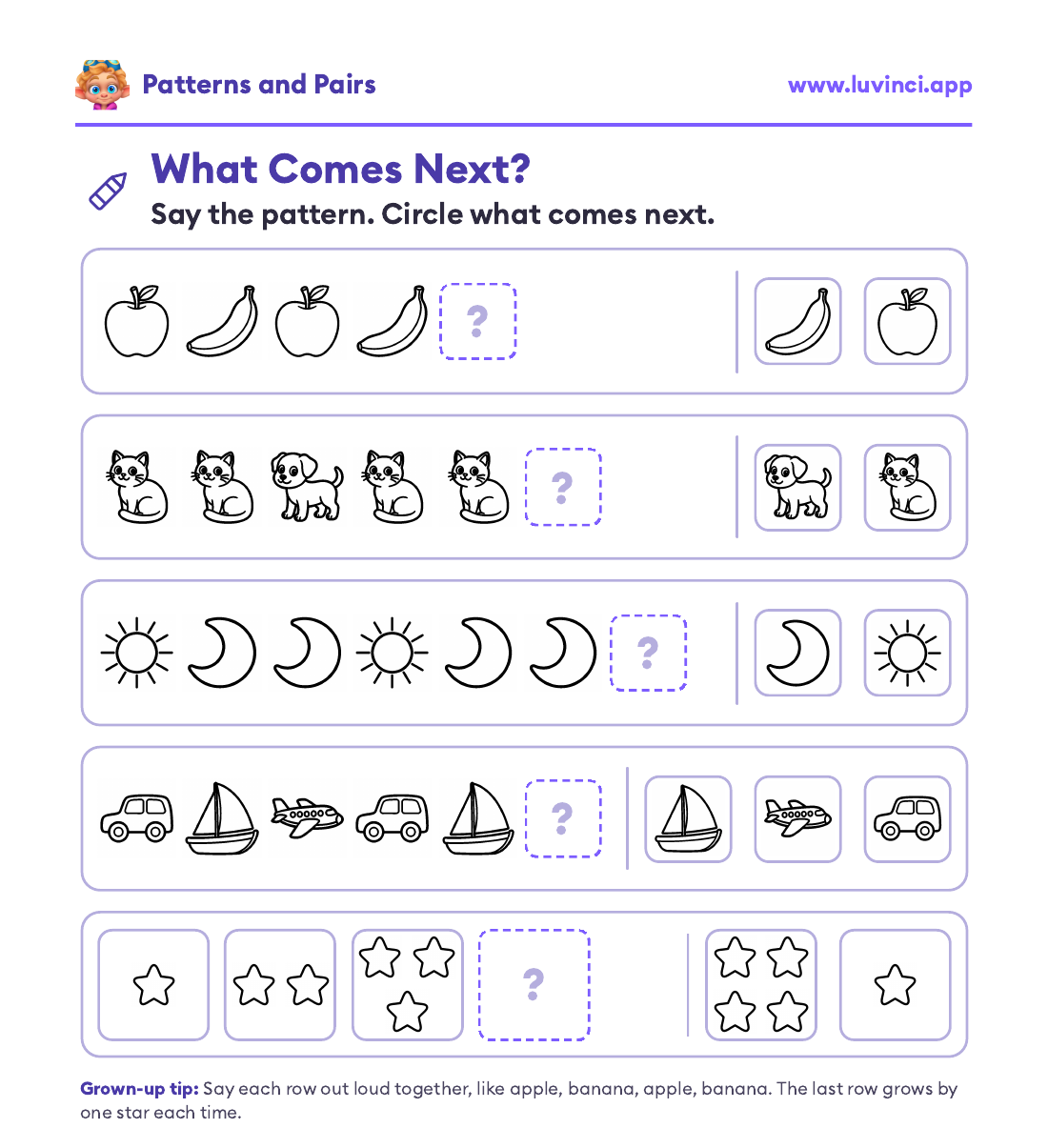
| Patterns and Pairs | 2 pages. Circle what comes next in AB, AAB, ABB and ABC rows, plus a row of stars that grows. Then cut and glue pictures onto pattern strips |
The AB rows on their own make a first week of AB pattern worksheets. Leave the longer rows for later.
Printing tips:
- Print at 100% (“actual size”) on US Letter, so the round pieces on page 3 fit the glue spots on page 2.
- Black and white is fine for most pages. The pictures are line art, so they print light and are fun to color. Page 1 has colored dots, so print that page in color, or color the dots in together first.
- Laminate the chart and the cards, or slide them into a sheet protector. Then use a dry-erase marker.
- Print the answer key for yourself.
The round pieces give scissor practice too. Our fine motor skills guide has more.
AB patterns first, then AAB, ABB, ABC and ABCD
An AB pattern takes turns between two things, like apple, banana, apple, banana. Most kids learn this one first. Snap, clap, snap, clap is an AB pattern too.
After that, the core grows longer one step at a time.
| Type | Example | The part that repeats |
|---|---|---|
| AB | sun, moon, sun, moon, sun, moon | sun, moon |
| AAB | cat, cat, dog, cat, cat, dog | cat, cat, dog |
| ABB | red, blue, blue, red, blue, blue | red, blue, blue |
| ABC | car, boat, plane, car, boat, plane | car, boat, plane |
| AABB | clap, clap, stomp, stomp, clap, clap, stomp, stomp | clap, clap, stomp, stomp |
| ABCD | spoon, cup, bowl, fork, spoon, cup, bowl, fork | spoon, cup, bowl, fork |
AAB and ABB use a core of the same length. They still look different. In AAB, the double comes first. In ABB, the double comes last. AABB has a double of each. ABCD needs four different things, so it comes last.
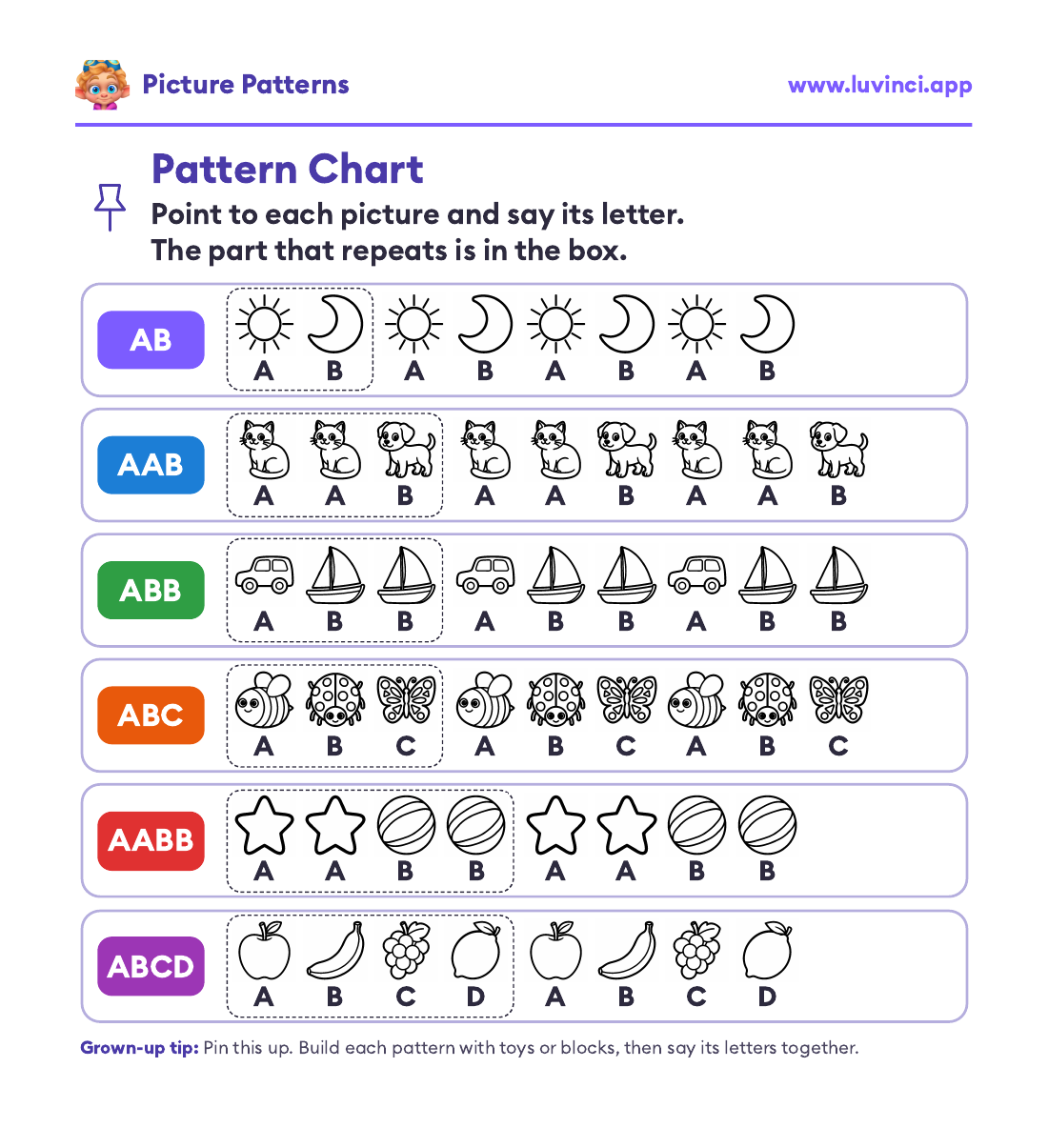
Say the letters early. Call sun, moon, sun, moon an AB pattern. Call red, blue, red, blue an AB pattern too. The letters show that both rows work the same way, even with different things. Long before they can name a core on their own, your child can follow the letters.
How to teach patterns in kindergarten
Most children go roughly in this order. Some skip ahead and some go back a step, and both are fine. Most 4- and 5-year-olds can copy a pattern. Many can keep one going. Fewer can say which part repeats.
- Copy it. Your child builds the same row right below yours, piece for piece. Use real things first. The “Copy it” cards in Pattern Cards show rows to build with real spoons, cups and socks.
- Fill the gap. A picture is missing inside the row, with more pictures after it. Your child works out what goes there. Picture Patterns pages 2 and 3 do this with cut and glue.
- Keep it going. Your child finishes the pattern by adding the next part, then the next. Our free Patterns and Pairs pages do this twice. Page 1 is circle what comes next. Page 2 is cut and glue strips. The “Make it longer” cards do it with real things and a dry-erase marker.
- Fix a mistake. One picture doesn’t belong. Your child finds it and says why. That’s page 4 of Picture Patterns.
- Make your own. Your child picks the things and the core. The last row on page 1 of Picture Patterns is blank for this.
- Same pattern, new things. Red, blue, red, blue turns into clap, stomp, clap, stomp. The activities below are good for this step.
- Find the part that repeats. Your child shows the core and names it, like AB or ABC. It’s the hardest step, so Picture Patterns puts it on page 5, the last activity page.
Keep the session short. Five minutes and a few rows is plenty. Whenever the paper gets hard, go back to real things.
How to explain patterns to a kindergartener
Keep the words short. Try this script.
- “This is a pattern. One part comes again and again.”
- Read the row out loud together. “Red, blue, red, blue.”
- “Which part comes again?” Cover the rest with your hand and show the core. “Red, blue. That’s the part that repeats.”
- “What comes next?” Let your child say it before they place it.
- “How do you know?” This question tells you the most.
For a 4-year-old in preschool, start with copying. Build a short AB row with blocks and ask, “Can you make one just like mine?” Say the row out loud as you build. Kids hear the pattern better with a chant. You can wait on naming the core.
Things you may see.
- Copies the last item. Red, blue, red, blue, then blue again. Read the whole row out loud from the start, and let your child hear it.
- Stops at the end of the core. Your child makes red, blue and stops. Ask “What comes after that?” and keep going together.
- Calls any colorful row a pattern. Red, green, yellow, purple is pretty, but nothing repeats. Ask “Which part comes again?”
How to tell your child gets it. They keep a pattern going without help. They spot a mistake and fix it. They make up a new pattern and tell you its core.
Pattern activities for kindergarten
These ideas work at home and in class.
- Snap cubes or unifix cubes. Build a red, blue cube train and ask your child to copy it.
- Beads. String an AB bracelet with pony beads or pasta. In class, each child makes one to wear home.
- Clap and stomp. Clap, stomp, clap, stomp, then let your child lead. In class, line up with hands up, hands down, hands up.
- Snack trains. Line up crackers and grapes in an AB or AAB row, then eat it in order.
- Real things. Lay out spoons and cups, or socks in two colors. Our free Pattern Cards show 24 rows to build with things from the kitchen drawer. Laminate them, build each row, and draw the next picture on the “Make it longer” cards with a dry-erase marker.
- Pattern blocks. Make a row like triangle, square, triangle, square. Our free pattern block templates come with paper blocks, so you don’t need a set. More shape play is in shapes for kindergarten.
Lay a deck of cards red, black, red, black for a quick AB row. Our math card games use the same deck.
Want to watch one first? The Kids’ Picture Show has an AB pattern video with shapes and colors on YouTube. Say each pattern out loud as you watch it together.
Bigger patterns come later
Some patterns grow instead of repeat. One star, two stars, three stars. The star row on page 1 of Patterns and Pairs is one to try. Ask “How many stars come next?” Growing patterns belong to the later grades.
Number patterns come later too. Common Core has kindergartners count by 1s and 10s. Counting by 2s and 5s comes later in most states, and some, like Tennessee, start 5s in kindergarten. When your child is ready, our skip counting chart and hundreds chart show those number patterns.
FAQ
What is an AAB pattern?
An AAB pattern has a core of three, with the first thing twice. Cat, cat, dog, cat, cat, dog is an AAB pattern. The part that repeats is cat, cat, dog.
What does color an AB pattern mean?
It means color a row so two colors take turns. Red, blue, red, blue is an AB pattern. On page 1 of Picture Patterns, each row starts with colored dots that show the pattern, and your child keeps the colors going.
What is a pattern in math?
A pattern is something that repeats or grows by a rule. In kindergarten, it’s mostly a row where a part repeats, like AB or ABC. Number patterns come in later grades.
The takeaways
- A pattern is a row where a part repeats. That part is the core.
- Show the core at least two times when you make one.
- AB first. Then AAB, ABB, ABC, AABB and ABCD.
- Copy it, fill the gap, keep it going, fix it, make your own. Then find the core.
- Real things first, then paper.
- Say the letters. Sun, moon and red, blue are both AB.
- Ask “How do you know?”
- Print the free Picture Patterns PDF. 7 pages with an answer key.
In the Luvinci app, Patterns sits in the Activities menu. Your child sees a row of cube animals, like a frog, a pig and a penguin, with one or more gaps. They drag the right animal into each gap. Level 1 has short AB and ABC rows with one gap, often at the end. Level 2 has two gaps in every AB row. Level 3 moves to longer ABC rows, with a few AAB and ABB rows mixed in. Level 4 has the longest rows, in ABC and ABCD. All four levels are in the full app. The printable covers the steps the app skips, like copying a pattern, fixing a mistake and making your own.
More free math pages, each with its own free PDF:
- Shapes for kindergarten: 2D and 3D shapes
- Counting mats and number sense activities for kindergarten
- Math War and three more card games
- More free math worksheets in the math printables library
Sources
- Frye, D., Baroody, A. J., Burchinal, M., Carver, S. M., Jordan, N. C., and McDowell, J. (2013). Teaching Math to Young Children (NCEE 2014-4005). What Works Clearinghouse, Institute of Education Sciences.
- Office of Head Start. Head Start Early Learning Outcomes Framework, Mathematics Development, Preschool (Goal P-MATH 7).
- Common Core State Standards for Mathematics (K.CC.1, K.MD.3, 2.OA.3, 2.NBT.2, 3.OA.9, 4.OA.5, and Standard for Mathematical Practice 7).
- Clements, D. H., and Sarama, J. Learning Trajectories, Patterns, Structure, and Algebraic Thinking (Patterner AB).
- Baroody, A. J., Yilmaz, N., Clements, D. H., and Sarama, J. (2021). Evaluating a basic assumption of learning trajectories: The case of early patterning learning. Journal of Mathematics Education, 13(2), 8-32.
- Rittle-Johnson, B., Fyfe, E. R., Hofer, K. G., and Farran, D. C. (2017). Early math trajectories: Low-income children’s mathematics knowledge from ages 4 to 11. Child Development, 88(5), 1727-1742.
- Fyfe, E. R., McNeil, N. M., and Rittle-Johnson, B. (2015). Easy as ABCABC: Abstract language facilitates performance on a concrete patterning task. Child Development, 86(3), 927-935.
More free math worksheets: ten frames, number charts, addition and subtraction, daily practice workbooks and more, all in one place. See the math printables →